
J/TH: reading ASIC efficiency correctly
Source report: 2026-08-12 · Editorial analysis published: 2026-09-10
Energy per terahash connects hashrate with power draw. Lower J/TH means less energy for the same SHA-256 work.
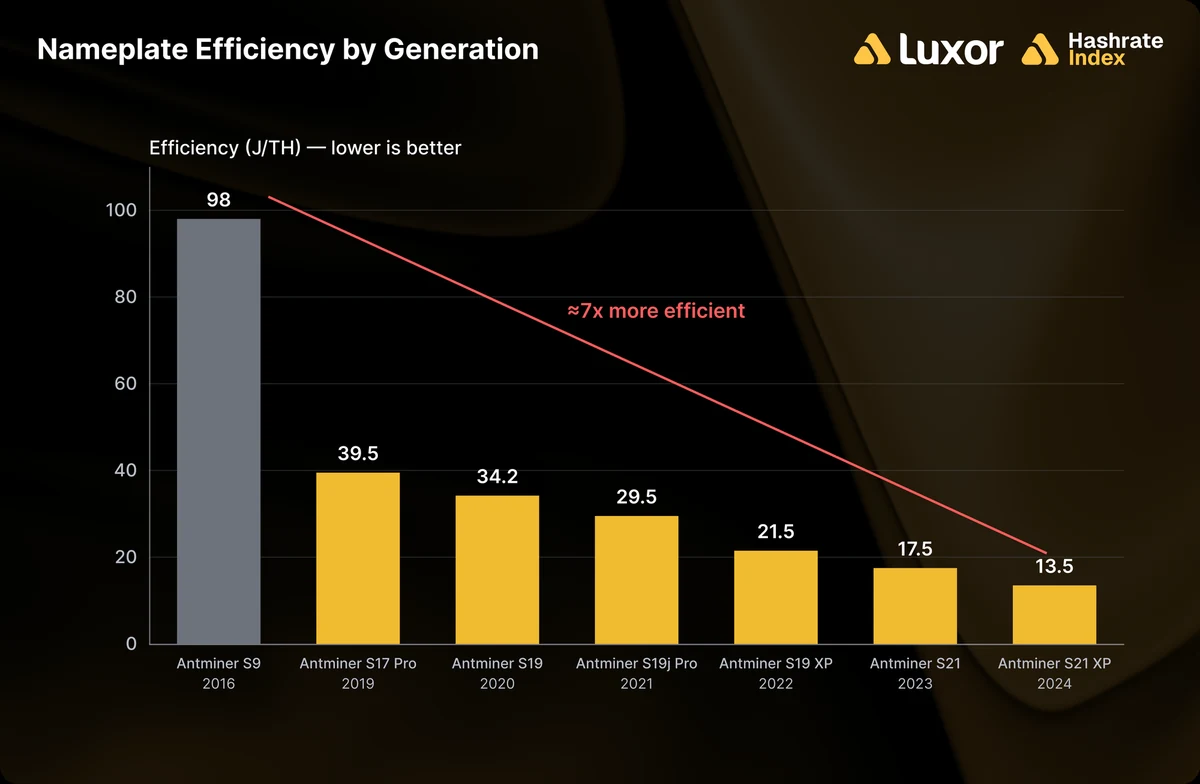
Analysis and practical implications
This section is our analysis and illustrative calculations, separate from the source report.
Read efficiency as a ratio
Joules per terahash expresses the relationship between electrical power and SHA-256 work. A practical shortcut is to divide watts by terahashes per second. A hypothetical machine drawing 3000 watts at 200 TH/s has an efficiency of 15 J/TH. The units cancel in a useful way: watts are joules per second, so dividing by work per second produces energy per unit of work.
The ratio is valuable because two machines can have similar hashrates and different operating costs. It also prevents a common comparison error: assuming that a larger hashrate number must mean a better machine. The relevant choice depends on the cost of energy, the amount of available electrical capacity and the total installed cost.

Compare measurements taken at the same boundary
Power measured inside the electronics differs from power measured at the wall. For operating-cost calculations, the wall measurement is usually the useful starting point because it includes power-supply losses. If a cooling pump or fan bank serves the installation, its consumption must be accounted for separately or allocated consistently.
Hashrate measurement also needs a defined boundary. A device can report work it attempted while a pool records work it accepted. Using the most favorable local hashrate with an unrelated power reading produces an attractive ratio without demonstrating useful output. Match the measurement periods and explain which values you used.
A fleet example shows why small differences matter
Compare two illustrative 200 TH/s operating points: 15 J/TH requires 3000 watts, while 20 J/TH requires 4000 watts. The difference is 1 kW, equivalent to 24 kWh per continuously operating day. At an assumed tariff of 0.07 dollars per kWh, that represents 1.68 dollars per machine per day before considering other costs.
For 100 machines, the same arithmetic gives 100 kW of additional continuous load and 168 dollars per day of additional electricity. These are example calculations, not specifications for a particular product. They demonstrate why a small-looking efficiency difference can become significant when multiplied across a site.
Choose an operating point, not an isolated number
A miner may support several performance profiles. Reducing output can improve energy efficiency while lowering total daily production. Increasing output may improve use of a fixed number of rack positions while increasing energy cost and cooling demand. Neither objective is automatically correct for every site.
Record the purpose of a tuning change before testing it. Then compare accepted work, measured energy and stability over a representative period. A useful efficiency result should be reproducible and connected to the site's actual constraint. The best published ratio is less valuable than a stable operating point that your electrical and cooling systems can sustain.
Source: Hashrate Index / Luxor ↗
Mining calculator ↗