Keryx updates GPU mining: faster kernels and fewer whole-rig pauses
Source report: 2026-11-08 · Editorial analysis published: 2026-11-09
November 8 releases from two related projects change kernel selection and multi-GPU behaviour. Developer measurements depend strongly on the card and power setting.
Two related miners, two version numbers
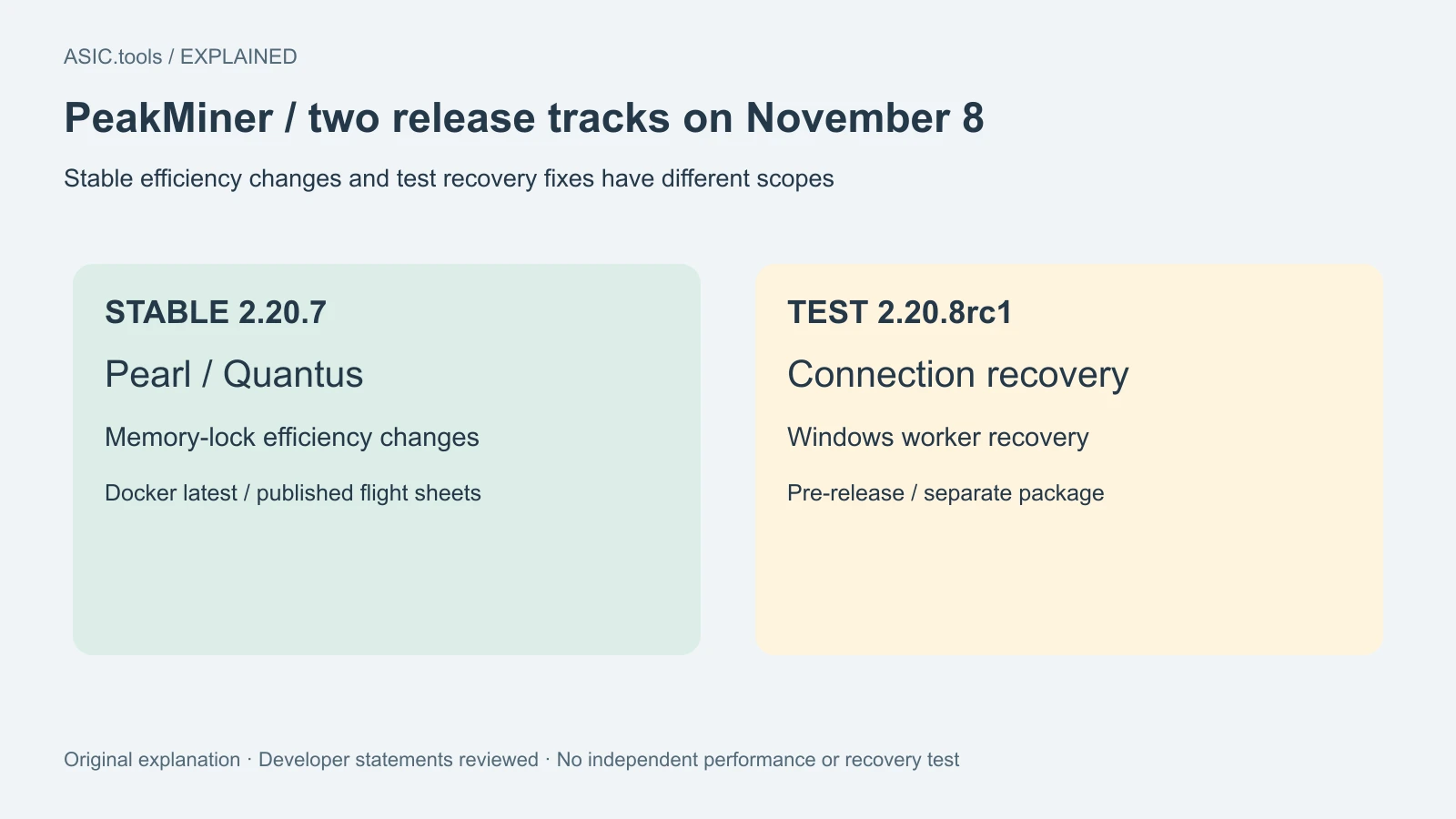
Keryx received two substantial GPU (graphics-card) software updates on November 8. Miner Supr 0.16.3 selects a faster computing path for the H16 network rules for each supported card where its checks justify the switch. Later, the upstream Keryx miner published 0.6.1-PoM with new NVIDIA work handling and more independent behaviour for rigs containing several GPUs. These are separate projects and packages, not two names for one download.
Keryx combines mining with serving AI requests. An inference is the work of running a model to produce an answer; it can interrupt the card that serves it. That makes both mining speed and the way a rig shares requests relevant to the owner. The new releases address those operating details. They do not announce a new ASIC, and their hashrate figures cannot be compared with Bitcoin SHA-256 figures just because both use a per-second unit.
A new kernel is selected only when it helps
A kernel is the small computing routine executed by a GPU. Supr 0.16.3 keeps the established routines and compares eligible new ones on the actual card and model. A new path must first produce the same exact result, then demonstrate at least a 0.5% timing advantage to replace the older choice. NVIDIA uses warmed per-card timing; AMD also chooses how much work to group into a dispatch, keeping measured launches within 20 milliseconds.
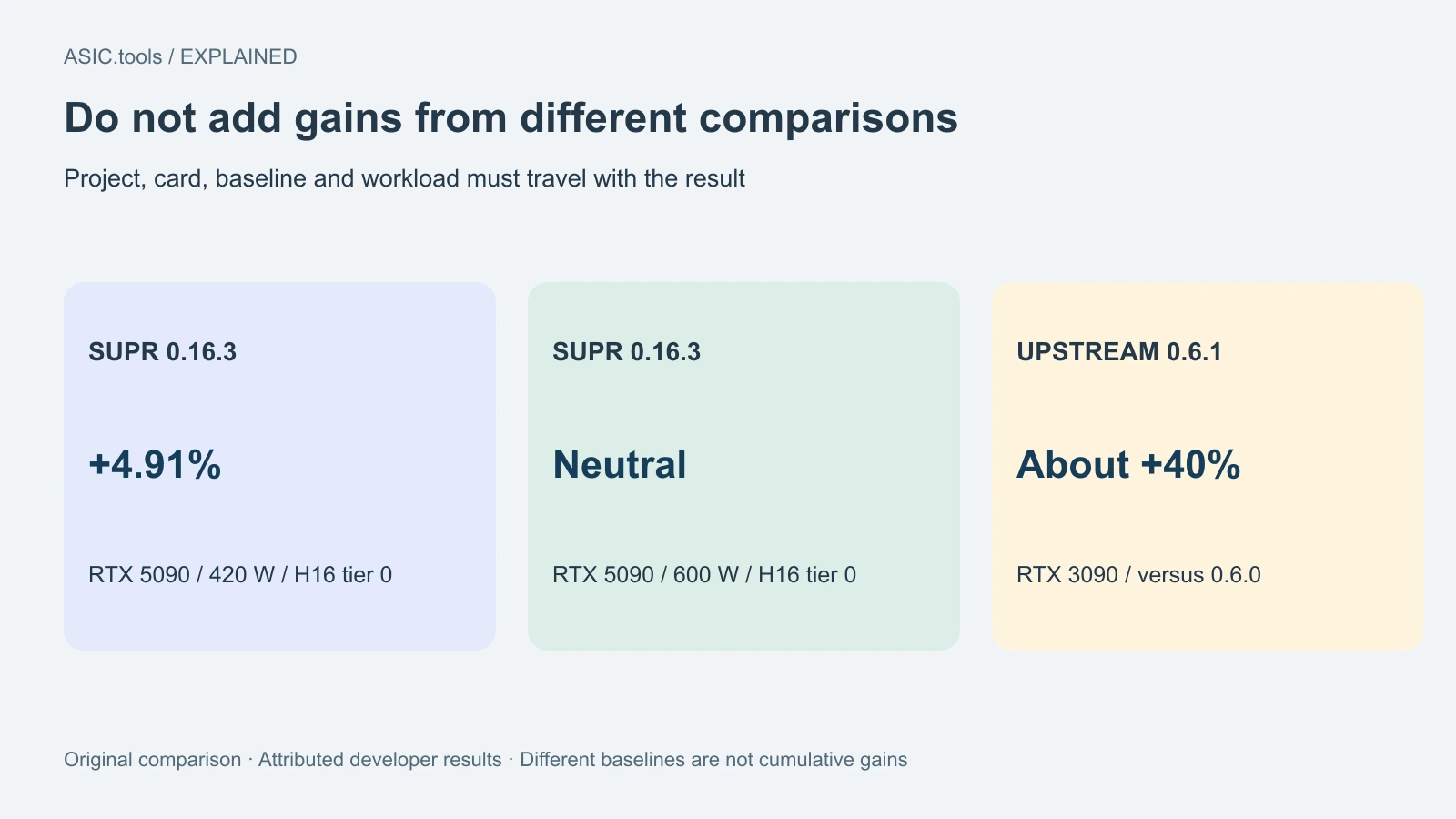
That design explains why an update need not accelerate every card. In the developer's matched tier-0 H16 investigation, the 420 W RTX 5090 comparison rose from 5.2208 to 5.4771 MH/s, about 4.91%. At a 600 W limit, the same model was effectively unchanged and retained the established kernel. RTX 5080 and RTX 3070 controls were also neutral. A higher power limit and a newer routine are therefore not automatic instructions for a better result.
The AMD gains need their measurement context
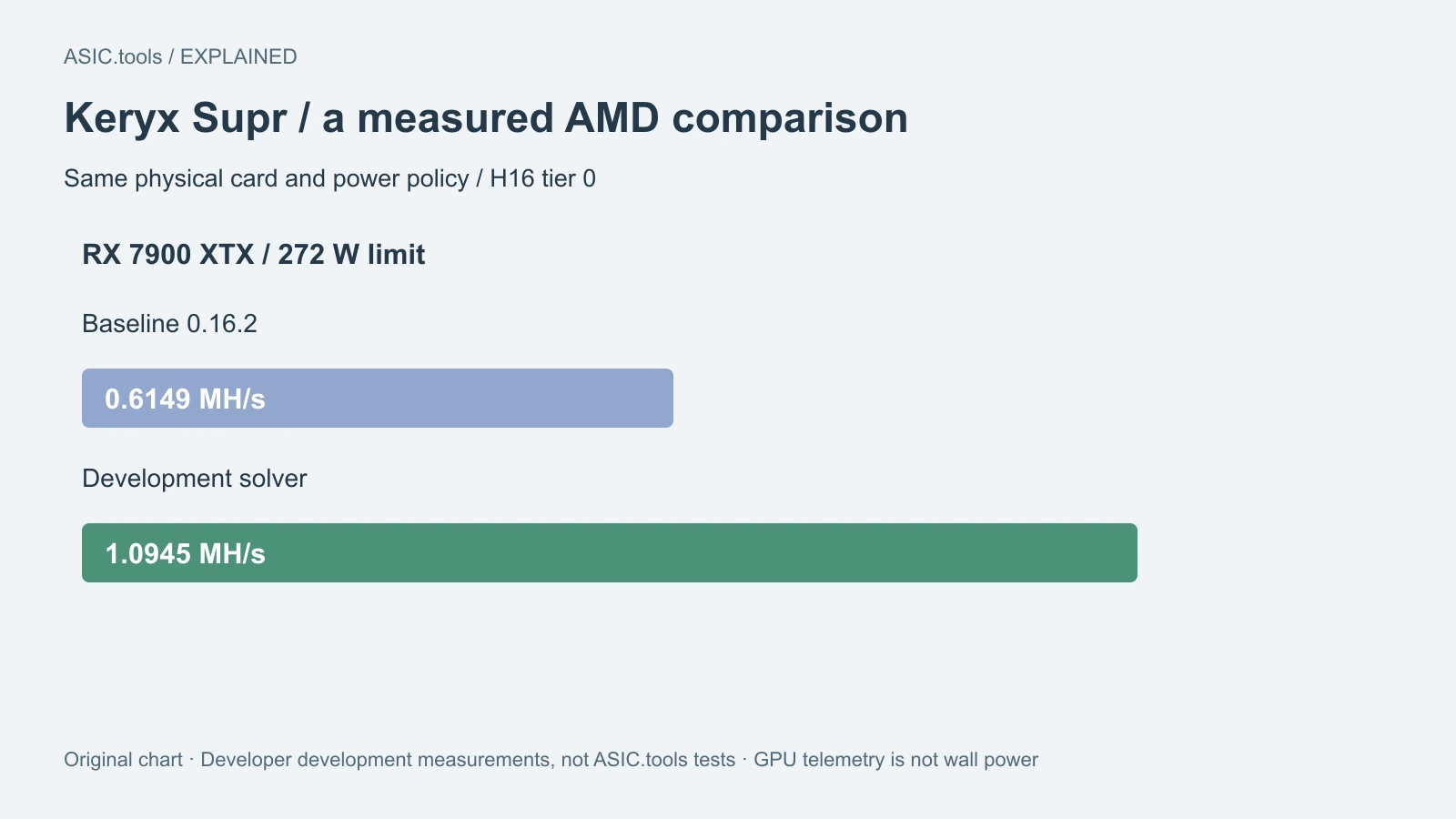
The development table reports RX 7900 XTX rising from 0.6149 to 1.0945 MH/s at a 272 W limit, approximately 78%. RX 7600 XT and Instinct MI50 comparisons also improved. These are the developer's controlled measurements of the solver included in the release, not ASIC.tools benchmarks or a survey of every packaged platform. They compare against frozen 0.16.2 source, with the same physical card, driver, model and power policy.
Most comparisons alternate old and new runs after warm-up; short measurement windows cannot establish a month of income. The document's wattages and clocks are GPU telemetry, not whole-computer wall measurements. Its loopback job source creates repeatable work, but local acknowledgements are not live pool acceptance. Separately, the author reports a final live test with 75 accepted shares and no rejects. Those distinct checks should stay distinct when estimating whether an update is useful. The MI50 row makes the power distinction concrete: reported GPU draw moves from 142.2 to 149.3 W despite the same 150 W limit. A fixed limit is a ceiling, not a promise of equal consumption. Record the measured draw alongside the speed before judging efficiency, and retain the separate wall measurement for the electricity bill.
Several cards can keep working independently
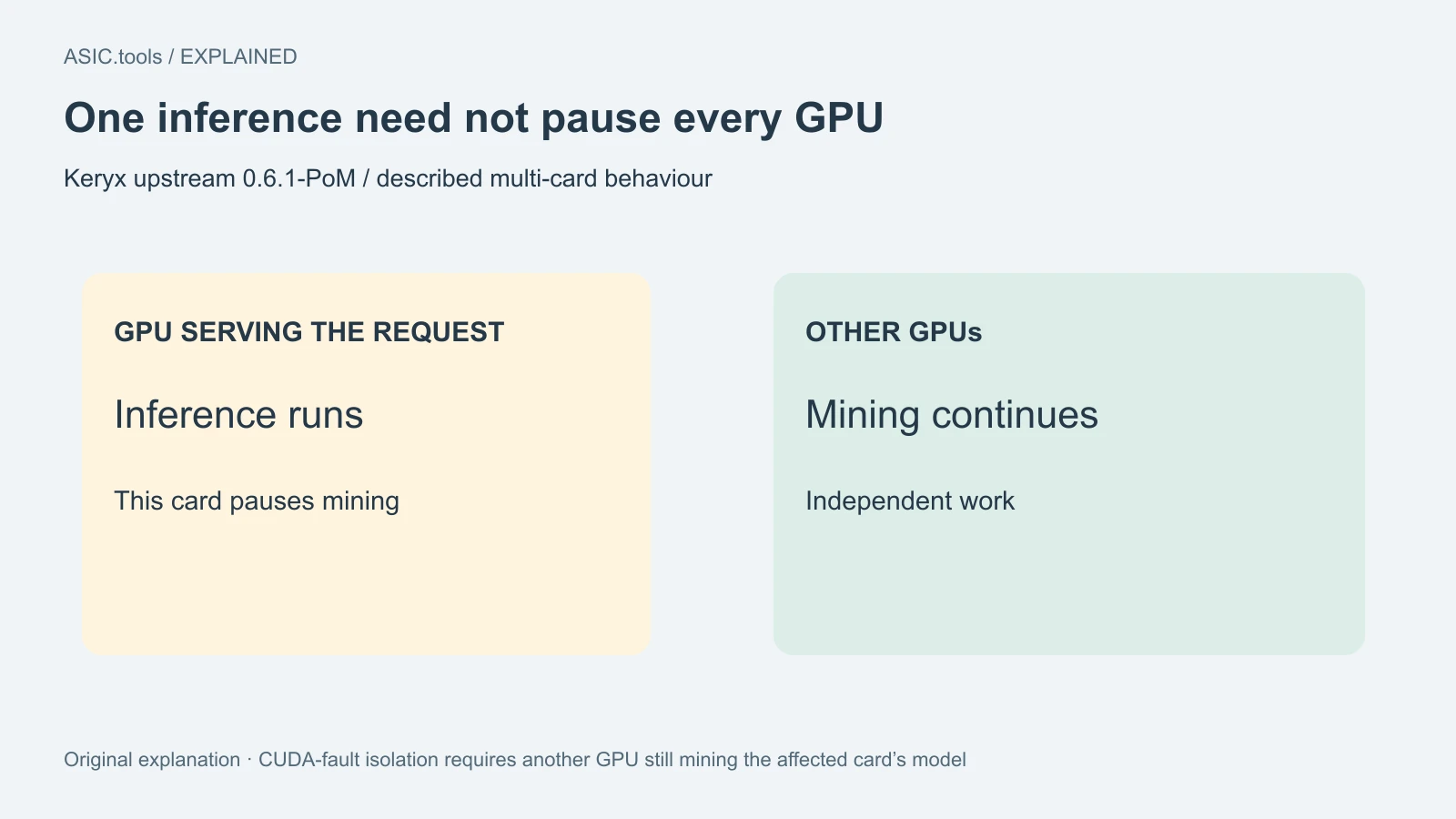
The upstream 0.6.1-PoM release says that only the GPU serving an inference pauses; other cards continue mining. A card suffering a CUDA fault can be dropped on its own when another GPU still mines its model. This narrows the interruption instead of automatically turning one card's problem into a pause for the entire rig. The condition about another card covering the model matters when judging a particular machine.
Upstream also reports about 40% overall improvement against 0.6.0 on an RTX 3090 and credits Supr for the lock-step routine and reorganised model weights. That claim belongs to a different release, GPU and baseline from Supr's H16 table. The percentages must not be added together. Several nonces, or candidate attempts, share GPU execution work and read contiguous model data; changing that organisation aims to reduce wasted movement rather than change the answer the network verifies.
A pool connection has to carry more than shares
The upstream release expands pool handling for traced inference and audit requests: the pool decides which request needs a trace, and the miner supplies the requested records. It advertises the models it can serve at connection and updates that information. Where the pool supports base64 proof encoding it can use that format, with hexadecimal as the fallback. Skipping unknown messages and oversized lines is intended to make the connection more robust.
The previous Supr 0.16.2 also fixed requests containing a NUL byte and a multi-tier context error that could reject the main tier's shares. These are useful context for the new release sequence, rather than another reason to count the same improvement twice. A tier identifies a model/work level. For the owner, a successful connection, a visible local speed and a request or share actually accepted by the network remain separate records to check.
What the validation establishes
Supr's documentation describes 400 captured proofs checked with the unmodified node 1.6.7 verifier, alongside exactness and mining/inference recovery checks. The published development investigation did not measure Windows GPU execution or higher-tier performance. macOS remains experimental with its existing H15/H16 limitations. The final Linux package tests and the live pool run do not remove those platform boundaries or prove an equal gain elsewhere.
Keep the selected executable with its matching engine libraries and record the project name as well as the version. Compare accepted work and wall energy over matching periods, preserving the working package for a return if needed. ASIC.tools reviewed the pinned release and benchmark documents without running the miners. The releases change how existing cards do and share work; Supr explicitly leaves H16 activation, consensus rules and model weights unchanged. There is no new electricity tariff or guaranteed reward multiplier in these results.
Source: Keryx developers / versioned benchmarks ↗ · Pinned H16 benchmark method and limits ↗ · Keryx upstream 0.6.1-PoM release ↗ · Supr preceding 0.16.2 release ↗ · Versioned upstream documentation ↗
Mining calculator ↗