NerdQAxe test firmware checks discovered devices and fixes HTTPS telemetry
Source report: 2026-11-07 · Editorial analysis published: 2026-11-08
Two November 7 prereleases share discovery and certificate fixes; the development branch also corrects exported records.
Two test releases for home miners
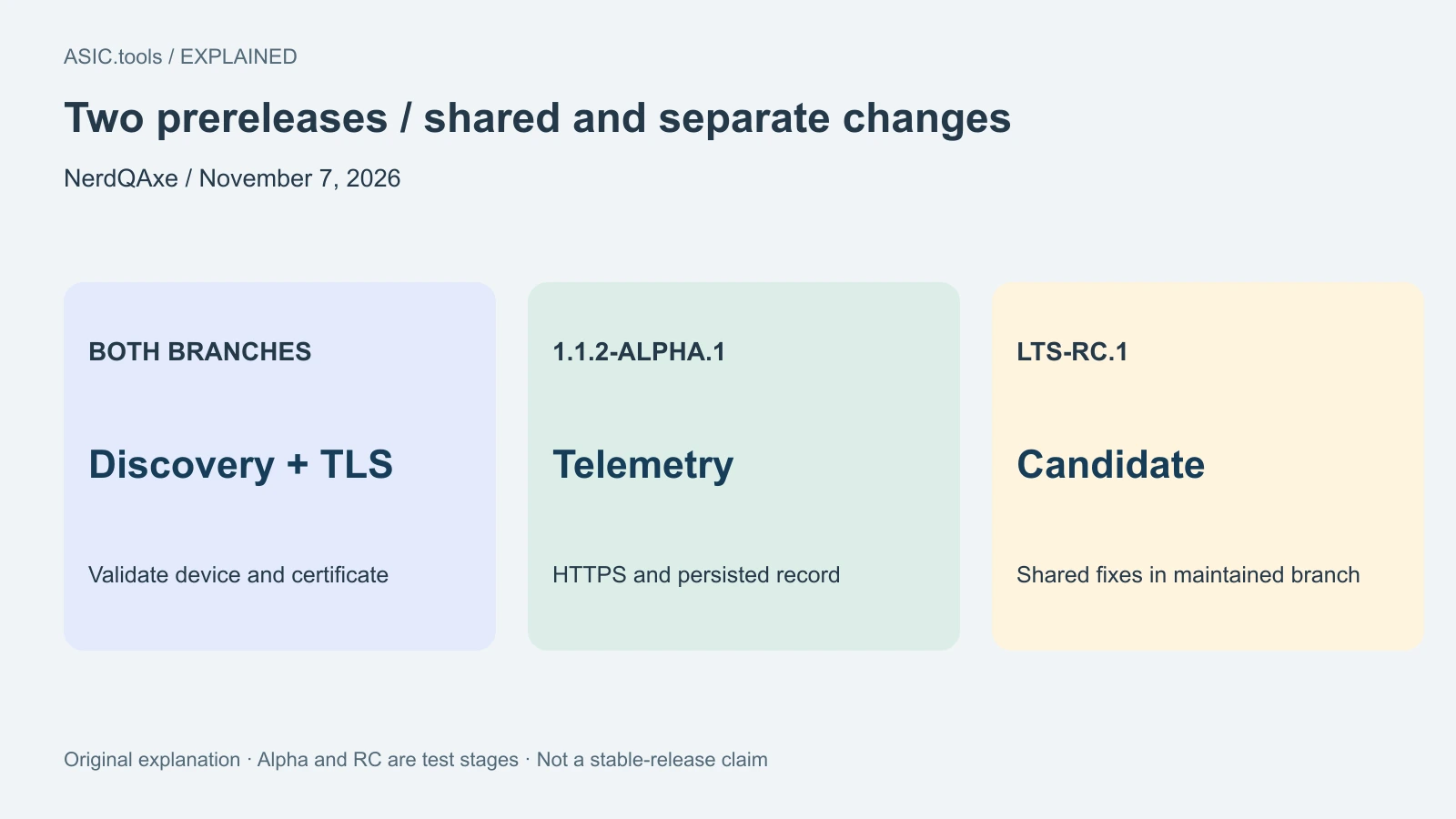
NerdQAxe published two test firmware releases on November 7: 1.1.2-alpha.1 and 1.0.37.5-LTS-rc.1. Both improve device discovery and certificate handling. The newer development branch also fixes HTTPS telemetry and a misleading historical difficulty record. These changes matter when a home miner shares its network with other smart devices or sends operating data to a dashboard.
Both downloads are marked as prereleases. Alpha means an early testing version; RC means a release candidate awaiting further validation. LTS identifies the longer-maintained branch. A version number from one branch does not describe the release stage or feature set of the other.
The common fixes appear in both branches, while the development release lists additional changes. An owner can use that distinction to understand the announcement before considering a firmware file for a particular board. This is a review of published changes and linked tests; ASIC.tools did not flash a device or measure a hashrate improvement.
Swarm checks that a device is really a miner
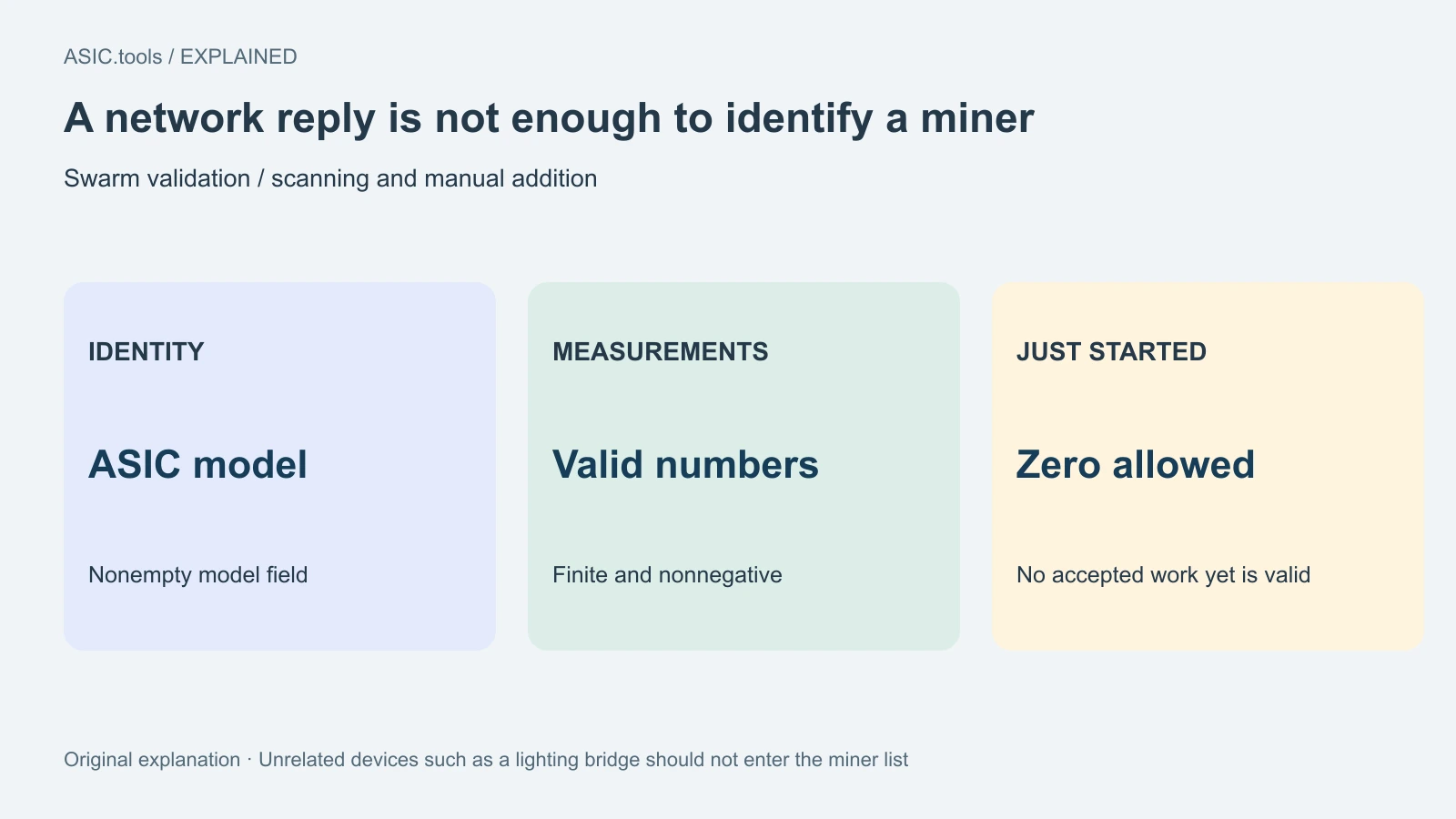
Swarm is the interface that groups miners discovered on the local network. Previously an unrelated device, such as a Philips Hue lighting bridge, could appear in that list. The new validation applies both when scanning the network and when adding an address manually.
A response must contain a nonempty ASIC model and usable hashrate and accepted-share values. Those numbers must be finite and nonnegative. Zero is still valid: a miner that has just started may have no accepted work yet. The change distinguishes a valid idle miner from a device returning unrelated data.
For a home setup, the practical result is a more reliable equipment list. An IP address replying to a request is not by itself evidence that the device is a miner. The developer reports regression tests and browser checks with real miners and a Hue bridge. That supports the stated discovery fix, rather than a claim about faster mining.
The optional ASIC-information endpoint remains optional. The patch does not require every board to expose an additional interface just to stay in the list. It validates the identifying response already used by discovery, so a missing optional detail and an invalid miner identity remain separate cases.
Encrypted connections keep their trust checks
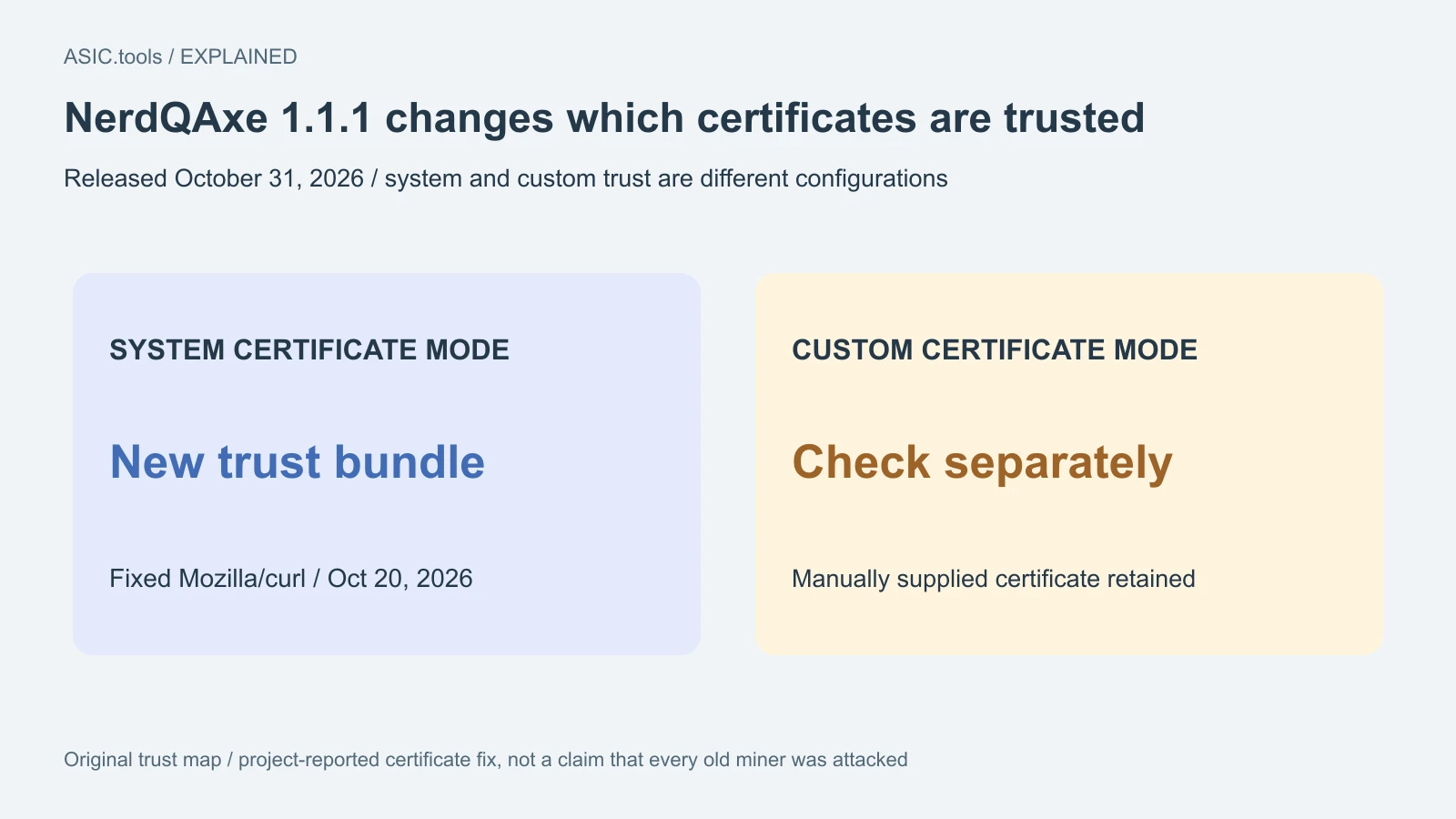
The shared certificate fix concerns servers that send a cross-signed root. In simple terms, a server can present an alternative certificate chain leading to a root the miner already trusts. The previous verification callback could reject that chain because it looked only at the issuer of the highest certificate sent.
The new wrapper can also match that certificate’s subject and public key against a root in the pinned bundle. It adds no roots and keeps signature verification for the certificates below it. The change is therefore more specific than turning certificate checks off to make a connection work.
The linked change covers encrypted Stratum connections, factory firmware downloads, API requests and Discord. Stratum carries work between a miner and its pool. The author reports builds and offline checks against real server chains, while on-device TLS handshakes remained to be tested in that change record. The two test packages retain that qualification.
Telemetry gets HTTPS and the right record
The development release allows an HTTPS address for InfluxDB, the database some users employ to store mining measurements. It attaches the configured certificate bundle to the telemetry clients, while existing HTTP support remains. HTTPS encrypts the connection and checks the server certificate when configured this way.
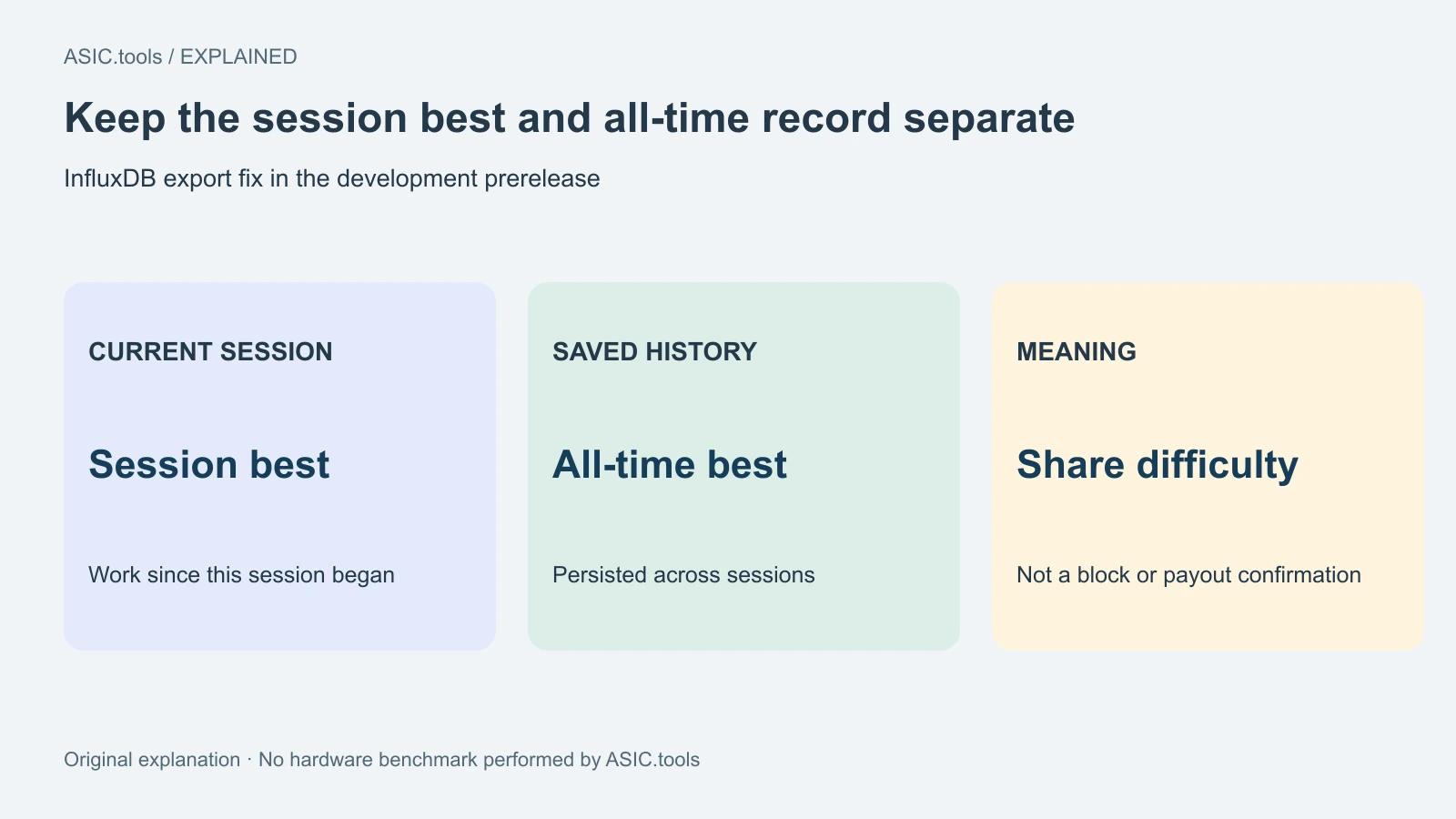
A second InfluxDB fix separates the best share difficulty of the current session from the best value saved across sessions. A share is a piece of submitted mining work. Its difficulty describes how demanding that particular result was. A personal best share does not mean a Bitcoin block was found or a payout was earned.
Previously the exported all-time field could contain only the session best and disagree with the miner’s own dashboard. The fix reads the persisted all-time record for that field and keeps the session field separate. The linked work reports regression tests and actual NerdQAxe++ telemetry checks; those are the contributor’s results, not a new ASIC.tools hardware test.
Choose by board, branch and release stage
The development release also corrects where the OCEAN pool icon is obtained. An icon change affects the display; it does not change the pool’s payment rules or imply a new mining algorithm. Grouping that small visual fix with the connection and measurement changes helps show what each part actually does.
The LTS candidate lists the discovery and cross-signed-certificate fixes. Its notes do not list the development branch’s two InfluxDB changes. Reading both release lists prevents an owner from expecting a feature merely because another package was published on the same day.
Firmware assets are built for named hardware targets. Match the exact board and branch, keep the existing pool, receiving address and configuration record, and read the project’s upgrade instructions before any change. The announcement provides useful fixes to evaluate, with the alpha and candidate labels kept visible rather than presenting either package as a completed stable rollout.
Source: NerdQAxe / GitHub releases ↗ · LTS release candidate ↗ · Discovery response validation ↗ · Certificate-chain handling ↗ · HTTPS telemetry ↗ · Persisted difficulty record ↗
Mining calculator ↗