Suprminer brings faster NEB to AMD and gives RTX more result-table memory
Source report: 2026-11-21 · Editorial analysis published: 2026-11-21
Version 1.9.49 adds the AMD OpenCL path; 1.9.50 follows with denser RTX tables and a HiveOS log fix. Large fixed-model test gains are not sustained payout measurements.
AMD joins the faster NEB method
Suprminer 1.9.49, released on 20 November at 18:10 UTC, brings NEB's cheaper-attempt selection to AMD OpenCL cards. Version 1.9.50 followed on 21 November at 02:50 UTC, increasing the result-table capacity for RTX cards and fixing the HiveOS log location. These releases extend yesterday's NVIDIA-only optimisation to a new set of users; the latest version keeps the AMD work introduced in 1.9.49.
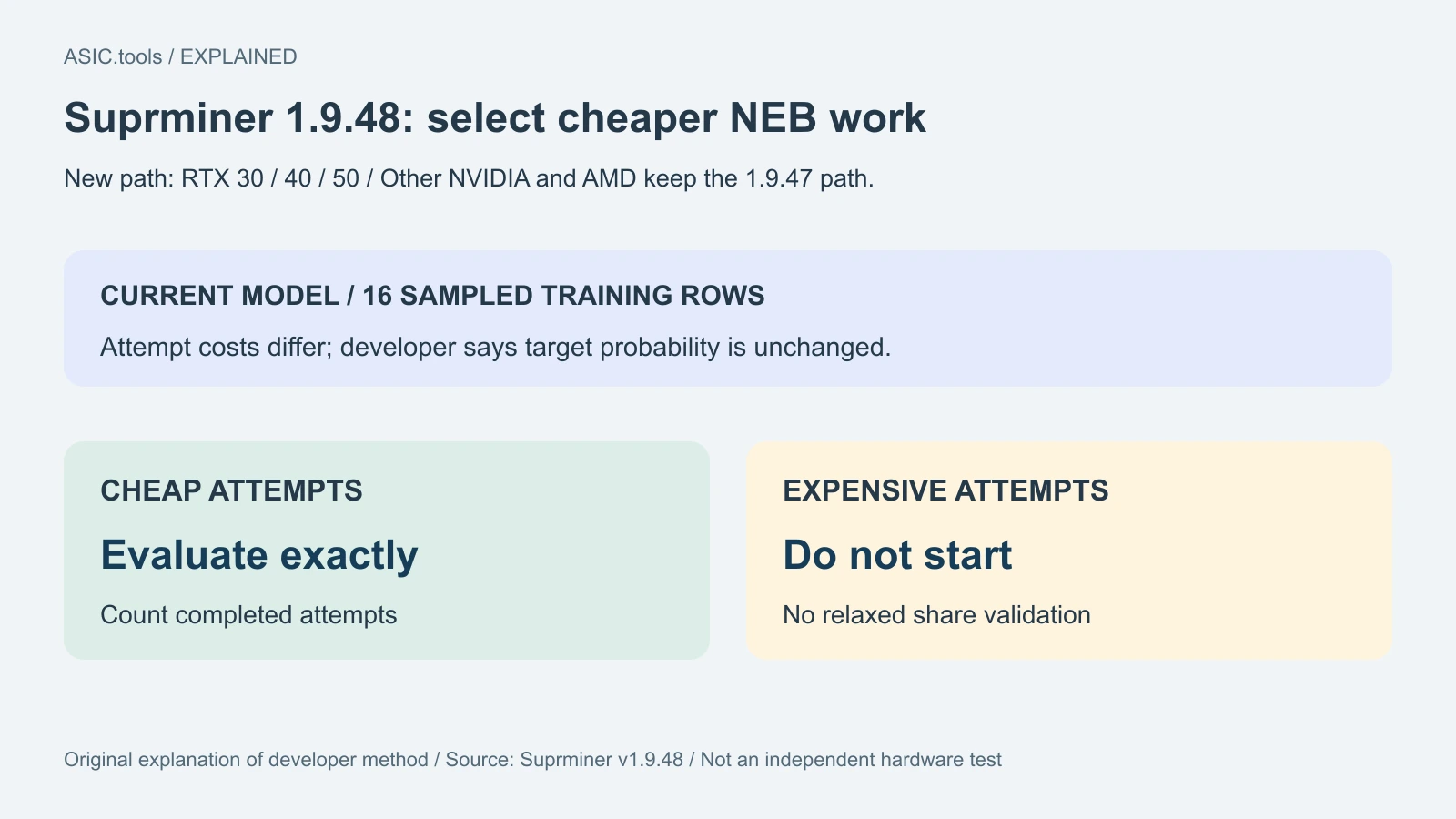
NEB, Neural Engine Byte, uses proof-of-training: a mining attempt evaluates an exact integer training step on 16 samples. Some attempts cost less to calculate than others. The miner selects cheap ones for the current trained model, checks them exactly and counts the attempts actually evaluated. It is not a change to Bitcoin ASIC mining or a claim that skipped expensive attempts count as completed work.
Three AMD cards have published comparisons
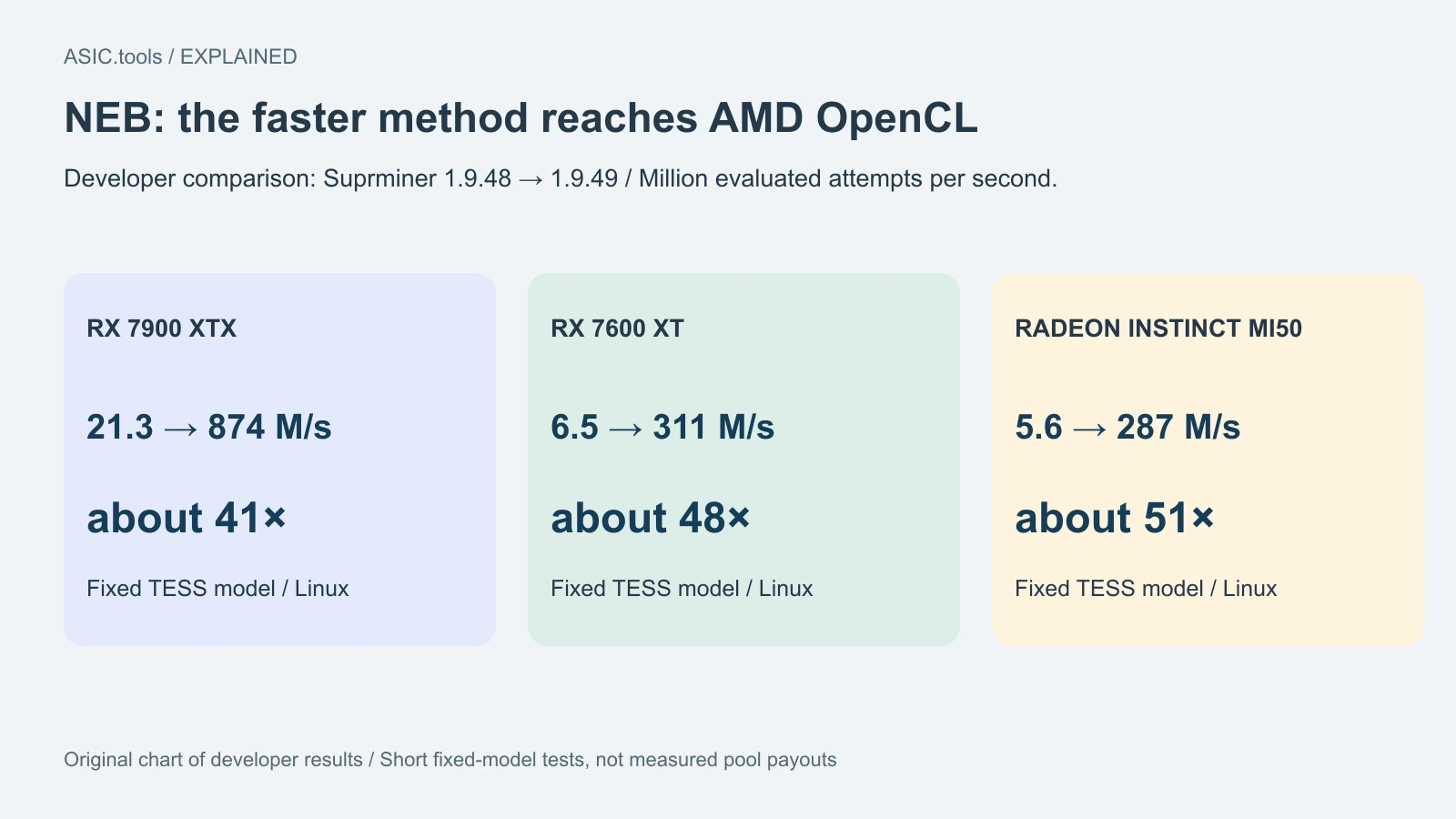
In the developer's paired Linux tests, RX 7900 XTX goes from 21.0 to 97.6 million evaluated attempts per second on Kepler and 21.3 to 874 million on TESS. RX 7600 XT goes from 6.1 to 29.8 million on Kepler and 6.5 to 311 million on TESS. Radeon Instinct MI50 goes from 5.1 to 19.9 million and from 5.6 to 287 million respectively.
The reported TESS ratios are about 41, 48 and 51 times, but they apply to those fixed trained models and test conditions. They are not measured pool payouts or a promise of the same improvement for every future block. The release says the final executable reproduced the rates on RX 7900 XTX and RX 7600 XT; it does not claim new qualification for every AMD generation.
Short tests are not sustained operating rates
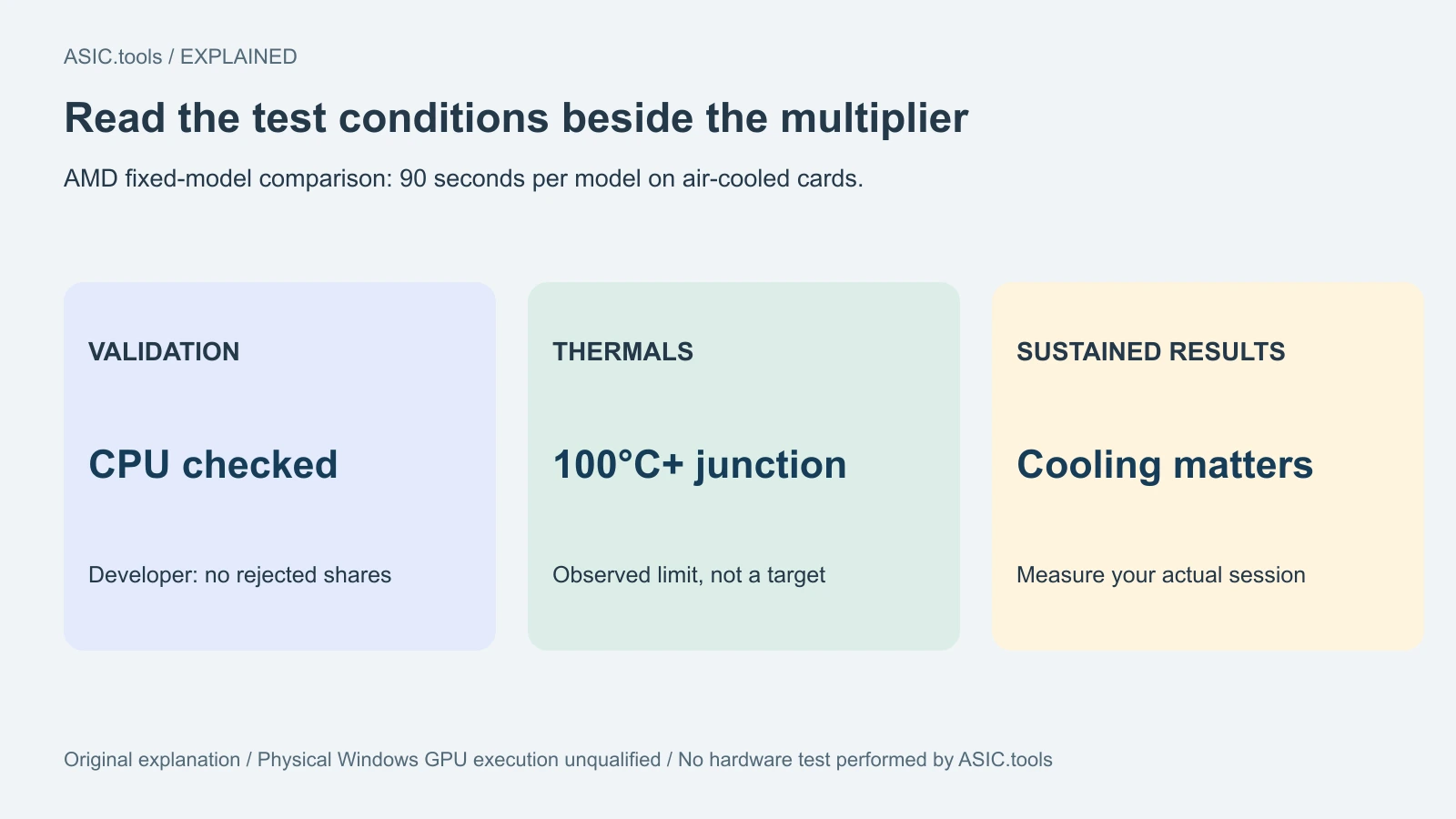
The AMD comparison used the same work and unchanged clock settings on 20 November, with models from the main network on 19 November. Runs lasted 90 seconds per model. The author says the air-cooled cards reached thermal limits, including junction temperatures of 100°C and more, so sustained performance depends on cooling. That observation is a limitation of the test, not a recommended temperature target.
Every returned share in the reported runs passed a CPU reference, with none rejected, according to the developer. The new AMD path is checked against the previous kernel at each model change and used only when faster. With the current models its table needs up to about 0.6 GB of GPU memory. The option NEB_DISABLE_NONCE_SELECTION=1 returns the earlier behaviour.
The latest RTX update uses more free memory
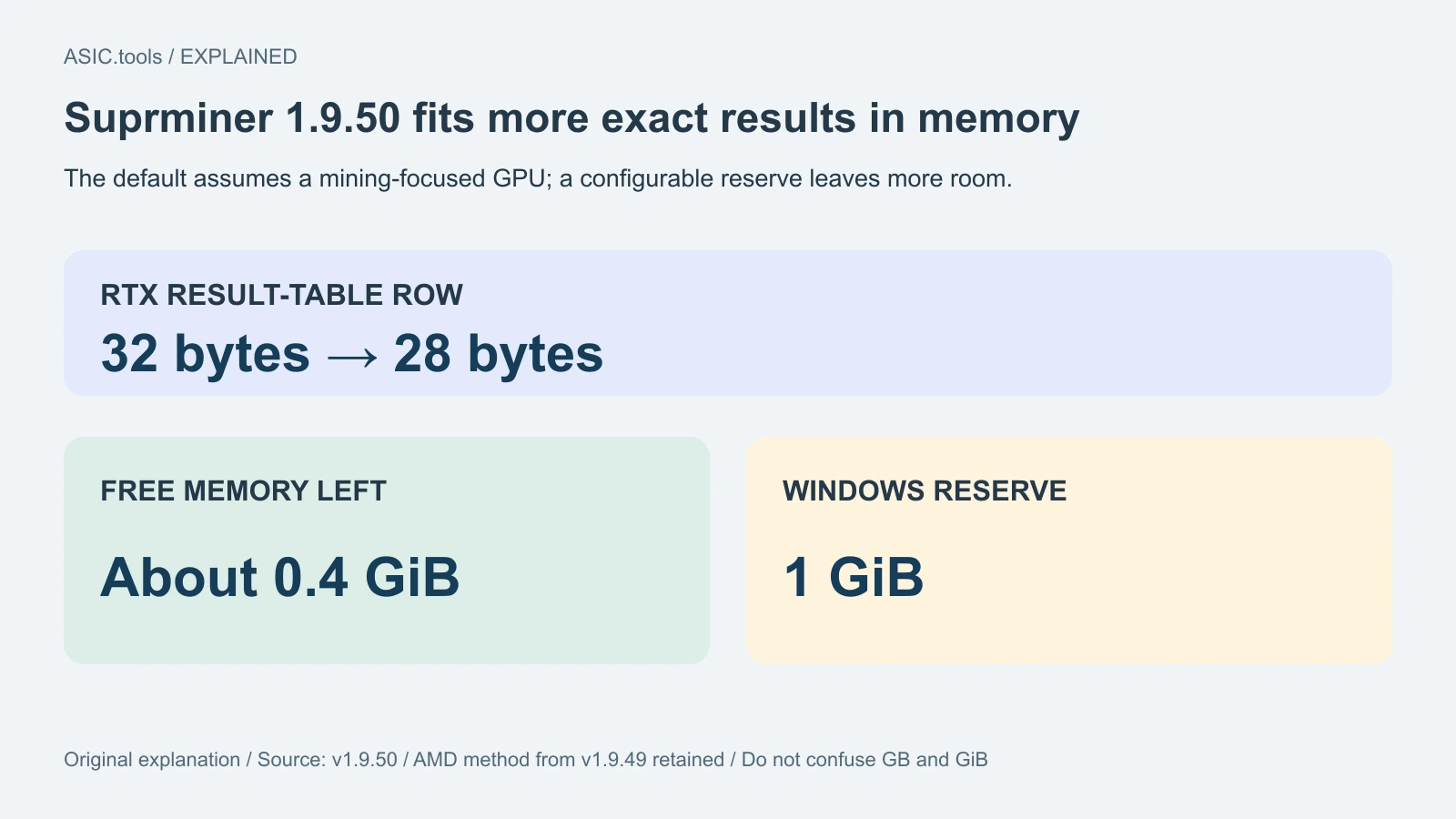
Version 1.9.50 makes result-table rows 28 bytes rather than 32 and leaves about 0.4 GiB of free memory, or 1 GiB on Windows. Packing more results into video memory helps answer more attempts from the table. The developer tells users not to run other programs on the same GPU during NEB mining, because the table consumes its free memory.
Users can reserve more memory with NEB_TRIPLE_RESERVE_MB, limit the table with NEB_TRIPLE_TABLE_GB or disable it. On the fixed-model tests, the latest RTX 5090 TESS rate rises about 5%, RTX 5080 about 8.9% and RTX 3070 about 6.4% versus 1.9.49. Kepler is essentially unchanged on the 5090 and 3070. These are separate comparisons from the much larger AMD gains.
What stays the same, and what gets easier
The algorithm setting remains neb, and the miner fee remains 0%; any pool fee is separate. Other algorithms are unchanged. Both releases keep exact validation rather than floating-point approximation. The tables persist across alternating Kepler and TESS blocks and are updated where the model changes, reducing unnecessary rebuilding.
The latest release also writes the miner log to the file HiveOS actually reads, making the normal miner log view useful again. Packages exist for Linux, Windows, HiveOS, mmpOS, SMOS and Docker, with NVIDIA and AMD variants. Physical Windows GPU execution remains unqualified in the release notes, so the presence of a package is not the same as a completed hardware test.
Compare an actual session, not just a multiplier
For an AMD rig, the important new question is whether the supported OpenCL path is active and producing accepted work. For a shared-use RTX card, it is whether the chosen memory reserve leaves room for other needs; the default now assumes a mining-focused GPU. Check the official package, model-specific rate, accepted shares, temperatures and actual energy over the same period.
Our diagrams separate the AMD comparison from the latest memory change and the test limitations. We have retained the versioned release notes and the current setup documentation, but have not installed or independently benchmarked these executables. This is a practical software expansion and a resource-use change, not a measured earnings forecast or an instruction to buy a particular card.
Source: Suprminer ↗ · AMD support: Suprminer 1.9.49, November 20 ↗ · Current methodology and setup ↗
Mining calculator ↗