Proxima 1.7.3 tightens snapshot recovery: one source now needs explicit trust
Source report: 2026-11-21 · Editorial analysis published: 2026-11-21
The November 21 node release changes source-majority and median checks, bounds memory under stale-branch traffic and updates proxi displays. It introduces no ledger change.
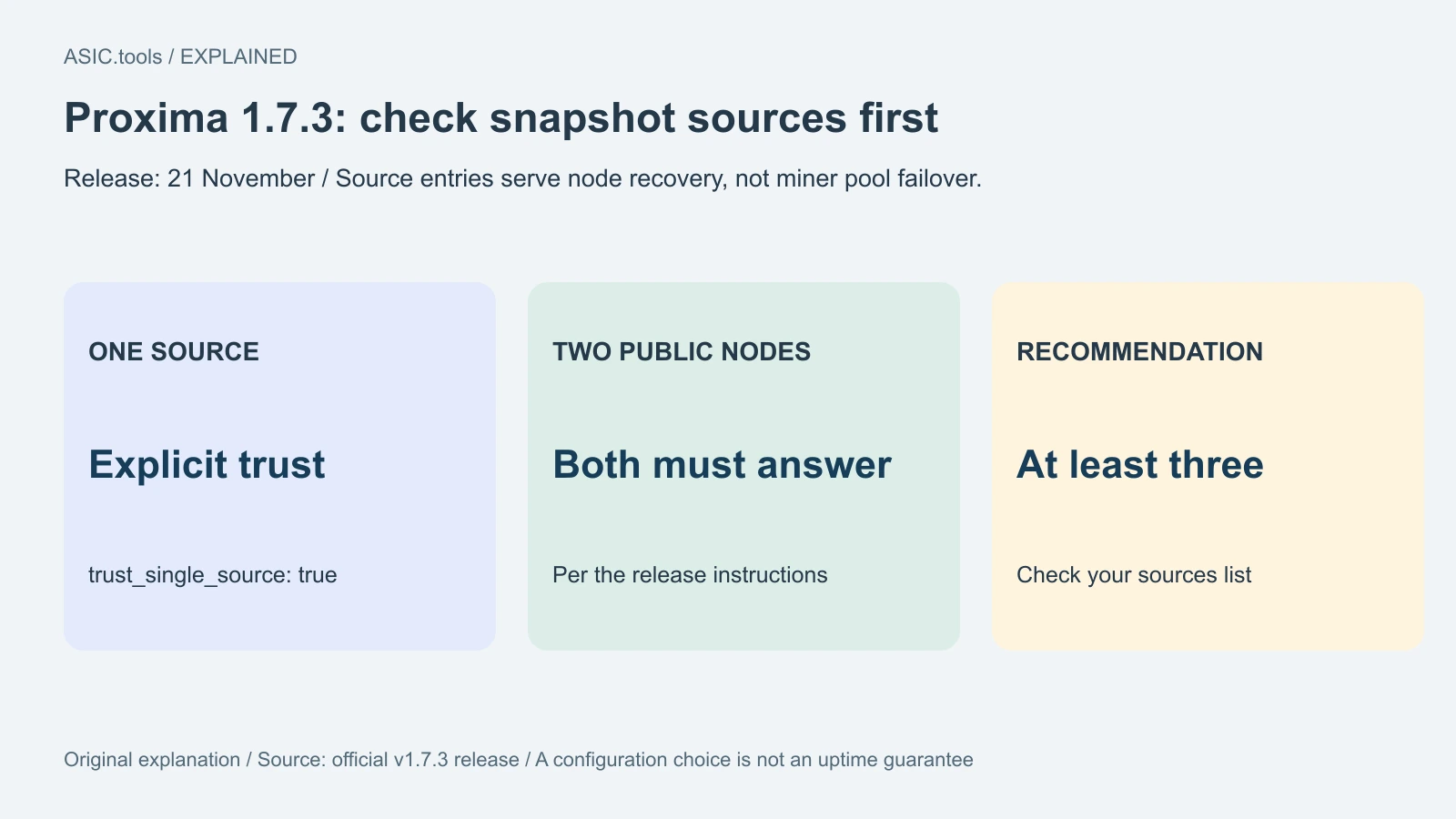
Proxima changes the way a node trusts a recovery snapshot
Proxima v1.7.3 was released on November 21 at 08:27:10 UTC, or 10:27:10 Kyiv time. The developer recommends it for every node. The most visible change for someone maintaining their own mining infrastructure is stricter snapshot recovery: a node configured with only one snapshot source now refuses to download unless the operator explicitly enables single-source trust.
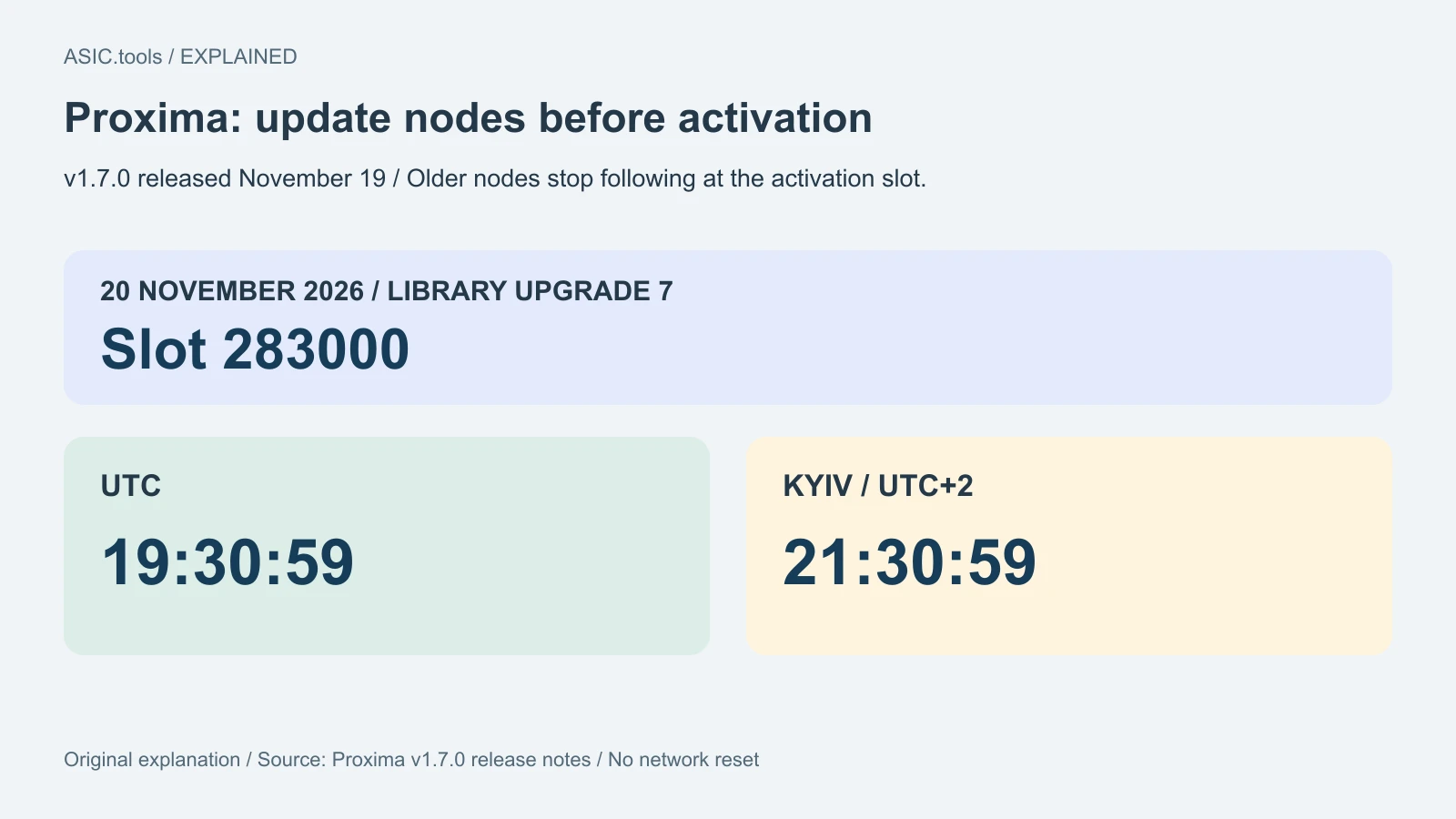
This is a node and command-line wallet update, not another ledger upgrade. The release says there is no ledger change and no v1.7.2. It follows the upgrade-seven release covered earlier this week, but today's practical issue is different: memory cleanup and recovery-source checks, rather than another activation deadline or a new mining algorithm.
A snapshot is a shortcut, so its source matters
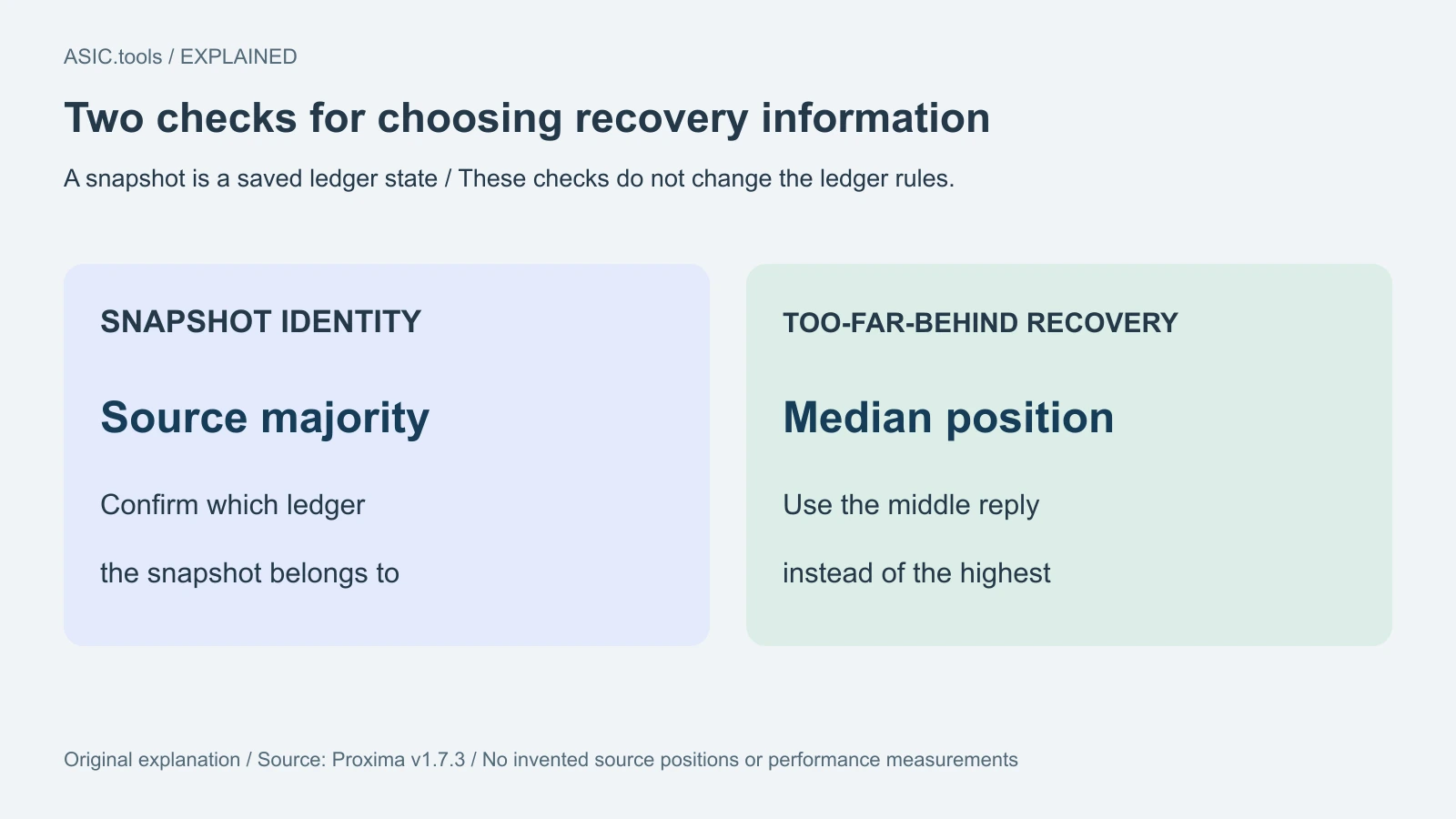
A snapshot is a saved ledger state from which a node can recover. Instead of treating one remote answer as sufficient, v1.7.3 requires a majority of the configured sources to confirm which ledger the snapshot belongs to. For recovery when the node is too far behind, it uses the sources' median position rather than their highest position.
The median is the middle value after ordering the answers. One unusually high answer therefore does not determine that recovery reference by itself. This is a source-selection safeguard, not a promise that every downloaded file or every source is trustworthy. The release changes how the node chooses its recovery information; it does not turn a snapshot supplier into a guaranteed uptime service.
One source now needs an explicit trust decision
With a single entry in the configuration's sources list, downloading a snapshot requires the new top-level option trust_single_source: true. Without that explicit choice, the node refuses the download. The developer recommends at least three sources. A setup using the two public nodes can restore only while both are answering, according to the release.
For the operator, this means checking the existing source list before assuming that an update can recover exactly as before. The option is an acceptance of single-source trust, not an automatic reliability improvement. Do not confuse this with having three interchangeable mining pools: these entries provide snapshot recovery information to a node, not pool failover addresses for a miner.
Stale branches should no longer hold memory cleanup back
The release also addresses nodes receiving transactions from sequencers that lost the network and keep sending on an outdated branch. A sequencer is a participant that builds a sequence of transactions. Previously this situation could hold back memory cleanup on every node; the developer says the new version keeps memory bounded in that situation.
This is a specific improvement to handling stale-branch traffic, not a published RAM requirement or a measured speed-up for a graphics card. The note supplies no universal memory saving, daily production gain or ASIC compatibility claim. Separately, equally covered branches are ordered consistently across nodes, improving a deterministic part of branch selection without changing the ledger rules.
PROX amounts become easier to read
The proxi command-line tool now displays amounts in PROX in its main commands, for example 29,940.121488 PROX. Command inputs and JSON output stay unchanged. That distinction matters when a person reads a terminal while a script consumes structured output: the human-facing display changes, but the release does not announce a new JSON unit or new command input convention.
The command proxi node seq withdraw now refuses amounts below 1 PROX or the storage deposit. This is a withdrawal-request check; it should not be presented as a mining reward or a new pool minimum payout. A displayed number with more convenient units is also not an increase in the wallet balance. Compare the unit and the operation before interpreting the result.
Update the component you actually operate
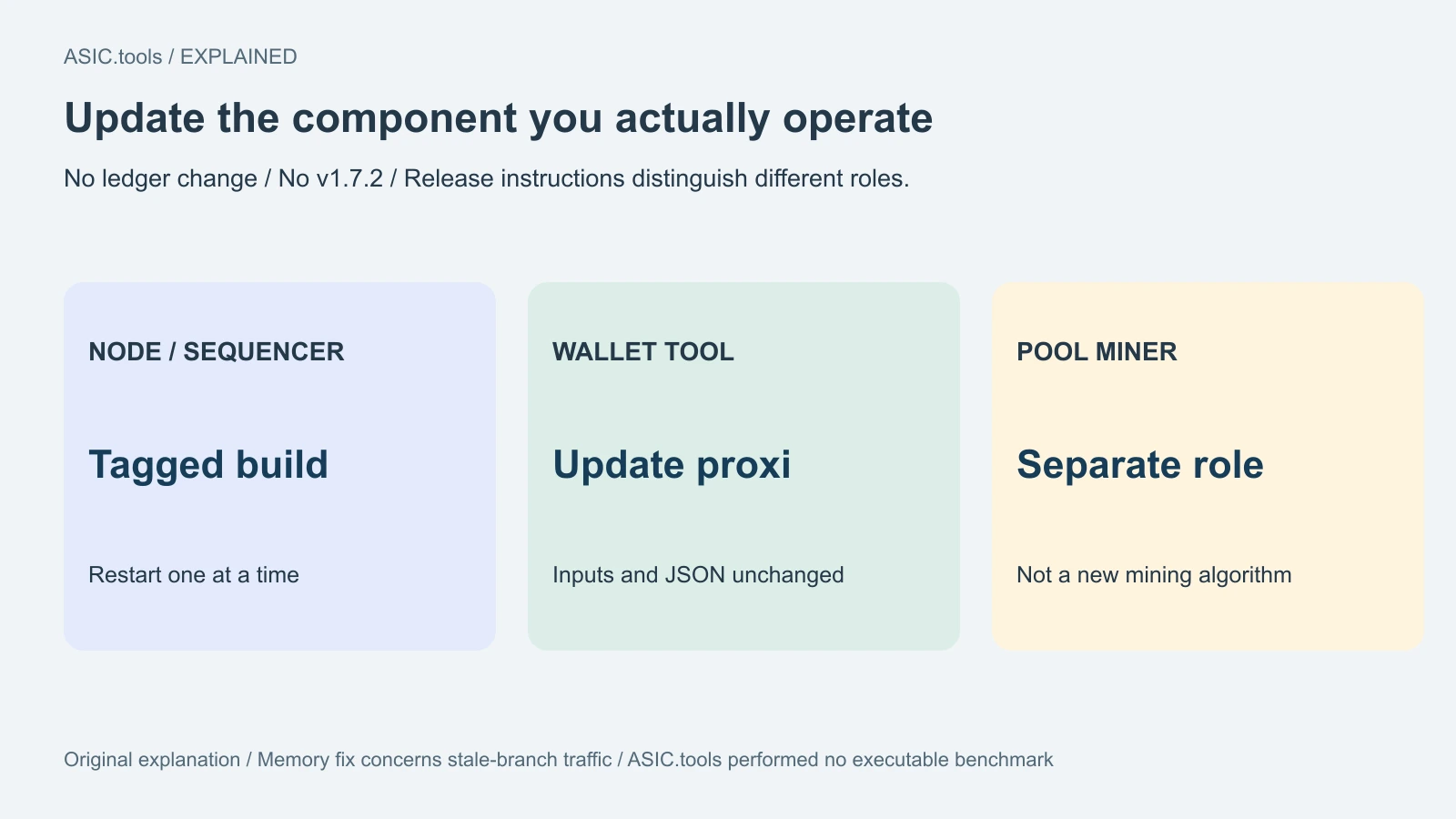
The developer's instruction is to build from the tag and restart sequencers one at a time, waiting until each is producing again. Wallet users are told to update proxi. These instructions concern operators of those components. A miner connected to someone else's pool should distinguish their mining application from the node and sequencer maintained by the pool operator.
ASIC.tools has checked the release record and documentation, but has not installed or benchmarked the executable on users' equipment. Our three diagrams explain source counts, median-based recovery and the separate node/wallet/miner roles. The useful task before an update is to identify your role, inspect the recovery-source configuration and follow the tagged release instructions, rather than assuming that a version number alone changes the amount of work your hardware can earn.
There is a simple version-number check too: an operator moving from 1.7.1 to 1.7.3 has not missed an intermediate 1.7.2 package, because the release explicitly says that version does not exist. Use the actual tagged release record when matching instructions to source code. A missing number in the sequence is not evidence of a missing ledger upgrade or a requirement to install an unofficial package.
Source: Proxima ↗ · Tagged Proxima source and documentation ↗ · Earlier ASIC.tools report on upgrade seven ↗
Mining calculator ↗