Suprminer 1.9.48 speeds NEB on RTX cards, with gains that depend on the model
Source report: 2026-11-20 · Editorial analysis published: 2026-11-20
The November 20 release selects cheaper exact training attempts. Paired Linux tests show very different Kepler and TESS gains; those rates are not payout measurements.
A new NEB path for RTX cards
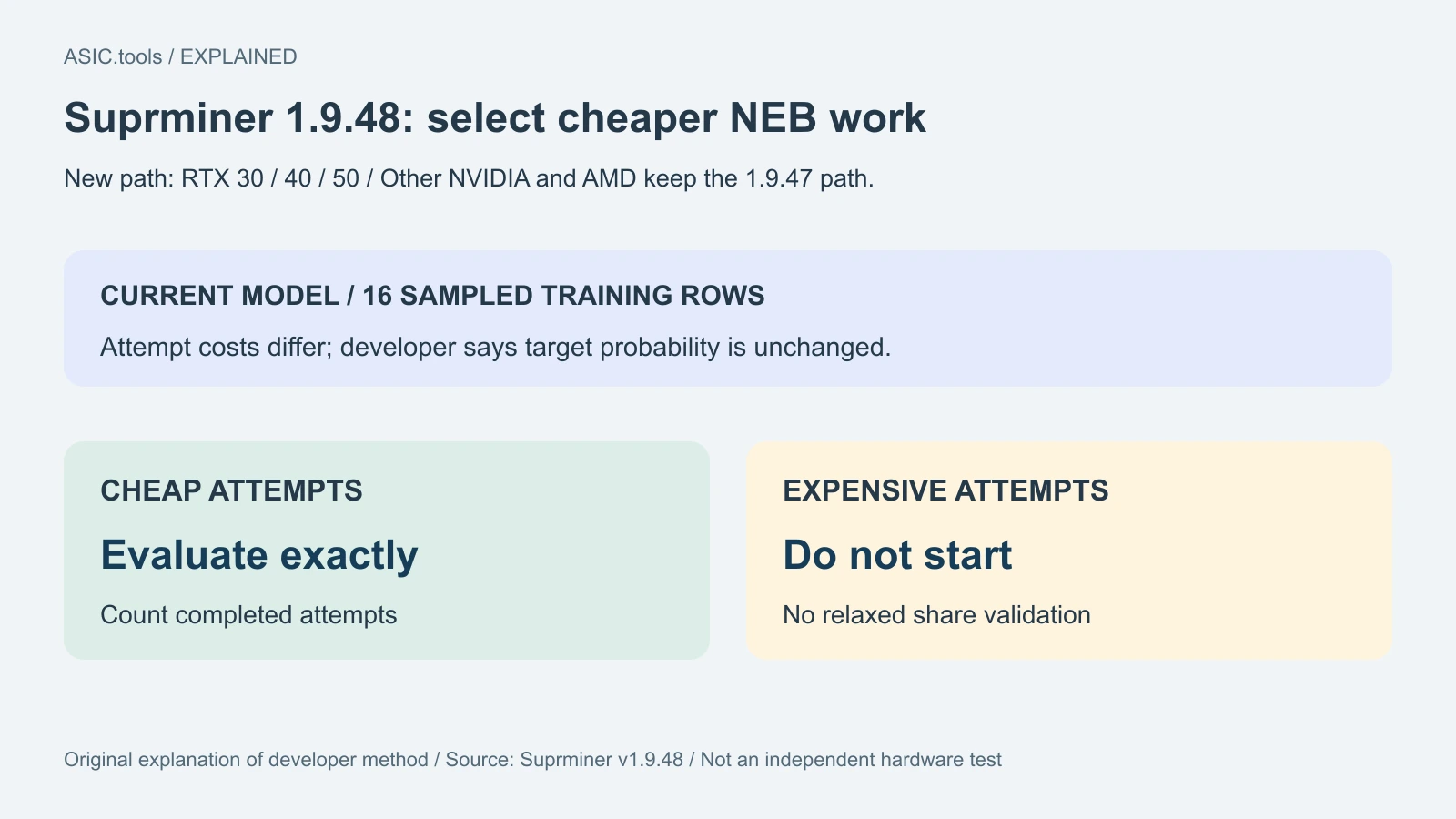
Suprminer 1.9.48 was released on 20 November at 13:17 UTC with a new optimisation for Neural Engine Byte (NEB) mining on RTX 30, 40 and 50 series GPUs. The developer reports substantially faster work on trained models, with a much larger gain on TESS than on Kepler in its paired Linux tests. Other NVIDIA cards and the AMD OpenCL backend retain the 1.9.47 path for now.
The change targets how NEB work is evaluated, not Bitcoin ASIC mining. NEB uses proof-of-training: an attempt performs one exact integer training step on 16 samples from a dataset. Its two slots use Kepler and TESS models. The miner's displayed speed can therefore change with the model of the current block, rather than remaining a directly comparable number across all jobs.
Find cheaper attempts without weakening the check
According to the developer, attempts have the same chance of meeting the target but can differ greatly in computational cost. Version 1.9.48 identifies cheap attempts for the current model, evaluates those exactly and avoids starting expensive ones. The reported rate counts attempts that were actually evaluated, not merely candidates examined during selection.
The software checks its methods against the original kernel whenever the model changes and checks submitted shares against a CPU reference. The release says it uses neither floating-point approximations nor relaxed validation. These are the developer's implementation and test claims; we have not installed the executable or independently reproduced its hardware benchmark.
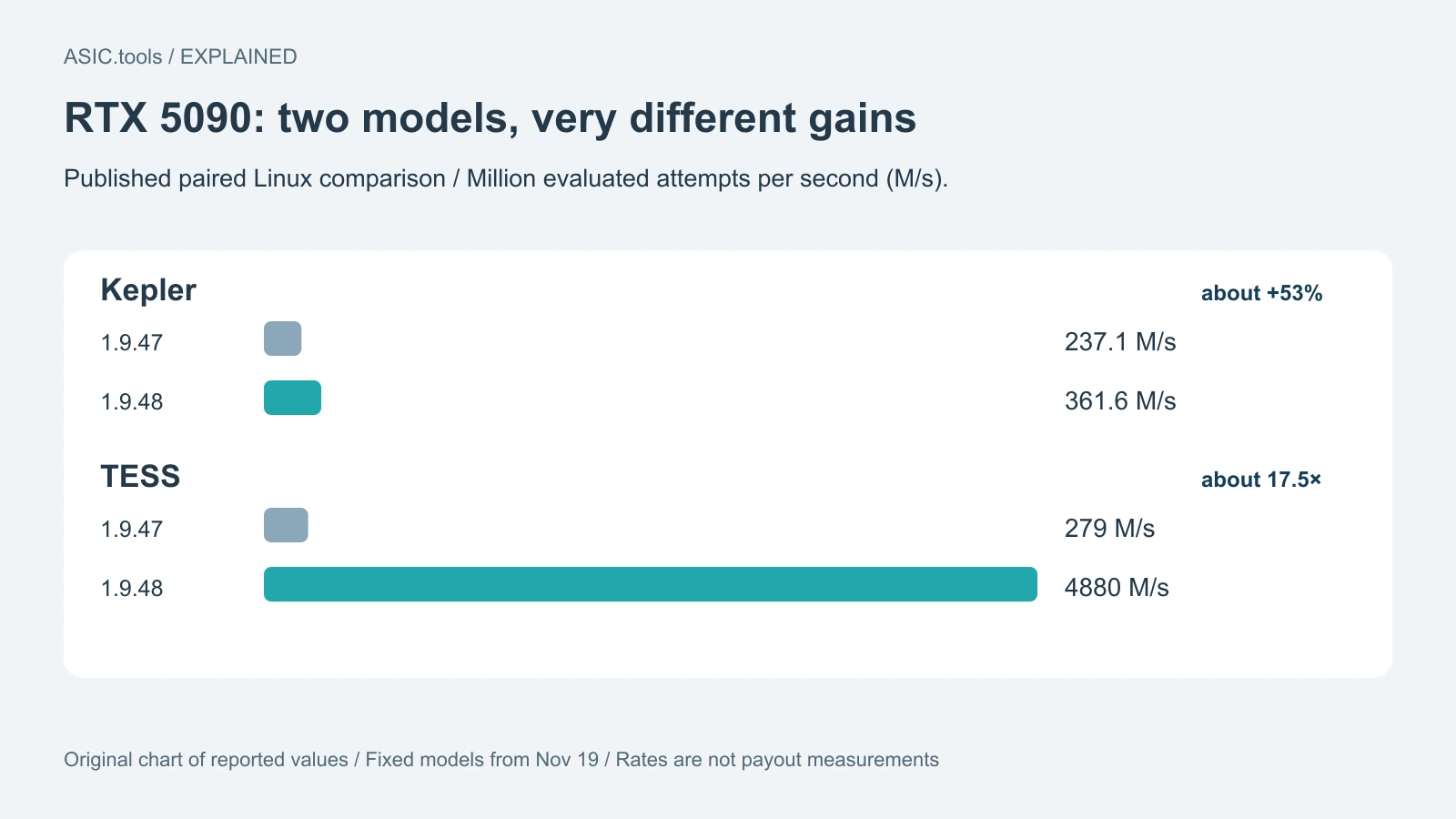
The same card can show very different gains
In the release's comparison, an RTX 5090 goes from 237.1 to 361.6 million evaluated attempts per second on Kepler, roughly a 53% rise. On TESS it goes from 279 million to 4.88 billion per second, about 17.5 times the earlier rate. That is not a claim of 17.5 times more wallet income, nor a universal gain for every model the network will train.
The RTX 3070 example rises from 36.0 to 63.4 million per second on Kepler and from 44.3 to 626.9 million on TESS, about 14.1 times for the latter. The same publication includes RTX 5080 and 4070 Ti SUPER results. All belong to a paired 1.9.47-versus-1.9.48 comparison; mixing them with an older release's differently trained-model table would give a misleading baseline.
Test conditions matter more than a headline multiplier
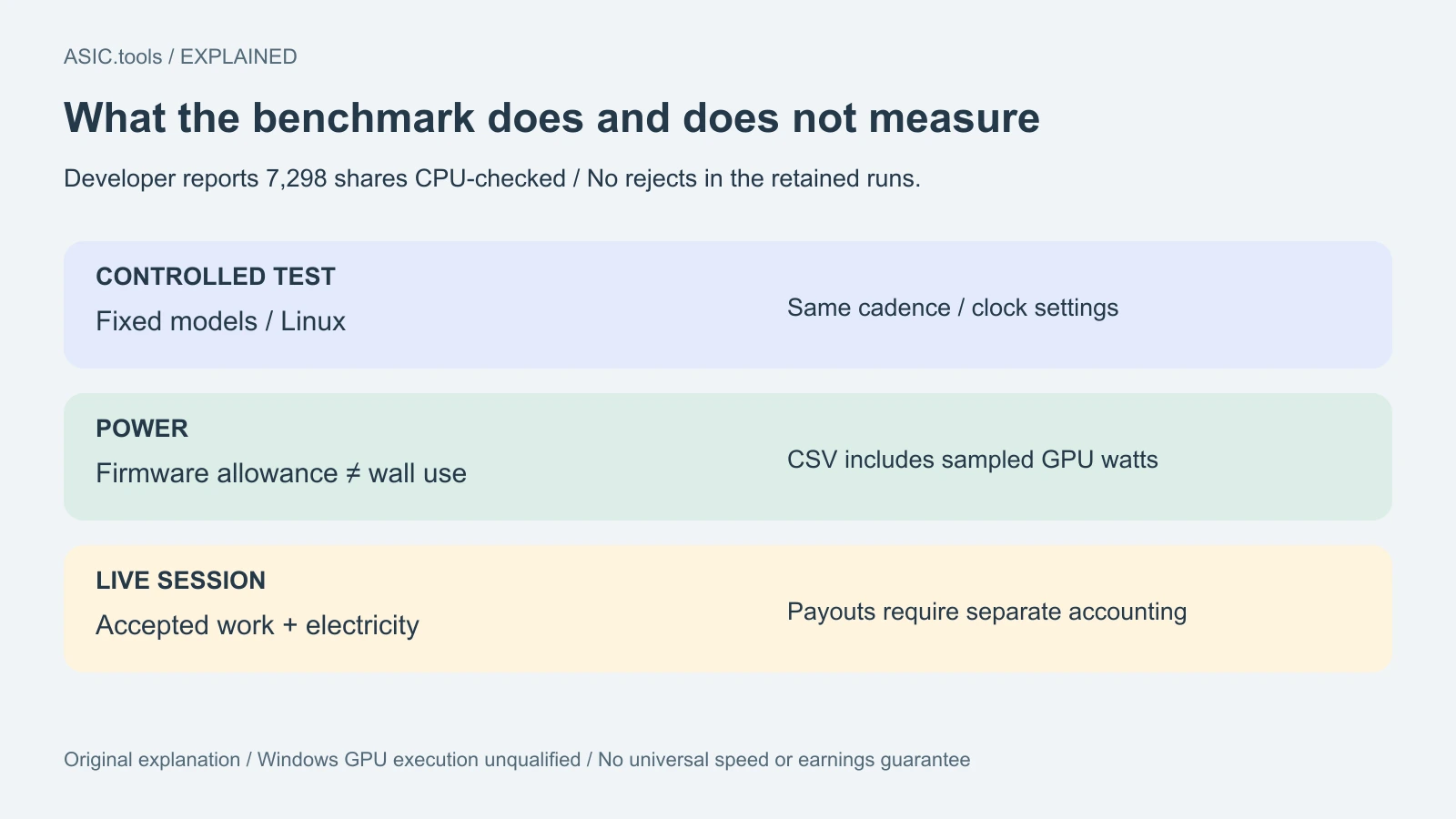
The README dates the Linux measurements to 20 November using frozen models from the main network on 19 November, identical work cadence of 90 seconds per model, unchanged clock settings and each card's maximum firmware power allowance. The retained CSV records individual runs, sampled watts, clocks and temperatures. A 600 W allowance for a 5090 is a setting, not proof that it continuously consumed 600 W at the wall.
The developer reports that all 7,298 returned shares in those runs passed an independent CPU reference, with none rejected, and says the final Linux executable reproduced the rates. That is useful validation of its fixed-model tests, but not a pool-payout measurement. On the live network, the model changes and so can the speed; actual electricity and accepted shares still need their own observation.
More memory gives the method more room
The miner keeps tables of exact results in video memory. By default it uses free memory while leaving about 3 GB aside; the larger table can be limited or disabled, and nonce selection can be disabled to restore 1.9.47 behaviour. This does not mean NEB requires a giant Keryx-style AI model in video memory: the two projects use different work and their memory rules should not be mixed.
The pool must allow variation of the extranonce, an extra field used to extend the search space; the release names ordinary Stratum operation at Suprnova as compatible. The algorithm option stays neb. Existing certificate-verified TLS connections remain available, and the miner fee remains 0%; this does not remove a separate pool fee.
Check the package and compare a real session
Packages are offered for Linux, Windows, HiveOS, mmpOS, SMOS and Docker, including separate NVIDIA and AMD variants. Availability of a Windows archive is not a physical Windows GPU benchmark: the release explicitly leaves that execution unqualified. It also says other algorithms' GPU code is unchanged from 1.9.47, so this NEB result should not be promoted as a general speed increase for every coin.
For an existing NEB rig, useful checks are the official package, the matching GPU path, current-model speed, accepted work and measured consumption over the same period. The three original diagrams explain the selection method, two-model comparison and measurement boundary. The new release offers a concrete optimisation to test; the benchmark alone cannot settle electricity-adjusted earnings or hardware payback.
Source: Suprminer / Suprnova ↗ · Suprminer current methodology and benchmark notes ↗ · Full paired 1.9.48 benchmark CSV ↗ · NEB setup and compatibility guide ↗
Mining calculator ↗