Proxima nodes must update to v1.7.0 before tonight’s rule change
Source report: 2026-11-19 · Editorial analysis published: 2026-11-20
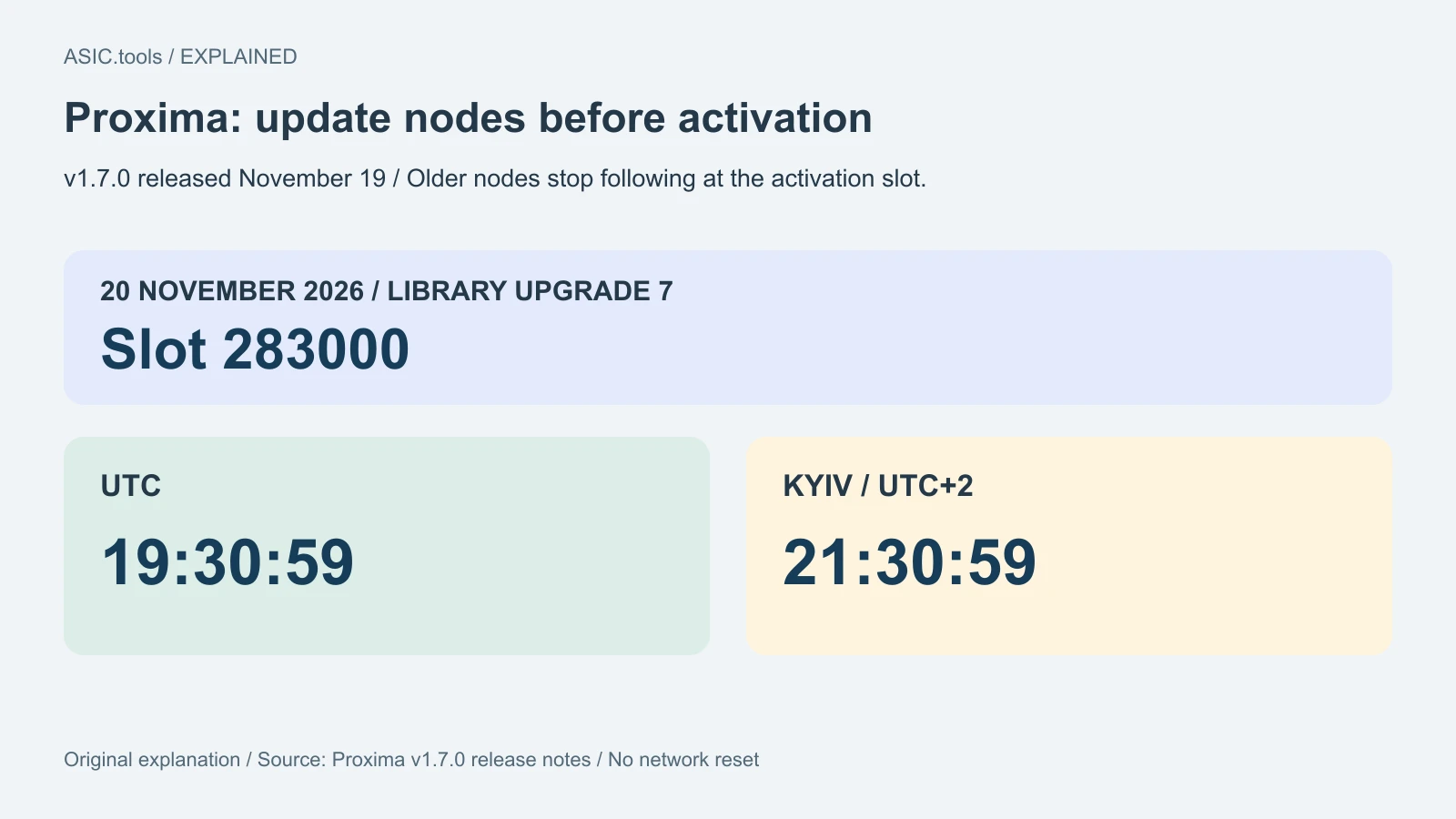
Upgrade 7 activates on November 20 at 19:30:59 UTC. Nodes and proxi need updating; Suprnova says its mining program needs no update.
Nodes face a deadline this evening
Proxima v1.7.0, released on 19 November, is mandatory for every node before library upgrade 7. The new rules activate at slot 283000 on 20 November at 19:30:59 UTC, or 21:30:59 in Kyiv. The project's release notes say an older node stops following the network at that slot. This is a same-day operating deadline, rather than a new miner-performance claim.
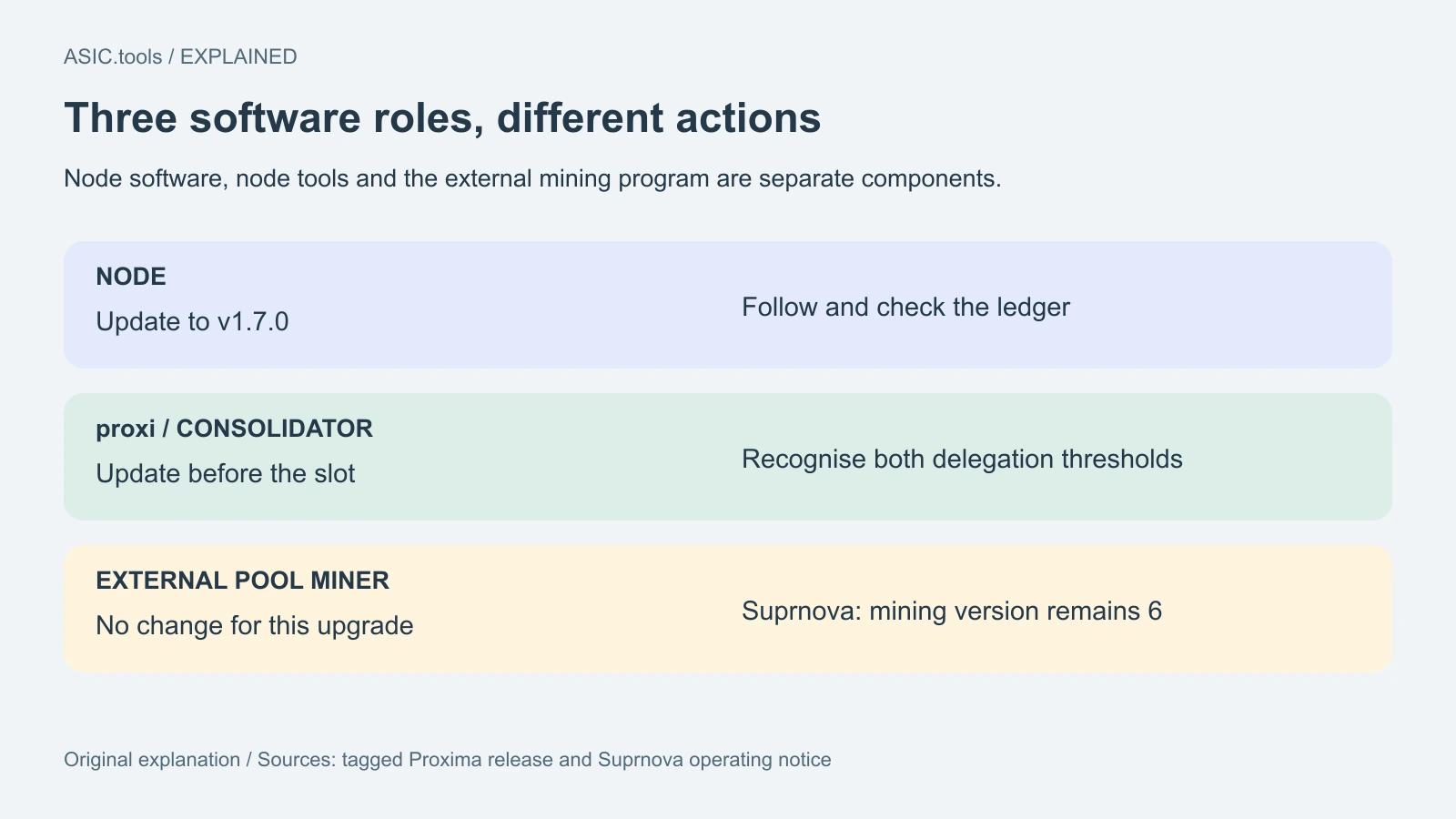
Suprnova's Proxima pool reports that its node and SUPRNV sequencer have used v1.7.0 since 19 November at 16:52 UTC. It also says mining does not change: the mining parameter called miner version stays 6 and miners need no update for this transition. The distinction matters because the project separately instructs operators to update the node's proxi command-line tool.
Which software needs attention
A node follows and checks the ledger. The proxi tool controls node operations and delegation tasks. A separate mining program submits work to a pool. Upgrading one does not automatically mean the other two are current. For pool users, Suprnova's notice concerns the external mining program; for node operators and users of the delegation consolidator, the v1.7.0 release instructions still apply.
The developer says to build from the release tag and restart nodes before 19:30 UTC. Operators with several sequencers should restart them one at a time, waiting for each to produce again. If a node misses the slot, the same upgrade procedure applies; a snapshot taken after the activation slot is the stated fallback if it cannot catch up. There is no network reset or blanket requirement to erase the database.
A different way to set branch bonuses
A sequencer is the token-backed participant that orders transactions in Proxima's ledger. Upgrade 7 lets it choose its branch bonus between one mote, equal to 0.000001 PROX, and 5 PROX. The request is committed before the slot ends and revealed in the branch, so participants cannot first inspect everyone else's request.
When branches tie on coverage, each receives a lottery value from zero to 10 PROX, with its requested bonus deducted; the highest result wins. Asking for a larger bonus therefore trades a larger prize for a lower chance in that tie. The default request is 5 PROX. These are protocol rules for sequencers, not a promised daily return for a GPU miner or a pool customer.
Two routes to branch eligibility
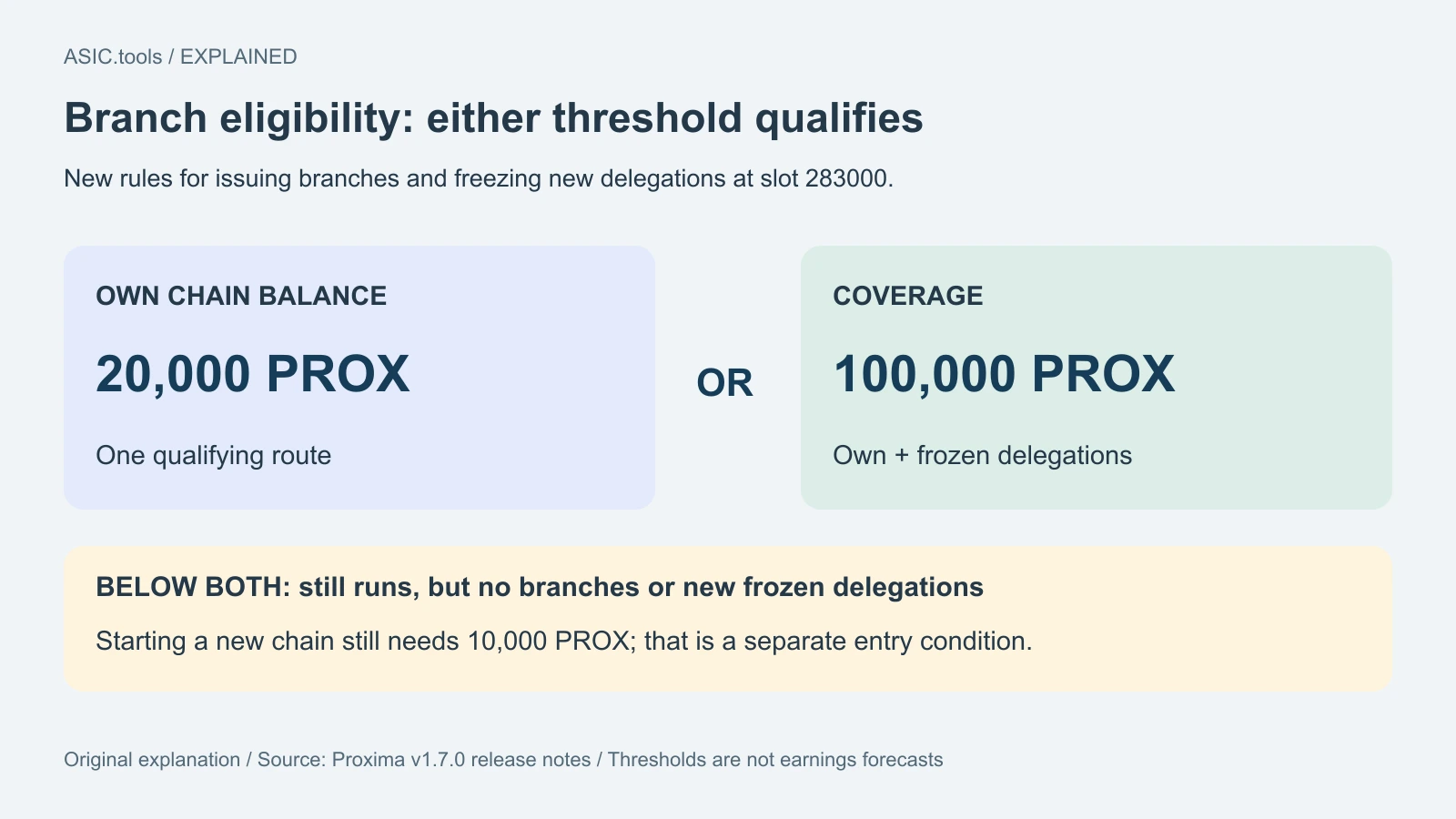
To issue branches and freeze new delegations, a sequencer needs either 20,000 PROX of its own on its chain or 100,000 PROX of coverage. Coverage combines its own balance with delegations frozen to it. These are alternative conditions: qualifying through coverage does not also require the 20,000 own-balance threshold.
Falling below both does not switch the sequencer off. It can still issue milestones, take tag-alongs and retain existing frozen delegations until they expire, but cannot issue branches or accept new frozen delegations. Starting a new sequencer chain still requires 10,000 PROX. That entry amount is different from the new conditions for issuing branches; it is not a third equivalent qualifying route.
Delegation tools need the new rules too
Delegators running the consolidator must update it before the activation slot. The release notes warn that an older consolidator does not recognise eligibility through coverage alone: it may treat a qualifying sequencer as unable to freeze delegations and ask its delegations to stop. An operator can inspect both thresholds with proxi node seq info after updating the tool.
The release also allows anyone to top up a delegation, for example a pool or exchange paying directly into a user's delegation. The tokens belong to the delegation owner and the owner's rights do not change. That is a protocol capability, not proof that every pool already supports such payments. After activation, creating a new sequencer chain also requires proxi v1.7.0; an older init_genesis command creates a chain the ledger refuses.
This does not turn Proxima into Bitcoin mining
Suprnova describes Proxima's mining work as BLAKE2b transaction-ID work on GPUs or CPUs, while consensus is provided by token-backed sequencers in a DAG/UTXO ledger, a graph of transactions tracking unspent outputs. That ledger structure differs from Bitcoin's chain of blocks. Here, doing proof-of-work for token issuance and participating in consensus are separate roles; the node deadline should not be read as a SHA-256 ASIC compatibility announcement.
For a Suprnova pool user, the practical first check is the pool's current operating notice. For a node or consolidator operator, it is the tagged v1.7.0 release and an upgrade before tonight's deadline. The three illustrations explain the activation time, software roles and alternative thresholds. They show rules from the primary sources, not measured hardware gains or an earnings forecast.
Source: Proxima / Suprnova ↗ · Suprnova Proxima: node upgrade and unchanged mining version ↗
Mining calculator ↗