Pearl contributor proposes keeping RTX 40 cards in mining after the FP8 switch
Source report: 2026-10-27 · Editorial analysis published: 2026-10-28
An October 27 pull request adds an Ada arithmetic profile to the proposed FP protocol. RTX 4070 Ti SUPER measurements support the idea, but integration, proof machinery and activation remain unfinished.
A route for RTX 40 exists on paper, not yet in an activated release
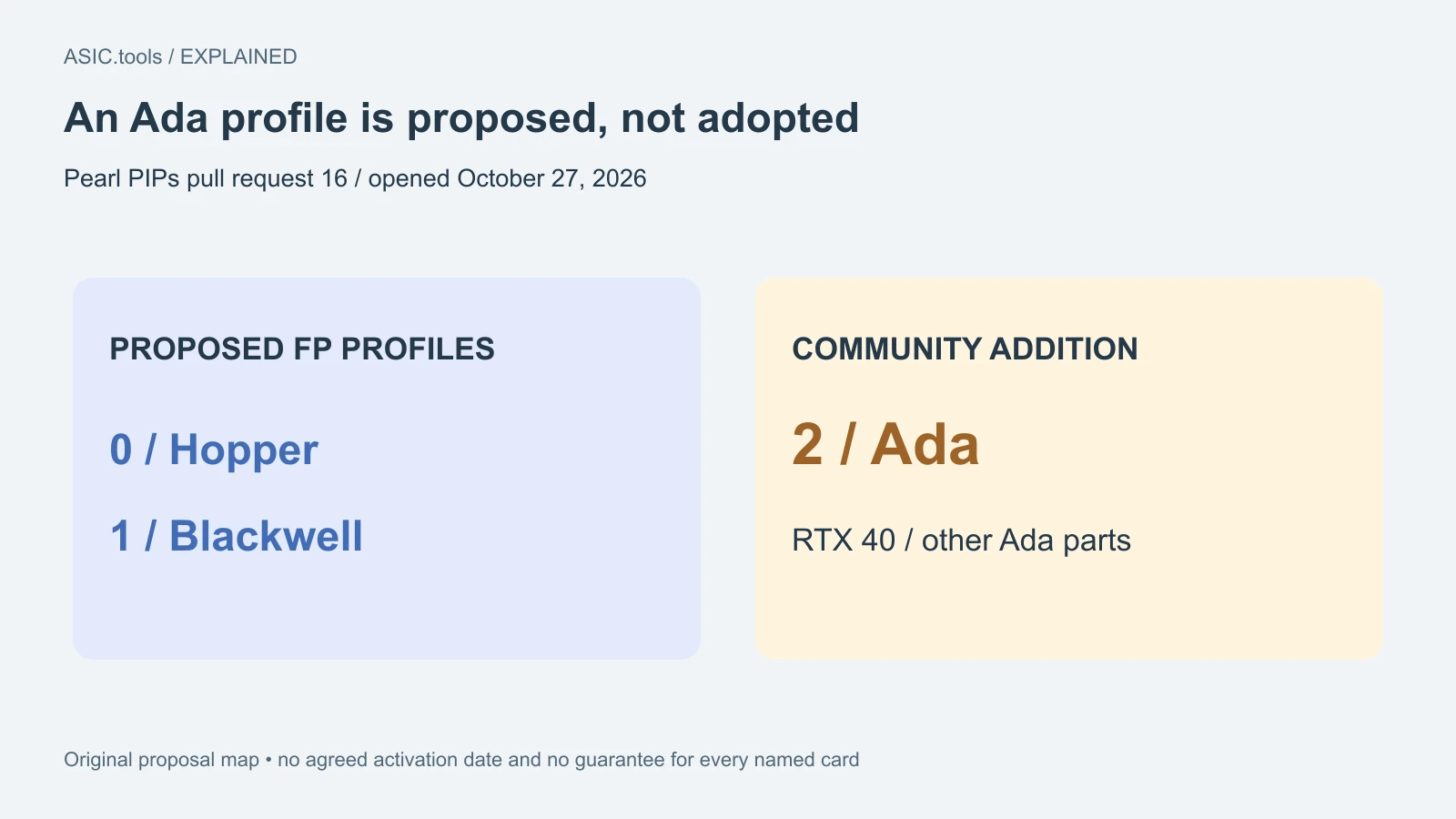
Pearl community contributor Tim, using the name JustAResearcher, opened pull request 16 on October 27 proposing an Ada Lovelace device profile for the future floating-point mining protocol. It covers the architecture used in GeForce RTX 40 cards, as well as RTX 6000 Ada and L4, L40 and L40S data-center cards. For owners, the news is a concrete proposal for continued participation after a protocol change that currently names Hopper and Blackwell.
The distinction is timing. When checked October 28, the pull request was open and unmerged, and the document itself carried Draft status. The underlying PIP-3 proposal also remained a draft; the Ada document says PIP-3 has not activated. This is not a notice that existing RTX 40 miners stopped working today, nor an official promise that every listed Ada card will be supported by the eventual network rules.
Why FP8 hardware alone is not enough
Pearl’s proposed FP protocol uses floating-point matrix multiplication, the type of numerical work common in AI. FP8 represents values with eight bits; the present integer scheme uses a different number format. A mining certificate is evidence that the required work was done, and network verifiers need to reproduce the committed device profile’s arithmetic exactly. A card being able to execute FP8 instructions does not, by itself, make its output match another architecture’s rules.
Ada and Hopper accumulate groups of products differently. The proposal describes Ada combining 16 products at a time, with a 13-bit accumulation window, rather than Hopper’s 32-product grouping. It collects these in 128-product windows and promotes each window into a 32-bit floating-point total. A plain analogy is adding a long bill while rounding after different groups of items: the last digits can differ even though the inputs were the same. Here, matching those digits matters to verification.
What the author measured
The proposal would add Device = 2 for Ada beside the existing proposed Hopper and Blackwell profiles, numbered 0 and 1. The device field identifies arithmetic rules, not a certificate proving which physical graphics card somebody owns. A miner committing the Ada profile would still have to produce results that verify under that profile. The change is therefore more than adding a model name to a compatibility list.
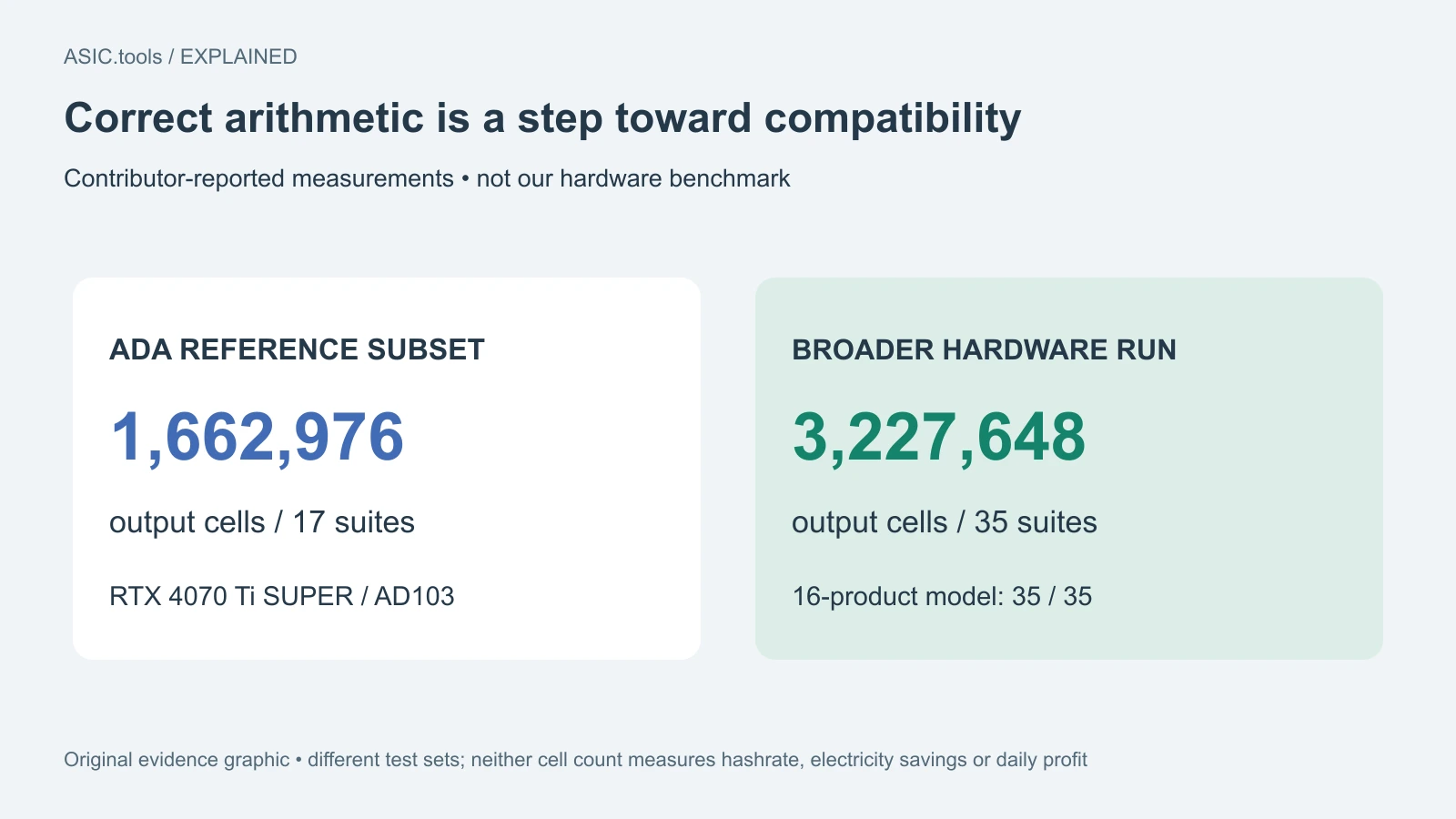
The author reports measurements on an RTX 4070 Ti SUPER with an AD103 chip. A standalone Rust reference matched all 1,662,976 output cells in the 17 test suites structured as the proposed Ada operation. A broader hardware run covered 35 suites and 3,227,648 cells; the 16-product model matched all 35 suites. These two cell counts describe different test sets, and should not be presented as two measures of mining hashrate.
These are the contributor’s numerical correctness results, not our independent hardware benchmark. Only AD103 was measured for Ada. The text expects other Ada chips and data-center parts to behave similarly, but explicitly says they have not been measured. There is no demonstrated network-wide income gain, electricity saving or ready-made daily-profit figure in these tests. A matching arithmetic reference is useful evidence, but does not complete a production mining pipeline.
The proposal still needs implementation and a network decision
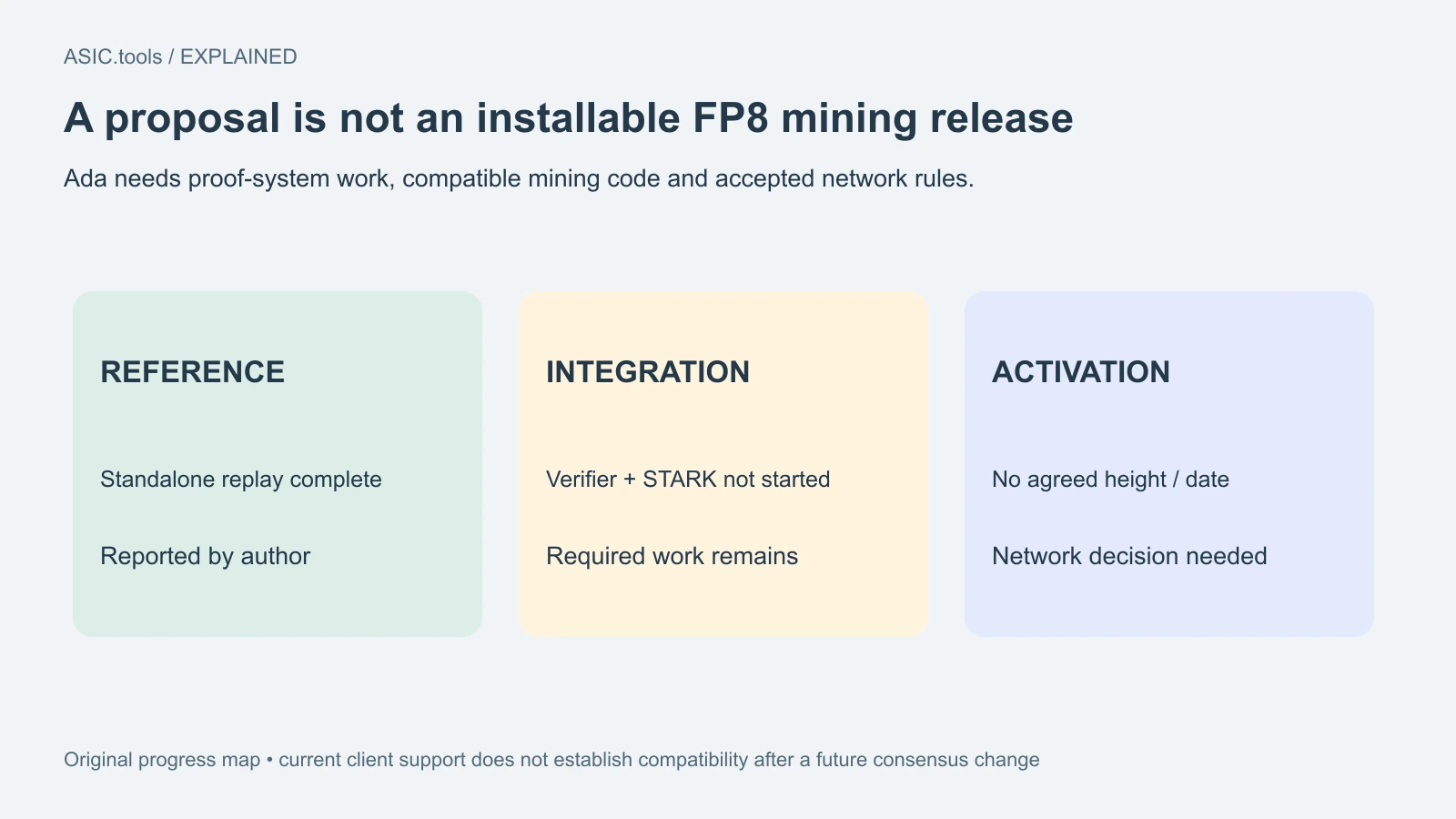
The document says the standalone replay implementation is complete, while integration inside Pearl’s verifier and the Ada matrix-multiplication STARK have not been started. A STARK is a cryptographic proof mechanism used to check work without repeating every step. The text also calls for an Ada FP8 mining kernel, device mapping and a verifier-work admission entry. Until these pieces exist and are accepted together, owners do not have a finished supported FP8 mining release to install from this proposal.
The author asks for Ada to activate at the same height as PIP-3, so it would not need a second hard fork later. A hard fork changes which blocks network software accepts; its height is the block number where the new rules begin. The request does not supply an agreed activation block or calendar date. It also does not establish that the project has approved the proposed parameters. If Ada were added only after the initial switch, the document says it would require a separately announced activation.
What owners should watch before buying or changing cards
An important detail is that the documents are at different stages. The main PIP-3 text still describes certificate version 3, while the implementation branch and Ada proposal refer to version 4 and a pending PIP-3 revision. Copying one version number into a claim about the live network would hide that discrepancy. The durable point is the proposed change from integer work to a floating-point profile; the final certificate rules need to be checked against an accepted specification and release.
For an existing RTX 40 owner, watch the proposal’s review, measured support for the actual chip, merged verifier changes, compatible mining software and an explicit activation announcement. Current third-party mining software working under today’s rules is different evidence from compatibility after a future consensus change. A client optimization released this week cannot by itself make the network accept a new device profile. This also explains why driver support and hardware FP8 capability alone do not settle the question.
For a planned hardware purchase, the proposal is a reason to follow development, not a basis for calculating guaranteed future Pearl revenue. There is still no adopted Ada activation date, complete integration or benchmark covering every named card. The useful progress is that a community contributor has specified the arithmetic and supplied reproducible reference material. The next milestone is acceptance and working integration, which would turn a plausible technical route into support owners can actually use.
Source: Pearl PIPs / community proposal ↗ · Current draft PIP-3 ↗ · Ada proposal text at reviewed commit ↗ · FP implementation pull request 311 ↗
Mining calculator ↗