eCash activates its November upgrade and moves nodes to Bitcoin ABC 0.34
Source report: 2026-11-15 · Editorial analysis published: 2026-11-15
Bitcoin ABC confirmed the November 15 activation. Miners who run a full node should check the node supplying work to their pool.
The November upgrade is active
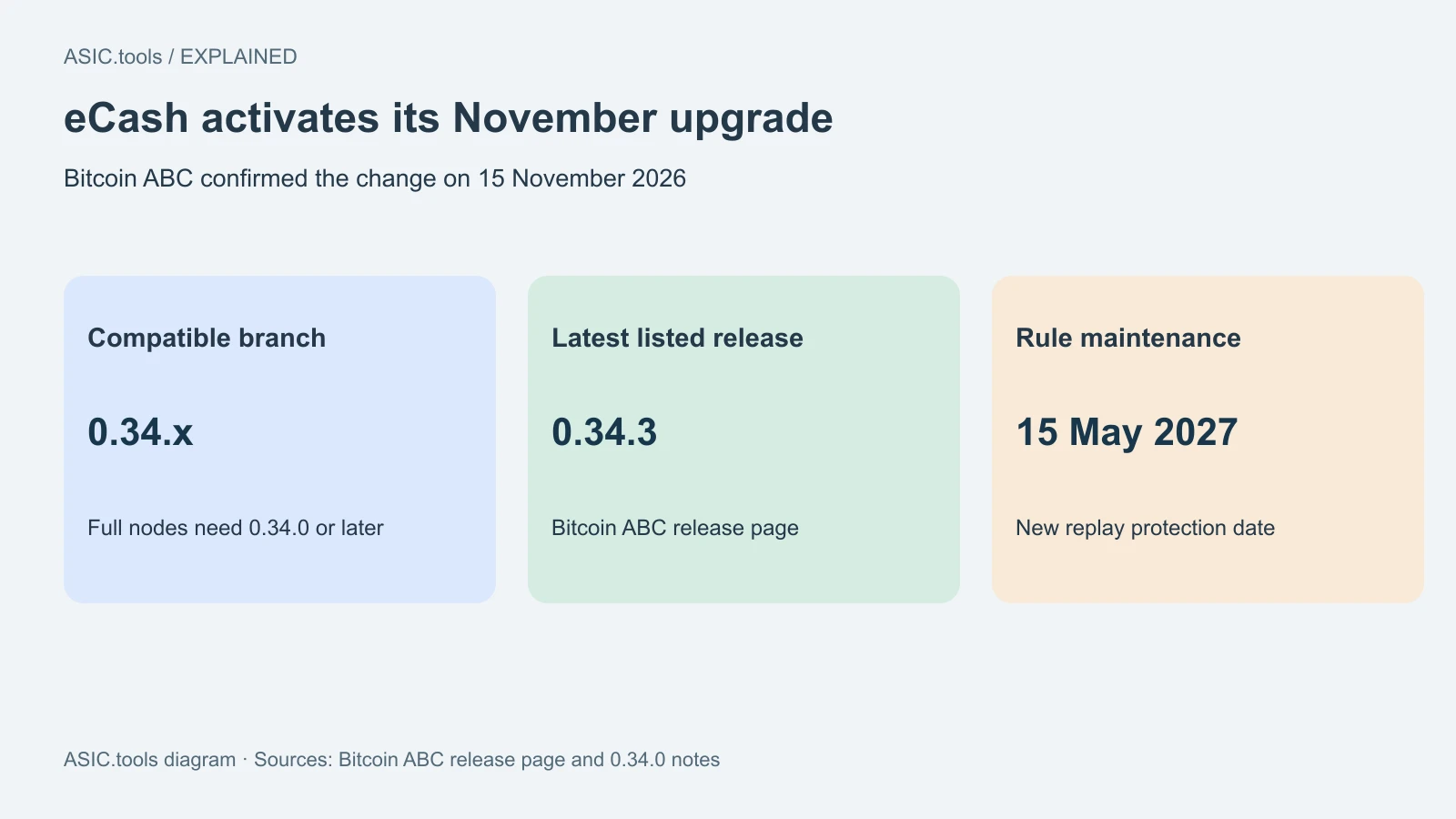
Bitcoin ABC confirmed on November 15 that the eCash network activated its scheduled upgrade. Its release page says full nodes running older versions than 0.34.0 will no longer stay in sync. The compatible branch is 0.34.x, and the project lists 0.34.3 as the latest release. For miners, the version that matters is the one on the node supplying current work. An ASIC can keep doing calculations while the upstream node has fallen behind.
The upgrade page says the change introduces no new protocol features. It moves the date used by automatic replay protection to May 15, 2027 as part of the regular upgrade cycle. Replay protection helps separate activity across incompatible rule sets. The immediate job for anyone running a full node is to follow the current chain. The release notes do not describe a new mining algorithm or an ASIC firmware update.
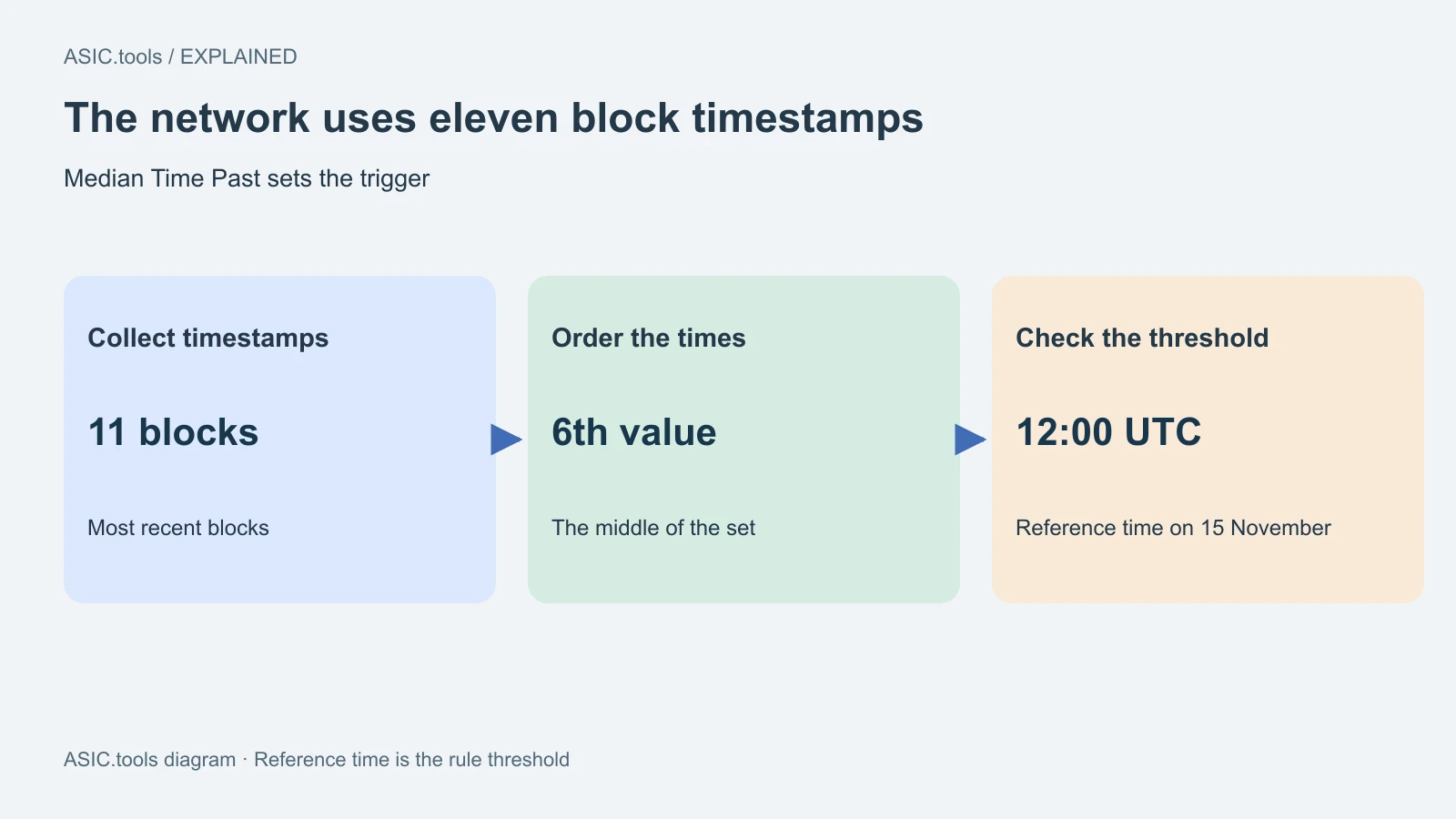
Why the timing depends on blocks
The official reference time was 12:00 UTC on November 15. The trigger uses Median Time Past, which sorts the timestamps from the eleven most recent blocks and takes the middle one. A reference time in the announcement is therefore a marker for the network’s rule, while the actual switch depends on when enough blocks with later timestamps arrive. The block timestamps used by nodes matter more here than the time on an operator’s desk clock.
In a check using public Chronik data, the eleven-block median at height 975,614 was 12:56:30 UTC, past the reference time. The project confirms that the rule has taken effect, so operators can now check live status instead of guessing from the planned time. A useful first check is to compare the local node’s reported chain tip with a current eCash explorer. The chain tip is the latest block the node considers valid. Check the block hash at the same height and repeat after another block or two if you catch a brief gap between services.
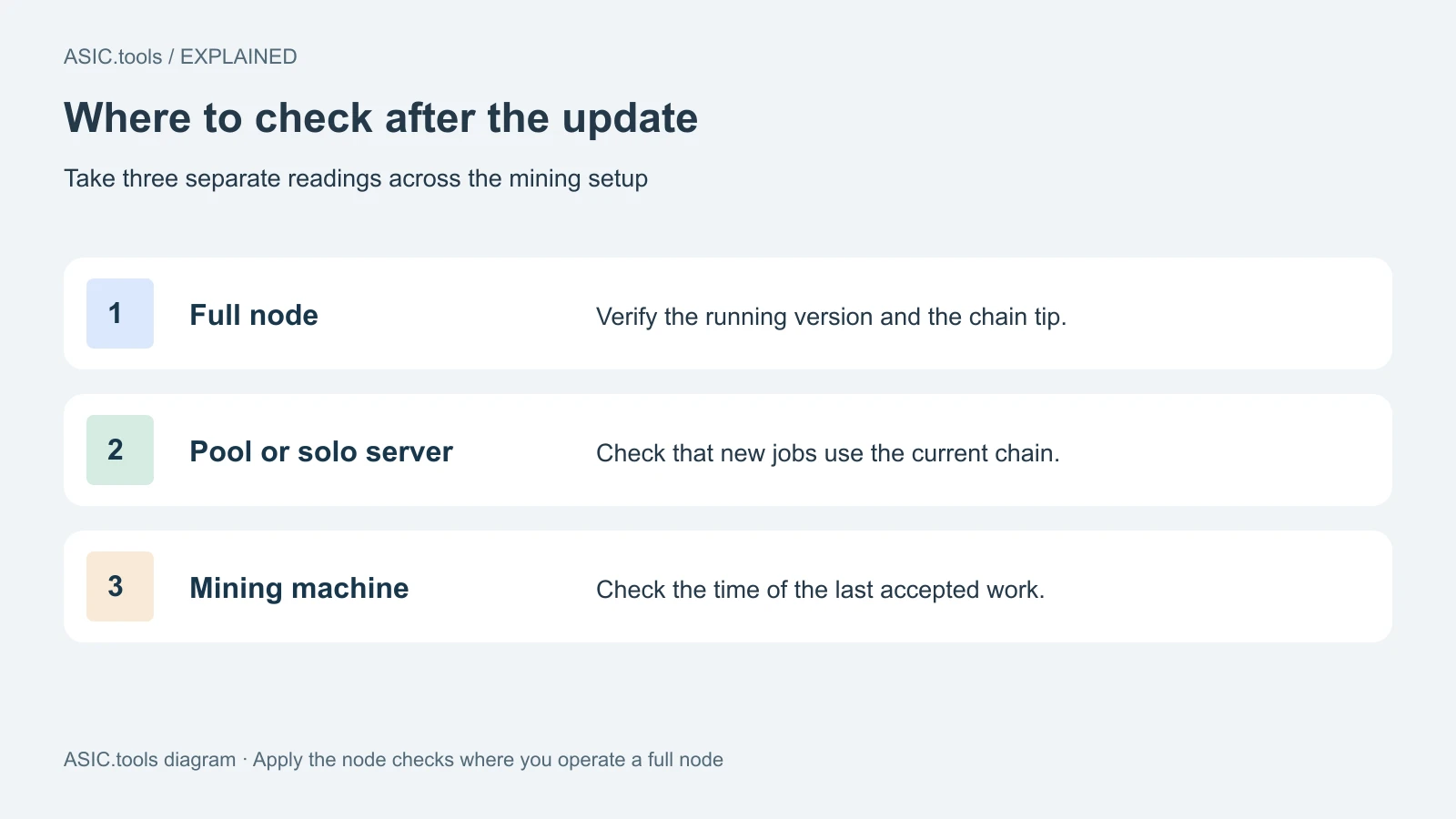
Which part of the mining setup to check
An operator who runs a pool or a solo setup with a full node should start with the machine that actually supplies the work, including any backup node selected during a failure. Checking that an updated release was downloaded does not tell you which version the running service uses. After confirming the version and synchronization, check that the pool is issuing work based on the current chain and that it continues to credit submitted work.
A miner who connects to somebody else’s pool does not generally run that node. In this case the useful data are the pool’s status notice, timestamps for the last accepted shares and any changes in reported work. Shares are easier results the pool uses to count a machine’s contribution. Seeing a regular stream of accepted shares indicates that a pool is receiving work, while a chain check tells the operator if it is building on the right blocks.
What wallet users need to know
The project says ordinary wallet users do not need to update because of this event. If a wallet or exchange displays delayed deposits, the service’s status page and the transaction record are the useful places to check. For a payout, compare the transaction identifier and recipient with the pool’s own payment record.
The most practical signal after this upgrade is movement on the same chain. Check the node’s version and block, then trace the jobs from that node through to accepted work. This puts an old-node problem, a pool problem and a delayed payout in their proper places.
Source: Bitcoin ABC ↗ · Bitcoin ABC network upgrade instructions ↗ · Bitcoin ABC 0.34.0 release notes ↗ · eCash block explorer ↗ · Chronik data at block 975,614 ↗
Mining calculator ↗