Hyperscale’s mining-to-AI conversion still needs $74.8m of construction spending
Source report: 2026-11-18 · Editorial analysis published: 2026-11-19
The November 18 filing puts the remaining Michigan build cost beside a warning that available liquidity will not cover the next twelve months. Contract value is not cash available to finish the site.
The conversion has a bill before it has full capacity
Hyperscale Data’s quarterly filing submitted on November 18 shows why turning a former Bitcoin-mining site into an artificial-intelligence data center is more than changing the machines. The company estimates another $74.8 million of construction spending to complete a 20 MW Michigan deployment, while warning that existing cash and currently available liquidity will not cover its expected requirements for the twelve months after the financial statements are issued.
For readers following miners’ move into AI hosting, this is a concrete update on a previously announced conversion. Having a customer agreement and an electrical site does not mean the new service is finished or fully financed. The filing says substantial doubt remains about the company’s ability to continue as a going concern. That is a formal liquidity warning, not a statement that the campus has already closed or a forecast of a certain outcome.
What the $74.8 million actually measures
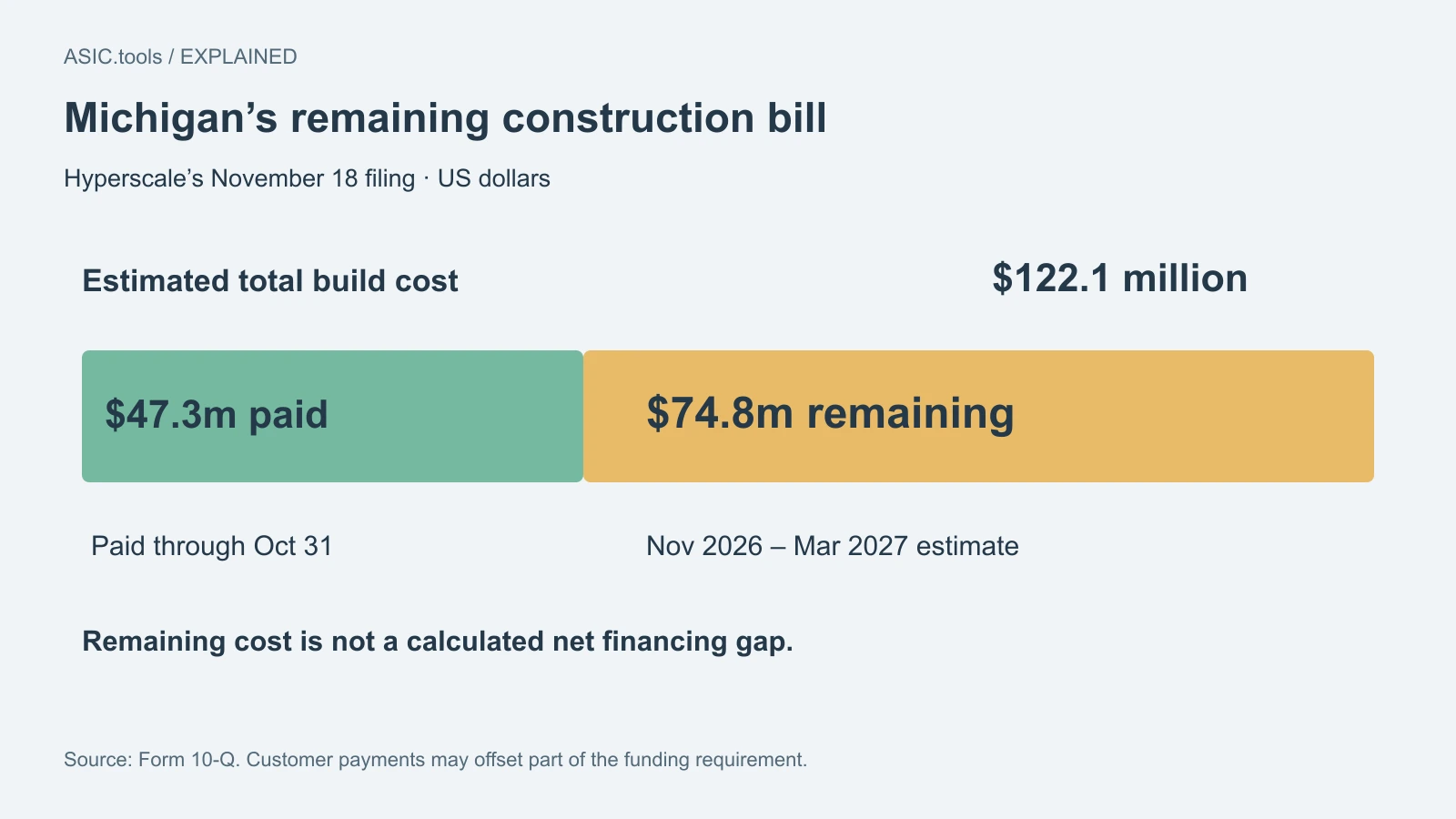
The estimated build-out totals $122.1 million. Hyperscale says $47.3 million had been paid through October 31, leaving approximately $74.8 million. It expects $27.4 million of that spending in November and December 2026 and $47.4 million in the first quarter of 2027. The figures describe costs still to be paid, including equipment not yet ordered and installation estimates that can change.
They are not a calculation of the final net financing gap. The agreement includes certain one-time customer fit-out payments and partial prepayment of monthly colocation fees, which management expects to offset part of the requirements. Colocation means providing space, power and related infrastructure for a customer’s equipment. The filing does not quantify all those offsets here, so subtracting a single cash figure from $74.8 million would create a more precise shortfall than the source establishes.
Twenty megawatts remain a phased plan
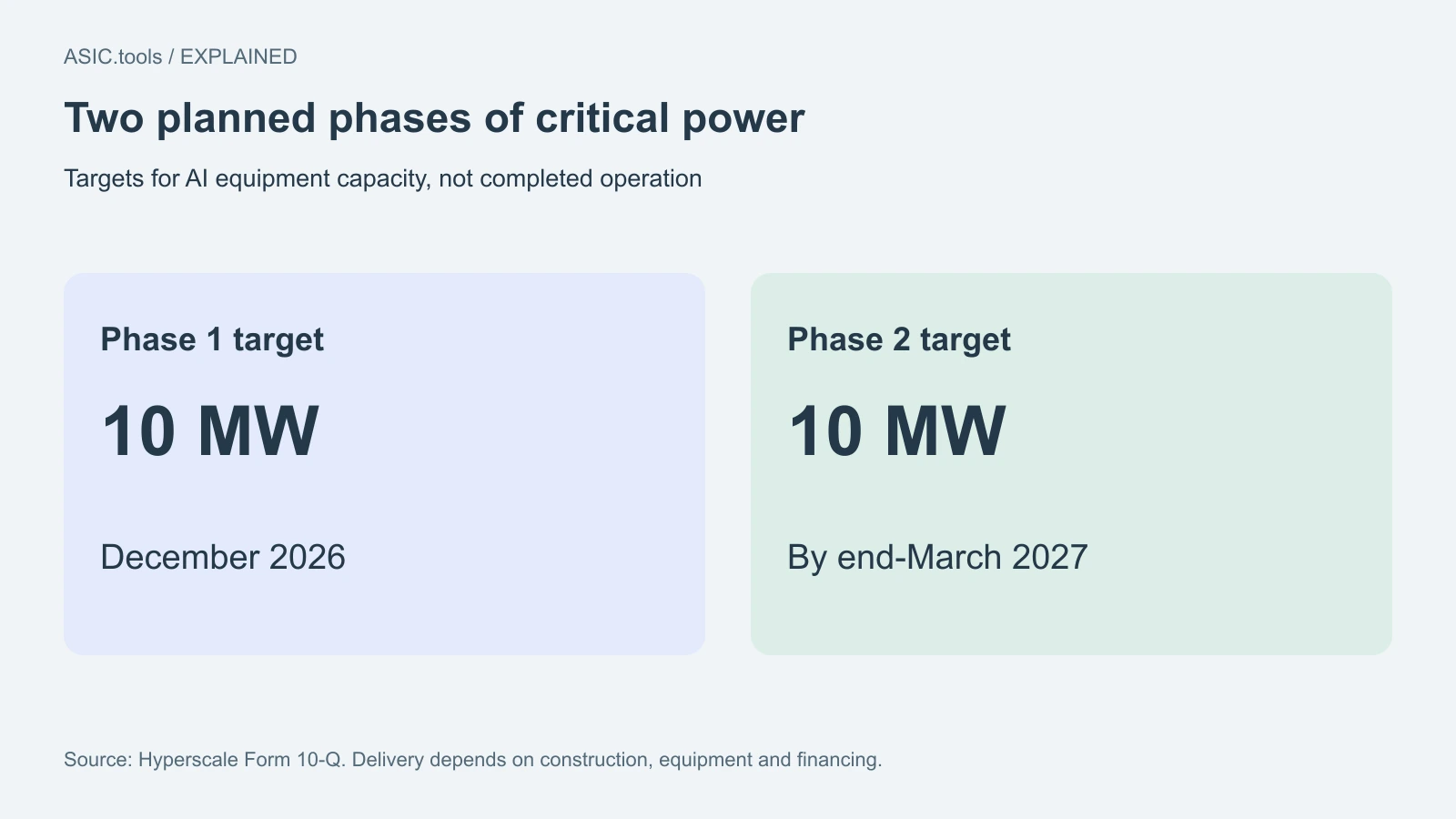
The agreement calls for two phases of 10 MW each. The first ready-for-service target is December 2026; full deployment of the second is targeted by the end of March 2027. Here MW measures critical power capacity supporting the customer’s computing equipment. It is a capacity figure, not a quantity of Bitcoin mined, a guaranteed electricity bill or a declaration that both phases are already operating.
Hyperscale says timing and cost depend on construction progress, equipment procurement, installation, customer deployment schedules and financing availability. For someone comparing mining hosting with an AI conversion, that makes the delivery date as important as the headline capacity. A site may have an existing power connection while still needing service areas, power modules and other infrastructure before it can deliver the contracted computing environment.
A billion-dollar contract is not cash in the bank
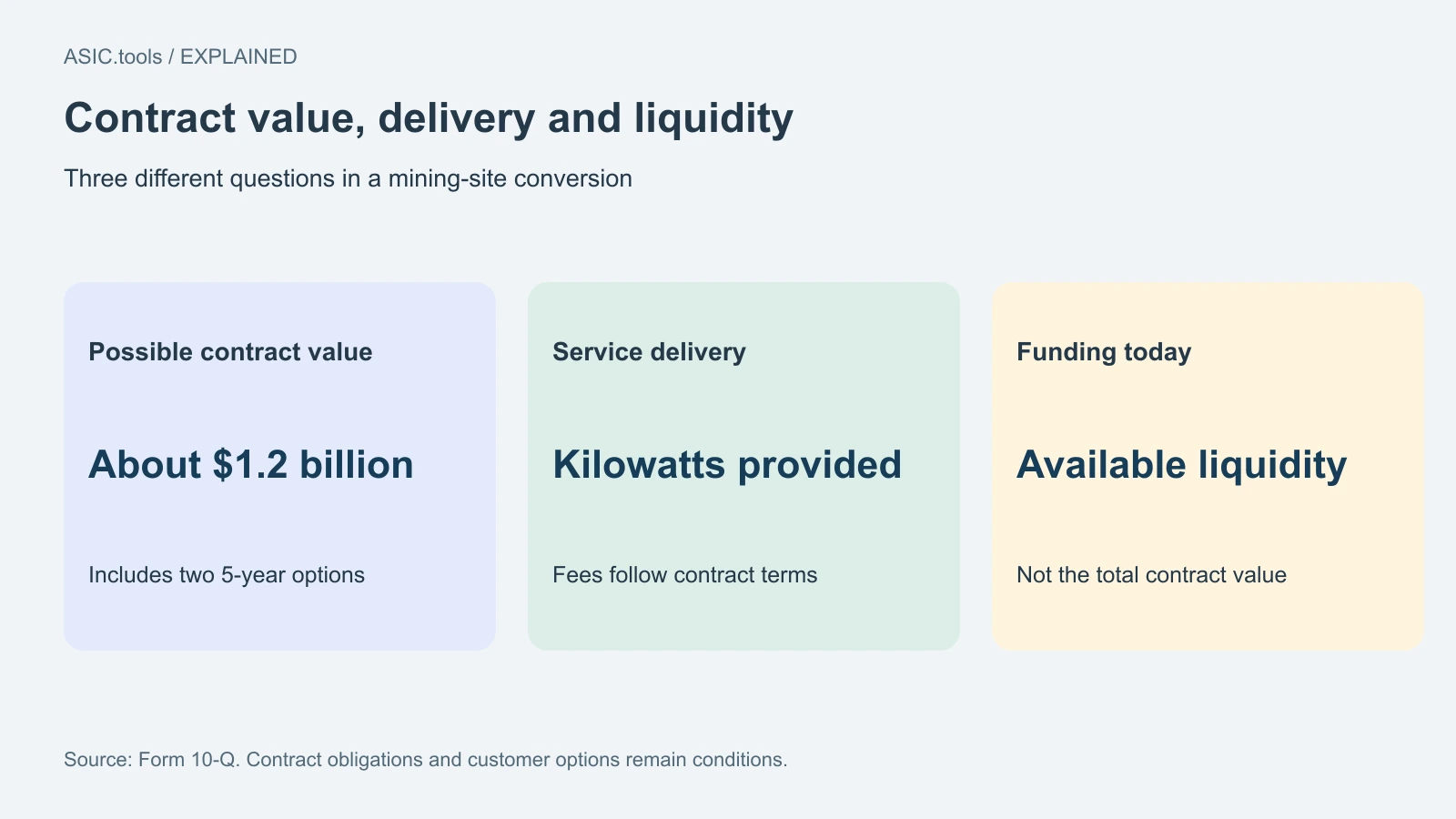
The filing describes approximately $1.2 billion of total contract value if the customer exercises two five-year extension options and the provider meets its obligations. That condition matters. It is a possible value over the agreement’s term, not a current cash balance, a construction advance of that amount or guaranteed revenue already earned. A large contract headline cannot on its own answer who pays the next equipment invoice.
Monthly colocation fees are tied to delivered kilowatts, alongside the specified fit-out payments and partial prepayments. This connects the commercial promise with actual delivery of infrastructure. For a reader assessing a mining-site conversion, ask which phase is ready, what has been delivered and which payment is contractually due. Those questions separate a signed agreement from a completed installation without assuming that the agreement has failed.
Keep the dates of cash and financing separate
At September 30, the group reported about $17.3 million of cash and cash equivalents and $27.8 million of restricted cash. Restricted cash can be used only for purposes allowed by its arrangements. These are group balances on a historical reporting date, not a November 18 cash count or a measure of the Michigan operation alone. The warning evaluates expected liquidity requirements beyond that balance-sheet snapshot.
The filing also records later transactions: about 211.6 BTC sold on November 6 for gross proceeds of $16.0 million, and the subsequent-events discussion records repayment of $12.8 million of JGB principal plus about $1.3 million of premium on November 16. Convertible-note closings raised gross proceeds of $10 million on November 6 and $5 million on November 18. Gross proceeds are not the same as unrestricted money left for construction after repayments, fees and other uses.
The lesson for mining infrastructure
A further $10 million note investment is conditional on shareholder approval and mutual agreement within the stated window; it is not financing already received. Management says significant additional funding will be required and cannot assure it will arrive when needed on acceptable terms. Its plans have not removed the substantial doubt. The group’s figures also cover businesses beyond this campus, so they should not be repackaged as the profit or loss of one ASIC fleet.
The new filing makes the conversion’s remaining work and funding conditions visible. It does not establish that every mining-to-AI project has the same economics, or that a private hosting customer has suffered a loss. For an ordinary reader, the useful distinction is between existing electrical capacity, a dated construction plan, customer payments and cash actually available. Hyperscale’s Michigan project has milestones and a sizeable remaining bill; the headline contract value does not make those intermediate steps disappear.
Source: Hyperscale Data / SEC ↗ · SEC filing date and document index ↗ · Issuer news archive and November 10 Bitcoin-sale announcement ↗ · Earlier ASIC.tools report on the Michigan conversion ↗
Mining calculator ↗