PowerCompute buys 600 Antminer S21++ units for existing slots
Source report: 2026-11-13 · Editorial analysis published: 2026-11-14
The company expects its November purchase to add 80–85 PH/s of active Bitcoin mining capacity without increasing its power capacity at Columbus, Mississippi.
More work from the same slots
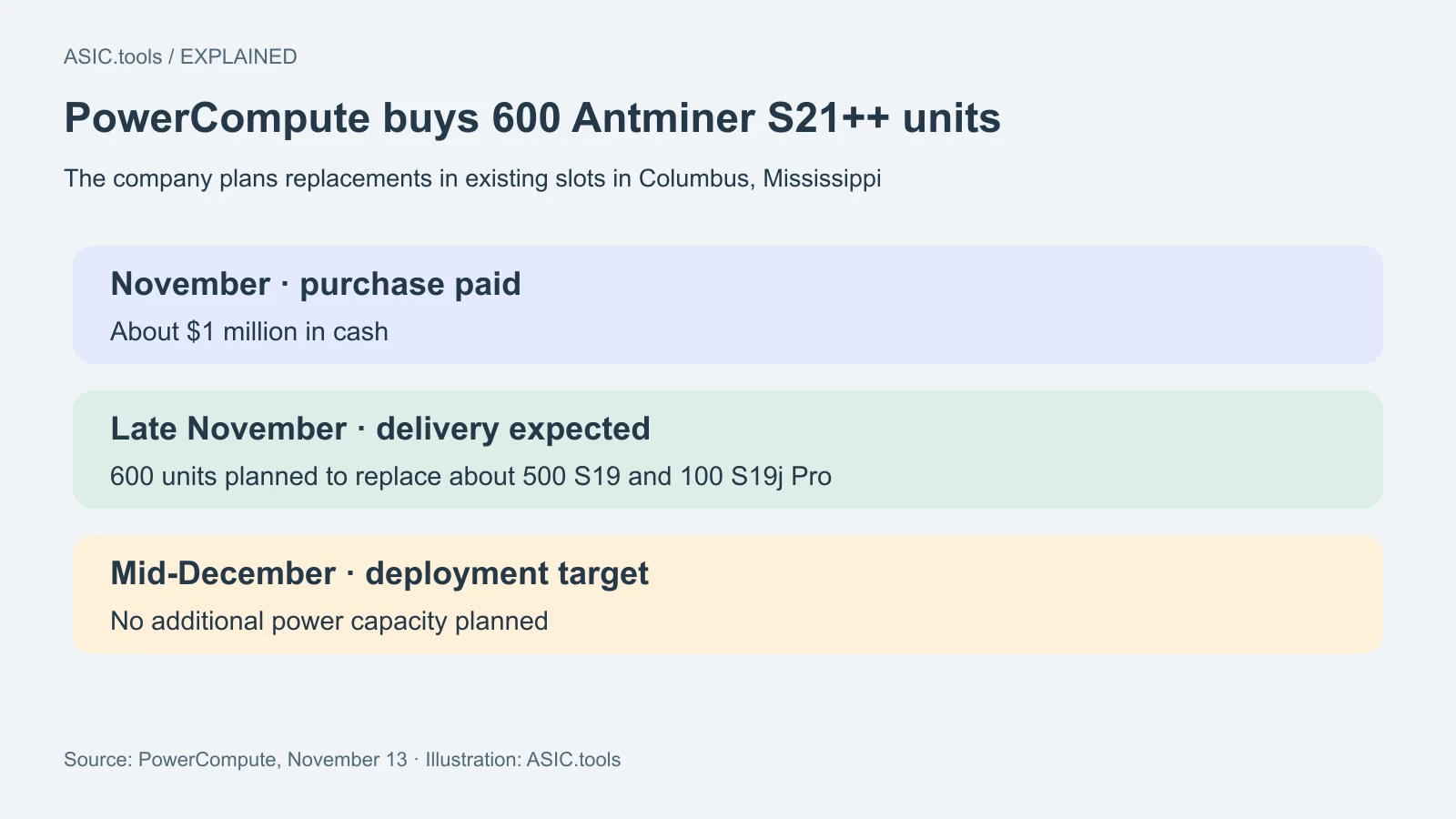
PowerCompute said on November 13 that it had paid about $1 million in cash for 600 Bitmain Antminer S21++ machines. They are meant to replace roughly 500 S19 and 100 S19j Pro units at its Columbus, Mississippi, site. The company expects delivery in late November and deployment by mid-December. It plans to use slots and power capacity it already has. The purchase is complete; the new machines are not yet part of the reported operating fleet.
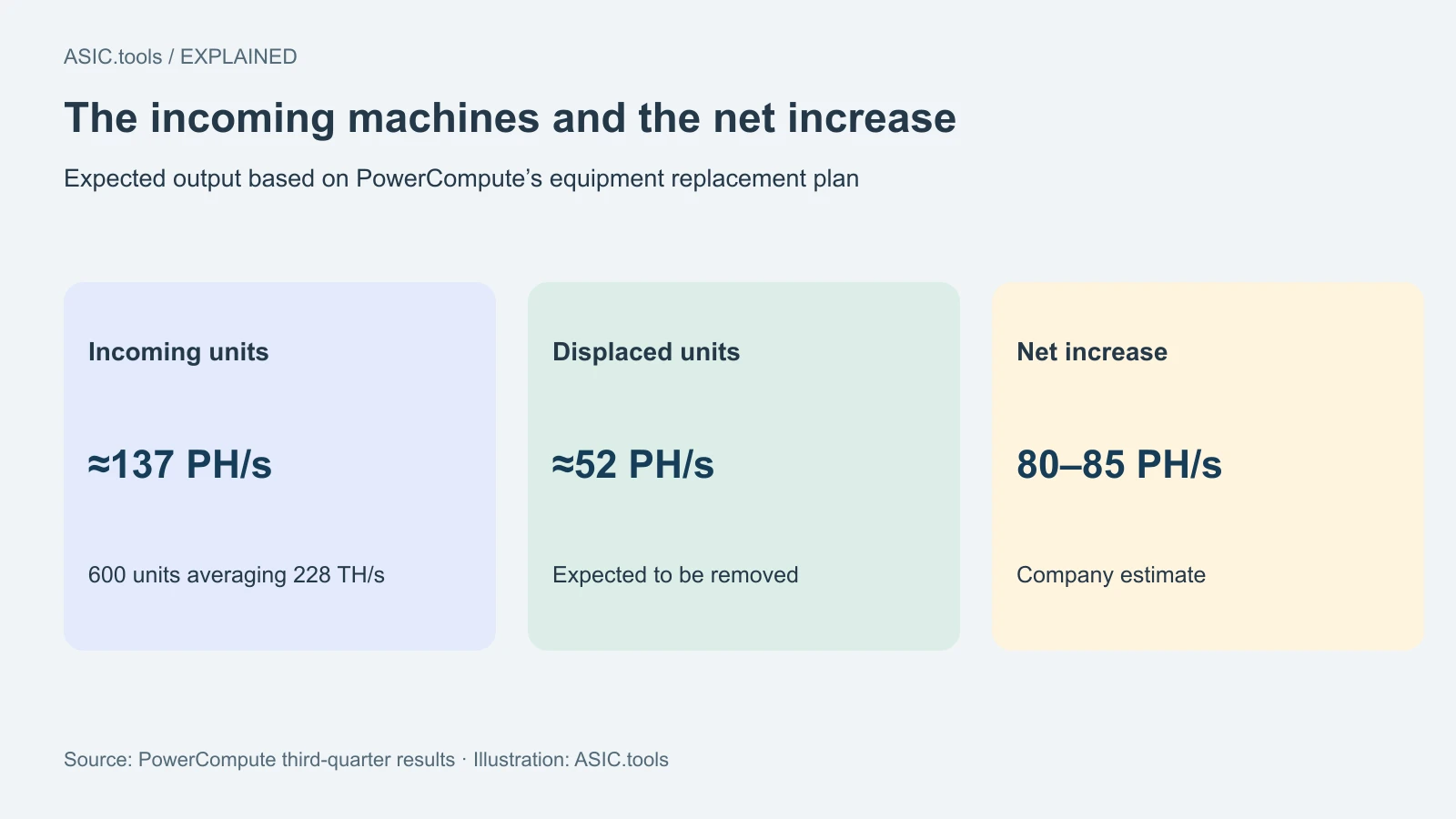
The company expects an average of 228 terahashes per second from each new miner. Multiply by 600 and the group works out to around 137 petahashes per second. A petahash per second is 1,000 terahashes per second. Because the machines being removed contribute about 52 PH/s, the projected net gain is about 80 to 85 PH/s, or about 10% of the company’s total active hashrate at the reference point it used.
The company’s figure is an average for this order, not a specification for every S21++ sold. If you are comparing a used miner with a new one, check the exact variant, its rated and measured wall draw, and cooling requirements. It is the actual operating point that determines which equipment will fit in a fixed electrical budget.
Read the two numbers together
The 137 PH/s figure describes what the incoming machines are expected to add before the old machines are removed. The smaller number describes the change to the fleet once both sides of the swap are accounted for. One number is useful when comparing equipment; the other is what belongs in a site-wide production forecast. The company puts its new target near 880 PH/s from the October 31 level.
Fitting a replacement within existing power capacity is useful when getting more grid capacity takes time. It does not show what the new units will draw at the wall in each mode. To compare two machines at a smaller site, track electrical draw, output and hours in the same mode. Available power, average consumption and uptime are different entries in the budget.
There is also a difference between a rack slot and a power budget. The slot tells you where a machine can go; the electrical limit tells you how many can run together. Cooling and idle loads remain in the total. Use a meter to answer the consumption question; the company’s reported capacity does not replace that measurement.
One terahash reading is not a capacity test. Pay attention to the period over which work is accepted, how often the miner can keep running and what auxiliary devices draw. Losing time because of a circuit limit can lower daily work even while the machine’s reported speed is higher.
More bitcoin can still mean less revenue
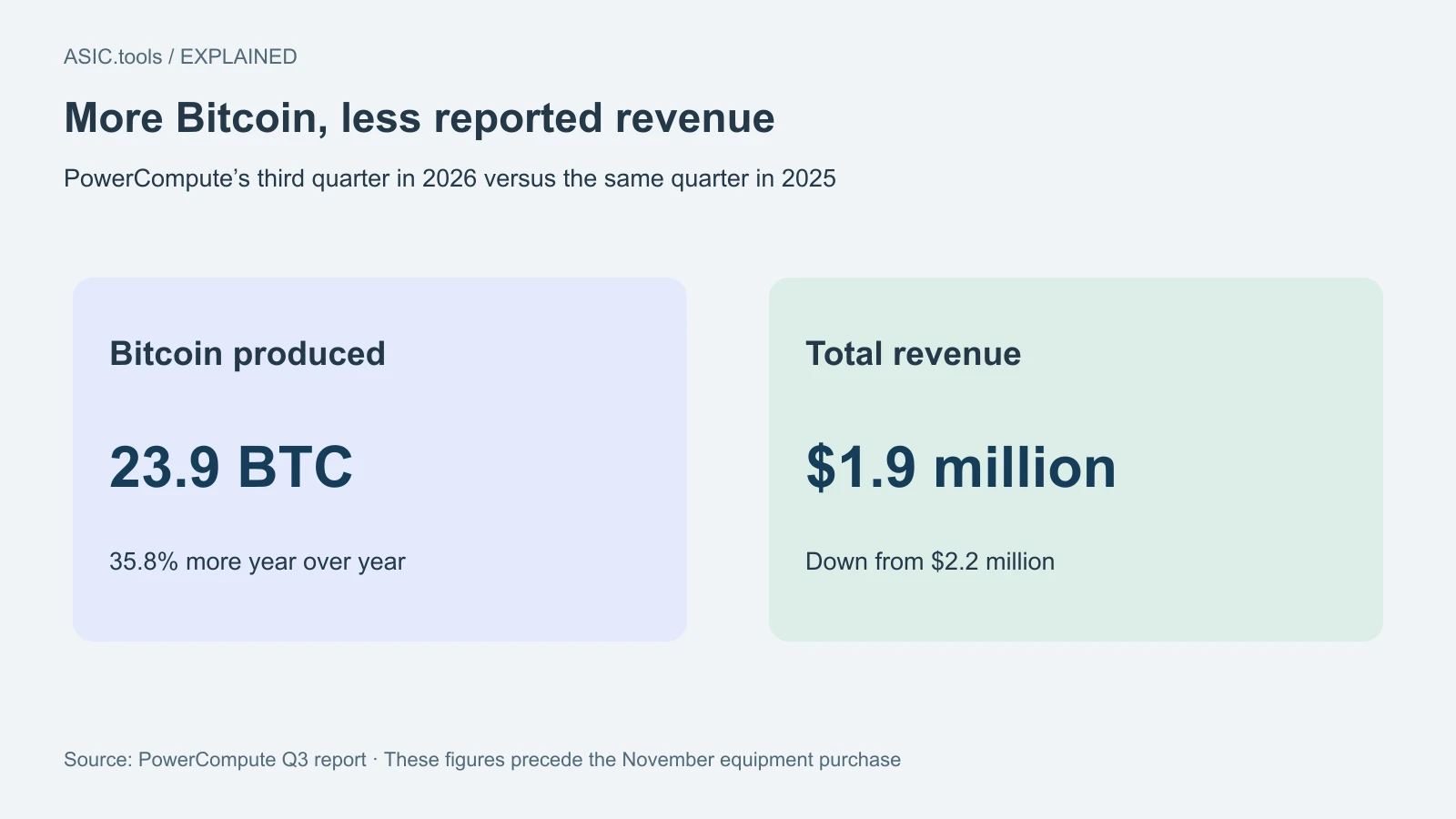
PowerCompute reported mining 23.9 BTC in the third quarter, up 35.8% from a year earlier, while total revenue fell from $2.2 million to $1.9 million. It said the average value of each bitcoin mined fell from about $114,200 to $71,400. Both can happen at once: the hardware produces more units of the coin, but each unit is worth less in the company’s reporting currency.
The company says its mining margin was 50.7%, compared with 29.0% in the preceding quarter. Its definition deducts mining costs and incorporates curtailment and energy sales. It reports a net blended power cost of about 2.4 US cents per kilowatt-hour and about $304,000 from curtailment and energy sales in the quarter. Curtailment means cutting consumption when a grid or contract calls for it. These site-level figures describe the company’s arrangements; they are not an available home tariff.
The energy figure is net of proceeds from managing demand and selling electricity. That accounting is useful for comparing the company’s own quarters. At home, keep your bill separate from any credit or compensation you actually receive. Adding a credit that does not apply to your contract makes even a well-measured power estimate misleading.
What to look for in December
Once the new machines are in service, the useful checks are how many of the 600 are online, what happens to active hashrate after the old ones are removed, and how long the machines stay online. A delivery date and an operating date measure different milestones. The quarter’s production and electricity figures are a baseline from before this purchase.
For anyone replacing a miner, the practical question is how much extra work the new device contributes after the old one is unplugged, and what that change costs at the meter. Start with both devices’ accepted work, draw and available hours. An upgrade that fits the existing electrical limit improves options; the next step is to measure the result rather than assume a proportional change in profit.
The company puts planned delivery in late November and deployment by mid-December. If it later reports a new active hashrate, compare the reporting date with those milestones. A fleet can ramp up in stages. The real test is the settled operating number after both the arrival and the old units’ removal.
At a smaller operation, make the comparison on a day when both settings are representative. Record the accepted hashrate and measured power before the change, then repeat after it. Keeping the dates and pool settings with each reading helps distinguish an equipment improvement from a different electricity or network environment.
Source: PowerCompute ↗ · SEC — PowerCompute earnings exhibit ↗
Mining calculator ↗