Classix pledges another year of Ethereum Classic client maintenance
Source report: 2026-11-12 · Editorial analysis published: 2026-11-13
The November 12 commitment follows the ETC Cooperative’s decision to wind down. Mining pools and node operators can check which software and public services their setups rely on.
What the commitment covers
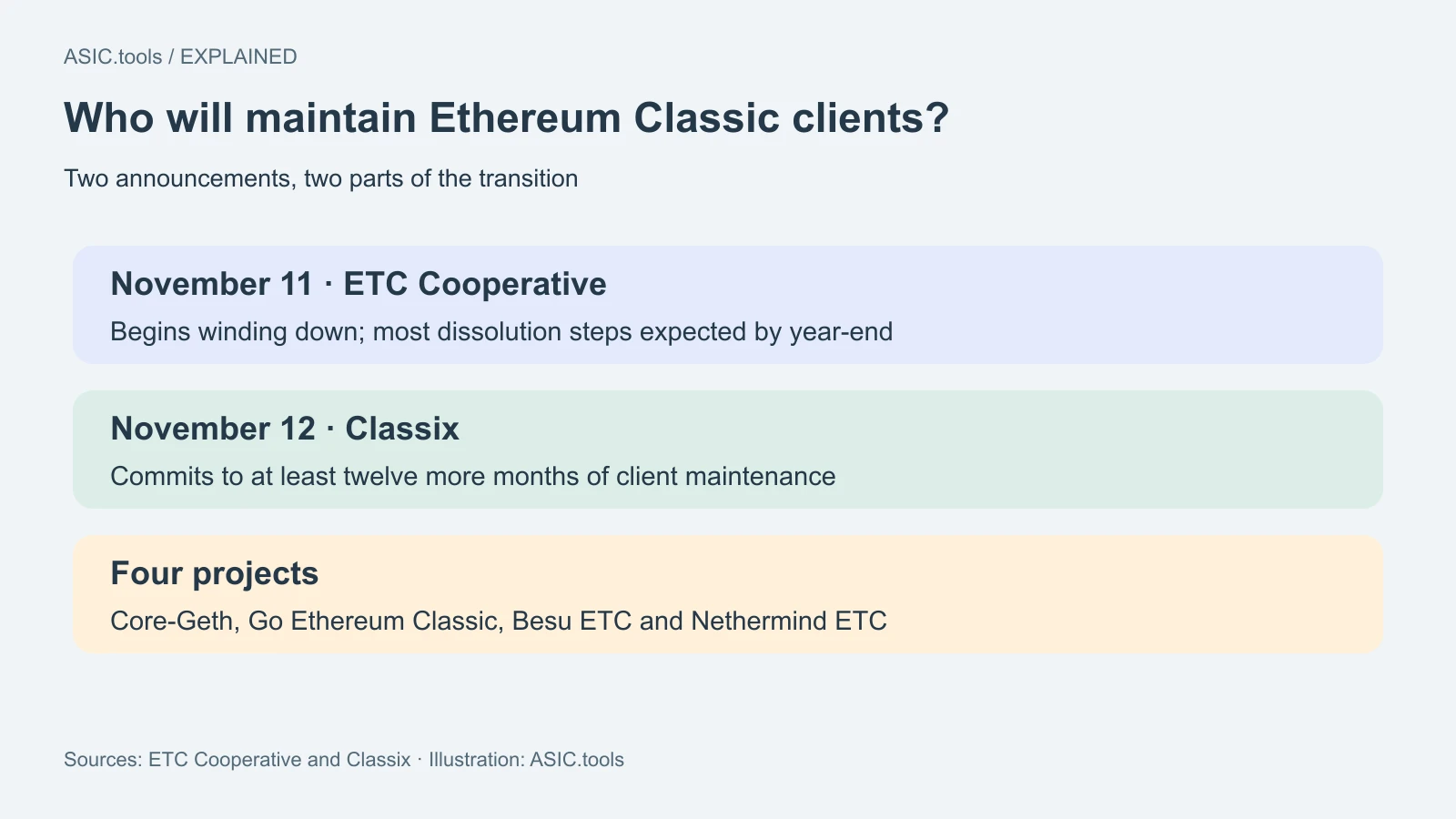
Classix said on November 12 that Diego López León would keep maintaining Ethereum Classic clients for at least another twelve months. The day before, the ETC Cooperative announced it had begun winding down and expected to complete most dissolution requirements by the end of 2026. For mining pools and people who run their own nodes, the two notices answer different questions: who plans to maintain the software, and what happens to services the Cooperative helped run.
A client is the software a node uses to talk to the Ethereum Classic network and check its blocks. Classix named four projects: Core-Geth, Go Ethereum Classic, the Besu ETC plugin and the Nethermind ETC plugin. A plugin adds the rules for this network to an existing client. The commitment is about maintaining those projects. It gives no date for a change in mining rules, and the Cooperative’s closure does not switch the blockchain off.
Where dependencies can break
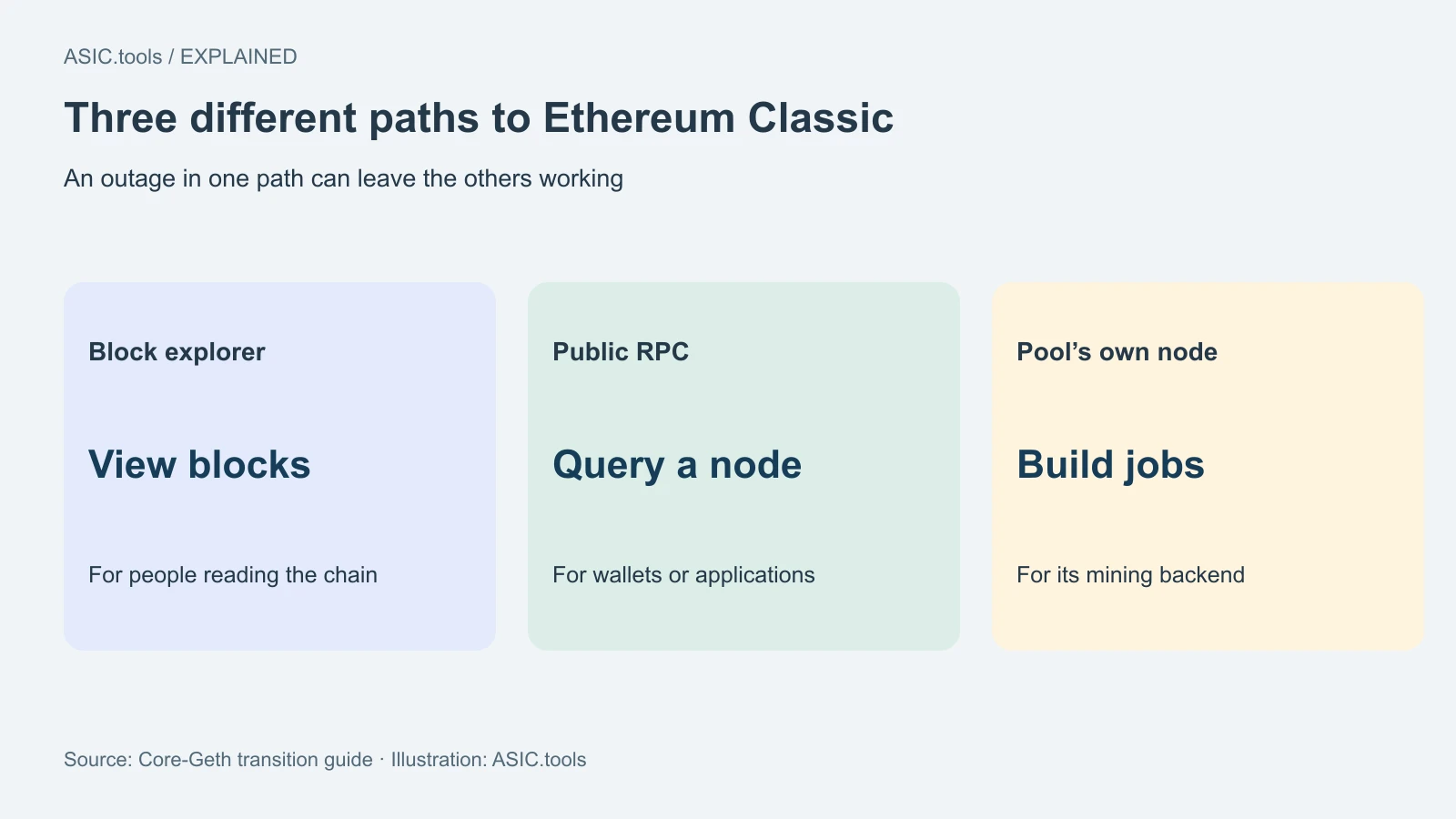
The Cooperative said it was arranging temporary continuity for public infrastructure it supported, including network nodes and the Blockscout explorer. The Core-Geth transition guide describes a separate move of software, peer discovery and other services into the ethereumclassic GitHub organization. It says the old public address etc.rivet.link stopped resolving in late August. That is a failure of one route to the network. It can leave a wallet or dashboard stuck even while blocks continue to arrive elsewhere.
An explorer displays blocks, transactions and confirmations. A public RPC endpoint lets an app ask someone else’s node for much of the same information. A mining pool may instead use its own node to build jobs and submit completed blocks. Check those paths separately: changing the explorer bookmark may fix what an operator can see while leaving an automated payout checker on the same dead address.
The same separation helps when talking to support. A working miner can still send accepted work while a wallet fails to load a balance. Conversely, a browser can show recent blocks from a different node while a particular pool is behind. When reporting a problem, say which service is out of date and whether your worker’s accepted work or payout records changed at the same time.
What to check on a pool or node
Start with the version and where it came from. The transition guide recommends the ethereumclassic/core-geth repository and lists v1.13.0, released on September 14, with its own peer discovery lists and starting peers. Classix also lists work on the earlier Core-Geth line in its history. The name alone is not enough to identify the package you installed; record the repository, version and any custom configuration before changing anything.
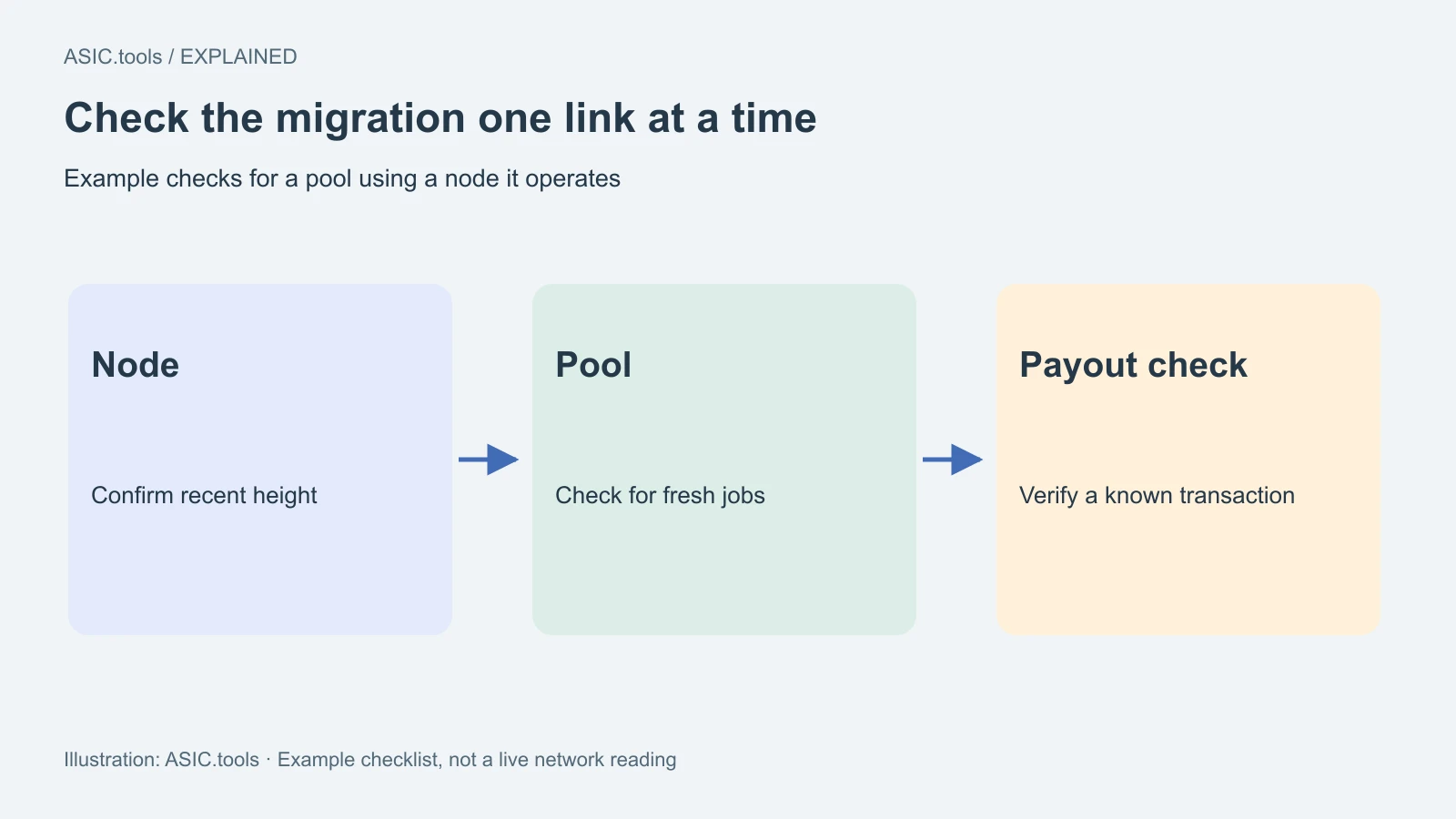
Next, follow a job through the system. Does the node see recent blocks and reach peers? Does the pool send fresh work as the chain advances? Does a payment monitor see confirmed transactions from the intended network? Compare the latest block height against another independent source. An old balance in a browser can come from the browser’s data source; a pool sending stale work is a different problem.
For an operator changing a node, a brief comparison of old and new setups is more useful than checking one successful connection. Compare their latest heights, then watch the pool issue work after the next block. If an application only reads balances, check a known transaction as well. Each test covers a different dependency that the migration could affect.
What changes for a home miner
If your ASIC connects to a commercial pool, the pool usually operates the node behind the scenes. Check whether it has issued instructions and whether accepted work and payments look normal. There is no reason to change a mining address solely because a nonprofit is closing. If you run a node yourself, the maintenance announcement makes it a good time to list the services you need and decide which ones to operate directly.
For a public dashboard, an independent fallback can help you tell the difference between a single endpoint outage and a wider problem. For systems that make mining or payment decisions, a node you control gives you a clearer way to check what the network actually accepted. The announcement gives maintainers time; it is useful now because operators can review those dependencies while the transition is still under way.
Source: Classix ↗ · ETC Cooperative — wind-down notice ↗ · Core-Geth — transition guide ↗ · Ethereum Classic — client and network roadmap ↗
Mining calculator ↗