Datavault cannot complete a Bitcoin withdrawal and will restate four reporting periods
Source report: 2026-10-26 · Editorial analysis published: 2026-10-28
An October 26 filing says BTC credited off-chain at Biconomy did not qualify as the company’s digital asset. The case shows why a custodial balance and completed withdrawal are different evidence.
A withdrawal request has remained unfinished since June
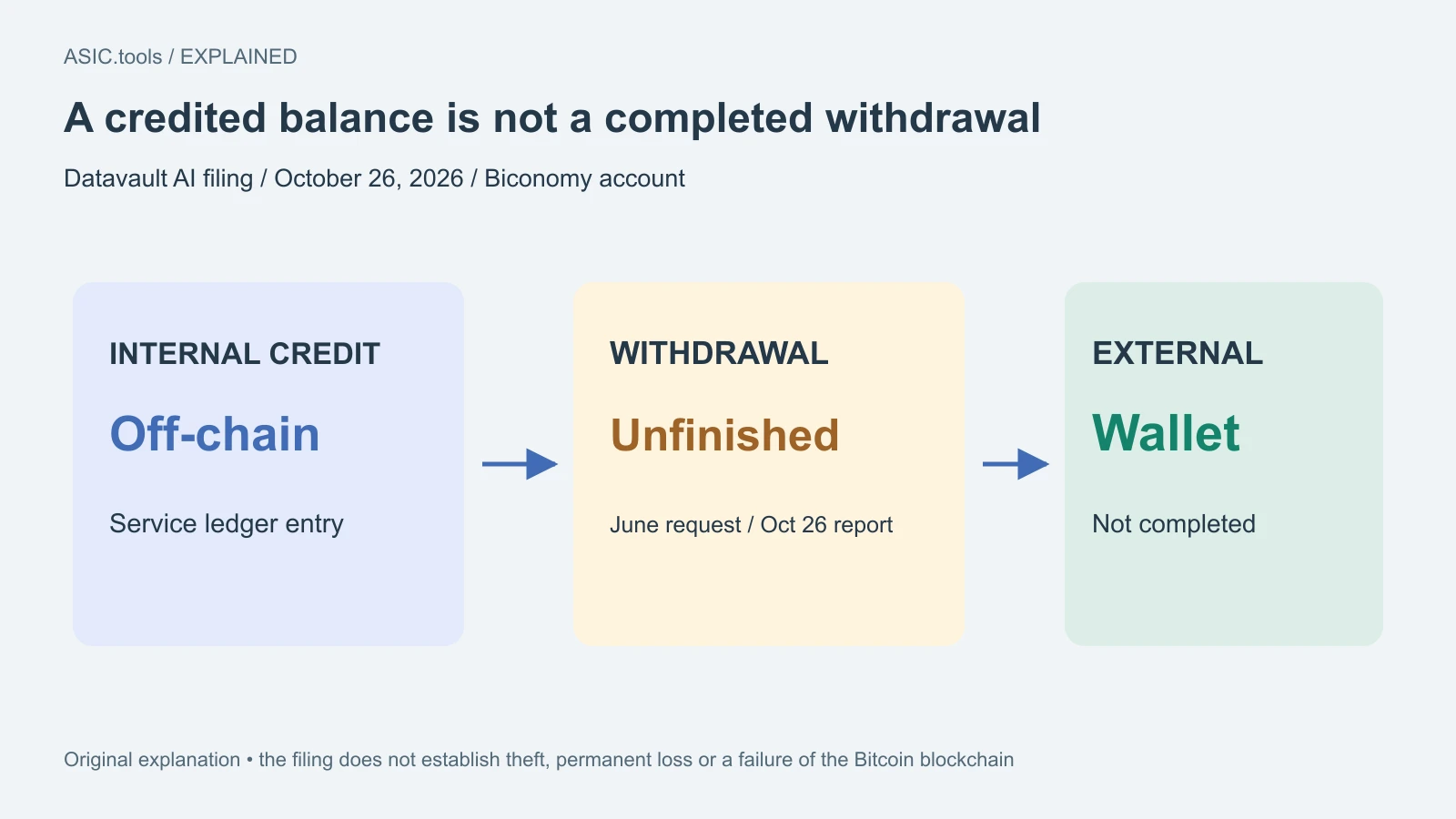
Datavault AI said in an October 26 regulatory filing that it had been unable to complete a Bitcoin withdrawal requested in June from an account maintained at BICONOMY PTE. LTD. to an external account. The company will restate four reporting periods after deciding that Bitcoin connected with a share subscription should not have been recognized as its digital asset. This is a newly disclosed accounting problem, not a withdrawal first requested this week.
The immediate relevance to mining is custody: where are coins after a payout, and what proves the owner can move them? Datavault is not identified in this report as a Bitcoin miner. Its experience concerns a company accepting BTC for securities, but the difference between a service’s account balance and an asset the recipient can withdraw also matters when mining proceeds accumulate with an intermediary.
How the Bitcoin entered the account
On September 25, 2025, Scilex agreed to buy 15 million Datavault common shares and a pre-funded warrant for 263,914,094 more shares. The $150 million consideration was payable in BTC, using a reference price of $112,915.52 per coin: approximately 1,328.43 BTC. These are historical transaction terms, not today’s Bitcoin price or a current valuation of the account.
Scilex credited 1,309.04 BTC through off-chain transfers on September 26 and November 25, 2025. The difference of 19.39 BTC reflected cash advances between signing and final closing. Between September 26, 2025 and January 30, 2026, Datavault sold 491.431 BTC shown in the account back to Scilex, also off-chain, for approximately $40.5 million in cash. A smaller credited balance and the original $150 million agreement are therefore different figures with different meanings.
An internal entry is different from a blockchain transfer
Off-chain means that a transfer is recorded outside the Bitcoin blockchain, for example in a service’s internal ledger. That can change the balance shown to a customer without creating a separate Bitcoin transaction to an address controlled by that customer. In this case, the filing specifically describes the credits and subsequent sales as off-chain; it separately identifies the attempted withdrawal to an external account.
The filing does not establish why that withdrawal could not be completed, announce a confirmed theft, or prove that the coins are permanently lost. It also supplies no completed withdrawal transaction that would resolve the issue. Describing the case as a failure of Bitcoin’s blockchain would confuse the network with access to an intermediary’s account. The disclosed problem is that Datavault could not finish moving BTC out of the account as of the filing date.
What changes in the financial statements
The audit committee and management reached their non-reliance conclusion on October 20. It covers the quarter ended September 30, 2025, the year ended December 31, 2025, and the quarters ended March 31 and June 30, 2026. Related presentations and earnings communications cannot be relied on to the extent they use the affected financial information. Readers checking an older claim about the company’s Bitcoin holdings should check which reporting period it came from.
Instead of recording the transaction as a digital asset, Datavault expects to recognize a subscription receivable from Scilex, presented as a reduction of shareholders’ equity. In plain language, a claim arising from the share purchase takes the place of the earlier asset treatment. Cash already received from the Bitcoin exchange transactions should reduce that receivable. This is the company’s preliminary accounting conclusion, rather than a final audited restatement.
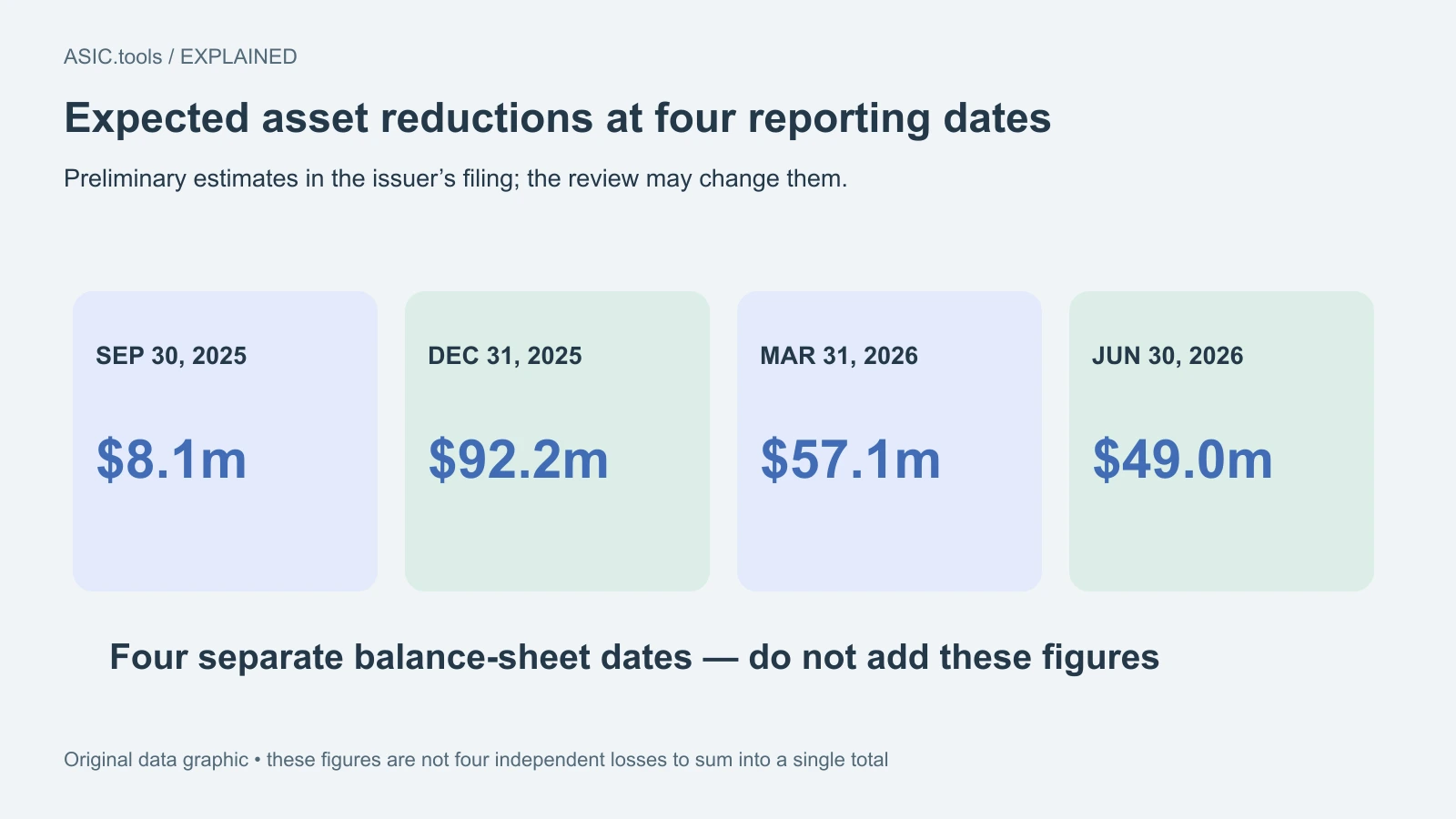
Expected reductions in total assets are $8.1 million at September 30, 2025; $92.2 million at December 31, 2025; $57.1 million at March 31, 2026; and $49.0 million at June 30, 2026. These are four balance-sheet dates, so adding them would double-count changes across time rather than calculate one loss. Associated crypto gains and losses are also expected to be reversed. The amounts may change as the review continues.
What a miner can take from this case
Management is reassessing liquidity and its going-concern evaluation because the BTC will no longer be presented as an asset and collection from Scilex is uncertain. A going-concern assessment asks whether a business can keep operating; a reassessment is not itself a declaration of bankruptcy. Datavault has not set a date for the corrected filings, and the October 26 report remains the latest item on the issuer’s filing list when checked October 28.
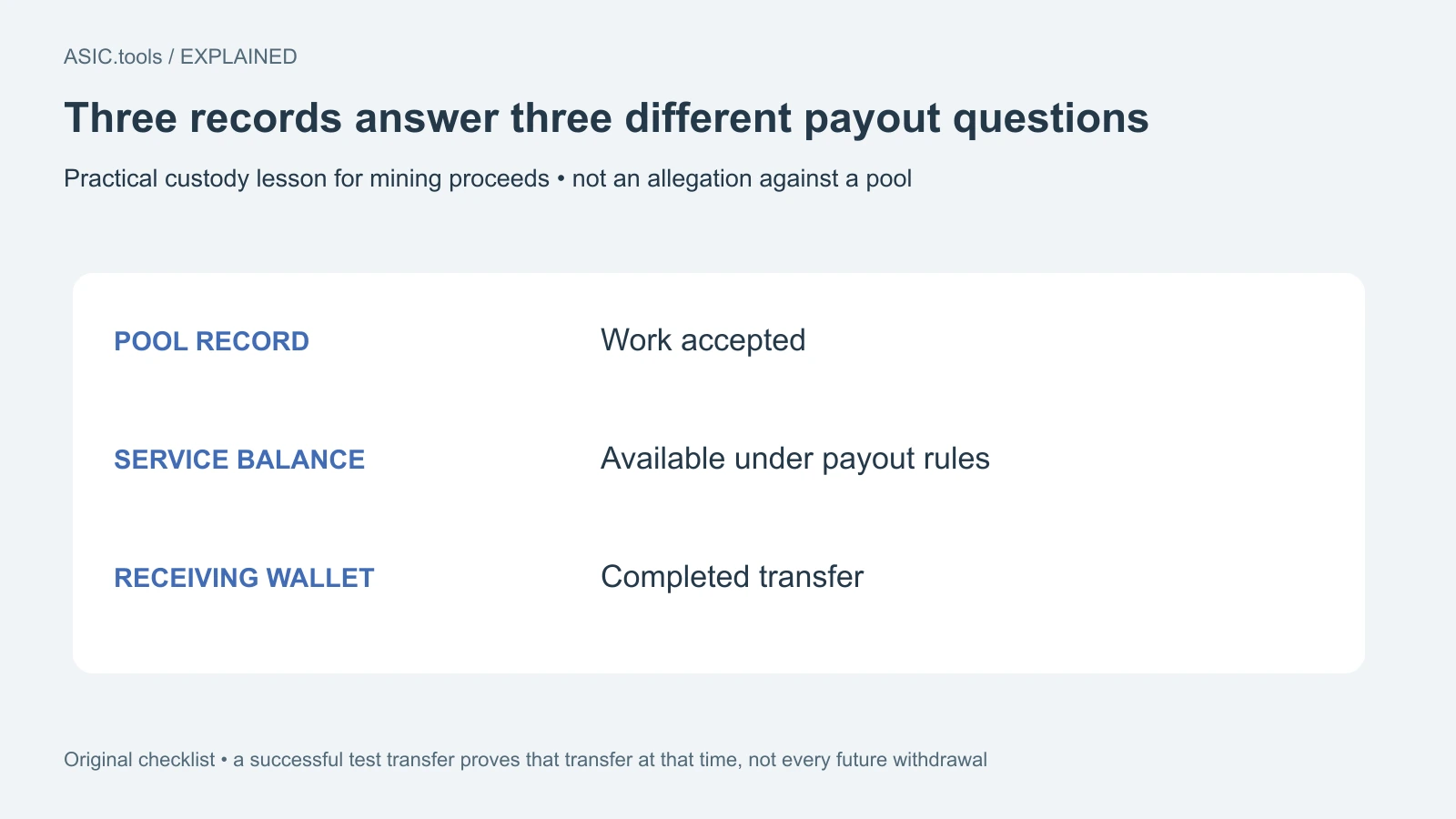
For mining proceeds, distinguish three records: work accepted by a pool, the balance available under that pool or service’s payout rules, and a completed transfer to the intended receiving wallet. They answer different questions. A withdrawal test can establish that a particular transfer worked at that time; it cannot guarantee all future withdrawals or remove the need to check the destination and network. This is a practical reading of the custody risk, not an allegation against any mining pool.
For a company advertising BTC reserves, the same distinction helps interpret a headline total. Look for how the coins were acquired, who holds the keys, what transfer evidence is available and whether the financial statements remain reliable. Here, the useful next evidence is a completed withdrawal or the promised corrected filings. Until then, repeating the old asset figure as spendable Bitcoin would overlook the company’s own warning.
Source: Datavault AI ↗ · Issuer filing list checked for subsequent disclosures ↗
Mining calculator ↗