Fortitude mined half as much Zcash, but the coins were worth more
Source report: 2026-11-16 · Editorial analysis published: 2026-11-16
Fortitude’s November 16 report shows how a Zcash fleet can grow, produce fewer coins and still generate more value: the network grew faster than the fleet while the coin price rose.
Fewer coins, higher production value
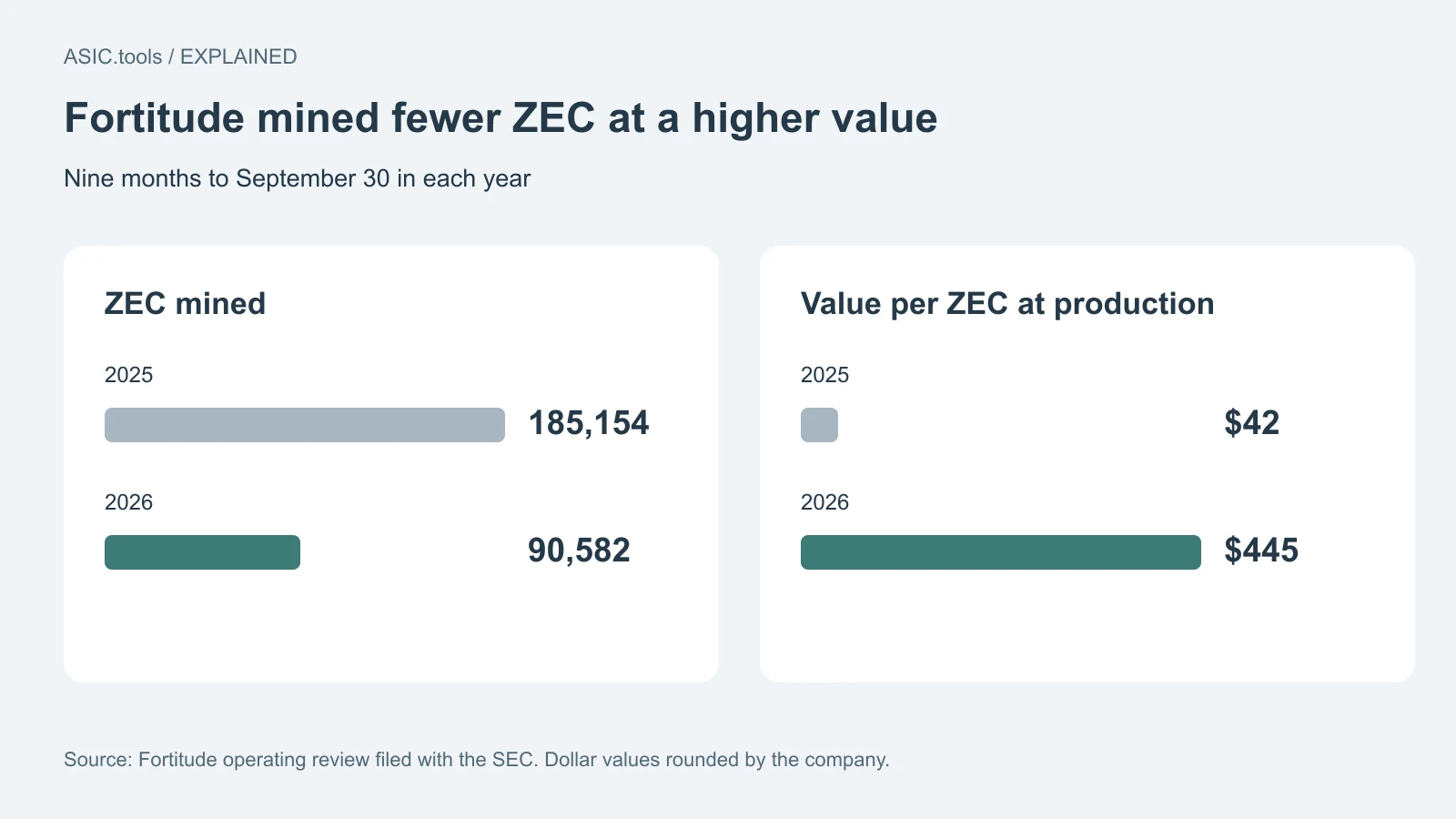
Fortitude Mining said on November 16 that it mined about 90,582 ZEC in the nine months to September 30, against 185,154 in the same period of 2025. Meanwhile, the value it assigned to each coin at production rose from about $42 to $445. A mining rig does not produce a fixed number of coins each day. Fortitude’s figures show why counting coins and tracking their dollar value tell different stories.
The company’s average deployed Zcash hashrate rose from 3.64 to 3.84 GSol/s. A gigasolution per second means one billion candidate solutions per second for Zcash’s mining algorithm. The company says competing hashrate and network difficulty grew faster than its fleet. It also cites a weather incident in July as one reason its share dropped. More work from your machines can still buy a smaller share of the network’s rewards.
What the price changed
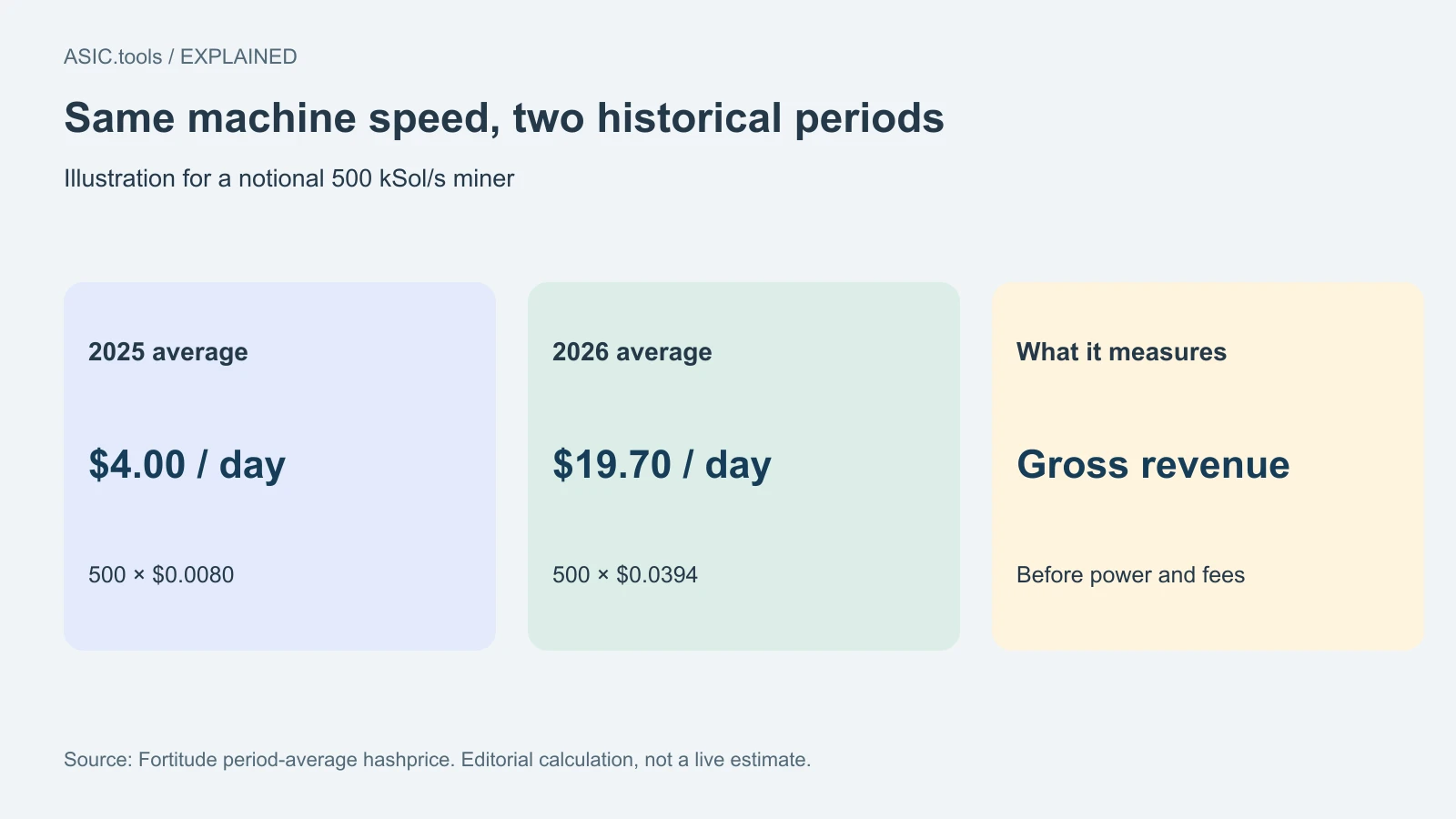
Fortitude reported an average Zcash hashprice of $0.0394 per kSol/s per day, compared with $0.0080 a year earlier. Hashprice is an estimate of the daily gross revenue from a given amount of computing power. It combines what the network is expected to pay with a coin price in dollars. Here the improvement came mainly from the higher ZEC price, according to the filing.
What a coin is worth when produced is also different from what the operator actually receives on sale. Fortitude gives an average selling price of $422 for the ZEC it mined and sold in the 2026 period, below its $445 production value per coin. Keeping those figures apart matters when you need real cash on a specific day to cover an electricity bill.
What the cost covers
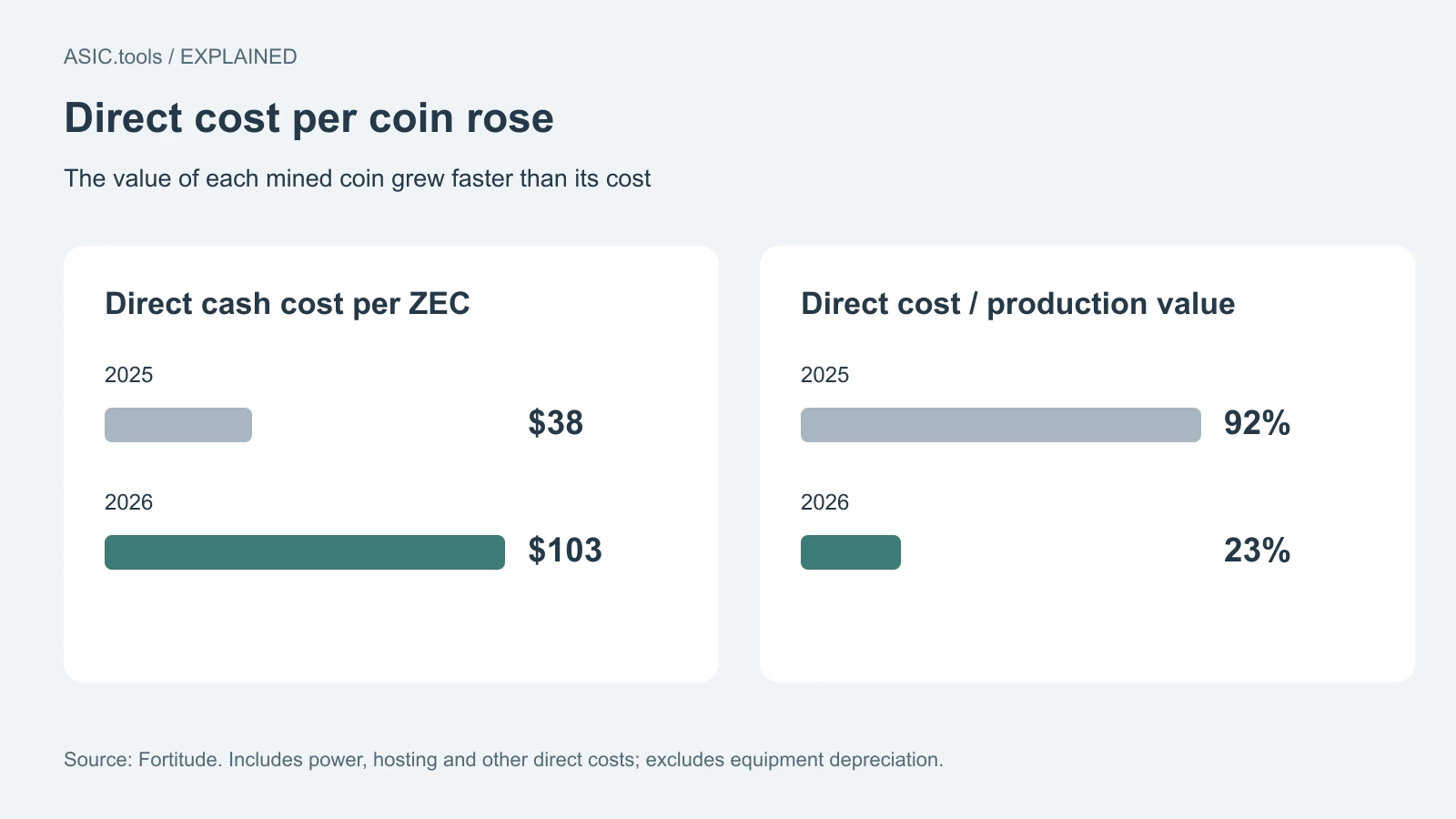
Fortitude’s direct cash cost rose from $38 to $103 per coin on the company’s rounded figures. The same report puts that cost at 23% of production value in 2026, against 92% in 2025, because value climbed faster. The comparison includes power, hosting and other direct spending but leaves out the cost of using up the equipment over time. The leftover share is therefore no measure of the company’s overall profit.
Watch the denominator as well. Running a stable fleet for a month while earning fewer coins can push up the electricity cost per coin even if your tariff stays exactly the same. If you run a hosted machine, the cost behind each coin can also include other charges from the host. Comparing only the quoted utility rate misses those costs, especially after a period with downtime.
Make it useful at home
The filing says Fortitude brought back some equipment that previously made too little to run. After the reporting period the company reported about 5.4 GSol/s deployed as it continued moving miners to its own sites. The later figure belongs to a different date; it cannot explain the production for all nine months or tell you how competitive a single machine is today.
For a home setup, start with coins actually credited by your pool over several weeks, then compare gross receipts at the price you could get and expenses at your own meter. Try a lower coin price and a share of rewards that shrinks as more miners join. Those are two separate changes. If only the best combination pays the bill, the fleet’s headline result will not fix that gap.
A quick check on the scale of the change
The company’s hashprice figures are per kSol/s, or one thousand attempts per second. For an illustrative machine averaging 500 kSol/s, the reported period averages would correspond to about $4 and $19.70 in gross daily revenue, respectively, before power and fees. The example compares historical conditions at the same machine speed; neither amount describes what a miner can earn today.
A useful test for an older rig is to calculate the price it can afford to pay for power. Divide daily gross receipts after pool fees by the electricity it uses in a day. That gives a power-only threshold. Leave room below it for everything else you pay for, including repairs and the purchase cost. A revival of older equipment can make sense for a large operator and still be uneconomic on someone else’s tariff.
Source: Fortitude Mining ↗ · Fortitude operating review filed with the SEC ↗
Mining calculator ↗