Core Scientific’s mining covered electricity but lost $7.49 million at the gross level
Source report: 2026-11-05 · Editorial analysis published: 2026-11-06
The November 5 filing puts third-quarter self-mining revenue at $12.26 million and power fees at $10.48 million. Equipment depreciation and other costs explain why the electricity margin was not enough.
A positive power spread did not cover the whole operation
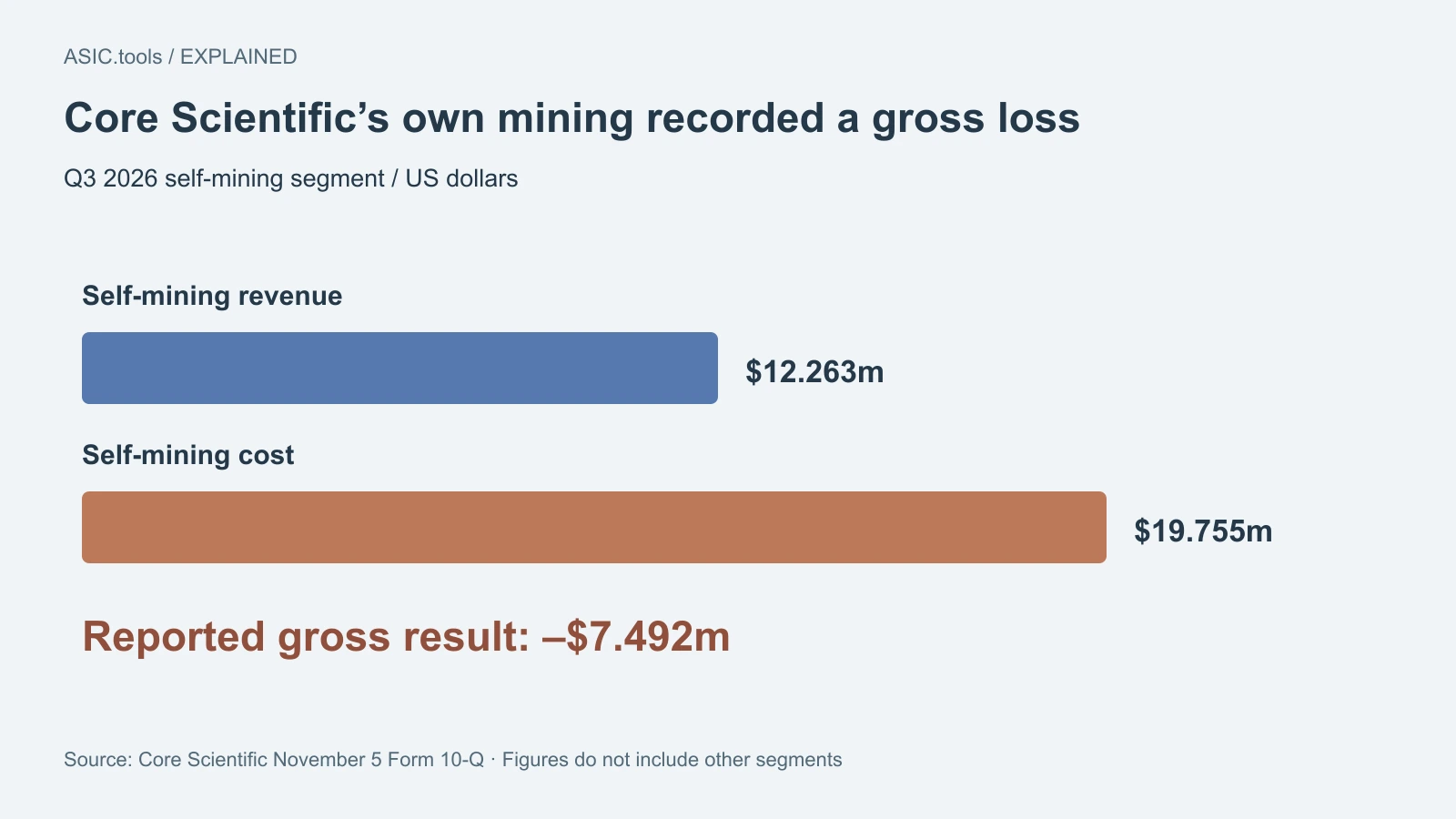
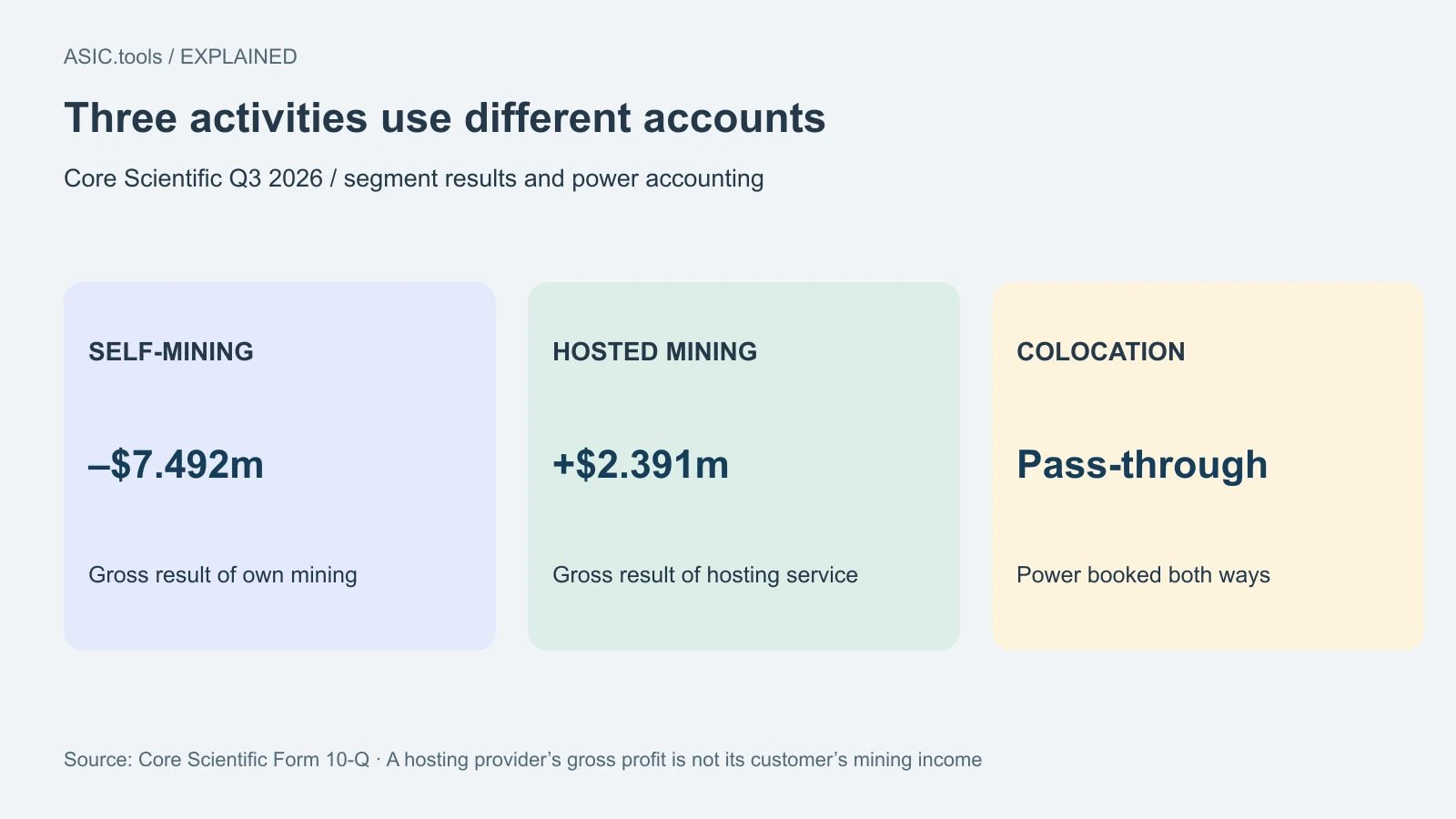
Core Scientific reported a $7.492 million gross loss from its own bitcoin mining for the third quarter in a filing dated November 5. The segment earned $12.263 million against $10.483 million in power fees. Subtract electricity alone and it looks $1.780 million ahead. The rest of the same table explains how that small surplus turned into a much larger loss.
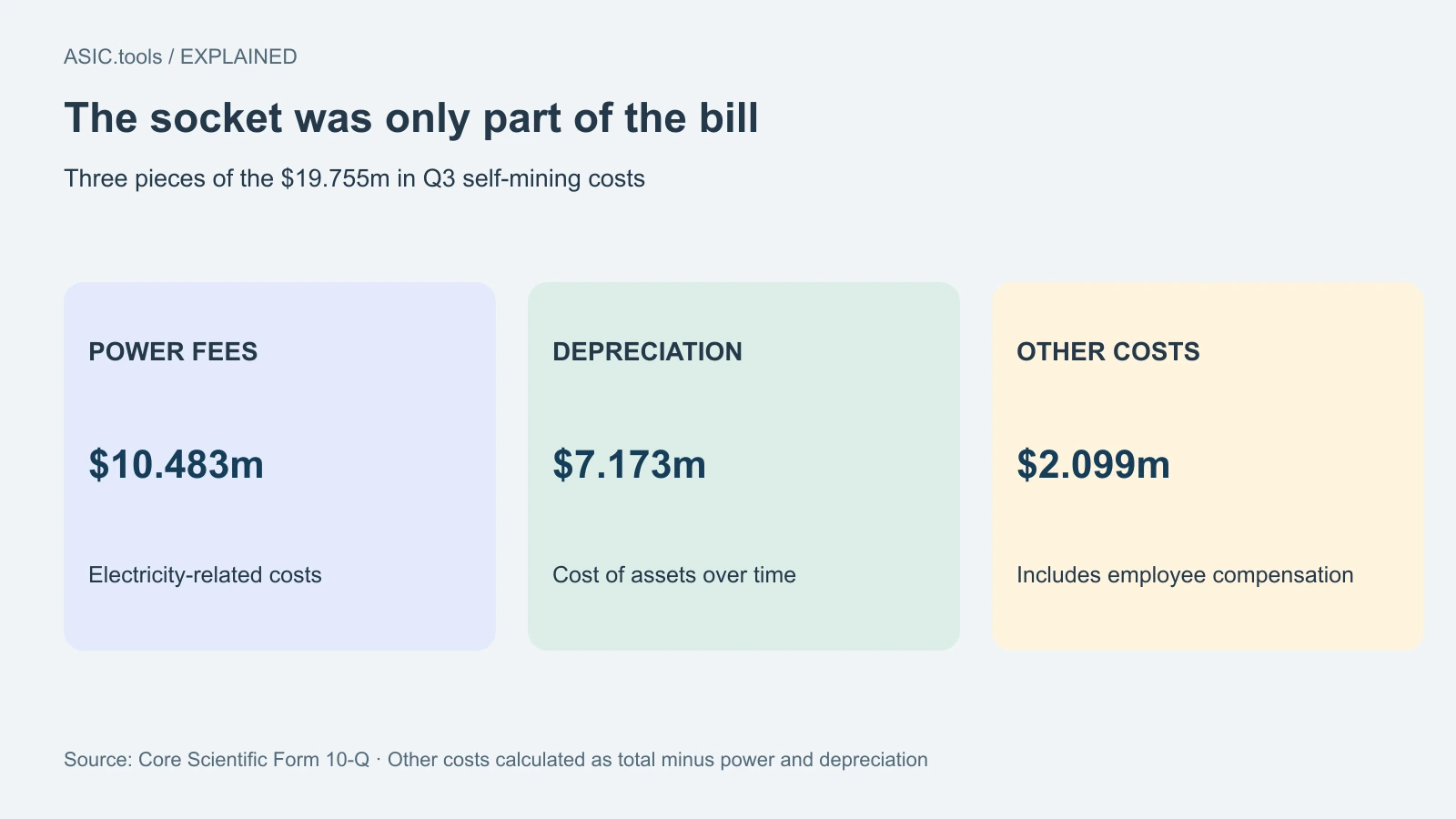
Self-mining means the company runs its own machines and is paid through mining pools for the work it contributes. Gross result here means the segment's revenue minus the costs assigned to providing that service. It is useful for seeing what the operation earned on its own, before company-wide items. The filing records $19.755 million in self-mining costs, so revenue minus that total is negative.
The numbers refer to the July–September quarter, not the cost of running a miner on November 5. The report is useful to a smaller operator because the same accounting mistake travels well: the margin after electricity can look positive even when the budget cannot cover repairs, staffing or the value consumed in the equipment.
The costs that sit behind the socket
The filing separates $7.173 million of depreciation from the power bill. Depreciation spreads the cost of equipment and other assets over their useful lives rather than treating the purchase as a charge each time a miner runs. It is not a fresh cash payment that quarter, but the cost matters if the business needs money for eventual replacement.
Subtracting depreciation from the reported cost total leaves $12.582 million in other reported costs, including electricity. That is still $319,000 above segment revenue. This subtraction is an illustration using the filing, not a cash-flow statement: payment timing and other accounting items can change when cash actually moves.
Employee compensation was $1.255 million; other segment costs made up the rest of the difference after electricity and depreciation. A home operator may not pay a staff wage, but the equivalent exercise is to list the actual costs of keeping a worker online: ventilation, replacement fans, downtime and the portion of the purchase you want it to earn back. This is more useful than copying a public company's percentage into a household budget.
Fewer coins and lower prices were two separate pressures
In the same quarter of 2025 the company's self-mining revenue was $57.438 million and the gross loss was $2 million. For the latest quarter the company says it mined 66% less bitcoin and saw a 38% lower average bitcoin price than a year earlier. It also describes moving power capacity from mining to its data center business. The two percentages measure different things; adding them would not give the change in dollar revenue.
Power fees did fall, from $33.280 million to $10.483 million. A lower bill alone does not identify a cheaper tariff: it can reflect fewer machines or hours as well as a change in price. The filing attributes lower costs in part to less mining and lower power consumption after capacity was reallocated. The figures do not give a household electricity rate or tell us how many machines will come onto the used market.
The company says its focus is to get cash from its remaining fleet during the transition, without buying new mining machines to hold or expand its hashrate. That describes one operator's capital plans. A global change in mining difficulty takes work from the whole network into account, so this filing alone cannot tell a small miner that competition is about to ease.
Hosting and colocation have different accounts
The same report gives hosted mining a gross profit of $2.391 million on revenue of $5.171 million. In hosted mining, the operator provides facilities for customers' mining hardware. Its margin is the host's result and says nothing by itself about what a customer earns from the bitcoin credited to their account.
The other large business is colocation: licensing data center space, power and services for high-performance workloads. The company says the relevant colocation power charges are passed through without a markup and booked both as revenue and expense. That treatment is different from the way the mining operations bear their power costs. Mixing the segments can hide the exposure of the remaining ASICs behind revenue from a different customer contract.
For a mining budget the report suggests a useful order: estimate the coins earned, value them on a consistent basis, subtract metered power and recurring costs, then see what is left to recover the purchase. If the margin is thin before those last steps, a positive number on an electricity-only dashboard says very little about whether another machine will pay for itself.
Try the same check on one machine
Take an illustrative 3 kW ASIC that actually mines for 20 hours in a day. At $0.08 per kilowatt-hour, 60 kWh costs $4.80 before any separately metered fan or network load. If the pool credits $6 of gross earnings for those hours, the $1.20 left is the power-only margin. Neither the electricity rate nor the earnings in this example comes from Core Scientific.
If those conditions repeated for 30 days, $36 would be left after power. A $300 purchase you want to recover evenly over 12 months would need $25 of that monthly margin. The remaining $11 would have to absorb other costs. A repair or a day offline can change the result without any new difficulty adjustment.
Keep the replacement reserve and the original purchase in one consistent account. For a decision about running a machine already paid for today, focus first on the costs you can avoid by switching it off. For buying another one, include the purchase and the time you expect it to work. The company filing shows why those are two different decisions. Keep an unknown cost visible rather than recording it as zero.
Source: Core Scientific / SEC ↗ · Issuer copy of the quarterly filing and segment tables ↗
Mining calculator ↗