Zebra Ándale tests faster Zcash mining work: the 9.6× figure is a node benchmark
Source report: 2026-10-31 · Editorial analysis published: 2026-10-31
The Foundation’s October 31 announcement introduces 7.1.0-alpha.0 for testing. It reduces waits before pools receive new work and improves block handling; the published benchmark is not a 9.6× increase in ASIC hashrate.
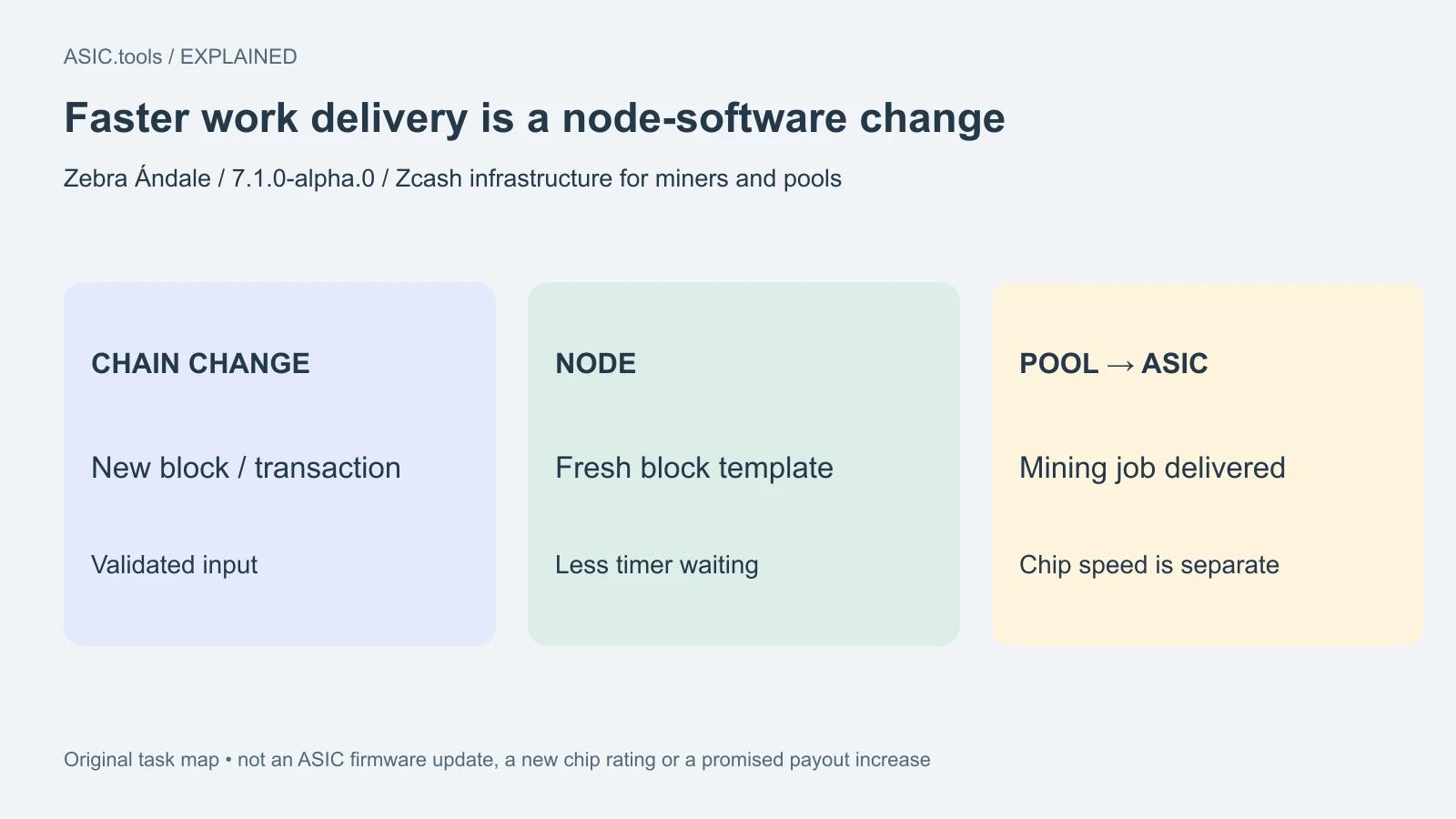
A faster handoff of work, not a faster chip
Zcash Foundation introduced Zebra Ándale on October 31, presenting version 7.1.0-alpha.0 as a test release for miners, pools and node operators. The change targets waiting between transactions arriving, a node preparing work and a solved block reaching the network. Someone running a Zcash ASIC benefits through that supporting infrastructure; installing the node software does not change the chip’s hashing speed.
A node checks the blockchain and gives a pool a block template: a proposed block body the mining equipment can work on. The pool then distributes jobs to its connected machines. If that handoff is delayed, fast hardware can still receive old work. Ándale focuses on shortening those software waits while keeping validation rules, rather than promising an electricity saving or a fixed increase in payouts.
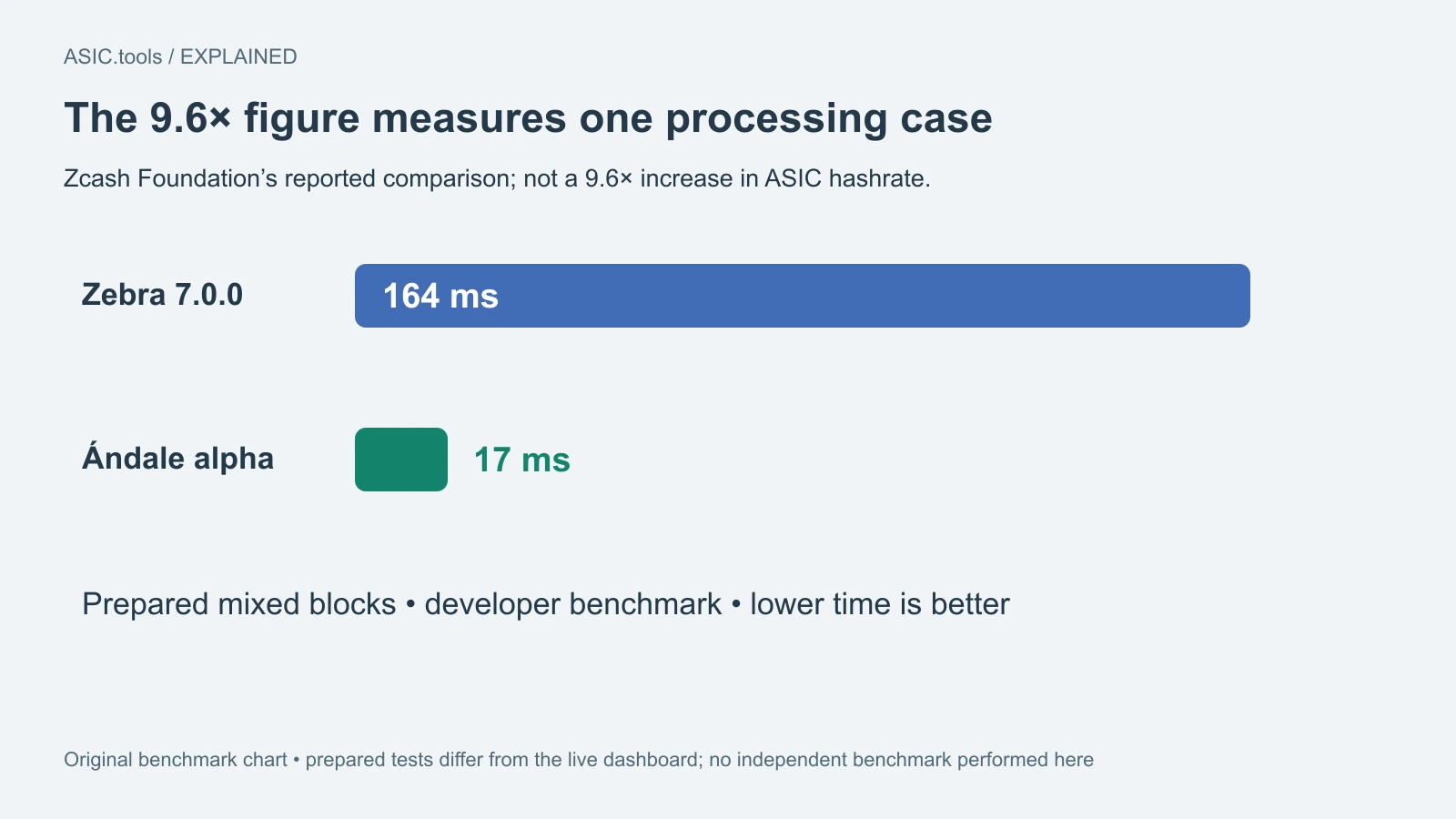
Read the benchmark with its test conditions
The Foundation reports 17 milliseconds against 164 milliseconds for prepared mixed blocks compared with Zebra 7.0.0, describing this as 9.6 times faster. A millisecond is one thousandth of a second. This is a specific node-processing measurement made by the developer, not a measurement of ASIC hashrate, the whole mining cycle or every production pool. This site has not independently benchmarked the software.
The Foundation also distinguishes its prepared tests from its live comparison dashboard. The dashboard sends the same new Mainnet block to the compared nodes with no peers and empty transaction pools. That setup answers a different question from a prepared mixed-block test. Different numbers on the dashboard are therefore not automatically a contradiction, and neither number alone establishes a miner’s eventual revenue.
Where the release removes waiting
In 7.0.0, verified transactions and template rebuilding could wait on separate five-second timers. The alpha reacts to verified transaction changes, limiting rapid rebuilds to roughly once a second or the time a build takes, whichever is longer. New chain tips trigger rebuilding immediately. The useful distinction is responsiveness to a new situation, not a claim that every block contains more fee income.
A solved block whose body matches a proposal the node already validated can reuse that earlier work. Proof of work, time and the current chain state still get checked. Faster handling does not mean the node simply accepts an unchecked block. Pool operators should measure the submission result and relay time together with the template delay to see which part matters in their own setup.
Pool integration also needs checking. The release adds older JSON-RPC batch compatibility and optional ZMQ block notifications; these are ways for pool software to ask the node for information and receive updates. ZMQ is not included in the published binaries or Docker images and needs a build with that feature. Seeing a feature in release notes is not enough to know it is enabled in a particular package.
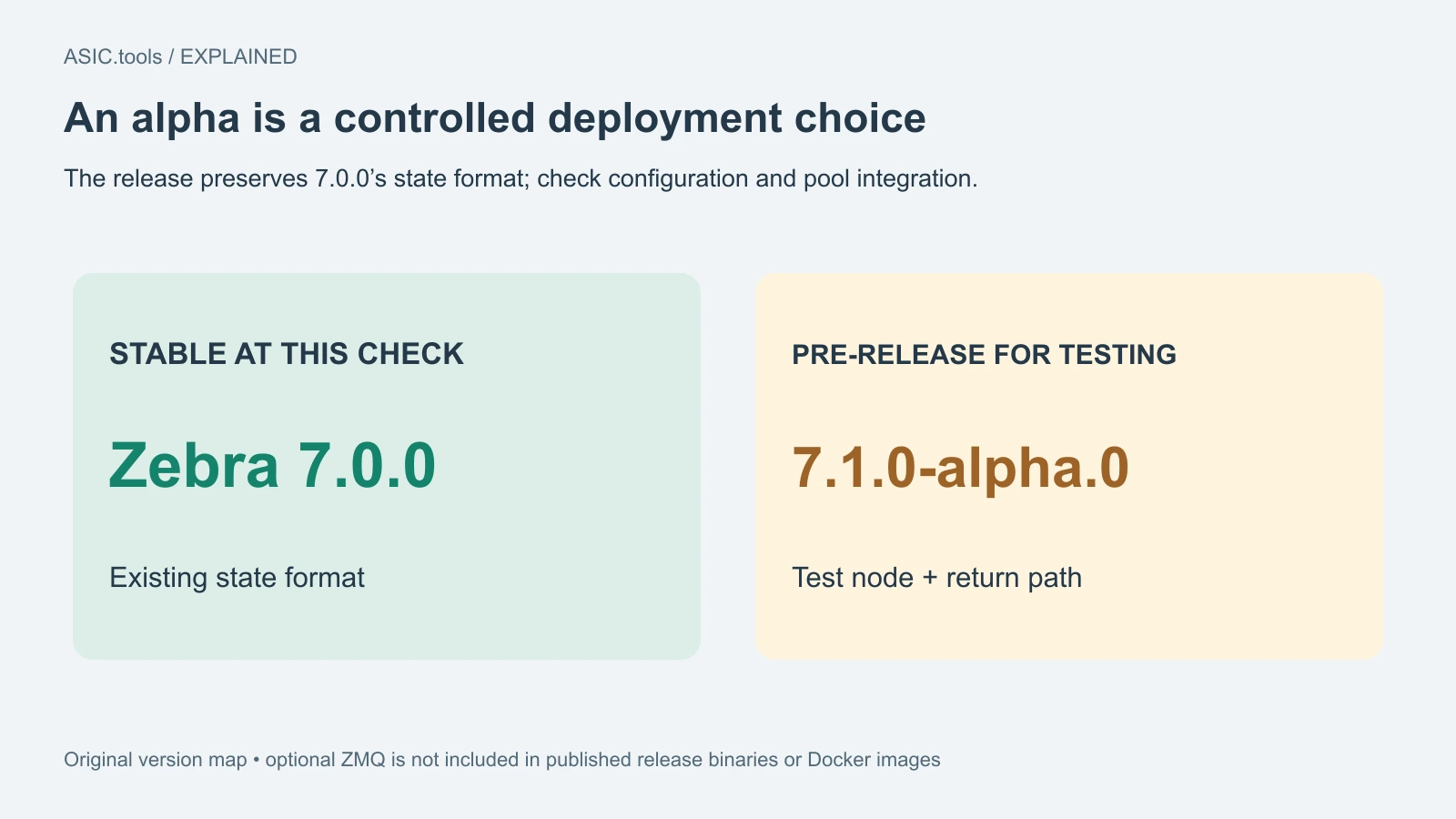
Treat the alpha as a controlled test
GitHub marks this release as a pre-release, published October 30 at 23:10:13 UTC, already October 31 in Kyiv. The Foundation’s explanatory article is dated October 31. The stable latest-release endpoint still points to 7.0.0 in this check. The alpha keeps 7.0.0’s state format, so the developer says it can be switched back without a blockchain resync.
Use a test node with a documented route back to the stable setup, and check the release’s stricter configuration validation before starting it. The developer rates mining-pool and solo-miner testing as medium priority; ordinary node operators can remain on 7.0.0. Documentation on the next branch follows ongoing development, so compare it with the tagged release rather than assuming every later page describes this exact alpha.
What to check before calling the change useful
Record the old version, package, configuration and observation period. On a comparable test, follow time to a fresh template, block submission outcomes and network announcement latency. These are the metrics the release is designed to improve. A short successful startup or one fast response does not show how the node behaves under a pool’s normal load or during a reconnect.
For an ASIC owner using someone else’s pool, this is primarily a question for that pool’s operators: which node and integration are they using, and how do they evaluate a change? It is not a reason to flash unrelated firmware onto a miner. Equipment uptime, accepted pool work and the pool’s payment method remain separate from the node’s processing benchmark.
The practical gain to look for is less avoidable waiting between the chain and useful mining work. Judge that with the same workload and time window before and after the test. Keep the developer’s benchmark attached to its conditions, and use actual pool records for any claim about income. That turns an impressive speed headline into an operational question a miner can verify.
Source: Zcash Foundation ↗ · Alpha release and operational notes ↗ · Mining pool guide for the next branch ↗
Mining calculator ↗