Zebra 7.2 beta tests faster Zcash mining work; production nodes stay on 7.1
Source report: 2026-11-18 · Editorial analysis published: 2026-11-19
The November 18 prerelease serves templates before a background proposal check and enables compact relay with compatible peers. Its new storage and fee behavior make a separate test node important.
A test release for the node behind the pool
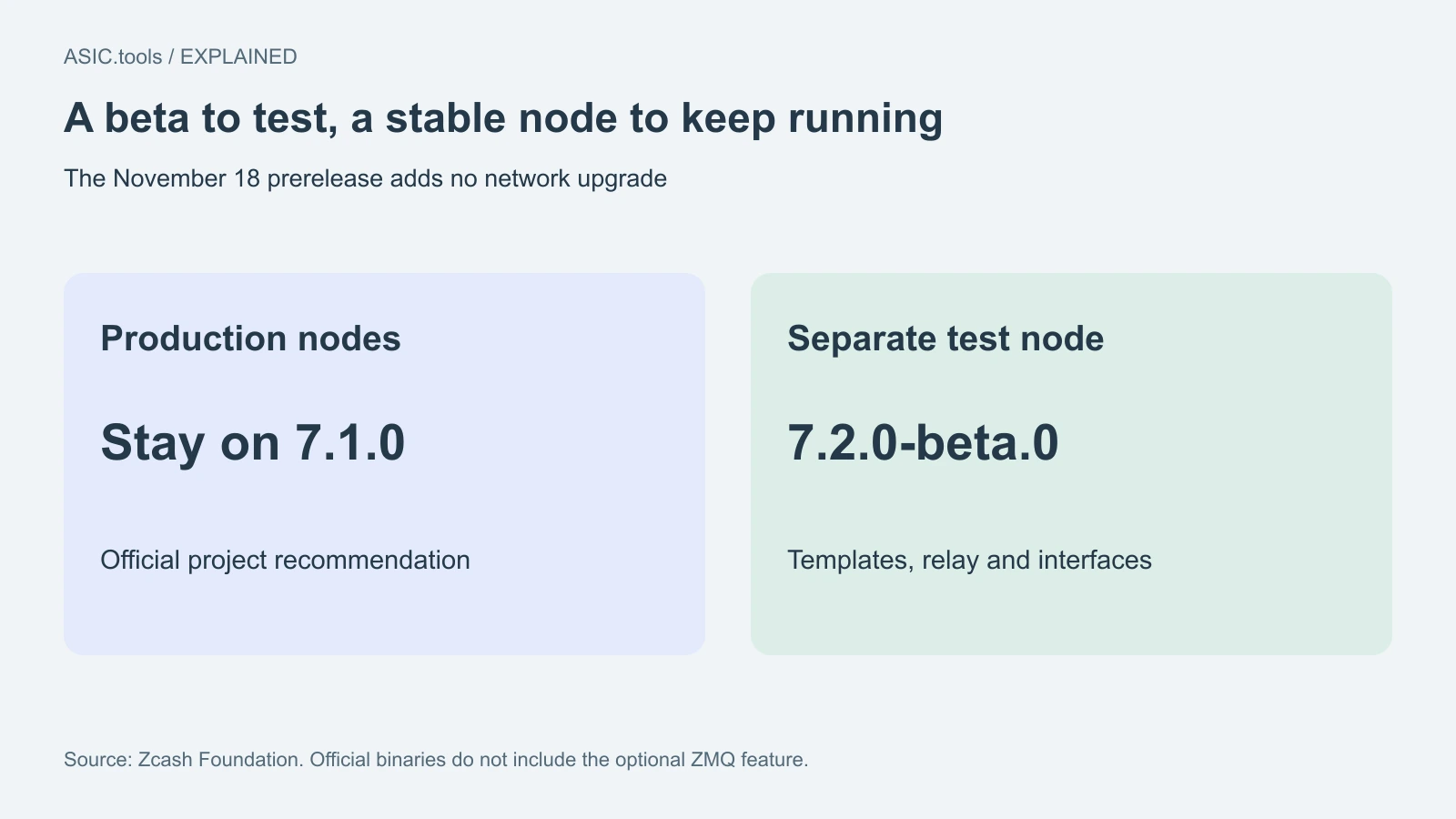
The Zcash Foundation published Zebra 7.2.0-beta.0 on November 18, with changes aimed at getting fresh work to miners sooner and moving blocks between peers more efficiently. The project explicitly reserves it for testing and tells production operators to stay on 7.1.0. This is a new experimental node release, separate from the stable security update already reported, rather than another mandatory network upgrade.
Zebra is full-node software: it checks the chain and can supply the proposed block contents used by a pool or solo-mining service. The ASIC performs the hashing, while the node helps determine which work the service sends. Changes in that path can affect how promptly miners receive new work without changing their rated hashrate. A miner using somebody else’s pool normally relies on the operator to maintain this backend.
Work is sent before the proposal check finishes
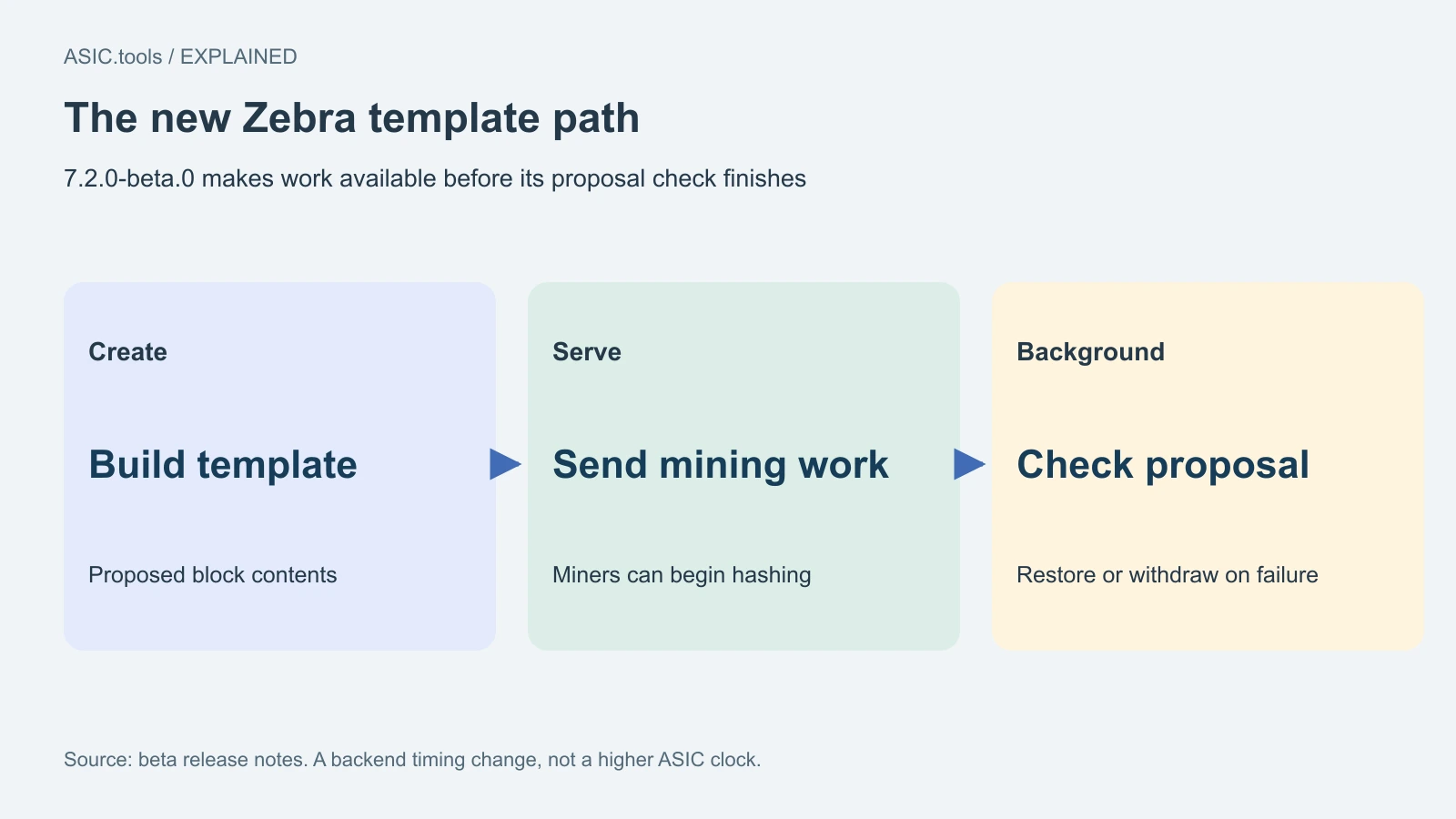
In this beta, Zebra serves a block template as soon as it is built, then checks it as a block proposal in the background. A template is the proposed contents on which miners start searching for a valid block. If the background check fails, Zebra restores valid work for that parent block or withdraws the work. The release therefore changes when work is made available and how a failed check is handled.
Early work containing only the coinbase transaction after a newly received block now expires after one second instead of thirty. Coinbase here means the special transaction paying the block reward, not the exchange. This is a work-lifetime rule, not a claim of thirtyfold income or a higher ASIC speed. A useful pool test follows the sequence of templates, replacement work and submissions around a newly arriving block, rather than measuring only the miner’s local speed.
Compact relay uses what a peer already knows
Compact block relay is enabled by default with peers that negotiate support. Instead of always sending every transaction in full, compatible nodes can reconstruct a block using transactions already in their local waiting list, the mempool. The release retains missing-transaction recovery and a full-block fallback; peers without the negotiated support continue to use full blocks. This is an exchange between nodes, not a new job protocol for the ASIC itself.
For operators, the practical observation is whether block arrival and replacement work behave correctly with the actual mix of peers. Faster delivery can be useful, but the release provides no universal earnings percentage. The beta also carries mining metrics and other earlier experimental work, allowing a test environment to observe behavior rather than relying on a feature name alone. The relevant result is a functioning path from a valid chain tip to usable mining work.
Storage options change the return path
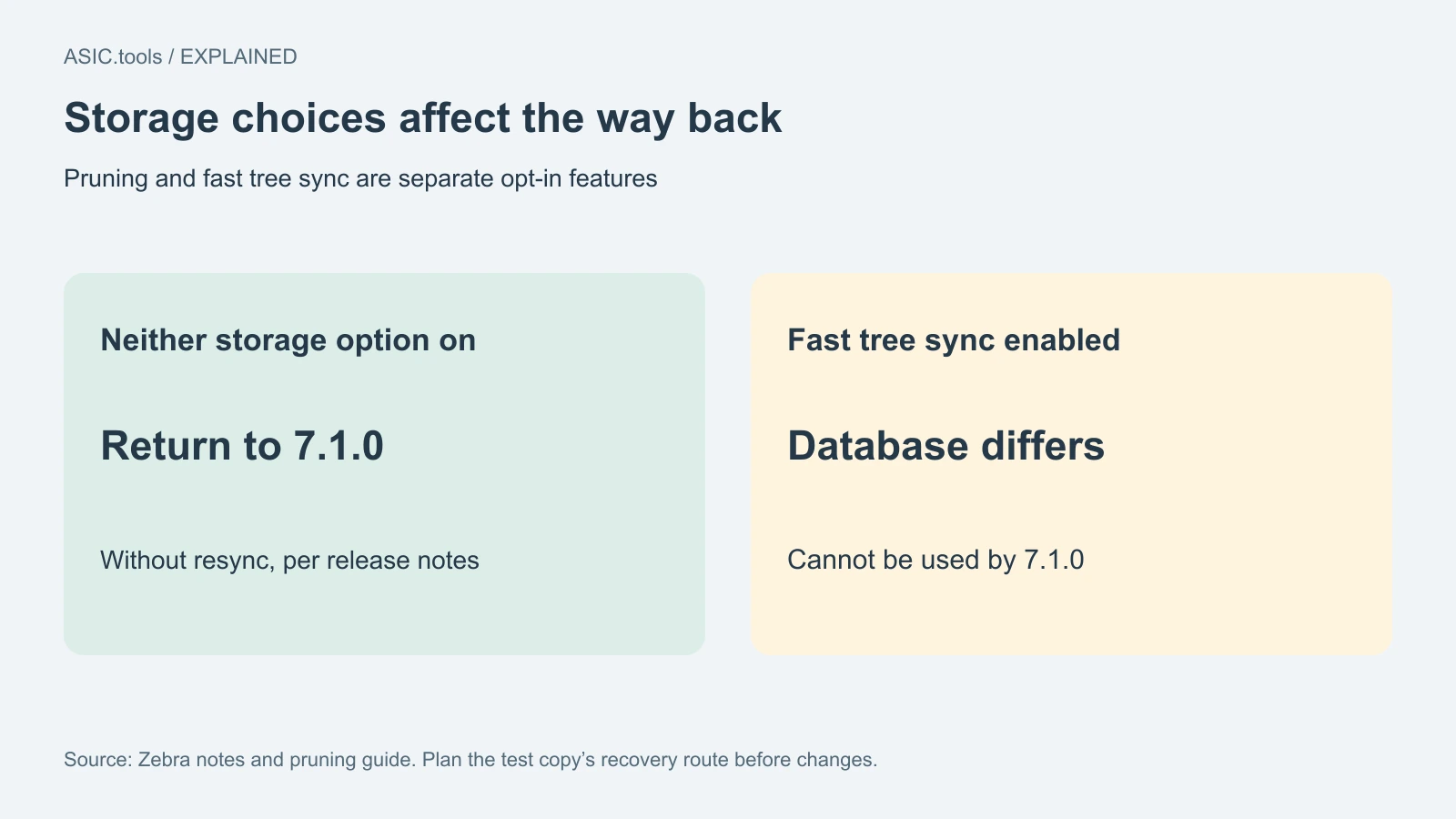
The beta updates the state format from 29.0.0 to 29.2.0. The project says a node that enables neither pruning nor fast tree sync can return to 7.1.0 without resynchronizing. Pruning means retaining only recent block bodies; it is an opt-in feature, and the guide requires an existing archive to be moved manually while the node is stopped. It should not be interpreted as the update automatically shrinking every existing database.
Fast tree sync is a separate opt-in setting. It obtains note-commitment tree roots from peers at three distinct IP addresses during checkpoint synchronization. Those trees are part of the state used for shielded transactions. A database produced by fast tree sync cannot be used by 7.1.0. Keeping the options separate explains why the general return-to-7.1 statement has conditions and why a test copy needs a planned recovery route before changing its storage behavior.
Fees follow a block height, not a calendar reminder
The beta applies the ZIP 2009 fee policy: before the next-block height reaches 3,590,000 on Mainnet, it requires the original ZIP 317 fees. Transactions using the reduced 1,000-zatoshi fee per logical action, already accepted by 7.1.0, are not relayed or mined by this beta until that height. A logical action is the policy’s unit for counting transaction work, not necessarily one payment or one user-visible transfer.
The notes expected that height around November 19. A calendar estimate is not confirmation of the current chain height, so an operator testing a transaction service must check the network and block condition in use. Public Testnet has its own height, 4,465,026. These fee rules concern transactions entering the node’s relay and mining path; they do not announce a change to a pool’s percentage commission or to the ASIC’s electrical consumption.
Test the interface the pool actually uses
Some features require a specific build or configuration. The release’s binary packages and Docker images are built without the ZMQ feature and refuse to start with `notify.zmqpubhashblock` configured; using those notifications requires a source build with that feature. ZMQ is a notification channel used by connected software. An operator expecting it should verify the running build, rather than assuming every item in the feature list is enabled in every downloaded package.
The release also changes example deployment settings and monitoring labels, so copied configuration deserves review alongside the program. Start with the official versioned notes and the service’s real template and notification interfaces. A useful test records chain progress, work replacement, accepted submissions and restart behavior, with a route back to the stable node. That is the opportunity in this release: evaluate a faster backend path before deciding what belongs in a later production deployment.
Source: Zcash Foundation ↗ · Official pruning guide for the next branch ↗ · ZIP 2009 fee policy ↗ · Current production release 7.1.0 ↗
Mining calculator ↗