Zebra 7.1.0 fixes ten security advisories that can interrupt Zcash mining nodes
Source report: 2026-11-16 · Editorial analysis published: 2026-11-18
The stable security release protects synchronization and memory. Pools should check configuration compatibility and plan another upgrade before the shorter support window ends.
Keep the node behind the miners running
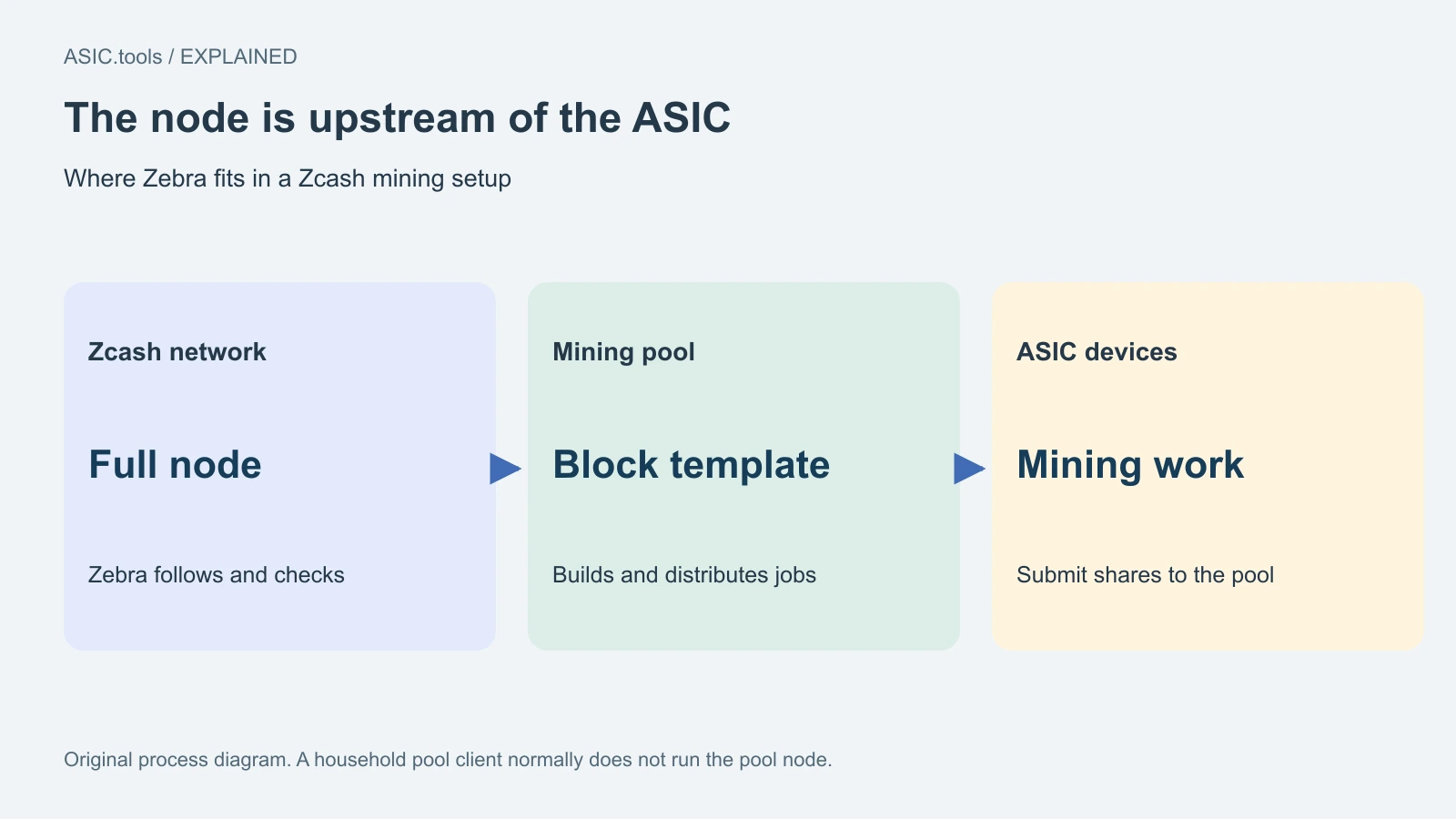
Zcash Foundation published the stable Zebra 7.1.0 security release on November 16 at 20:47 UTC. It fixes ten security advisories, including ways to stall synchronization or exhaust a node’s memory. The release gives mining pools and miners high upgrade priority because an unresponsive node stops providing block templates. For someone running Zcash mining infrastructure, the issue is continuity of work: the ASIC can remain powered while the software that prepares its next job is unavailable.
Zebra is a full node, the software that follows and checks the Zcash blockchain. A mining pool uses a node to obtain the proposed contents of a block, called a template, before distributing jobs to connected miners. A household miner connected to a public pool normally does not operate that pool’s node. The relevant first step is therefore to identify who runs Zebra in the setup, rather than trying to install a node release on the ASIC itself.
What the security fixes protect
Several fixes concern how a node handles data from other peers, meaning the computers it connects to on the Zcash network. The release describes forged or unsuitable block data that could stop initial synchronization or repeatedly restart a sync round. Other changes bound queues and avoid giving unnecessary work to verification threads. The ordinary reader does not need to reproduce those situations to understand their consequence: a node that cannot keep up with the chain cannot reliably prepare current mining work.
Memory is the other main theme. Recent chain forks previously copied indexes in ways that could consume too much RAM when blocks contained many transparent outputs. Another advisory concerns concurrent address-balance requests through the RPC interface or lightwalletd service. RPC is the interface used by other software to ask a node for data. The Foundation says the ten advisories are not consensus faults and do not put funds at risk. That statement describes these issues; it does not remove the need to update an exposed service.
An easier database upgrade, with a configuration check
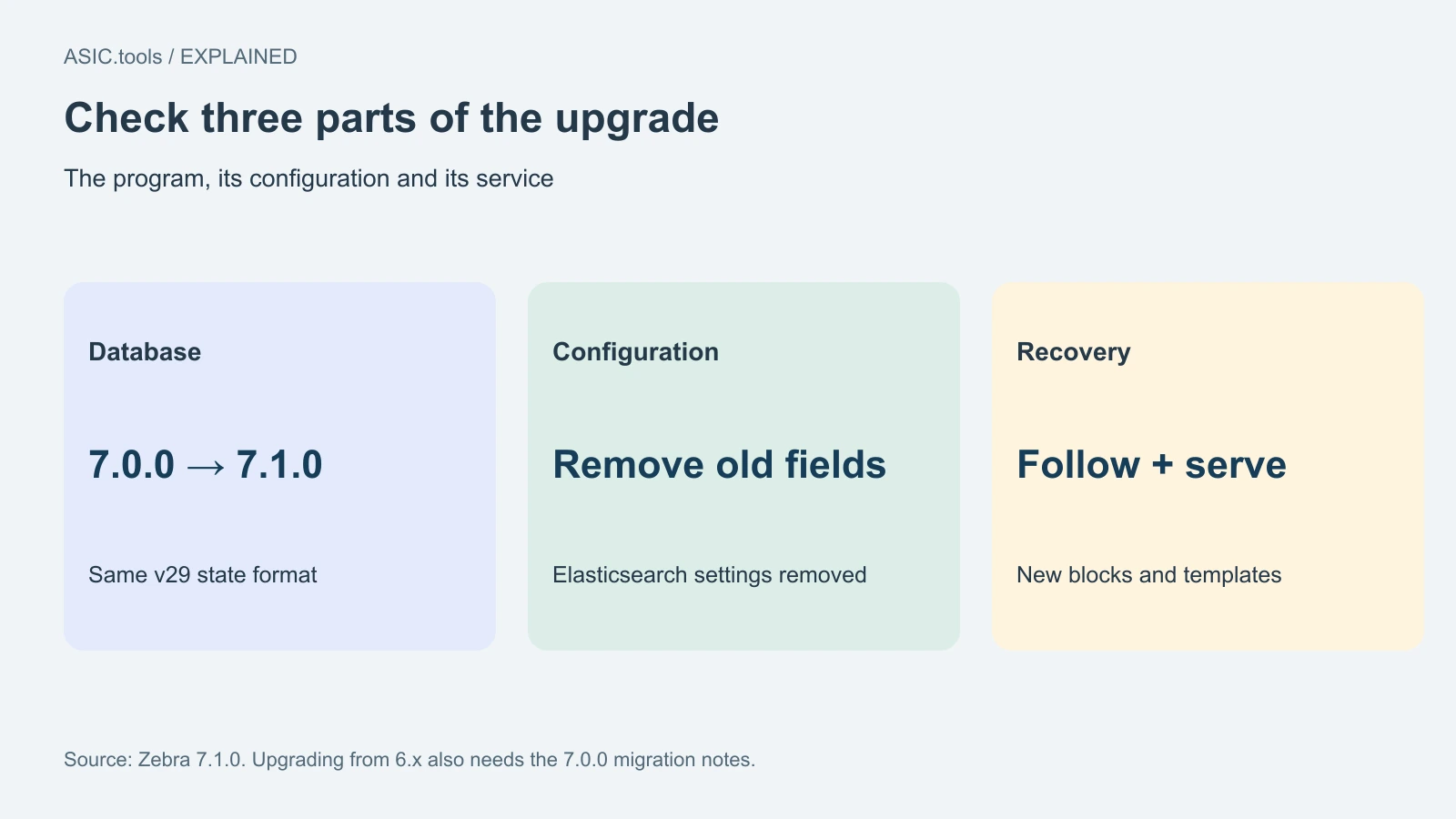
For operators already on Zebra 7.0.0, the new version keeps the same v29 state format, so the upgrade needs no database migration or blockchain resynchronization. That can reduce the work involved in a maintenance window. A move from a 6.x installation is different: the Foundation directs those users to the 7.0.0 migration notes as well. Check the installed version and the actual data directory before choosing the upgrade path.
There is a specific configuration change to handle first. The experimental Elasticsearch feature has been removed. A configuration retaining elasticsearch_url, elasticsearch_username or elasticsearch_password under the state section will no longer load. Remove obsolete entries using the release instructions, keep a copy of the previous configuration and verify that the service starts. A new executable that never starts cannot restore a pool’s supply of templates, however successful the file download was.
Memory limits also have an operating boundary
The release changes forks to share indexes and limits the size of recent-chain indexes. Under unusually dense blocks, Zebra can discard lower-work forks and finalize older blocks on its best chain earlier, retaining at least 100 recent blocks. The authors describe ordinary mainnet blocks as staying below the limit. While the limit applies, the node can follow reorganizations only as deep as the recent blocks it still retains. A reorganization means replacing the recent tip with a competing chain that has more work.
The Foundation continues to recommend 16 GB of RAM and provides new metrics for index entries and evicted forks. Those metrics help an operator distinguish memory pressure from a slow connection or an ordinary quiet period. They are not new hashrate readings and do not show how fast an ASIC computes. Check resource use on the node separately from accepted shares on the pool: the two measurements cover different parts of the mining process.
Put the next update on the calendar now
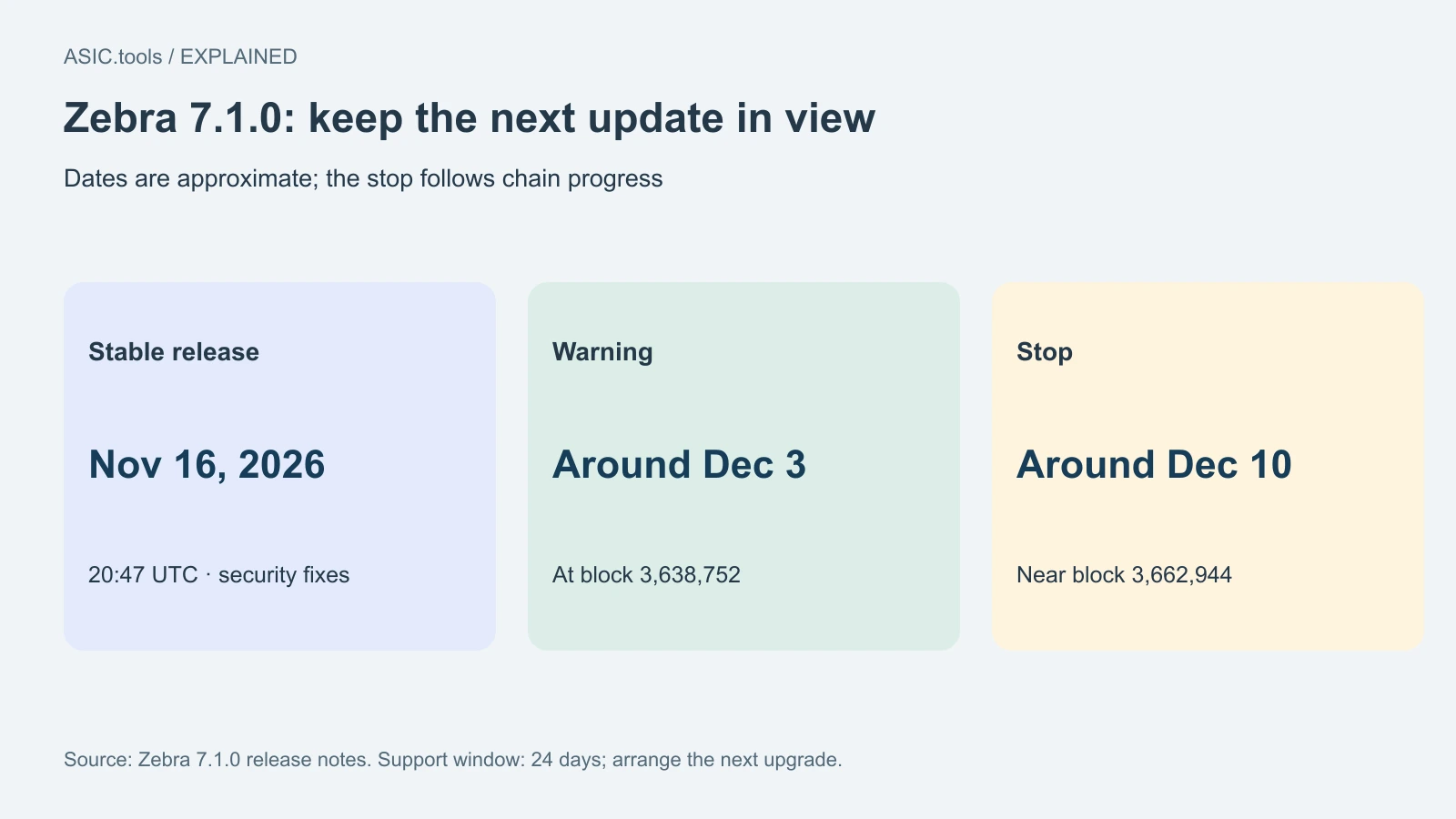
This release has a shorter support window: 24 days rather than eight weeks. Its notes place the warning around December 3 at block 3,638,752 and the stop around December 10 near block 3,662,944. The dates are estimates tied to chain progress. Operators should arrange the next supported upgrade before the stop, rather than treating the calendar date as a guaranteed exact deadline. A fixed security issue today does not make this version a long-term unattended installation.
After upgrading, confirm that the node follows new blocks, that its template interface responds and that the pool resumes accepted work. Review alerts too: some synchronization failures now appear at WARN level, and several metric labels have changed. Keep the deployment window and version in the operating log so a later graph can be interpreted correctly. The practical outcome is a maintained path from the Zcash network to the pool and its miners, without changing the ASIC’s algorithm or promising higher mining rewards.
A maintenance window covers more than the executable
Before replacing the node, identify the services that depend on it: template requests, a public data interface and monitoring may share the same process. If the installation has a separately configured backup backend, check its readiness before the maintenance window and route work according to that installation’s documented procedure. A second process using the wrong configuration is not a verified fallback.
Afterward, compare the node and pool over the same time window. A healthy node indicator, a new template and accepted mining shares each confirm a different part of recovery. Preserve the earlier configuration and maintenance record for diagnosis, while following the Foundation’s warning that returning to 7.0.0 also returns to the affected version. Database compatibility makes rollback technically possible; it does not remove the repaired vulnerabilities.
Source: Zcash Foundation ↗ · Security advisory: fork-index memory exhaustion ↗ · Security advisory: concurrent address-balance requests ↗ · Zebra 7.0.0 migration notes ↗
Mining calculator ↗