Bitcoin Core marks 31.3 final in source code, trimming repeated transaction notices
Source report: 2026-11-17 · Editorial analysis published: 2026-11-18
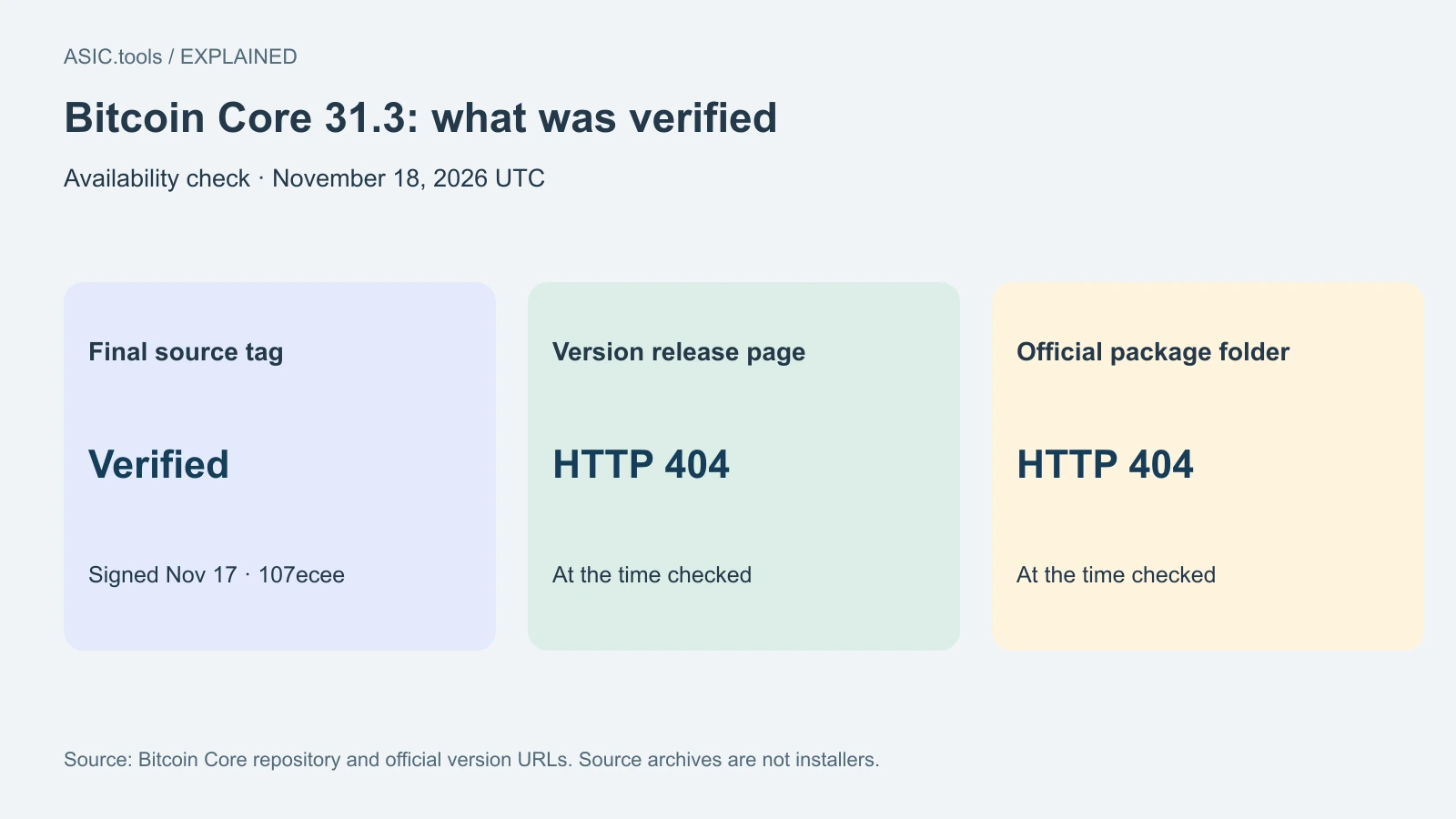
The signed final tag includes a network-processing fix. Official installer and release-page URLs returned 404 when checked, so the verified milestone is the source tag.
A final source milestone on the 31 branch
Bitcoin Core’s repository received the signed final v31.3 tag on November 17 at 16:07 UTC, pointing to commit 107ecee. Its release notes include a change that avoids repeated work when a node receives transaction announcements. The practical audience is operators maintaining Bitcoin nodes behind pools, local mining systems or other services. The change happens in the network software that receives transaction information, rather than inside an ASIC’s hashing engine.
There is a distribution detail worth keeping clear. During our November 18 check, the version-specific release page and official 31.3 package directory returned HTTP 404. GitHub’s releases API also had no published release object for that tag. The verified event is therefore the final source tag and its notes. It is not confirmation that the usual ready-to-install packages have been published. GitHub’s automatically offered source archives should not be mistaken for signed platform installers.
What a transaction announcement does
Bitcoin nodes tell one another about transactions they have available. A compact announcement gives an identifier first; the receiving node can decide whether to request the full transaction. Think of a catalogue entry that tells a service a document exists before the entire document is transferred. The announcement is part of finding and exchanging data, while checking the transaction and choosing whether to include it in a block are later, separate operations.
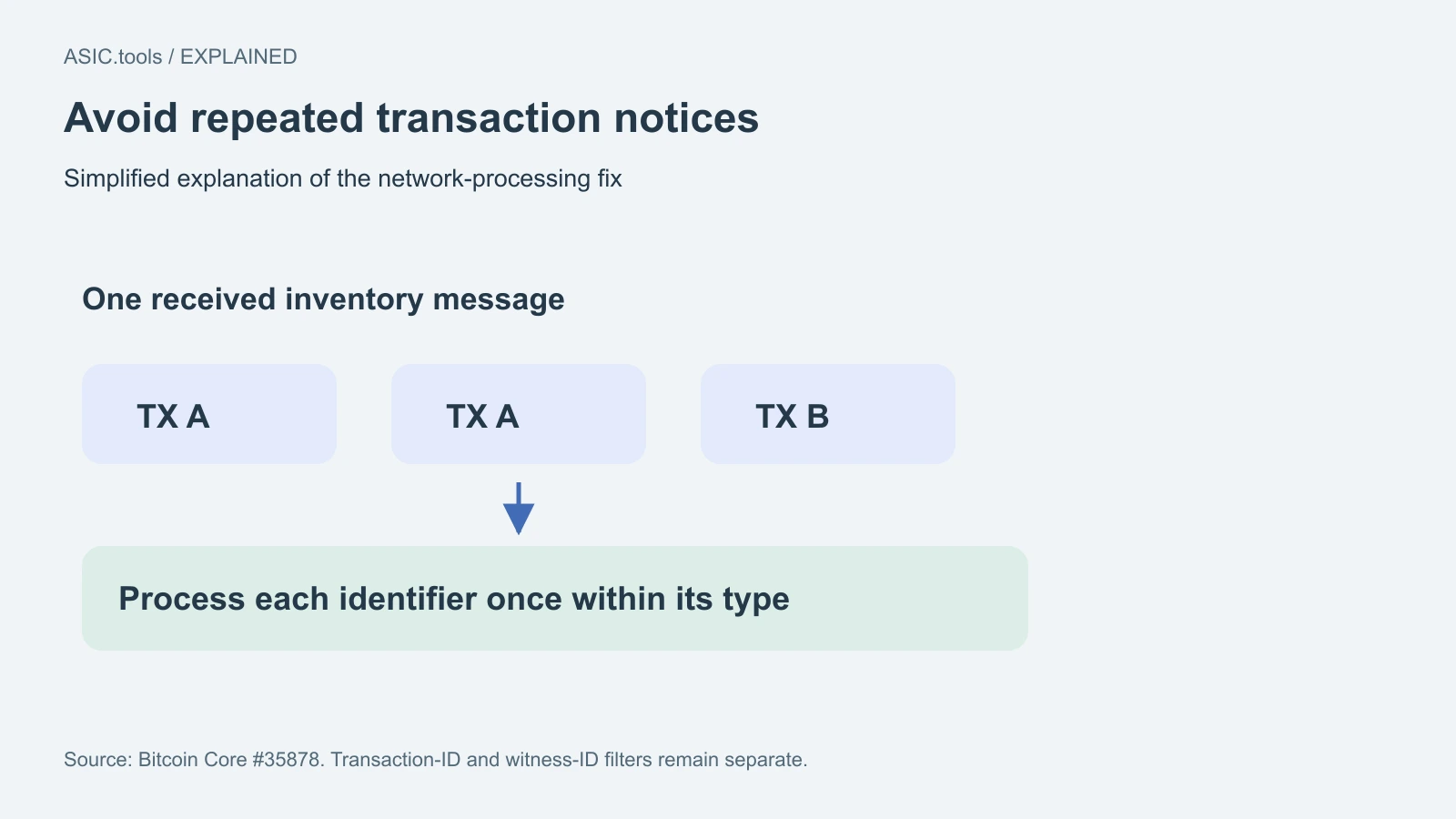
The change listed as pull request #35878 filters repeated transaction identifiers in a received inventory message before sending them through the announcement-processing path again. Its author describes the aim as avoiding unnecessary work, with no change in observable behavior. It does not make a new transaction valid, alter a miner’s block subsidy or change the target that an ASIC must meet. It is maintenance of the path that supplies a node with information.
Why the identifiers need care
The reviewed code distinguishes transaction IDs from witness transaction IDs. Witness data holds authorization information used by modern Bitcoin transactions, and the two identifier types address different representations. The change retains separate duplicate filters for those types. That matters because skipping repeated information should not accidentally skip a different kind of announcement that the node still needs to handle. The associated functional test exercises the announcement processing rather than an ASIC benchmark.
For a mining operator, the broader distinction is useful. Receiving a transaction notice, downloading the transaction, validating it and building a block template are not the same task. A pool’s template describes proposed block contents before machines start searching for a successful hash. Less repeated work at one node-processing step is useful software housekeeping, but the change supplies no measured increase in pool revenue, fewer stale shares or a particular percentage speedup for a whole installation.
The new milestone and the older patch
The original pull request was merged into the project’s main development branch in August. The fresh event is its inclusion in the final 31.3 source release on November 17, not discovery of a new November flaw. This distinction matters for maintenance branches: a fix can be developed and reviewed earlier, then become part of a later version maintained for existing users. A node on another branch may already have a different set of changes.
The tagged notes also list two continuous-integration changes, which concern the project’s build and test infrastructure. They are separate from the running node’s network fix. Neither that short list nor the word final establishes a consensus upgrade. The source is specific enough to explain what changed without attaching a new efficiency figure, network-wide deadline or security incident that the maintainers did not announce.
How to approach an eventual installation
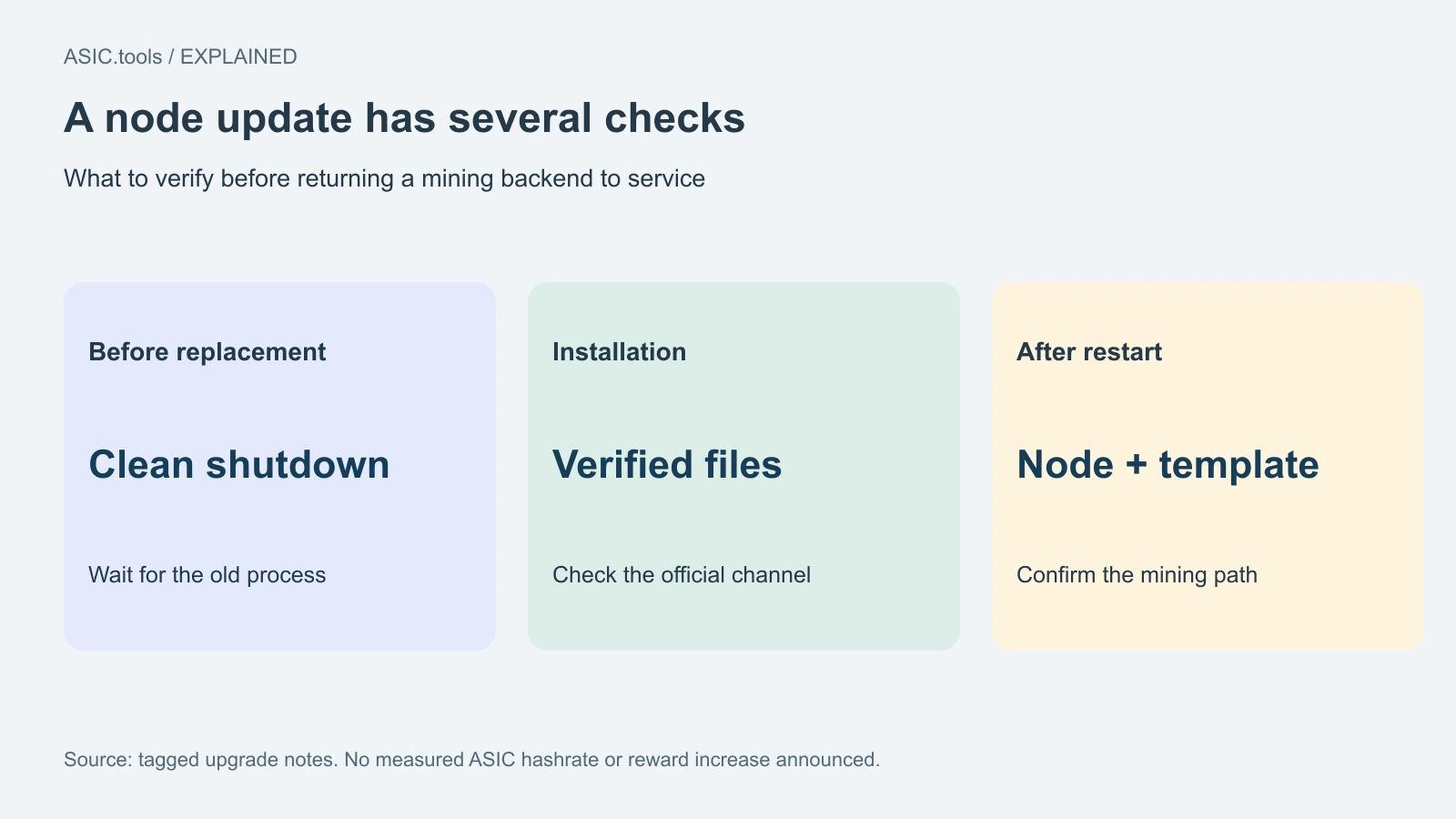
The tagged upgrade instructions say to shut down the old process and wait for it to finish before replacing the installed program. This matters for a machine that has a large database or is busy: initiating shutdown and completing it are different events. Keep track of which service and data directory are in use, and preserve the current configuration before a planned change. A pool with several node backends can schedule maintenance around how its own template service is routed.
Use the official download channel to establish when the intended platform packages are actually available, and follow its verification instructions. A tag signature identifies a signed source milestone; package checksums and signatures concern the files being installed. Those checks answer related but different questions. The observed 404 responses are a dated availability result, not evidence that the source tag is invalid or a reason to obtain an unverified installer from an unrelated mirror.
The tagged compatibility baseline lists Linux kernel 3.17, macOS 14 and Windows 10 version 1903 or newer as supported and tested. Check the host operating system alongside the application version; an available package for one platform says nothing about another machine’s compatibility.
Check the complete path back to mining work
After a node update, confirm the reported version, chain tip and peer connections. If it feeds a mining service, also check template responses and the pool’s accepted work. A running process alone does not prove that the service using it has reconnected to the intended backend. Keep the maintenance time in the operating log so a brief graph gap can be matched with the work actually performed.
A miner using a public pool normally leaves that pool’s Bitcoin Core maintenance to its operator. Someone running a local node or solo-mining stack has a more direct reason to follow this release channel. In both cases, the November 17 milestone is a modest, concrete network-processing improvement on the 31 branch. Its value is careful maintenance of node software, with package availability checked separately, rather than a promise that installing a new version increases a machine’s Bitcoin output.
Source: Bitcoin Core ↗ · Release notes at the final tag ↗ · Reviewed network-processing change #35878 ↗ · Signed final tag ↗ · Official download channel ↗
Mining calculator ↗