Strategy buys no Bitcoin for a week as Strive adds 6,182 BTC
Source report: 2026-10-26 · Editorial analysis published: 2026-10-26
October 26 filings show different uses of corporate cash: Strategy repurchased $204.9 million of STRC, while Strive increased its Bitcoin holdings. Neither action changes a miner’s block reward.
Two reports, different cash decisions
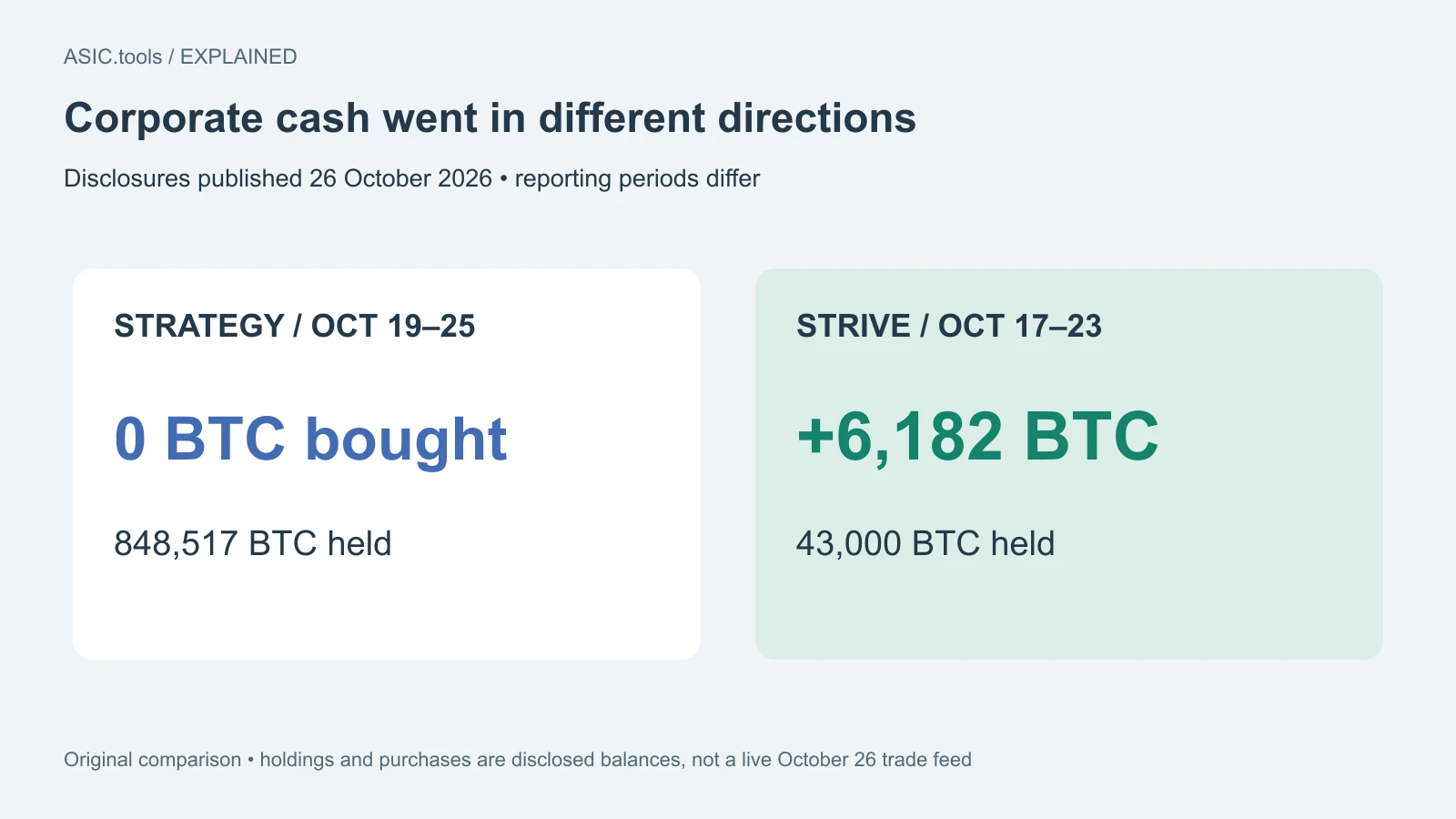
Strategy reported on October 26 that it bought and sold no Bitcoin during October 19–25. Its holdings stayed at 848,517 BTC. On the same publication day, Strive reported a purchase of 6,182 BTC during October 17–23, taking its balance from 36,818 to 43,000 BTC. Corporate buying did not move in one direction across both companies.
The reporting windows are different: Strategy’s ends on October 25 and Strive’s on October 23. These are completed-period disclosures, not a live feed of trades on October 26. A reader comparing the headlines should keep those dates attached rather than treating both balances as simultaneous observations.
For miners, corporate purchases are relevant as one part of demand for Bitcoin after it reaches the market. They are not new mining output. The filings do not identify the sellers as miners, establish a direct purchase from a particular pool or prove that the latest corporate transaction caused a movement in Bitcoin’s price.
Strategy spent on its own preferred stock
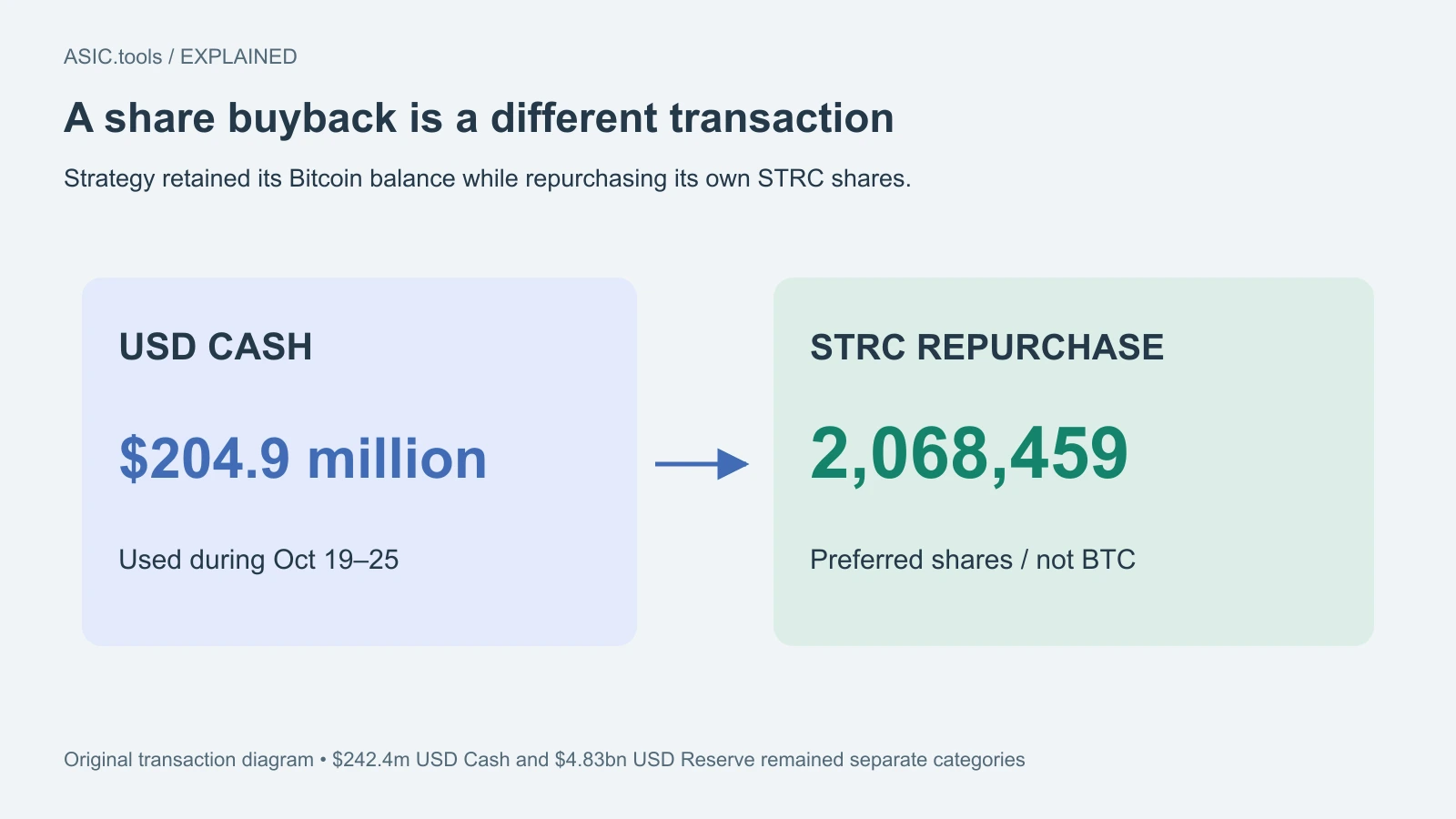
Strategy repurchased 2,068,459 shares of STRC for $204.9 million over its reporting week. STRC is a class of preferred stock issued by the company; buying those securities back is different from buying BTC. The filing also says Strategy sold no shares through its at-the-market program during that period.
The repurchases used the company’s category called USD Cash. At October 25, it reported $242.4 million of USD Cash and a separate $4.83 billion USD Reserve intended to support preferred dividends and debt interest. The reserve and the broader treasury cash category should not be silently merged into a claim that every dollar is earmarked for a Bitcoin purchase.
The company’s accumulated Bitcoin cost remained about $64.02 billion, or $75,446 per BTC including fees and expenses. That is the reported average acquisition cost of its holdings, not the current market price and not a price floor for other holders. A week with no trades also does not announce a permanent end to the company’s strategy.
Strive increased the coin balance
Strive’s reported average price for its 6,182 BTC purchase was approximately $82,732 per coin, including fees and expenses. Its balance rose by exactly the disclosed number of coins. The report describes a completed acquisition; the day a company publishes it is separate from the days when it executed the purchases.
Its cash and cash equivalents were $504.4 million at October 23, compared with $317.5 million a week earlier. It separately listed 505,000 shares of Strategy’s STRC, valued at $50.177 million. A preferred-stock holding is not cash, and the table keeps the two categories distinct. This matters when comparing a headline about liquidity with the company’s actual balance-sheet components.
Buying BTC while reported cash rises is not evidence that mining generated that cash. Corporate financing, existing assets and spending can move together. These reports describe treasury management; they do not provide the cost of producing a bitcoin, the economics of a home ASIC or a return that a small miner can copy.
A $1 billion program is an option to raise money
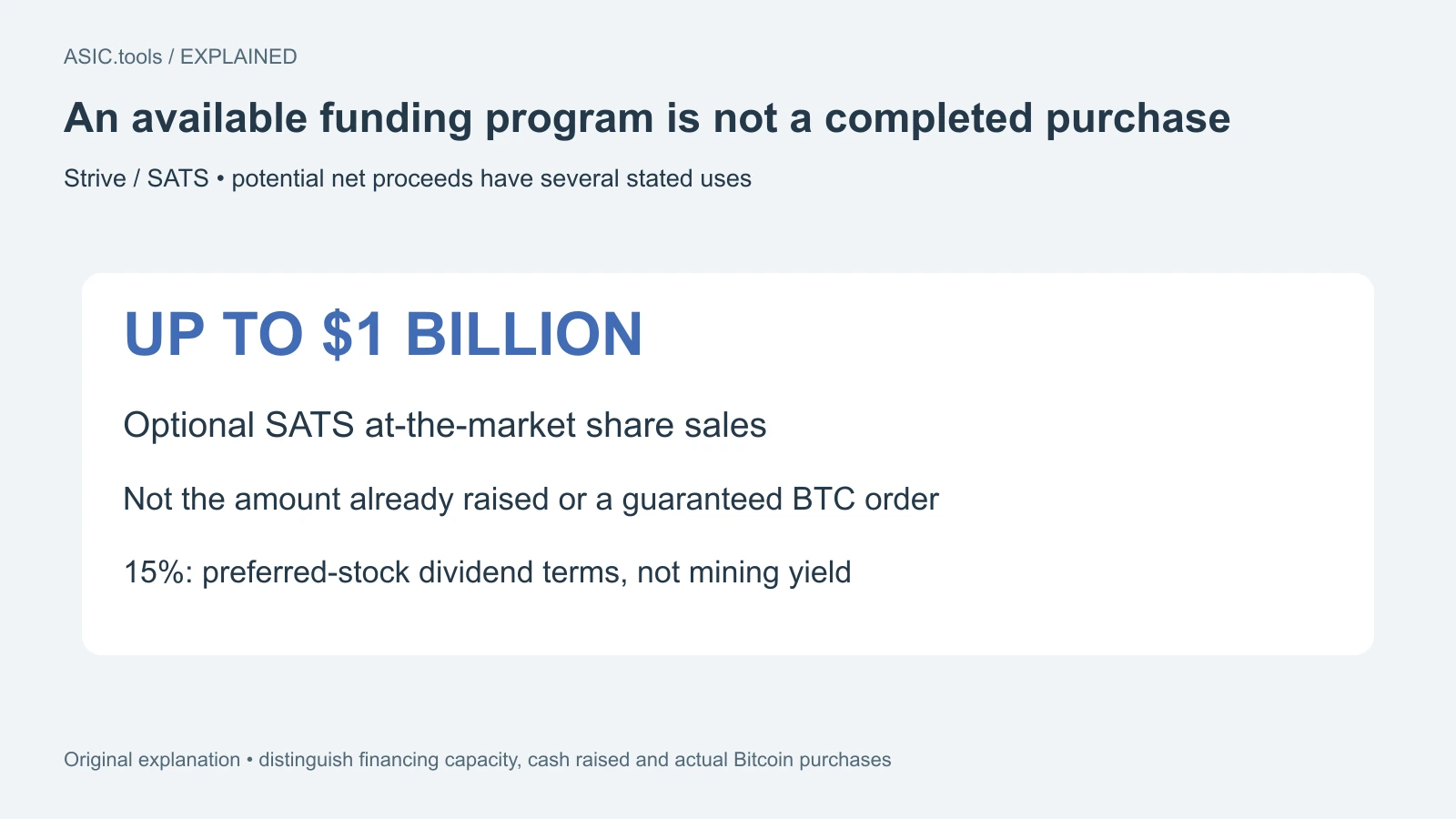
Strive also announced an at-the-market program for up to $1 billion of SATS preferred stock. At the market means shares can be sold over time into trading rather than requiring one fixed-size sale on the announcement date. The issuer describes potential sales; the full headline amount is not money already raised.
Bitcoin purchases are among the stated possible uses of net proceeds, alongside working capital, other assets, capital spending, repurchases and dividend payments. The announcement therefore cannot be translated into a guaranteed $1 billion Bitcoin order. Net proceeds would also differ from gross sales after the relevant costs.
SATS is described as 15% preferred stock. That percentage belongs to the security’s dividend terms, not to a Bitcoin mining yield or a guaranteed return on BTC itself. Owning a company security and operating a miner expose a reader to different obligations and risks, even when both are discussed in the same Bitcoin news cycle.
What this changes for a miner watching the market
The useful takeaway is that a large company’s cash does not automatically become same-week Bitcoin demand. One company can retain its coins and buy back securities while another adds coins. Reading the transaction type, reporting period and financing status is more informative than treating every treasury announcement as the same purchase signal.
A miner’s own accounting still starts with coins credited, actual electricity and other operating costs. A corporate acquisition does not change Bitcoin’s subsidy, network difficulty or a pool’s payout contract. It may form part of the broader market context, but neither filing establishes a dependable price response or an individual miner’s profitability.
We checked the original SEC submission metadata and the complete filing texts carried by an archival service; direct retrieval of the SEC documents was unavailable. The linked issuer release independently confirms Strive’s optional SATS program. The facts above retain those source limits and do not turn a weekly disclosure into an instruction to buy a security or keep an uneconomic machine running.
Source: Strategy / Strive — SEC filings ↗ · Strive October 26 holdings filing ↗ · Strategy filing text, archival copy ↗ · Strive holdings filing text, archival copy ↗ · Strive issuer announcement on optional SATS program ↗
Mining calculator ↗