HIVE mined 1,070 BTC and wrote down $31.2 million of equipment
Source report: 2026-11-09 · Editorial analysis published: 2026-11-11
HIVE’s quarterly filing shows how Bitcoin output can rise while the expected value of a mining fleet falls.
More Bitcoin, lower equipment values
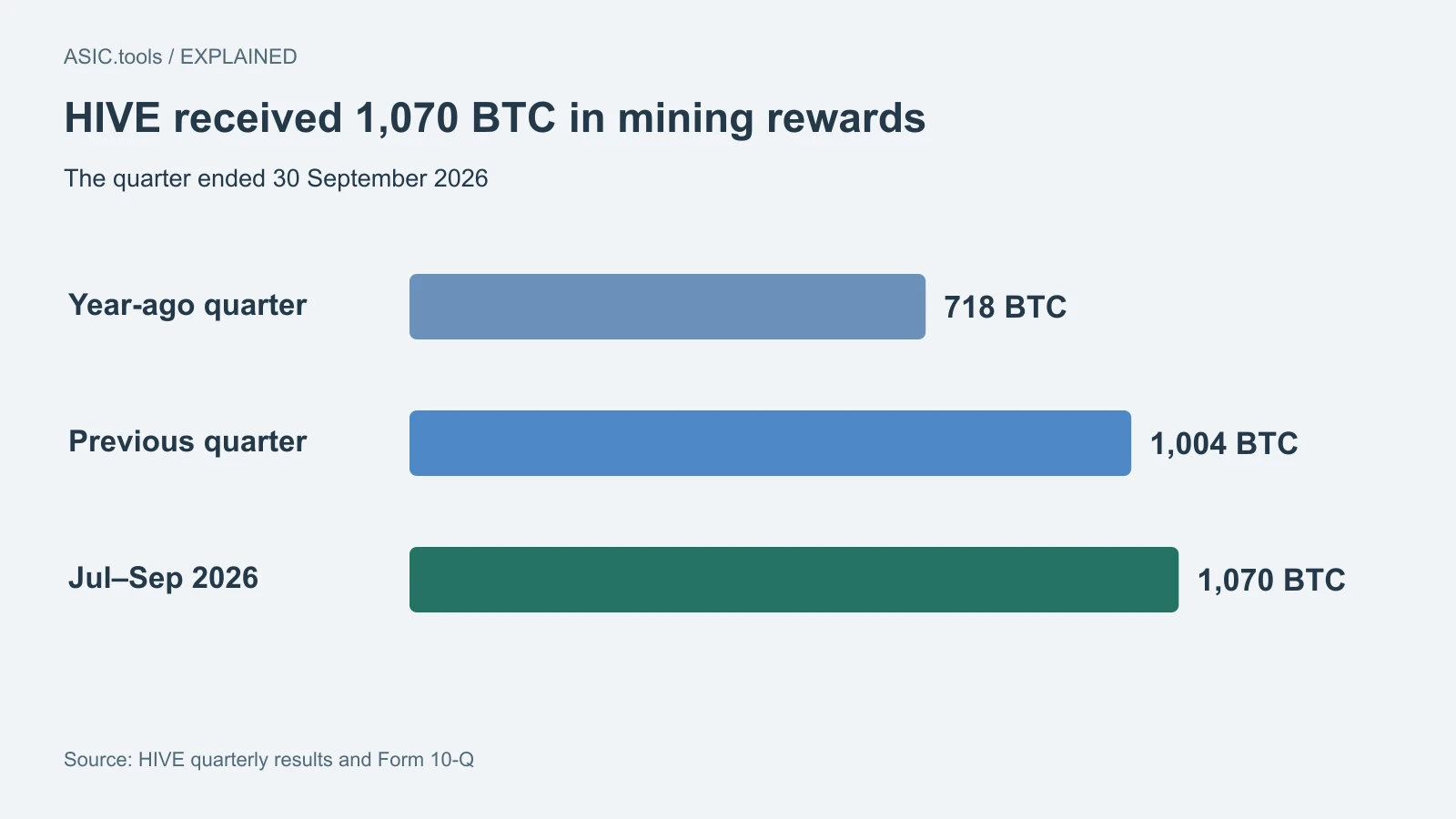
HIVE Digital Technologies reported 1,070 BTC in mining rewards for July through September and a $31.2 million equipment impairment. The November 9 release covers its fiscal second quarter ended September 30. The two figures answer different questions about a mining operation. One counts what the machines earned during the quarter. The other reflects how much value the company expects to recover from a group of machines over their remaining lives.
The company received 1,004 BTC in the preceding quarter. Mining revenue rose 5.5% from that quarter to $76.0 million. Across all activities, HIVE reported $84.9 million in revenue and a net loss of $78.7 million. The impairment is part of that loss. Figures in the release are in US dollars.
How production can rise while revenue falls
The same quarter a year earlier offers another comparison. HIVE received 718 BTC and recorded $82.1 million in mining revenue then. In the latest quarter it collected more coins and booked less dollar revenue than a year earlier. HIVE says the average Bitcoin price fell from $114,382 in the earlier period to $71,003 in the latest one. It attributes the higher coin output in part to growth in its own hashrate and a lower average network difficulty.
Hashrate measures how many attempts miners make per second. Difficulty is a network setting that affects how hard each attempt is to turn into a valid block. A larger share of the network’s computing work can help a miner earn more coins. The dollar value of those coins still depends on the price when the company measures the revenue. The figures describe HIVE’s quarter, with its own fleet and operations.
What the $31.2 million represents
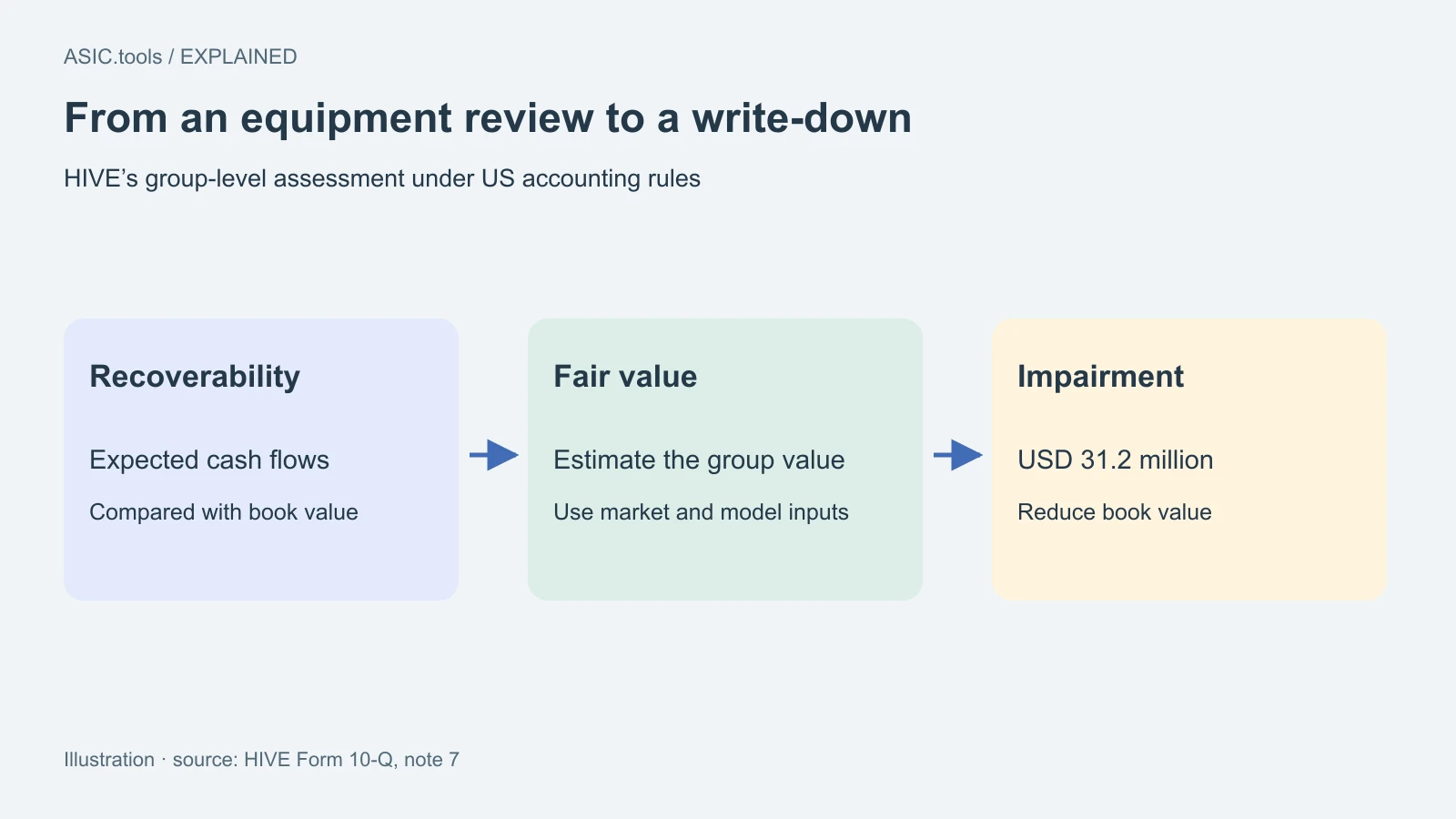
HIVE’s 10-Q says lower revenue per unit of computing power and lower ASIC market values prompted an assessment of a group of mining equipment. The company first compared the expected cash from using and eventually disposing of the group with the value already on its books. When expected undiscounted cash was lower, it estimated fair value and reduced the carrying amount to that level. The resulting accounting charge was $31.2 million.
The charge itself did not take cash out of the business. It records a lower estimate of what the equipment is worth. A machine can keep working even after its recorded value falls. The filing provides a group-level estimate based on assumptions about future economics, so the figure cannot be divided into a reliable resale quote for a specific miner. Individual units can differ in efficiency, condition and remaining service life.
Two decisions for a miner owner
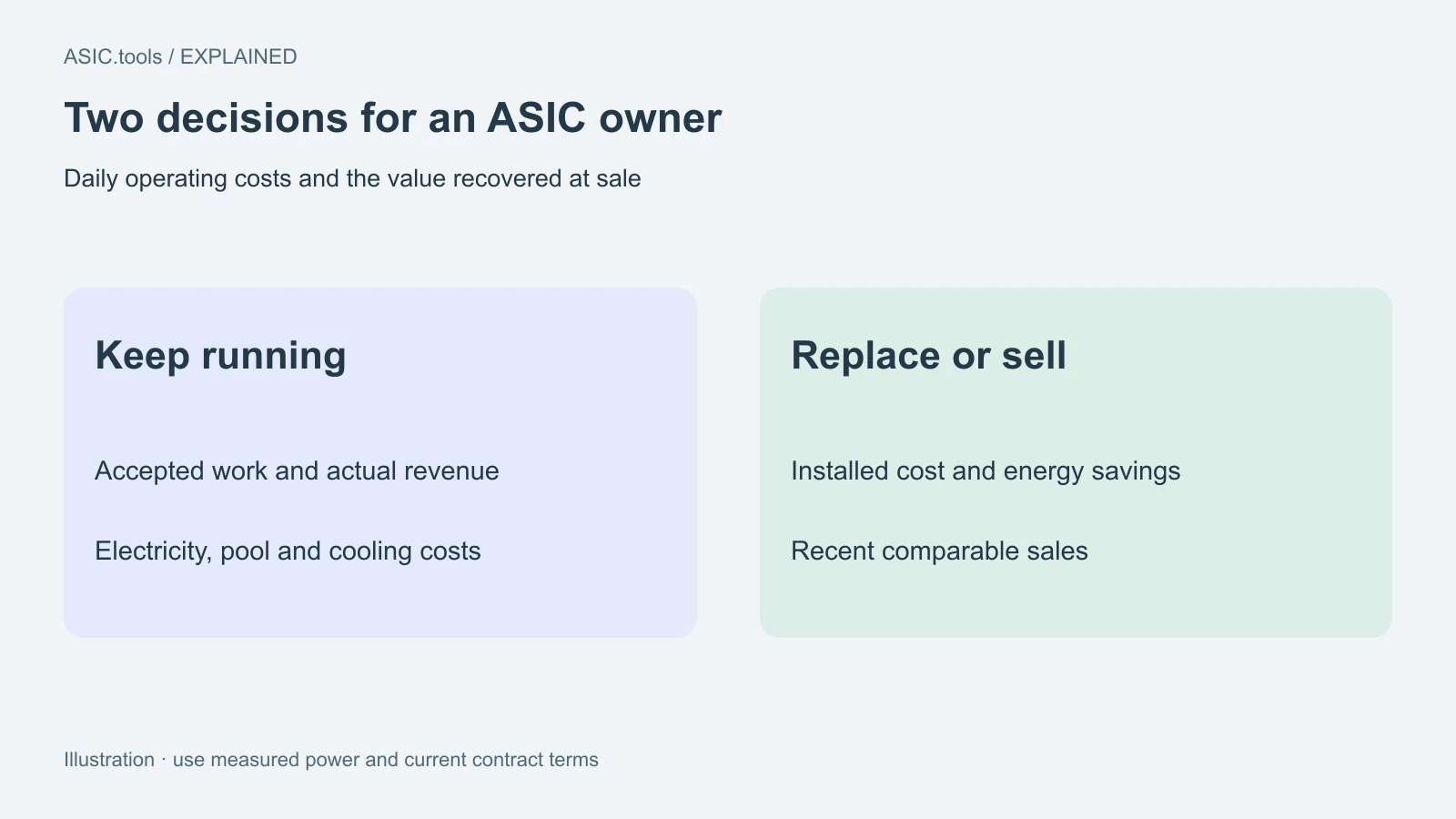
For a device already paid for, tomorrow’s operating decision starts with what it earns when on and what it costs to keep on. Use the actual power draw, the all-in electricity or hosting rate and the shares that a pool accepts. Include variable expenses such as pool fees and cooling when they matter. A quoted purchase price from months ago belongs in the history of the investment. It does not change the electricity drawn tonight.
A replacement decision has a longer horizon. Compare the cost of the new device and installation with expected energy savings and with what the existing unit could fetch in a real sale. The reported write-down illustrates why a lower used price can matter even when the machine still turns a positive operating margin. Lower resale proceeds mean less of the original purchase cost comes back at the end.
A cheaper unit still has a power bill
Two used miners offered at the same price can have different running costs. Compare watts at the wall and delivered work at the pool using the same operating mode. Efficiency is often shown as joules per terahash, the energy used for the same amount of calculation. For a unit running continuously, even a modest efficiency gap can add up across a billing period.
A realistic resale estimate uses actual comparable sales and the costs of getting the device to a buyer. For a device staying in service, a realistic cash estimate uses the rate and conditions that apply at its current site. The operator can update those inputs separately as the market and the electricity contract change.
Keep the time periods straight
For HIVE, the same report shows improved coin production compared with the previous quarter and a weaker valuation of mining equipment. A reader comparing the financial statements can follow the mining revenue line, the equipment note and the cash-flow statement to see how the pieces relate. The net loss includes other items as well, including depreciation of $54.9 million, the regular allocation of asset cost over time.
For an individual operator, pool data and the electricity bill give the first view of day-to-day performance. Recent comparable sales are more relevant to exit value. Each moves on its own schedule. The September quarter and the November publication date set the window for HIVE’s figures. Current decisions need current evidence for the particular model, contract and site.
Source: HIVE Digital Technologies / quarterly results ↗ · HIVE Form 10-Q, equipment note and financial statements ↗
Mining calculator ↗