Bitcoin hashprice falls to $31.89: the electricity budget gets tighter
Source report: 2026-11-09 · Editorial analysis published: 2026-11-10
Luxor’s November 9 snapshot puts gross revenue at $31.89 per PH/s a day. A possible difficulty cut remains a forecast; the electricity bill is already real.
A smaller daily envelope
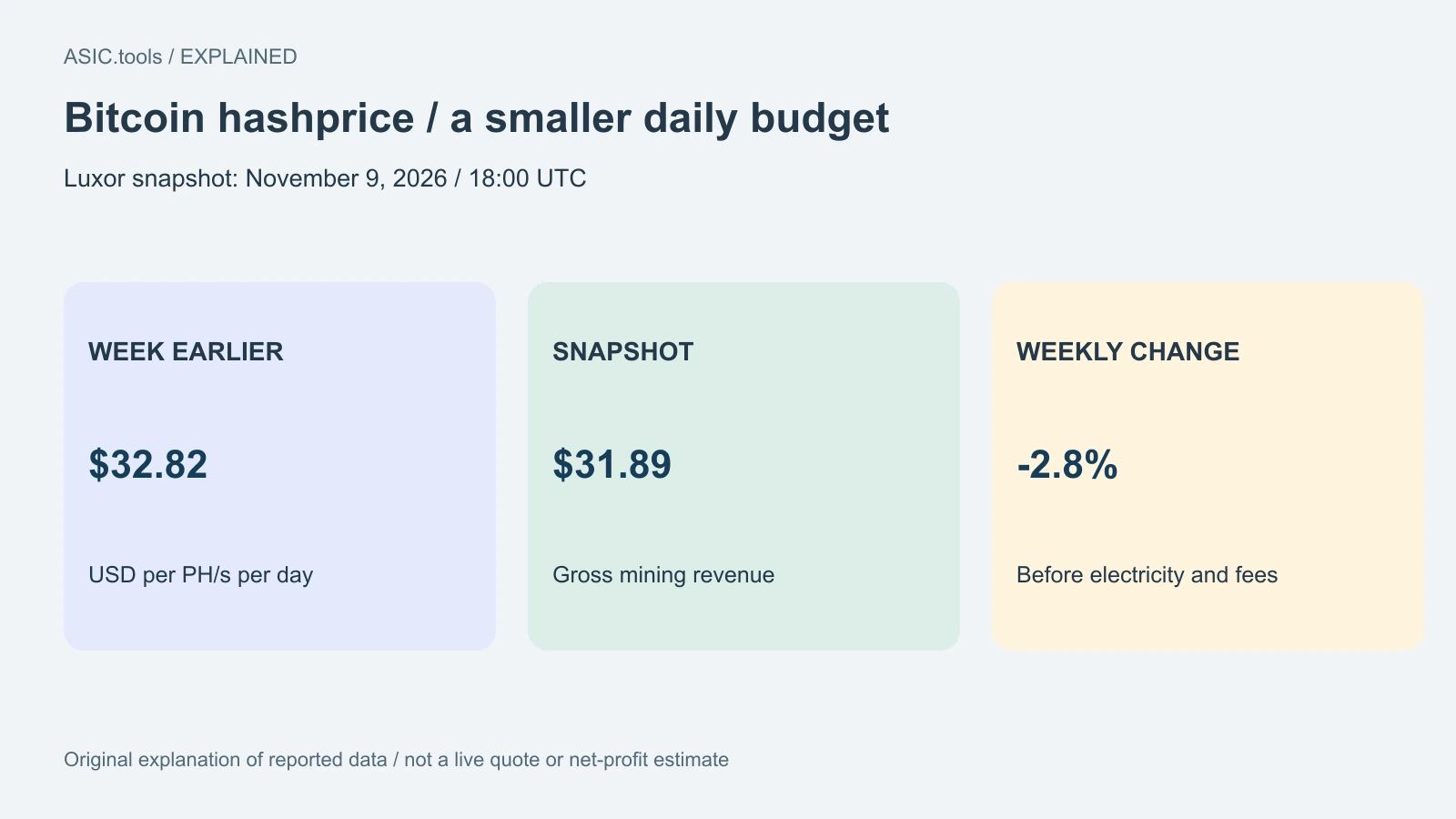
Bitcoin miners had less money available to cover electricity in Luxor’s November 9 weekly update. Dollar hashprice fell from $32.82 to $31.89 per PH/s a day, about 2.8%. Hashprice means the gross daily revenue expected from a unit of mining speed. It is a useful starting point for an operating budget, before pool charges, electricity, cooling, repairs and the cost of the machine itself.
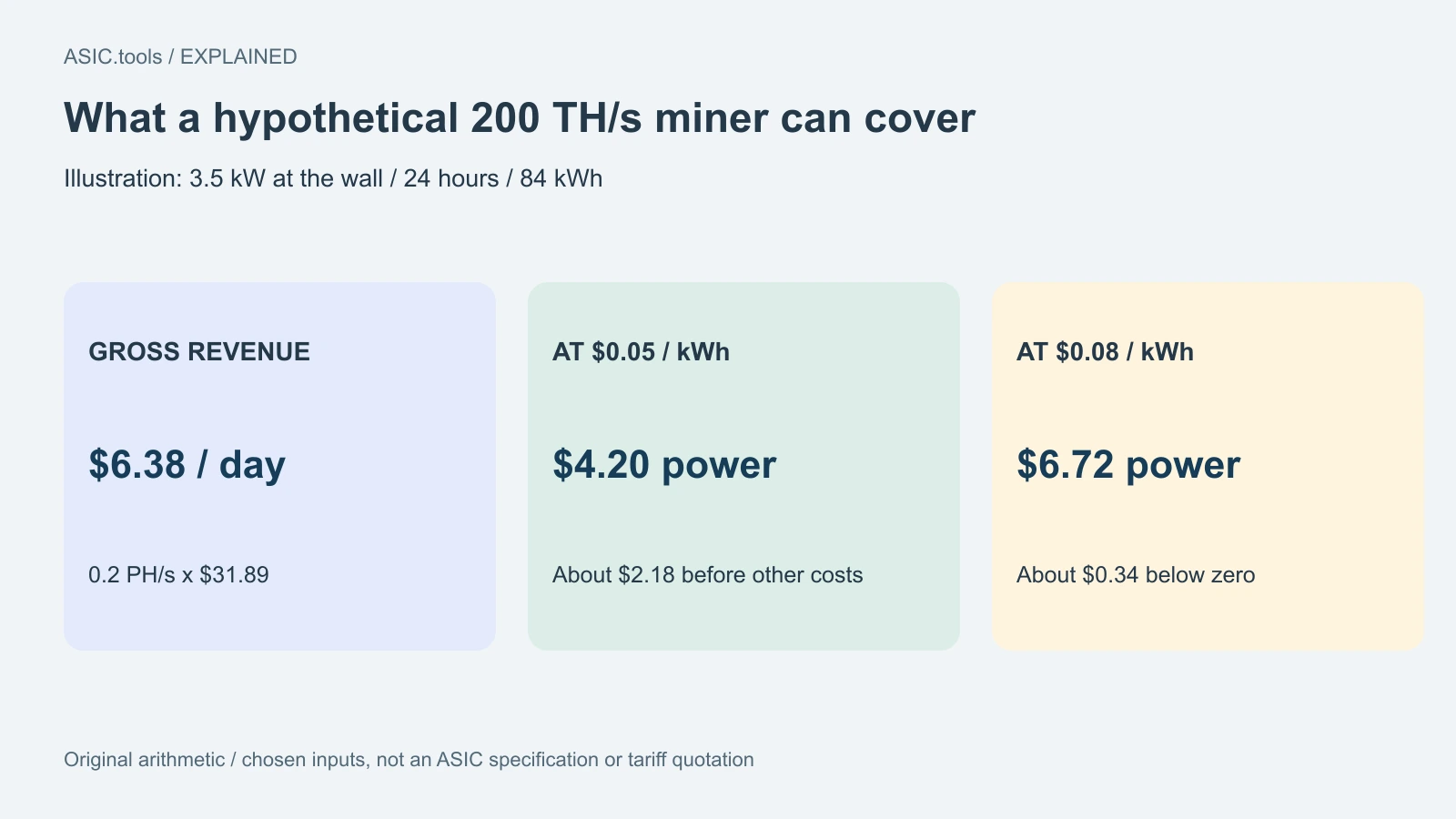
The report is a snapshot taken at 18:00 UTC on November 9, rather than a live quotation for November 10. A PH/s is 1,000 TH/s, so a hypothetical 200 TH/s miner represents 0.2 PH/s. At the quoted rate its gross daily revenue would be about $6.38. The week-earlier rate would have given it about $6.56. That small-looking change matters when most of the daily envelope is already committed to power.
What the wall meter changes
For a simple comparison, assume this example miner draws a constant 3.5 kW at the wall and runs for 24 hours. It uses 84 kWh a day. At a hypothetical tariff of $0.05 per kWh, electricity costs $4.20; at $0.08, it costs $6.72. The first scenario leaves roughly $2.18 before other costs, while the second has already spent about $0.34 more on power than it earns gross.
These are illustrative inputs, not a specification for a named ASIC or a household tariff quotation. Dividing $6.378 by 84 kWh gives an electricity-only ceiling of about $0.0759 per kWh. Actual affordable power must be cheaper once pool fees and other costs are included. Measure the complete setup: an ASIC display can omit a separate pump, cooling unit or other equipment that also appears on the electricity bill.
Less visible hashrate, unchanged difficulty
Luxor reports that its seven-day average network hashrate fell from 1,062 to 979 EH/s. Hashrate is the network’s estimated combined mining speed; a moving average smooths the block-to-block noise. This change describes a recent observation, not a count of machines permanently scrapped. A lower estimate alone does not show which miners stopped, or why they did so.
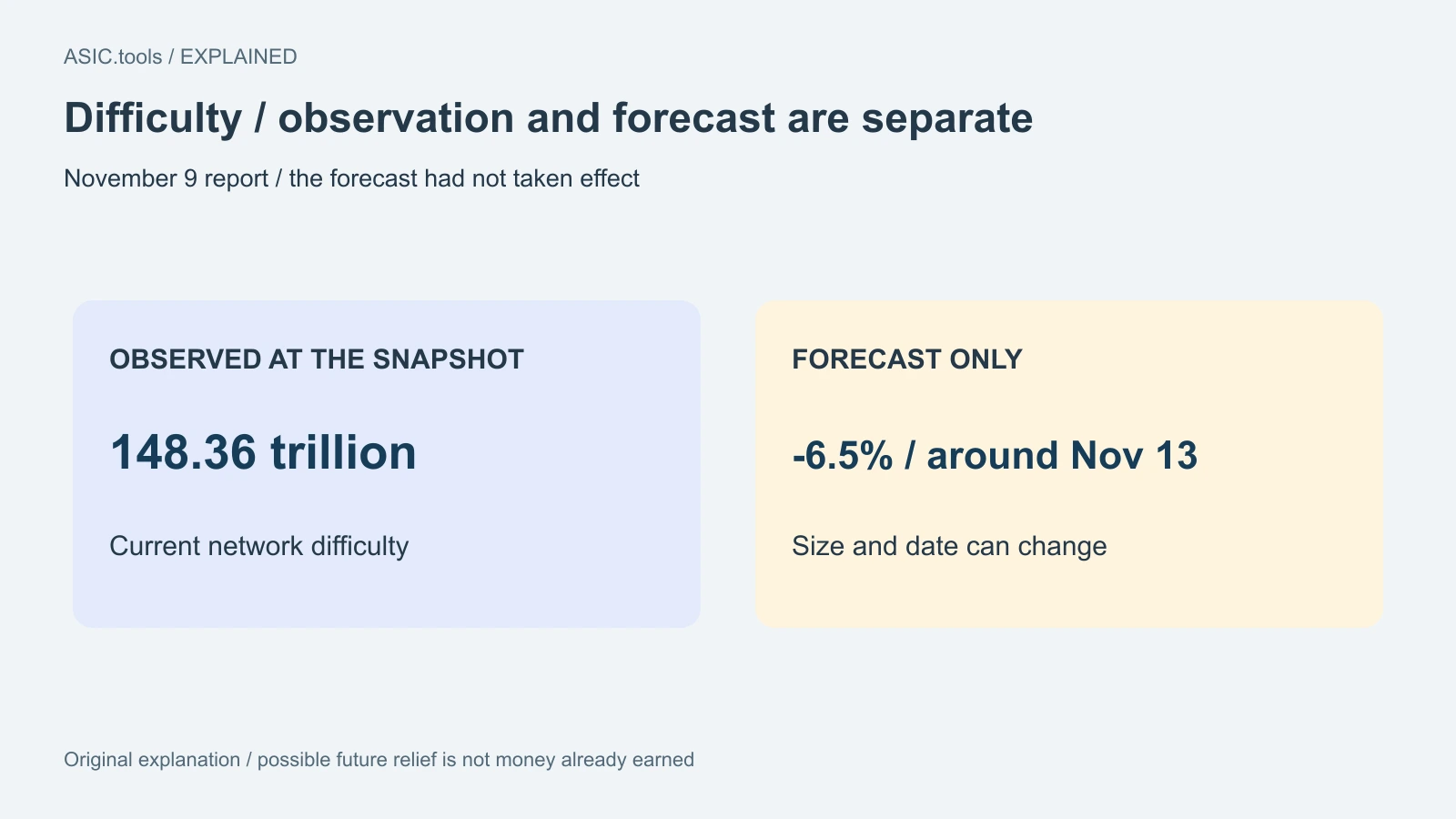
Difficulty, the Bitcoin rule controlling how hard it is to find a valid block, remained 148.36 trillion in that snapshot. It does not change continuously with every miner that disconnects. Consequently a falling hashrate estimate and immediate improvement in an individual miner’s earnings are different things. For a machine still running, the relevant starting point remains the work it submits and what its pool actually credits.
A possible cut is still ahead
The same report estimated a 6.5% difficulty reduction around November 13. Both the size and date were forecasts based on blocks and block times available at the check. They can move before the adjustment. A miner deciding whether to operate tonight should not enter that reduction into the calculator as though it had already taken effect.
Even if difficulty later falls, dollar revenue also depends on Bitcoin’s price and transaction fees. Lower difficulty can improve expected coin production per unit of hashrate, but it cannot lock in a dollar margin. A useful budget keeps a current case and a separate possible-adjustment case, with the forecast clearly dated. This makes it easier to see which decision still works if the expected relief is smaller or later.
Efficiency becomes a cash question
The news changes the value of saved electricity. If two setups deliver the same accepted hashrate while one uses less wall power, the more efficient one has a wider operating margin at the same tariff. Joules per terahash, written J/TH, describe how much energy a miner uses for a given amount of hashing work. A lower figure is better, provided the compared measurements cover the same equipment.
It still makes little sense to compare a factory specification at one setting with a tuned reading at another and call the difference free savings. Power reductions can also reduce speed. For a practical before-and-after comparison, keep a record of accepted pool work, wall energy, temperature and downtime over comparable periods. The useful result is the change in income after energy, rather than the highest number briefly shown on a screen.
A budget you can update
Owners can put their own measured speed, complete wall consumption and electricity price into the ASIC.tools calculator or My farm. Keep gross mining revenue separate from the amount remaining after electricity, and keep equipment repayment separate again. A positive electricity margin does not by itself mean that a newly purchased machine will recover its purchase price.
The November 9 update is useful because it puts a date and a number on a narrowing budget. For the example above, a tariff difference of three cents changes the daily electricity bill by $2.52, much more than the roughly nineteen-cent revenue decline. That is why the practical next step is to check the real tariff and meter alongside the fresh hashprice, then revisit the calculation when the network actually adjusts.
The 24-hour example also assumes the stated speed is maintained throughout the day. A real interruption changes production; some equipment can continue drawing power while useful mining has stopped. Keep measured uptime with the daily record so that a full-day illustration is not mistaken for an actual credited payout.
Source: Hashrate Index / Luxor ↗
Mining calculator ↗