NervaOne 1.4.0 prepares miners for Nerva’s fork: update the client tools too
Source report: 2026-10-26 · Editorial analysis published: 2026-10-27
The October 26 wallet-and-miner release supports Hard Fork 14 at block 4,480,000. Installing the app alone does not replace an existing node and wallet; both need Nerva 0.4.0.0.
The new app is available, with one extra update step
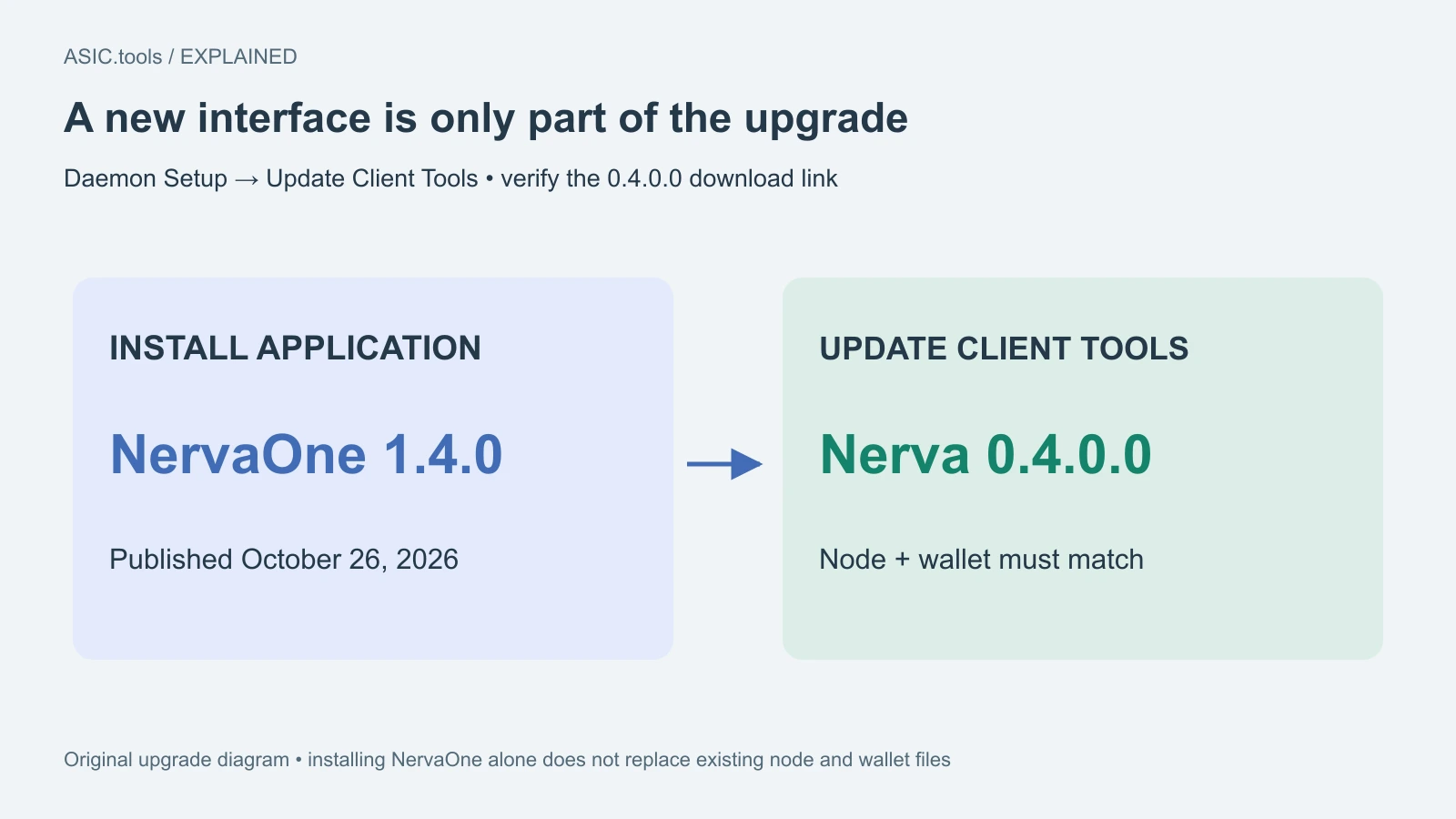
NervaOne 1.4.0 was published on October 26 with Nerva 0.4.0.0 bundled for the coming Hard Fork 14. Nerva is a proof-of-work coin aimed at mining with a computer’s processor. For an existing home miner, the immediate news is practical: updating the application does not automatically replace the node and wallet files already installed.
The release tells users to open Daemon Setup, select Update Client Tools, check that the download link points to version 0.4.0.0 and complete that update. The daemon is the background node program that follows the chain. The visible app and the programs doing the network work have separate versions; a new interface can still be using old tools.
The core Nerva release was published on GitHub on October 25, followed by the project’s October 26 explanatory post. That early post said a NervaOne update was coming. The later 1.4.0 release, published at 17:59 UTC on October 26, resolves that wait. Our report uses the newer release status rather than repeating the earlier expectation.
The deadline is a block height
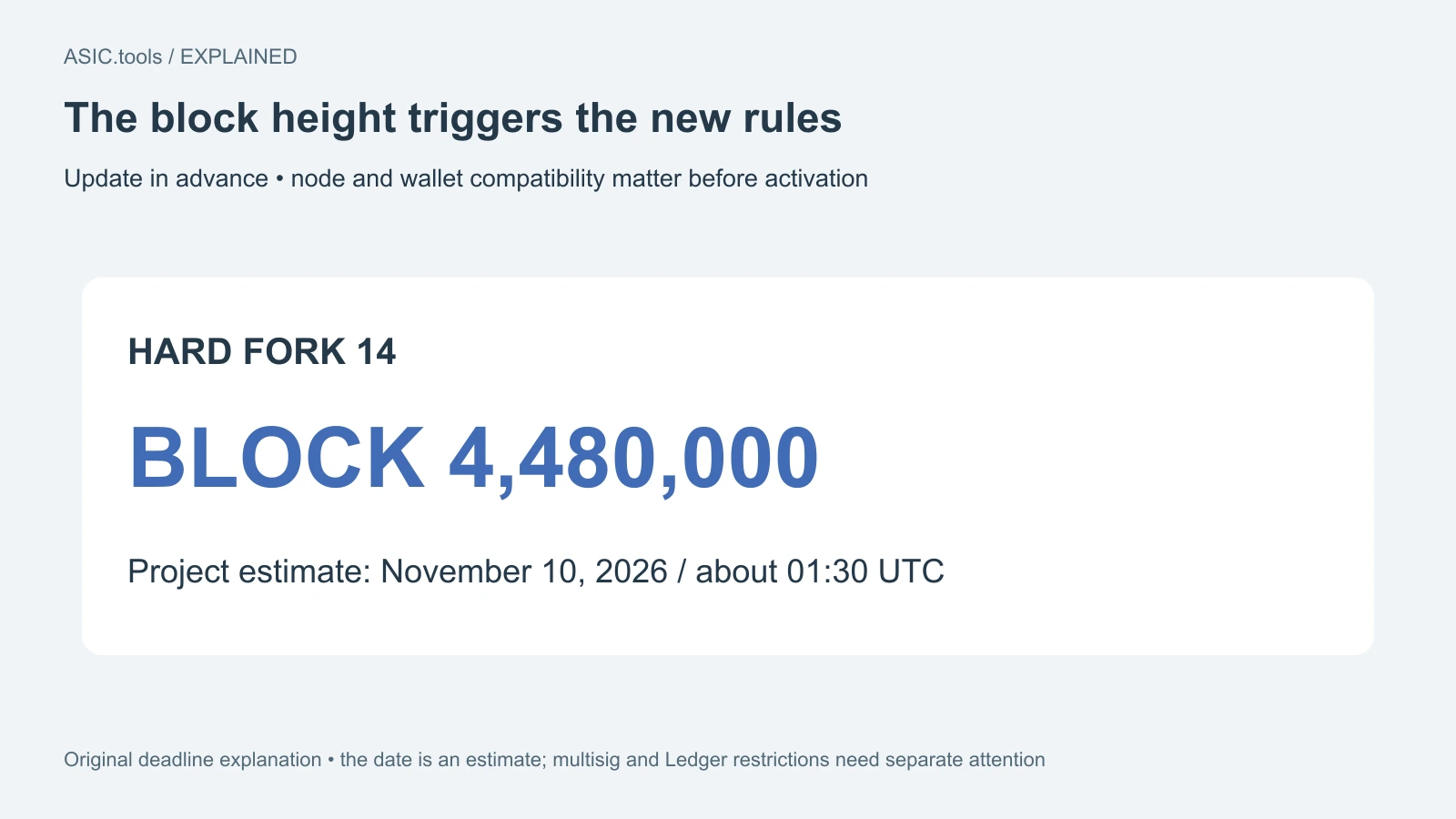
Hard Fork 14 activates at block 4,480,000. The project estimates November 10, around 01:30 UTC, but the block height is the trigger. A hard fork changes the rules nodes use to accept blocks and transactions. Older software will no longer follow the intended network after activation.
Both the wallet and node need version 0.4.0.0. The NervaOne notes warn that mixing an old wallet with a new node, or the reverse, can appear as a “no connection to daemon” problem. Repeatedly changing network settings will not solve a version mismatch. A wallet-only user connecting to a remote node should also check that node’s version.
The practical order is to preserve the wallet’s recovery material privately, obtain the matching official release, update both client components and confirm connection and synchronization before the deadline. A seed phrase is not needed by a stranger offering upgrade help. A successful download is only one step; the running versions and the node actually serving the wallet matter.
A bigger hashrate number will not mean 50 times the coins
The fork introduces CryptoNight-Adaptive v8, the computation used to prove mining work. It returns to a 1 MB working memory area and reads data across the chain’s block-hash history. The project describes this design as processor-friendly and resistant to specialized graphics-card, ASIC and pool-based mining.
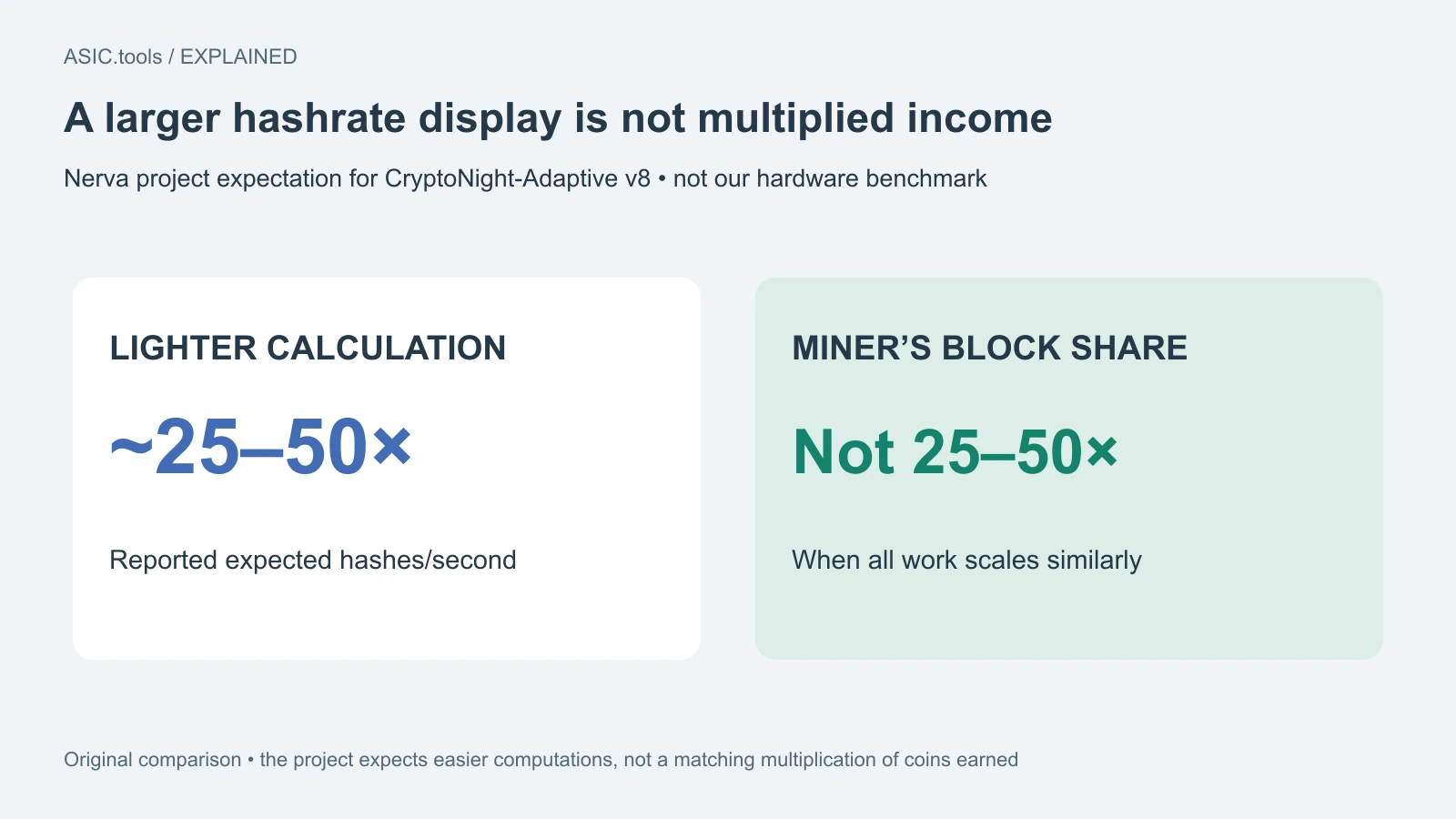
According to the project, the same processors may display roughly 25–50 times as many hashes per second because the new calculation is lighter. If everyone’s work becomes cheaper in the same way, a larger number on one screen does not create the same multiple of the owner’s share of blocks. Compare performance only with the algorithm and network conditions attached.
The project also expects a short adjustment period immediately after the fork: blocks may arrive quickly while difficulty catches up, as happened on testnet. Its testnet returned toward the usual 60-second interval in about two hours. That is a reported test observation and mainnet expectation, not a promised timetable or measured extra income for a particular processor.
Wallet restrictions deserve attention before activation
Transaction privacy changes too. The ring size rises from five possible inputs to sixteen, making the real spent input harder to distinguish, and the release adds CLSAG signatures and Bulletproofs+ proofs. These are ways of proving a transaction is valid while limiting what it reveals, not new mining hardware.
The developers say a typical transaction with two inputs and two outputs becomes about 22% larger, from roughly 1,800 to 2,190 bytes. Because the fee is charged by each started kilobyte, that example’s fee rises about 50%. The two percentages measure different things: data size and a rounded billing step. They are not a uniform fee increase for every possible transaction.
Existing multisignature wallets cannot spend after the fork, according to the project; it instructs users to move their funds before block 4,480,000. The notes also say the existing Ledger signing protocol cannot sign the new transactions. Owners using those arrangements should resolve compatibility through the official instructions before activation, rather than discover the limitation while trying to make an urgent transfer.
Check the tools actually running
NervaOne 1.4.0 adds a remote-node connection test and clearer synchronization information. It also explains that Rescan Spent requires the user’s own local node; with a remote node, it points users toward Rescan Blockchain instead. These functions solve different wallet-maintenance tasks and should not be confused with a mining speed setting.
The underlying release disables ZMQ, a messaging interface, by default and makes the Docker image’s remote-command service restricted. These are deliberate security changes. An operator relying on the old interface behavior should read the new options, rather than respond by exposing every service to the internet. The release provides signed hash lists for checking downloads.
For a household already mining XNV, the useful result is a completed, checked upgrade before the fork: the app installed, client tools updated, node and wallet versions matched, and synchronization confirmed. This news does not establish a particular daily yield, an ASIC option or a price forecast for the coin. It explains the new software and the concrete compatibility deadline.
Source: Nerva Project ↗ · Nerva 0.4.0.0 mandatory-fork release ↗ · Project October 26 fork announcement ↗
Mining calculator ↗