MARA mines more Bitcoin as revenue falls: what its $39,674 energy figure covers
Source report: 2026-11-09 · Editorial analysis published: 2026-11-10
The November 9 quarterly disclosure separates higher Bitcoin production from lower dollar revenue. Its owned-site energy cost is only one layer of a miner’s budget.
More coins did not mean more dollars
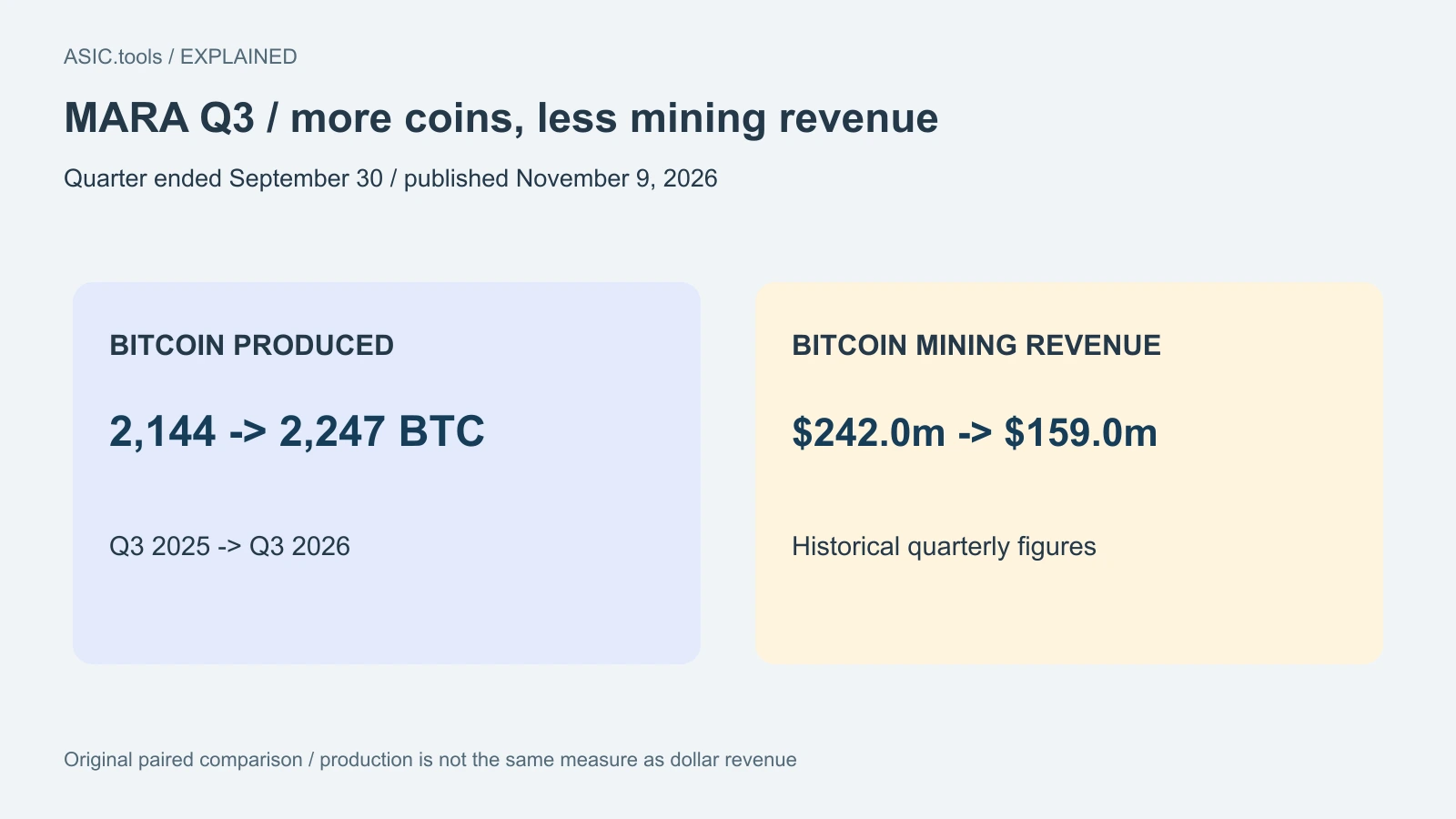
MARA’s third-quarter results, published on November 9, show why an increasing Bitcoin balance is not enough to judge a mining operation. The company reported production of 2,247 BTC for the three months ended September 30, up from 2,144 BTC a year earlier. Yet Bitcoin mining revenue fell from about $242.0 million to $159.0 million. More output met a much lower dollar value per coin.
The filing puts the average price of Bitcoin mined at $71,688, versus $114,440 in the comparable quarter, a decline of about 37%. These are historical quarterly figures, not today’s Bitcoin price or an offer to buy coins. For an ordinary miner the connection is direct: the pool can credit more BTC while the same coins pay less of an electricity bill denominated in money.
Read the $39,674 label carefully
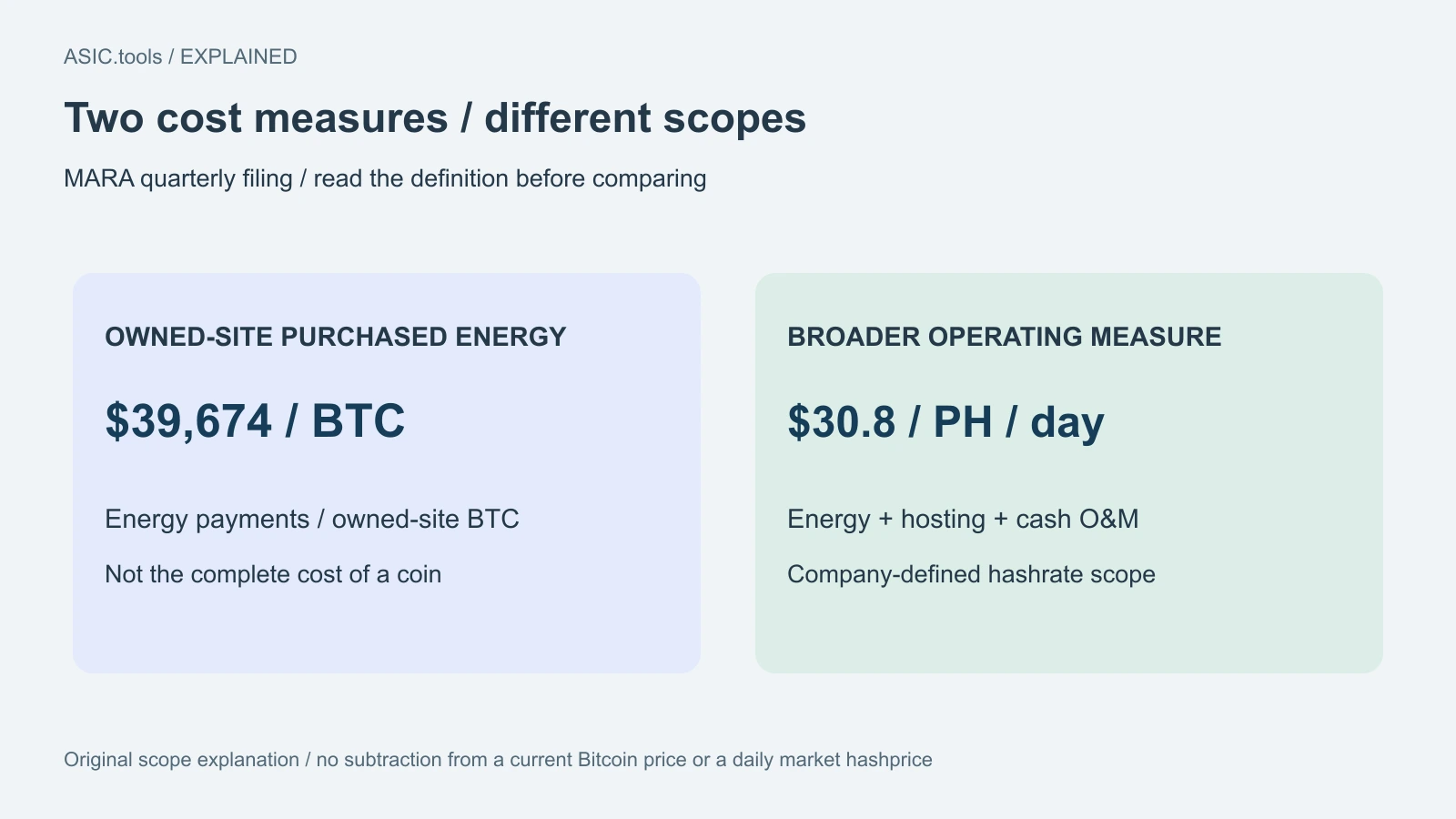
At MARA’s owned mining sites, purchased energy cost was $39,674 per BTC, compared with $39,235 a year earlier. This measure divides money paid to power providers for consumed power by Bitcoin produced at those owned operations. The relevant sites produced 1,213 BTC in the quarter. Their output is a subset of the group’s production, so it should not be mixed with the group-wide 2,247 BTC when reproducing the energy calculation.
That figure is useful, but it is not the full cost of producing or owning a Bitcoin. It leaves other operating and financial costs outside that particular measure. Subtracting $39,674 from a Bitcoin market price would therefore not reveal MARA’s net profit per coin. The same distinction matters at home: electricity is a visible recurring bill, while equipment depreciation, repairs and financing can arrive on different schedules.
A broader operating measure
The company also reports cost per petahash per day of $30.8, down from $31.3 a year earlier. A petahash is a unit of mining work; the daily measure makes it easier to compare costs against a quantity of operating hashrate. MARA’s definition includes purchased energy, third-party hosting and other energy costs, plus cash operating and maintenance costs, divided by average operational hashrate online during the period.
The definition excludes specified affiliate and noncontrolling-interest hashrate. It is broader than owned-site purchased energy per BTC, but it is still a company-defined operating measure, not a universal all-in profitability threshold. Nor should a quarterly fleet average be subtracted mechanically from a single current market hashprice. Time period, included machines and included costs need to match before two numbers can answer the same question.
Installed capability is not a pool payout
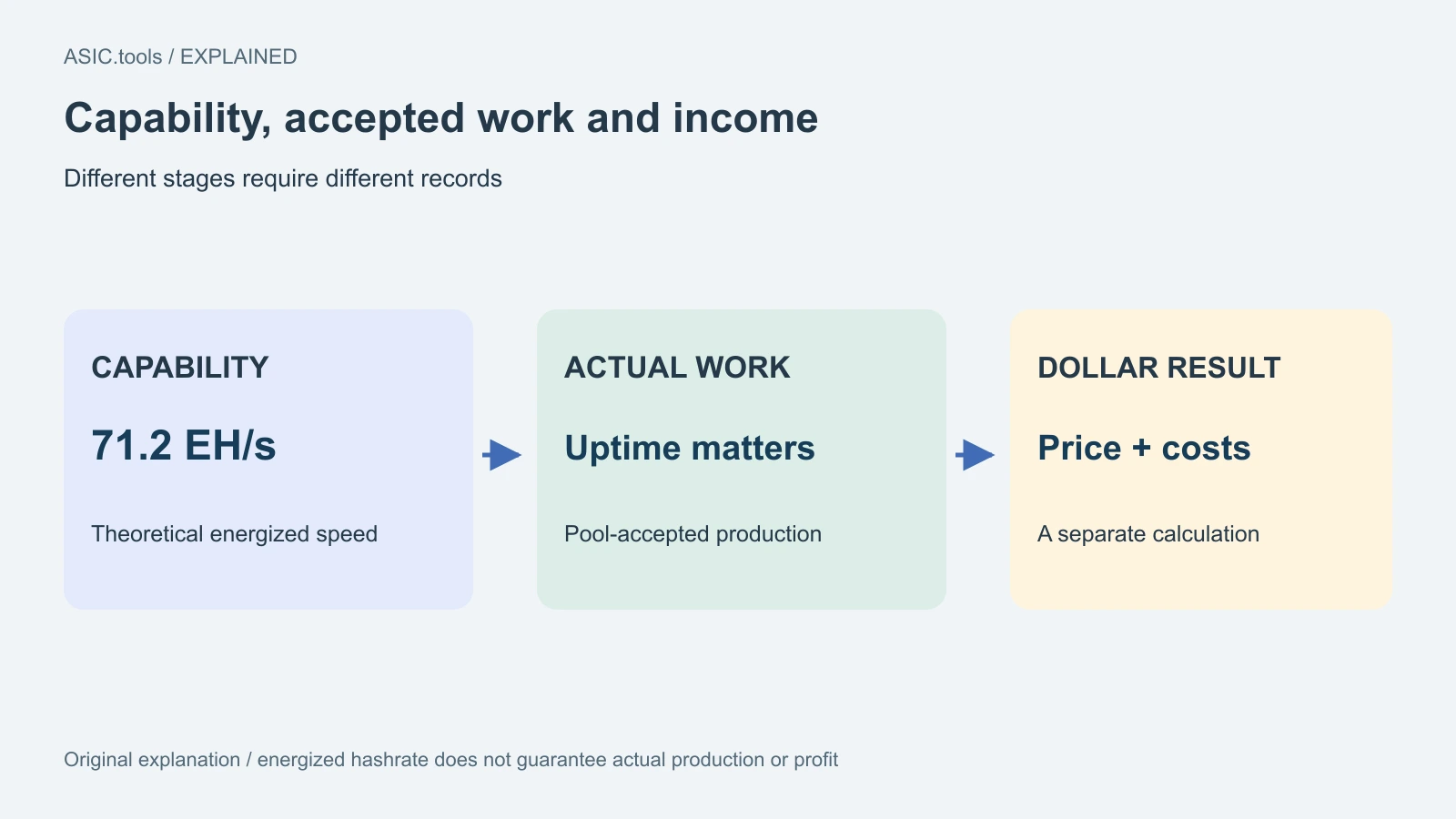
At September 30, MARA reported energized hashrate of 71.2 EH/s, against 60.4 EH/s a year earlier, and miner efficiency of 16.9 J/TH versus 18.6. Lower joules per terahash mean less energy needed for a given amount of hashing work. More efficient hardware can help keep a fleet competitive, but a headline speed figure alone cannot say how many hours every machine earned revenue.
MARA defines energized hashrate as theoretical capability if the relevant machines operate at full manufacturer specifications. Its filing explicitly describes interruptions such as curtailment and machine failure, as well as changes in network competition. A home operator sees the same distinction on a smaller scale: the speed printed on a product page, the local screen reading and the work accepted by a pool are useful numbers for different purposes.
Why efficiency did not remove every cost
MARA attributes lower cost per petahash per day partly to improved miner efficiency. Its discussion also identifies weather-related downtime at some Texas sites and higher site and miner repair and maintenance costs. These details show why a fleet can improve one efficiency measure while another cost per coin edges upward. Energy use, uptime, repair work and network conditions all affect different parts of the result.
The company’s owned-site purchased energy cost per kWh is shown rounded to $0.04. That is a historical company average with a defined scope, not a tariff available to every household or hosting customer. An operator comparing a hosting offer should use the contract’s complete charge and billing rules. Copying a large miner’s rounded energy figure into a personal calculation can hide the very costs that determine whether a smaller setup works.
A practical way to read the next report
Keep three separate questions in a mining budget: how much coin was produced, what dollar value that production had, and what costs were required to produce it. For a useful record, align the dates of pool credits, electricity meter readings and currency conversion. Then record equipment and other costs separately, rather than letting a favourable energy-only number stand in for the whole business.
The fresh disclosure covers July through September; it does not measure operating conditions on November 10. Its lesson is still timely: higher production and better hardware efficiency can coexist with lower dollar revenue. The report gives readers a concrete example of that combination and the definitions needed to read its costs accurately, without turning one industrial operator’s quarterly average into a promise for their own machine.
The filing also contains nine-month columns beside the quarterly ones. Before copying a cost figure, check the column heading and whether it refers to owned operations or the wider group. A correct number from a different period can still produce a misleading comparison.
Source: MARA / quarterly filing ↗ · MARA Form 10-Q, quarter ended September 30, 2026 ↗
Mining calculator ↗