New GPU miner releases target Pearl and Quantus: which cards get the changes
Source report: 2026-10-27 · Editorial analysis published: 2026-10-28
BzMiner 100.52 and OneZeroMiner 1.8.4 were released October 27. Their changes cover specific NVIDIA and AMD generations; a roughly 2% efficiency claim is not a universal increase in daily earnings.
Two October 27 releases give existing cards something to check
BzMiner 100.52 and OneZeroMiner 1.8.4 arrived on October 27 with changes for GPU mining, including Pearl and Quantus. The useful question is whether a release names the card and algorithm already running on a reader’s rig. These are updates to mining programs, not new coins, new ASIC models or evidence that buying another graphics card will pay for itself.
BzMiner’s GitHub release was published at 00:02 UTC and OneZeroMiner’s at 07:06 UTC. Neither entry is marked as a prerelease. We checked both original release records and their asset lists. The developers’ optimization statements remain their claims: we have not run these programs on test cards, and the release notes do not provide a common controlled benchmark that ranks the two miners against each other.
BzMiner separates Blackwell from AMD changes
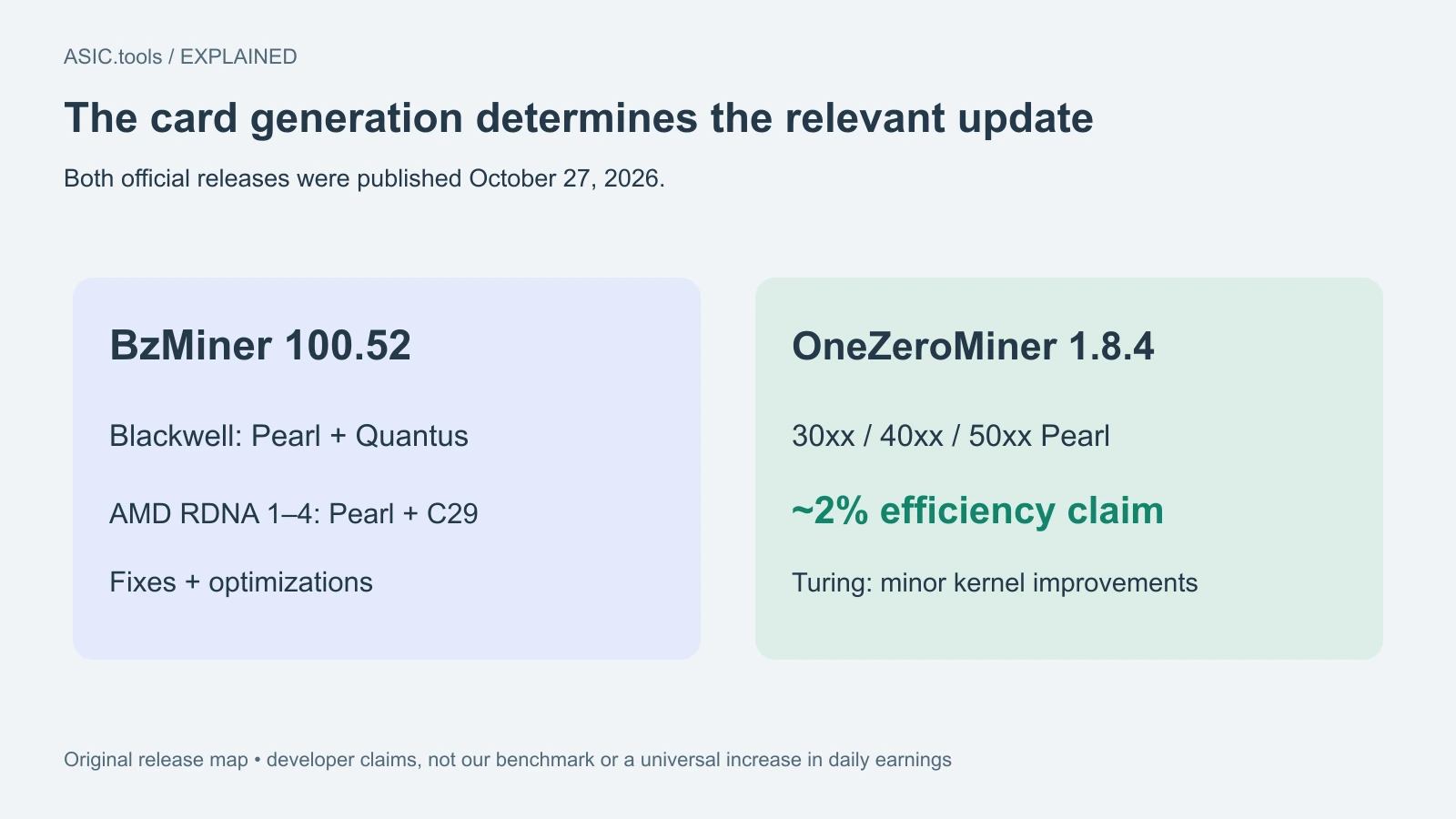
BzMiner 100.52 fixes Pearl hashrate for NVIDIA Blackwell and optimizes Quantus on the same architecture. Blackwell includes the RTX 50 generation relevant to home GPU owners. The wording does not specify a percentage for those changes or establish that older NVIDIA cards receive the same effect. A corrected hashrate reading also needs comparison with accepted work rather than being treated automatically as extra coins.
For AMD RDNA generations one through four, the release optimizes Pearl plus C29, another mining algorithm, in dual mode. It also fixes AMD GPUs not appearing on MMPOS, a mining-management operating system, and corrects the reset of overclock settings when the program’s hotkeys are used. Those are different issues: card detection, clock controls and algorithm execution should not be collapsed into one universal speed-up claim.
OneZeroMiner claims a modest Pearl efficiency improvement
OneZeroMiner 1.8.4 lists approximately 2% efficiency improvement in pearlhash for NVIDIA 30xx, 40xx and 50xx cards. It separately reports minor performance improvements to both kernel 1 and kernel 2 on Turing, including 20xx cards and CMP 50hx. A kernel here is a GPU computation routine, not a second physical card. The notes provide no exact percentage for the Turing change.
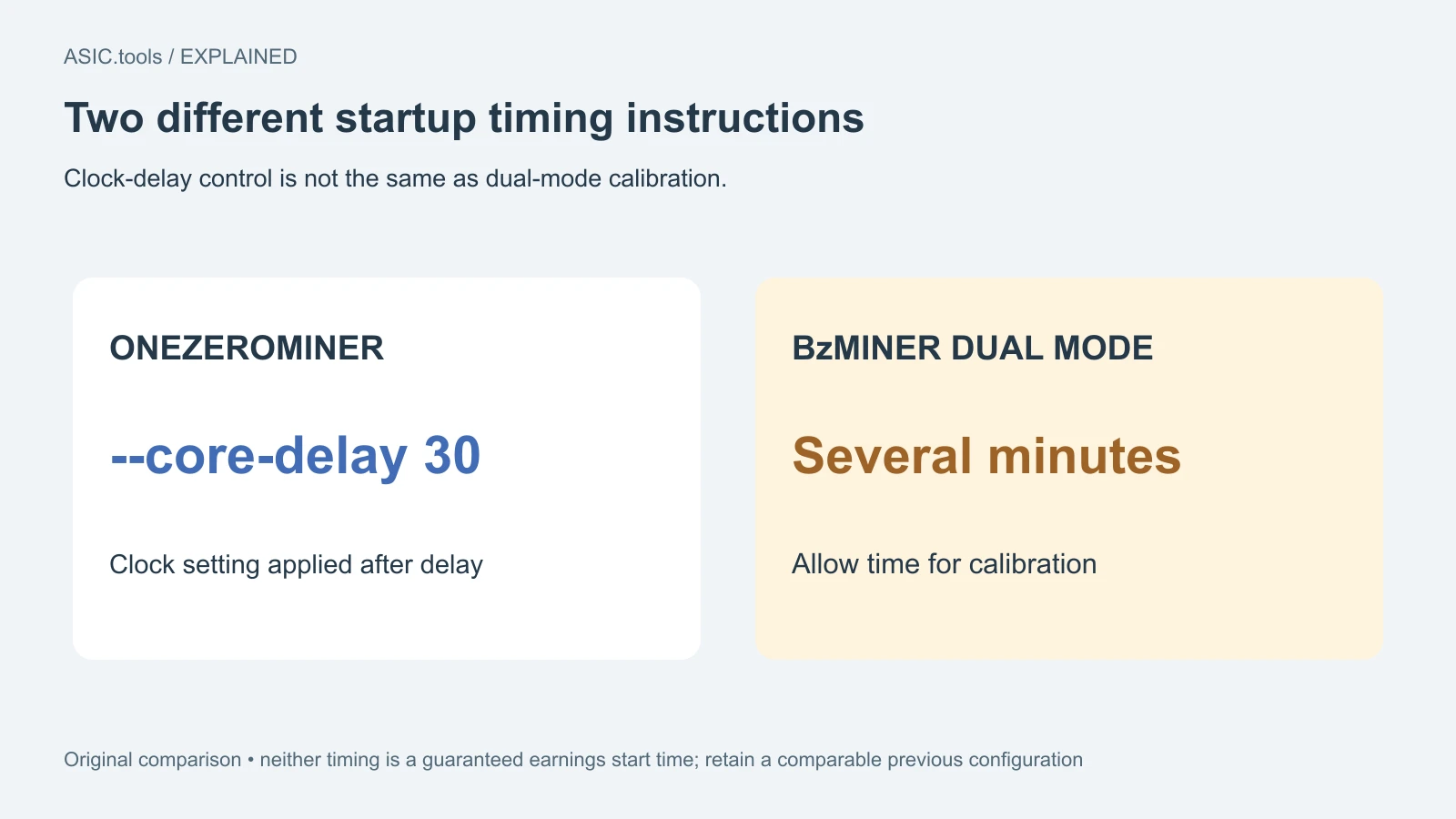
The release adds --core-delay, allowing core clocks and a core offset to be applied after a delay from startup; its example uses 30 seconds. This changes when a configured clock adjustment takes effect, not which clocks are inherently safe or profitable for every card. The reported efficiency improvement should be checked with actual power and accepted work under comparable conditions, rather than read as a promise of 2% more daily money.
The clock delay in OneZeroMiner and the calibration period in BzMiner are also different. The former delays applying a configured clock change; the latter asks the user to allow the dual-mode setup to settle. Neither means that mining earnings start at a fixed guaranteed level after thirty seconds. Keep the old version and configuration as a comparison point, and change one part at a time if the aim is to identify which update actually helped.
Dual mining instructions also determine the payout asset
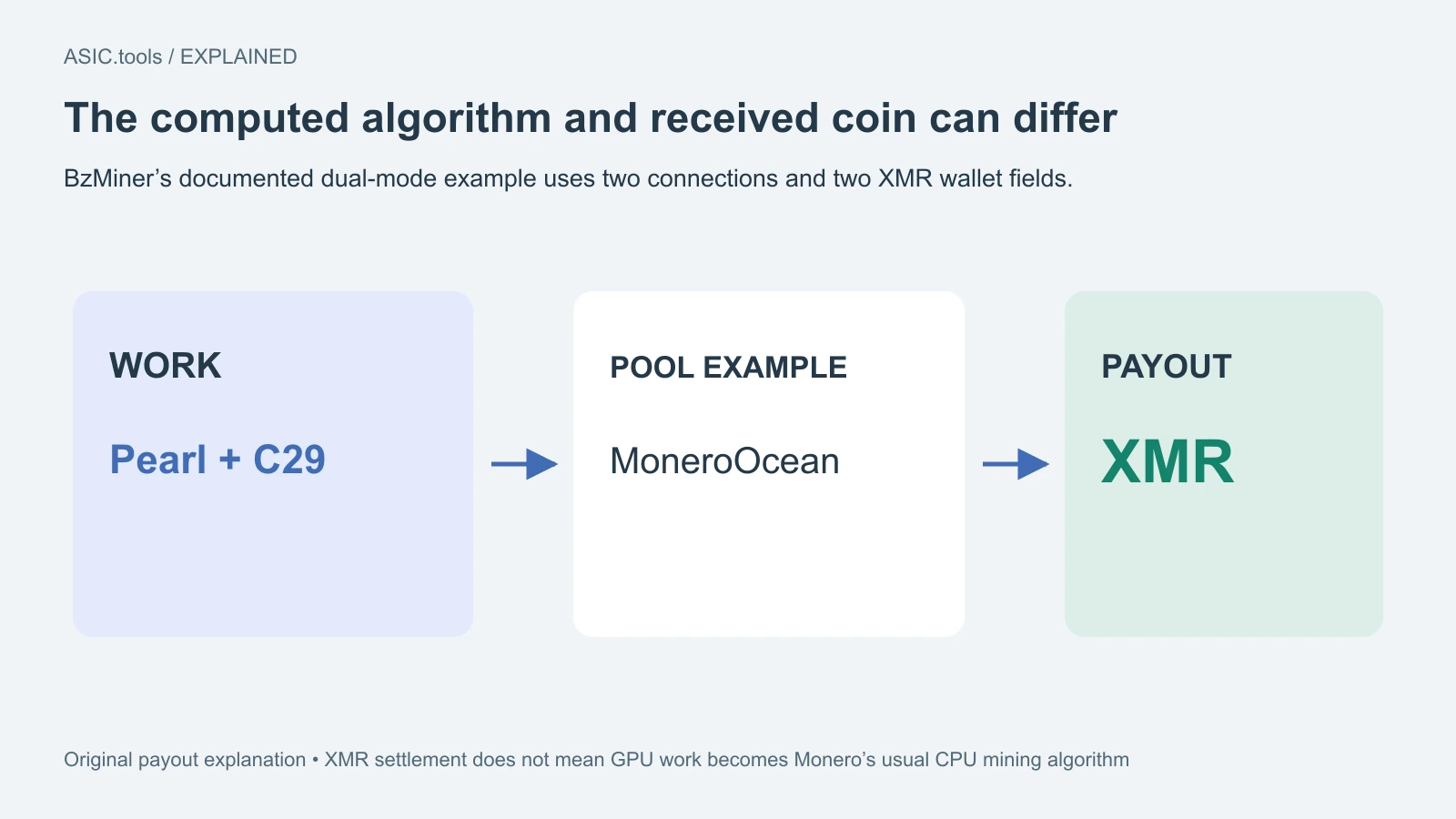
BzMiner’s Pearl plus C29 example uses two MoneroOcean connections and two XMR wallet fields. The documented passwords select the algorithms, and the same Monero receiving address can be used for both payouts. The computation being performed and the coin received are separate choices in this setup: payment in XMR does not make the GPU perform Monero’s normal CPU-oriented mining algorithm.
The examples cover Windows, Linux and HiveOS. The macOS example explicitly says C29 has no Apple GPU backend and exits; a macOS archive is not proof that this dual mode works on Apple graphics hardware. The release asks users to allow several minutes for calibration. In HiveOS, the additional-algorithm option adds C29 without replacing the main algorithm, so the flight sheet and second wallet deserve a check before applying it.
Compare the running setup, not just the headline percentage
An existing miner can retain the previous configuration, identify GPU generation and algorithm, and obtain the matching package from the official release. BzMiner publishes SHA-256 values for its files; matching one checks consistency with that publication, not an independent audit of the program. Installing a new version should not silently replace a receiving address or apply a sample wallet left in a startup script.
Afterward, compare accepted hashrate, rejected work, measured energy and stability over similar operating conditions. Pool fees, software fees, coin price and network difficulty belong in the earnings calculation separately. These releases offer specific improvements worth evaluating on compatible existing hardware. They do not settle a cross-program winner, a new hardware purchase, or the future rules of the Pearl network.
Source: BzMiner / OneZeroMiner ↗ · OneZeroMiner 1.8.4 official release ↗
Mining calculator ↗