ForgeMiner 1.9.1 fixes Pearl restart loops and stuck older Radeon cards
Source report: 2026-11-03 · Editorial analysis published: 2026-11-04
The November 3 release repairs several failures reported in 1.9.0, improves per-card control and lowers the NOID developer fee. Driver requirements still depend on the card and algorithm.
A repair release for rigs that stopped doing useful work
ForgeMiner published stable version 1.9.1 on November 3 at 17:59 UTC. Its most useful changes concern machines that restarted repeatedly, displayed zero hashrate or froze while preparing work. For their owners, restoring steady operation can matter more than a small headline speed gain. The release follows reports about version 1.9.0.
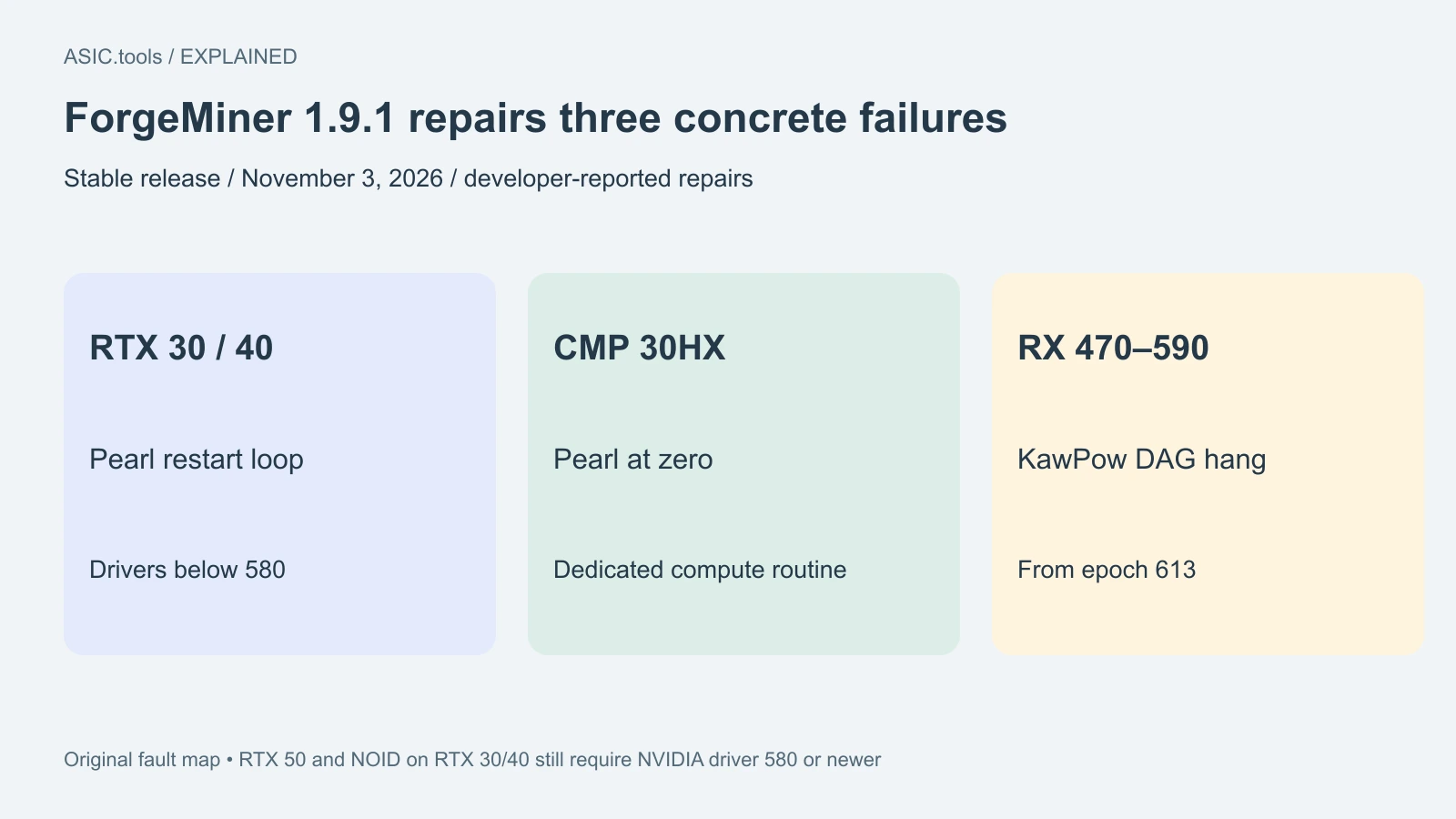
On NVIDIA RTX 30 and 40 cards running drivers below 580, the default Pearl compute kernel could cause a restart loop. The developer says it now loads on those drivers, with an automatic switch to kernel 2 where needed. A kernel here is the GPU calculation routine, rather than the operating system kernel. The release also adds a dedicated routine for the CMP 30HX, which had produced zero Pearl hashrate.
A separate fix covers KawPow on Radeon RX 470–590. From epoch 613, building its DAG could hang a card. The DAG is the algorithm's working dataset in GPU memory; rebuilding it at an epoch change is normal, hanging during that process is not. The developer lists this failure as fixed, rather than announcing a new coin or a change to the blockchain's rewards.
That does not remove every driver requirement. RTX 50 cards, and NOID mining on RTX 30 and 40 cards, still require NVIDIA driver 580 or newer. The older-driver Pearl repair should not be read as permission to use an older driver for every supported workload. Identify the exact card, operating system and algorithm before applying the release notes to a rig.
More honest clock settings and individual fan control
Version 1.9.1 expands Linux NVIDIA voltage controls across RTX 20, 30, 40 and 50 cards. An unsupported request skips the affected card while the others are still configured, with a reason shown in the dashboard. This is a control change reported by the developer, not a recommendation to copy another owner's voltage settings or a guarantee of lower electricity use.
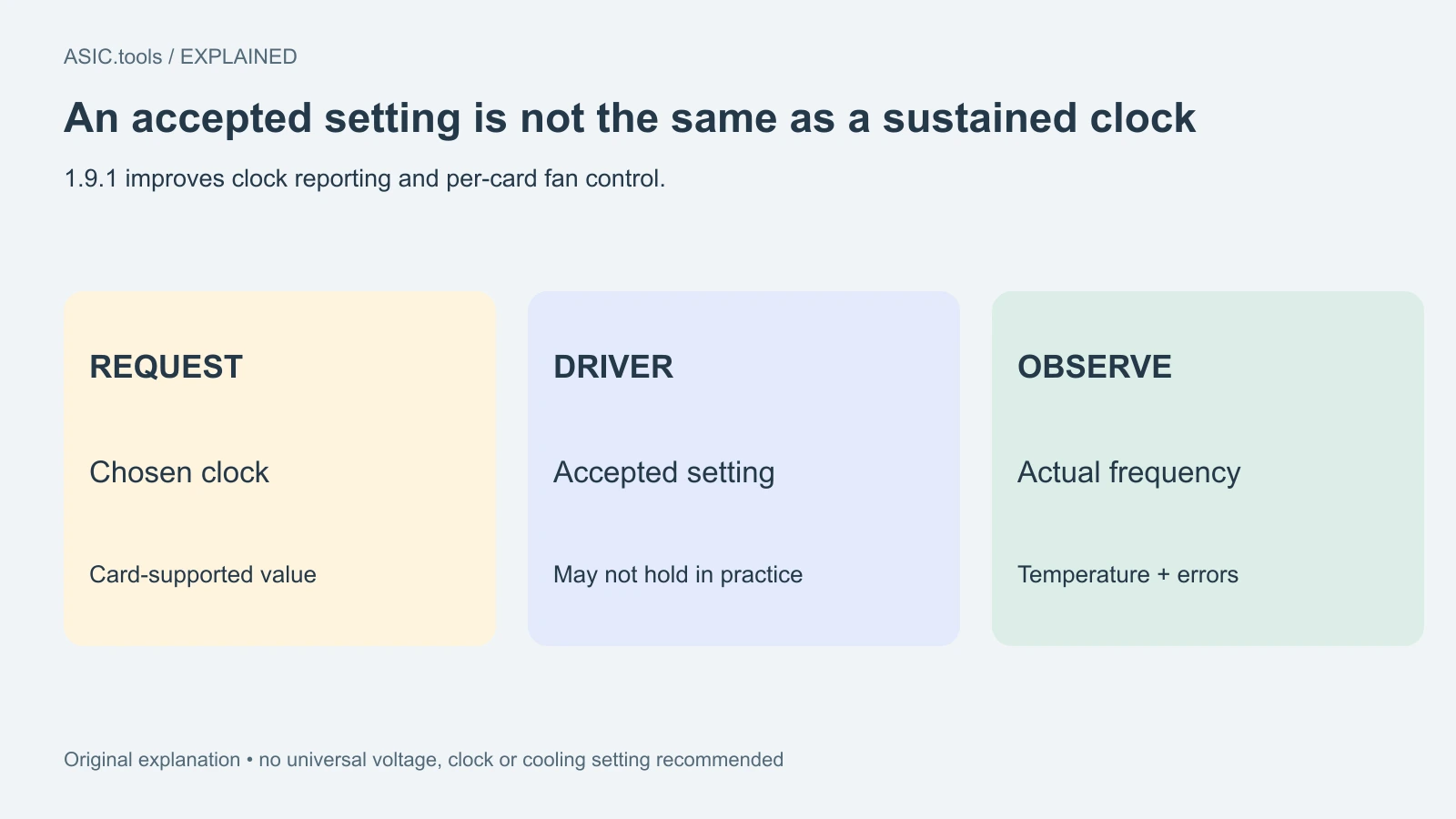
Memory-clock selection on GTX 10/16, RTX 20 and CMP 30–50HX now accepts the clocks the individual card lists. Unsupported requests are refused with the available choices. If the driver accepts a requested clock but fails to hold it, the miner reports that outcome. A setting being accepted and a setting actually remaining active are different things when judging stability.
The release supports a separate fan curve for each selected card, in GPU selection order; an asterisk leaves that card under driver control. It also fixes curves containing spaces that previously stayed at their first point. Mixed rigs need particular attention to card order, because a reasonable curve for one cooler may not suit the next card.
Other repairs make excessive core-clock requests show the frequency the driver will actually use, improve per-card reset on mixed rigs and return AMD fans to their own control on exit. Temperature, fan behaviour and actual clock readings therefore remain useful checks after changing versions. The notes do not establish a universal safe voltage, temperature or overclock for every board.
Pool recovery, isolated failures and a lower NOID fee
Two failed connections now move the miner to the next configured pool, and it returns to the first when that pool recovers. This helps an already configured fallback list; it does not create an account, select a trustworthy pool or ensure that the backup uses the right wallet and coin. Confirm accepted work on the active pool after a switch.
For Quantus, a GPU encountering a CUDA error can restart individually while the other cards continue mining. CUDA is NVIDIA's GPU computing platform. Keeping unaffected cards running can reduce the scope of an interruption, but the underlying cause still needs attention if the same card repeatedly fails. A recovering console is not by itself evidence of continuous credited production.
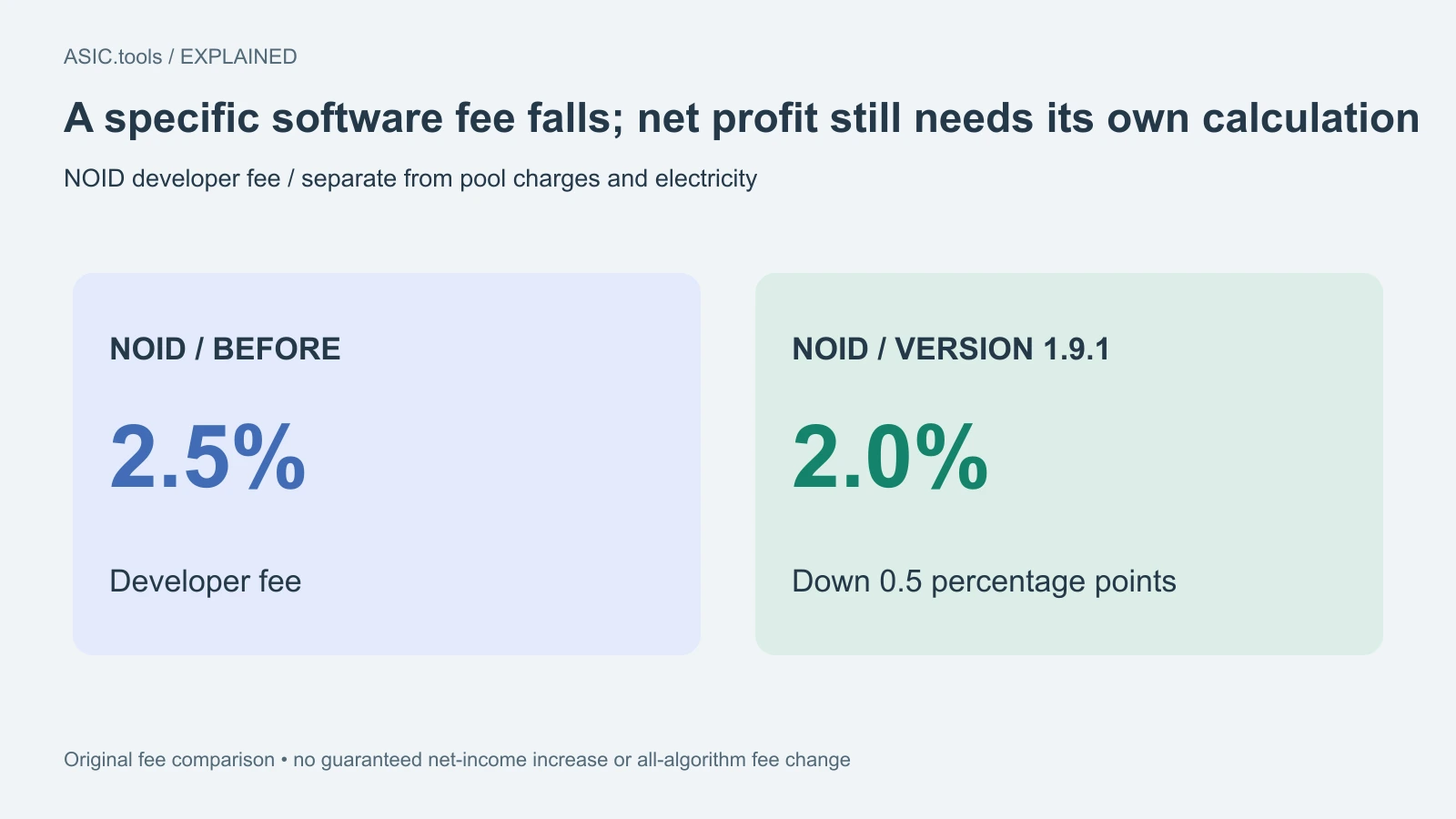
The NOID developer fee falls from 2.5% to 2%, a reduction of 0.5 percentage points. It is the software author's fee for that workload, separate from pool fees and electricity. This is not a 0.5% guaranteed increase in take-home profit: income also depends on accepted work, network conditions, coin value and operating costs.
The developer also reports cleaner shutdown and card handover, no unnecessary AMD OpenCL runtime on Windows systems without AMD cards, and HiveOS fixes for backup-pool URLs and commented GPU flags. A warning now identifies pools disconnecting on every full-size Pearl share. That is a specific compatibility symptom, not evidence that every lost connection is caused by a malicious pool.
Test the change against the problem you actually had
Reported performance improvements include up to 2% Pearl hashrate on RTX 50 at the same overclock, about 8% for Iron Fish on RX 470–590 and 0.3–1% Quantus on AMD. These are developer claims. They do not include an independent ASIC.tools benchmark or prove the same percentage gain in net earnings. Different algorithms' hashrates are not interchangeable.
A useful check holds the workload, pool, clocks and observation period comparable while recording errors, accepted work and whole-rig power. For a card formerly stuck at zero or restarting, first establish that it works steadily; only then judge speed and cost. Avoid changing several tuning parameters at once, because the resulting difference becomes harder to explain.
Official assets include Windows, Linux and HiveOS packages. The release supplies SHA-256 checksums, which can identify whether a downloaded file matches the named release. A checksum does not prove that software is harmless. Keep the previous configuration and a known working package available so a limited trial can be reversed if the specific fault remains.
No mining executable was run for this report. Its verified event is the publication of 1.9.1 and the repairs documented by its author. Owners whose existing machines already work reliably can compare the listed changes with their own hardware before scheduling an interruption. The practical aim is sustained useful work at measured cost, rather than updating every rig for a percentage in a release title.
Source: ForgeMiner ↗ · Official repository and documentation ↗
Mining calculator ↗