Suprminer 1.9.55 prepares NEB models early: what the tests actually show
Source report: 2026-11-22 · Editorial analysis published: 2026-11-23
The new release enables early TESS preparation on supporting pools. Live tests report modest gains, while Kepler preparation stays off by default.
An update aimed at the wait between models
Suprminer 1.9.55, published on 22 November at 23:11 UTC, changes how GPUs prepare work for NEB mining. When a compatible pool sends the next model early, the miner can prepare it while continuing the current job. The practical aim is to spend less time getting ready when the job changes.
A model here is a set of data and instructions used by the mining workload. Kepler and TESS are two model types in the NEB software; these names are not a claim that the update adds a new graphics card. Early preparation moves some work into the background, where it still consumes computing resources.
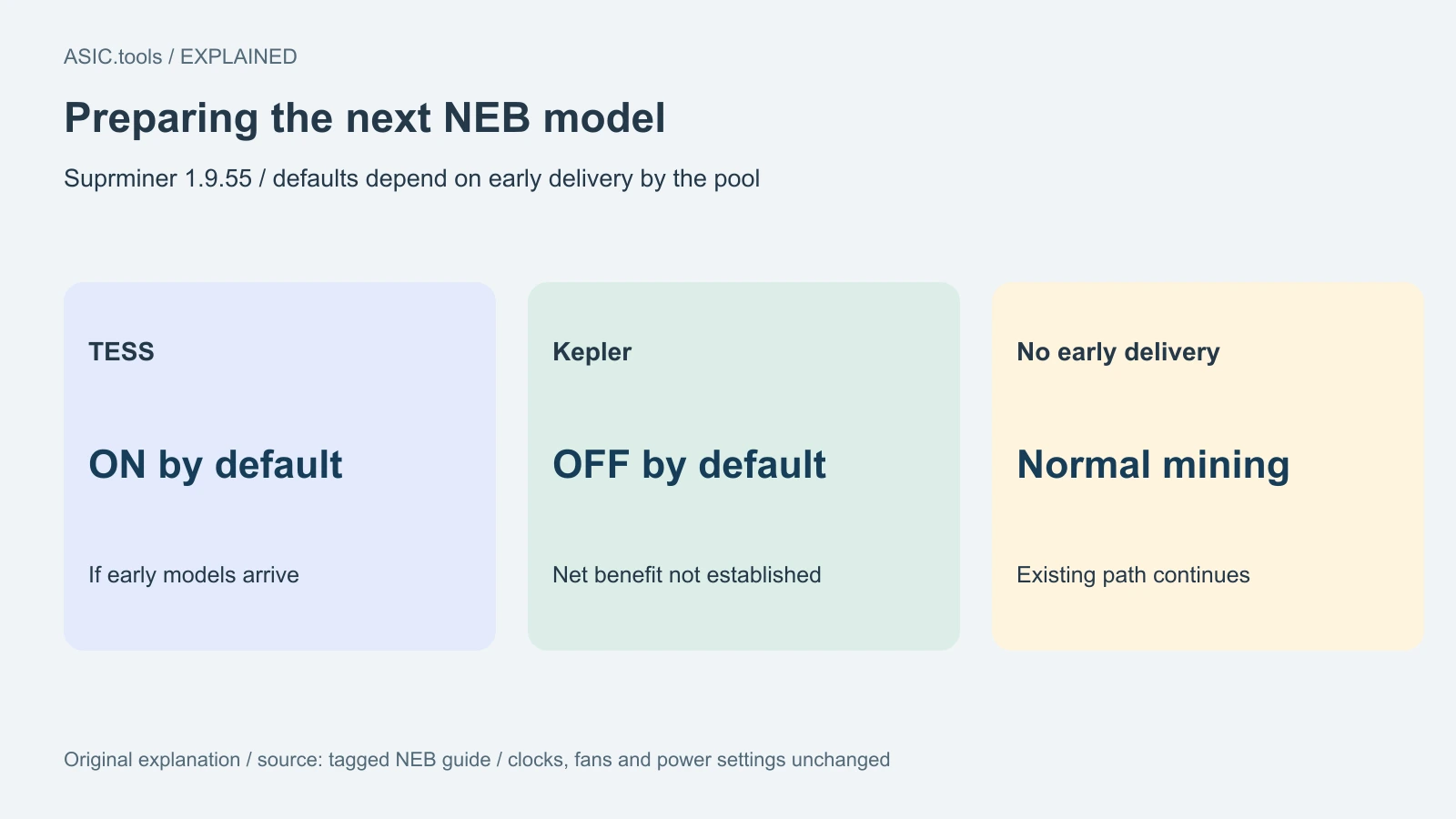
The defaults reflect that trade-off. TESS preparation is enabled when the pool supplies early models, while Kepler preparation stays disabled because a net speed benefit has not been established. A pool without early delivery continues normal mining. The release leaves clock, fan and power settings unchanged.
What happened in live pool tests
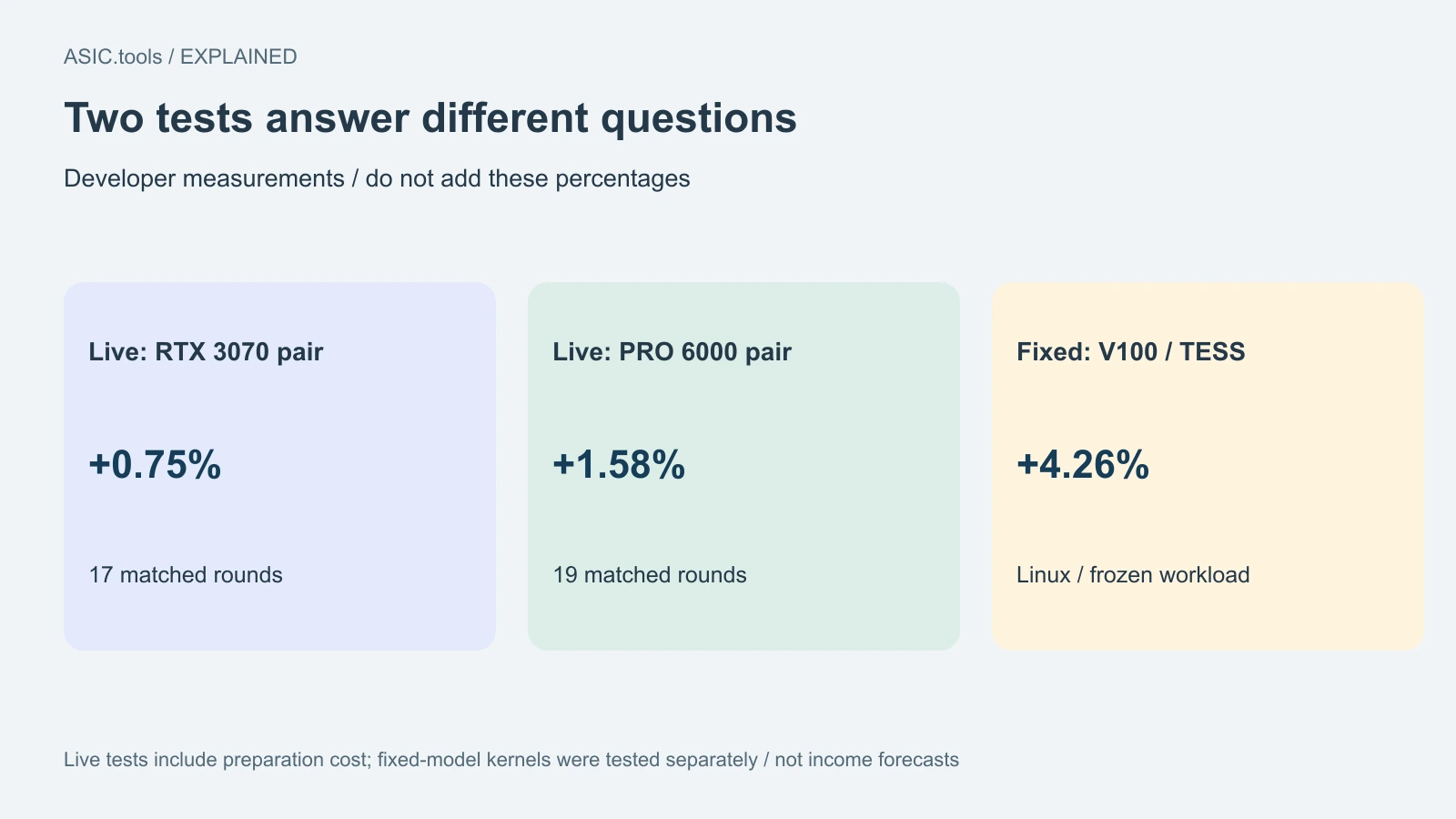
The developer tested pairs of RTX 3070 and RTX PRO 6000 cards with TESS preparation on and off. Each pair ran two ten-minute arms and exchanged roles. Only complete rounds with the same model hash were compared, excluding startup. This makes the comparison more useful than measuring two unrelated jobs.
The reported equal-arm geometric improvement was 0.75% for the RTX 3070 pair across 17 matched rounds and 1.58% for the RTX PRO 6000 pair across 19 rounds. Those figures include the cost of preparing the next model while mining the current one. They depend on how the pool delivers models and when jobs change.
Across these trials and a separate RTX 5090 connection check, miner and pool logs agreed on 469 accepted shares and six stale submissions marked “job not found”, with no invalid-hash rejects. A share is a result submitted to demonstrate work; an accepted share is not itself a Bitcoin or NEB block. No block was found during this test window.
Separate gains on fixed workloads
There is also a different benchmark: identical frozen Kepler and TESS models, tested on Linux on 22 November. Four 220-second arms per card alternated versions in A/B/B/A order. The first 60 seconds of each model interval were excluded for construction and warm-up. Tested development kernels were checked against the release kernels.
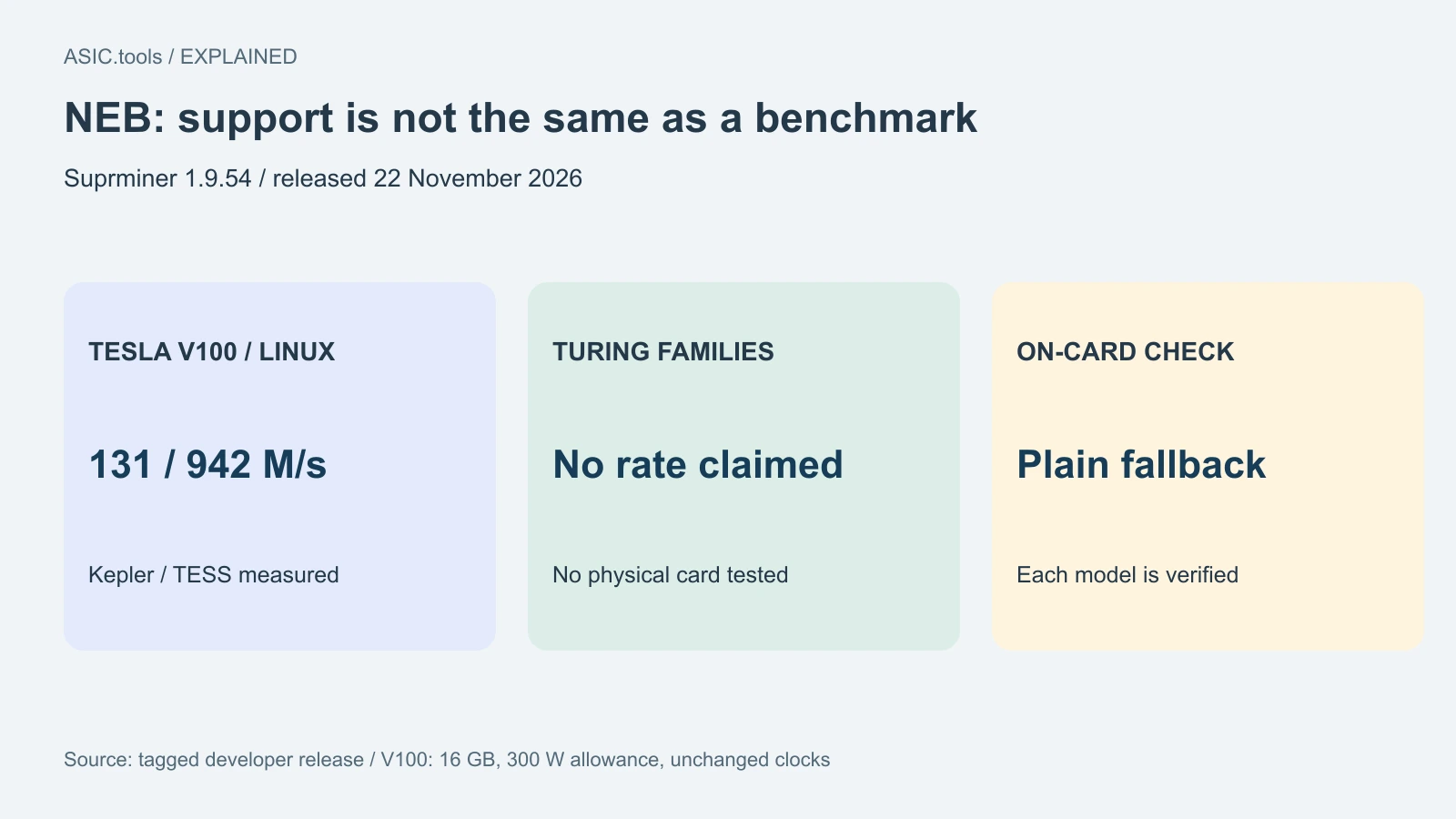
On the V100 16 GB, Kepler rose from 108.71 to 112.43 MH/s and TESS from 948.16 to 988.51 MH/s: reported gains of 3.43% and 4.26%. MH/s means millions of evaluated attempts per second in this workload. V100 NEB support is Linux-only. These fixed-model percentages must not be added to the live preparation gains; they measure different things.
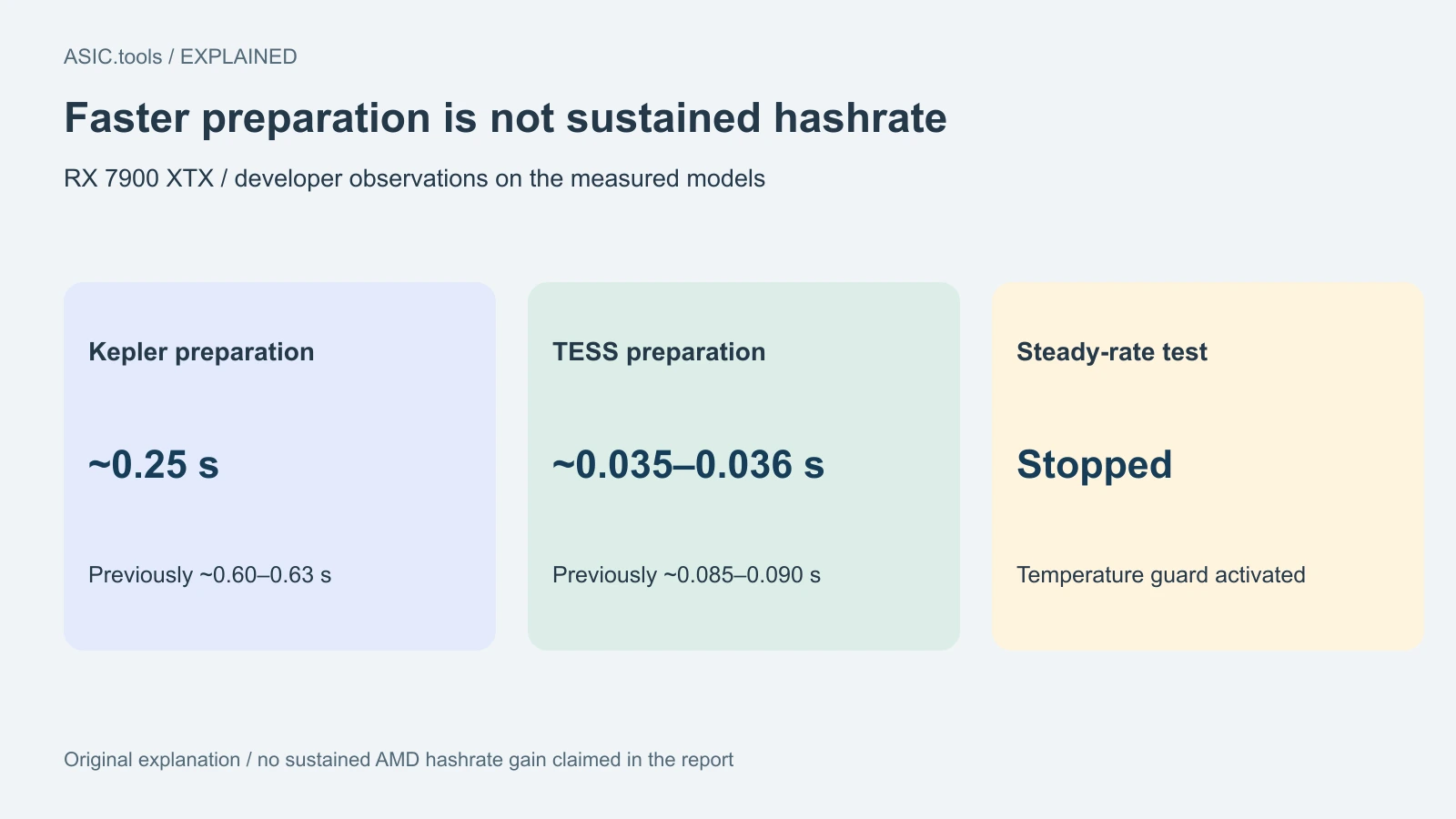
The report also limits its claims. Tiny RTX 5080 differences were run variation, and RTX 5090 comparisons did not establish a sustained gain. RX 7900 XTX prepared models faster, but the final steady-rate test stopped at a temperature guard, so no sustained AMD hashrate gain is claimed. Published GPU power readings are not whole-system wall consumption.
How to keep control of preparation
The global command-line option --disable-neb-predictions turns off all predicted-model preparation. Separate options --disable-neb-tess-predictions and --disable-neb-kepler-predictions target the model being prepared, regardless of which model is currently running. The global disable overrides both model settings. Normal mining and the model cache remain available.
An environment setting, NEB_PREPARE_AHEAD=0, offers another way to disable all preparation. Kepler opt-in uses NEB_PREPARE_KEPLER=1, but a per-model disable still takes precedence. Disabling preparation does not ask a pool to stop sending model messages. Missing or changed early updates are validated and fall back to normal mining.
For an existing rig, the useful comparison is accepted work over comparable rounds, along with stale shares, temperatures and measured electricity. These are developer tests, not measurements by ASIC.tools or a promised increase in income. No physical Windows GPU was available for the published benchmarks; Windows qualification used CI, host tests and kernel identity checks.
Source: Suprminer ↗ · Tagged NEB release guide ↗ · Matched fleet and live-pool tests ↗
Mining calculator ↗