ForgeMiner 2.1.2 adds NEB and brings Proxima to older Radeon cards
Source report: 2026-11-23 · Editorial analysis published: 2026-11-24
The November 23 release supports mixed NVIDIA and AMD rigs for NEB. Radeon RX 400, RX 500 and Vega gain Proxima support.
New work for GPUs already on the shelf
ForgeMiner 2.1.2 added NEB mining on November 23 and broadened Proxima support to older AMD cards. For a rig built around Radeon RX 400, RX 500 or Vega, the change provides more choices for testing existing equipment. ForgeMiner is a program for graphics cards that takes a job and sends the results back to a pool or, where supported, a node.
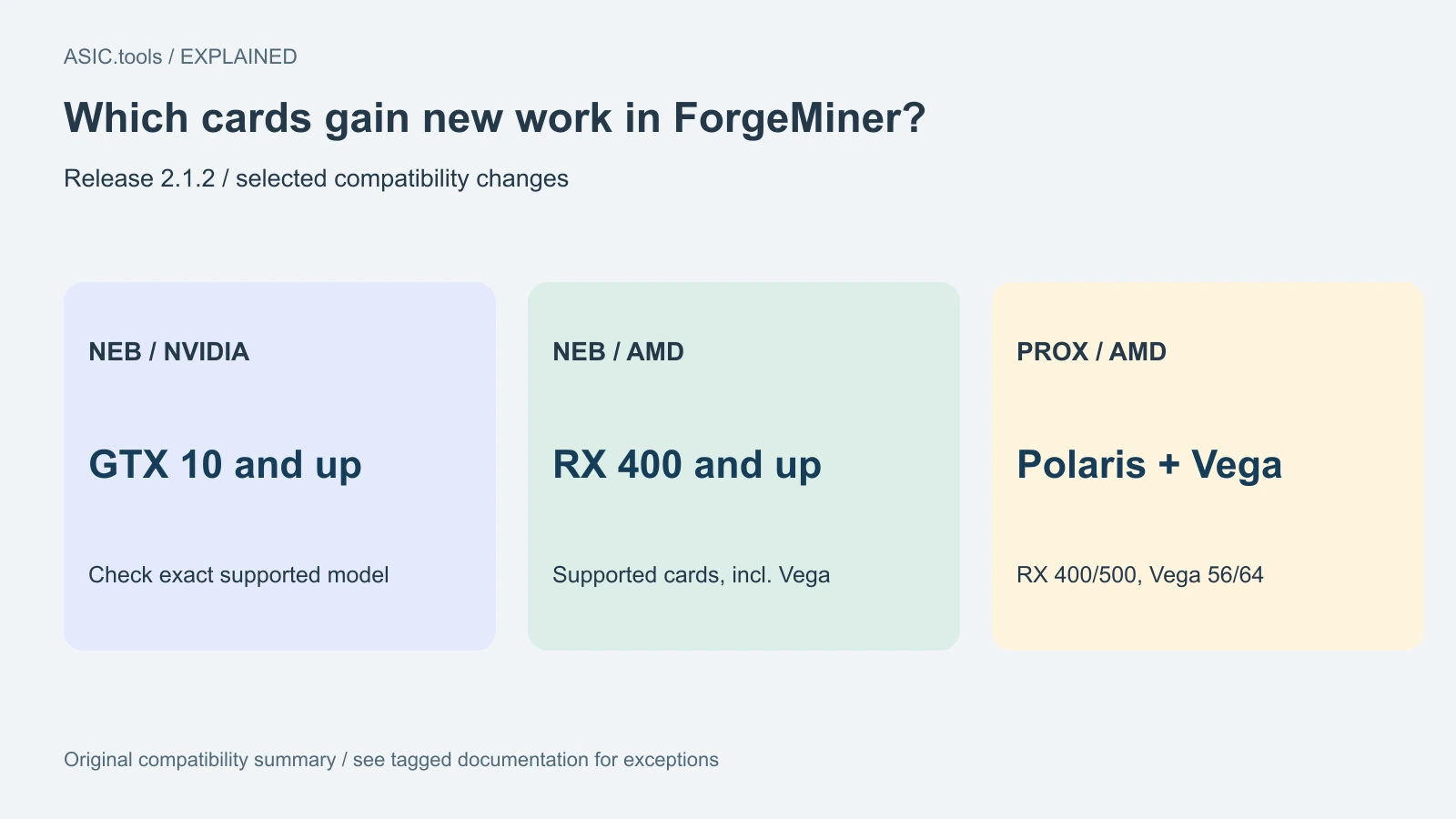
The developer lists NEB support from the NVIDIA GTX 10 series and from supported AMD RX 400 cards, including Radeon Vega. A mixed rig can mine NEB with both brands in the same process. Exact model support still matters. The hardware table excludes RX 6500 XT, RX 6400 and integrated Radeon graphics, and RTX 50 needs NVIDIA driver 580 or later.
NEB uses a 16 MB dataset, a file with data the GPU needs for its calculations. The release notes say the packages include it, and ForgeMiner can fetch, check and keep it if absent. The program checks each share on the CPU before sending it. A share is a small proof that the rig performed work, which the pool still has to accept. The developer charges 1% for NEB within ForgeMiner. Any pool charge follows the rules of that pool.
In the Linux documentation, NVIDIA uses the CUDA driver and AMD uses OpenCL, a runtime that lets software run calculations on the graphics card. Confirm both parts on a mixed rig. The tagged guide also lists the supported models by generation and the wallet format required by individual pools.
What changed for Proxima
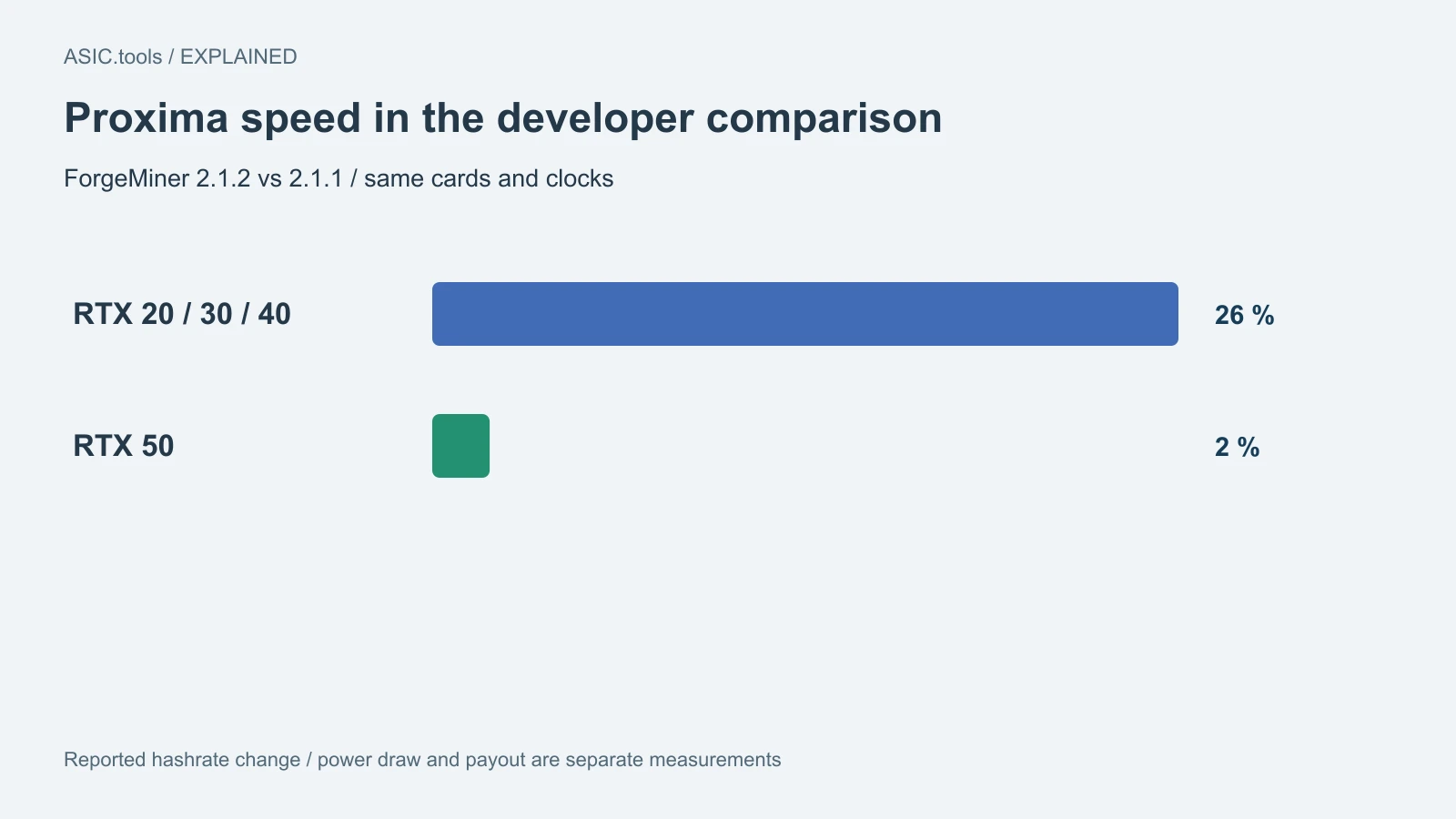
The release adds Proxima on Radeon RX 400 and RX 500, known as Polaris, and on Vega 56 and 64. It includes a Proxima kernel for the Tesla P100. The developer reports 26% more Proxima hashrate on RTX 20, 30 and 40 cards and 2% on RTX 50, compared with 2.1.1 at the same clock settings. Those are the developer’s speed figures for this specific comparison. There is no common power or earnings result for all the cards.
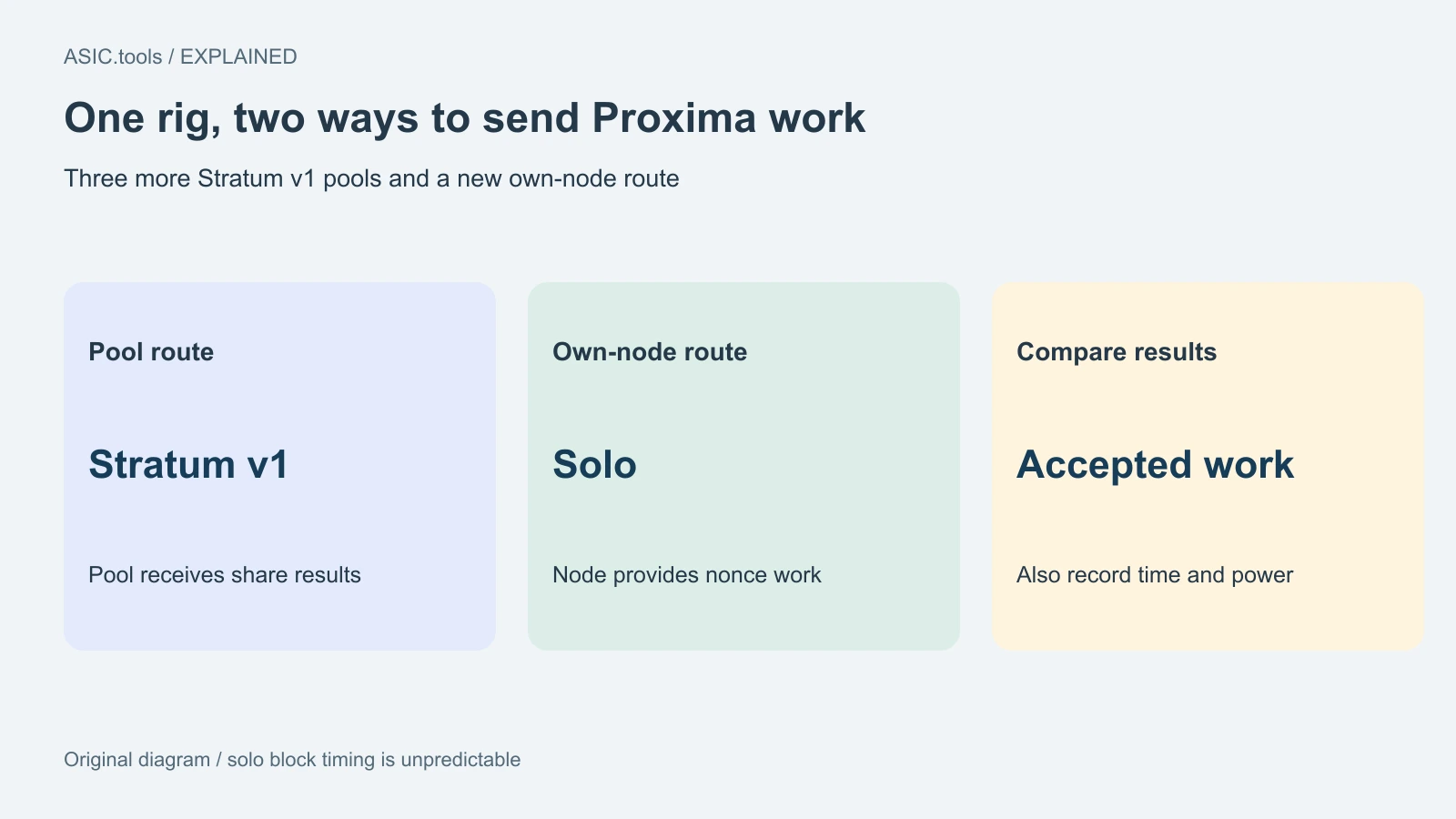
ForgeMiner also adds support for three more pools using Stratum v1, the protocol a miner uses to receive jobs and submit work. The other new route connects the software to an operator’s own Proxima node for solo mining. That node supplies work through its interface for finding a nonce, a value the miner varies as it searches for a valid result. The node and pool paths have different payment patterns. With solo mining, a valid block can take an unpredictable amount of time to find.
The new Vega support also changes the broader list of usable algorithms. BTX remains unavailable there, and Conflux needs more than 8 GB of memory. The developers report a fix for Xelis hangs on RX 400 and RX 500. The release also drops its Iron Fish mode and launchers, so an existing profile for that algorithm needs attention before switching versions.
What to compare on your own rig
The release offers Windows, Linux and HiveOS packages and lists SHA-256 checksums for those three archives. A checksum lets you compare the file you received with the one identified by the publisher. A HiveOS custom flight sheet points to a versioned installer. The tagged documentation notes that HiveOS can keep the earlier installation if the URL stays the same. Check the version shown on the rig after changing the sheet.
Run the same coin, pool and GPU settings when you compare two versions. Pool-accepted work, rejected or late shares, uptime and wall power provide a clearer view than peak speed alone. An example comparison can use equivalent operating windows long enough to include job changes. Record any change in card temperature or stability before carrying the new version to other rigs.
The existing release notes for 2.1.1 reported results for several Proxima work types. Use the test baseline given with the 2.1.2 numbers when comparing them. A percentage from a different task or version comparison does not describe the same run.
The practical gain is a wider choice of work on hardware readers may already own and a new Proxima route for people running their own node. How valuable those changes are depends on the card, the work a pool supplies, the payout rules and the electricity used.
Source: ForgeMiner ↗ · ForgeMiner 2.1.2 tagged documentation ↗ · ForgeMiner 2.1.1 release notes for comparison ↗
Mining calculator ↗