Braiins OS 26.09: cold-start fixes and PSU temperature logs
Source report: 2026-09-16 · Editorial analysis published: 2026-09-18
The September 16 firmware release improves startup diagnostics for supported Antminers. We explain control-board differences and a practical farm update checklist.
Analysis and practical implications
This section is our analysis and illustrative calculations, separate from the source report.
What the release says
Braiins released OS 26.09 on September 16, 2026. For S19/S21 devices it adds a startup-cooldown time limit, log search, safe-frequency preheat and APW11/APW12/APW17 temperature logging. Fixes cover Zynq hydro PSU communication after restart, cold-start power, custom fan ranges and saved ramping times. Mini Miner 101 gains compressed swap. These are firmware changes; the announcement gives no measured fleet-wide efficiency gain.
Observe the entire cold start
Our suggested test records the miner from power-on through preheat to sustained hashing. A brief low power reading during startup is not the same as a persistent shortfall under stable load. Keep timestamps for phase transitions and compare with a prior start under similar inlet conditions. Change one variable at a time: an upgrade combined with new power targets and cooling settings makes attribution much harder.
Read PSU temperatures in context
A logged temperature describes a sensor, not the wall-meter energy bill. Our operational recommendation is to retain the PSU model, load and cooling conditions alongside each reading. A change in inlet temperature can explain a change that might otherwise be blamed on firmware. Compare trends on the same device before comparing unlike supplies; neither one temperature nor a single hashrate sample establishes energy efficiency.
Treat communication errors as evidence
The documented I2C: no ACK fix has a specific hydro/Zynq context. Our advice is to preserve the error sequence before updating, then inspect whether it recurs after a comparable restart. If it remains, record the exact board, supply and firmware revision for support. The existence of a software fix does not show that a connector, cable or PSU is electrically healthy, and should not be treated as a reason to bypass protections.
Check settings after saving
Our post-update checklist reopens saved performance and fan settings, rather than assuming that a successful Save message proves persistence. Photograph or export the intended baseline first. Compare the displayed values after saving and after a normal restart, and observe the actual transition to load. For a large farm, separate desired configuration, returned configuration and observed behavior in the update log.
Identify the board before deployment
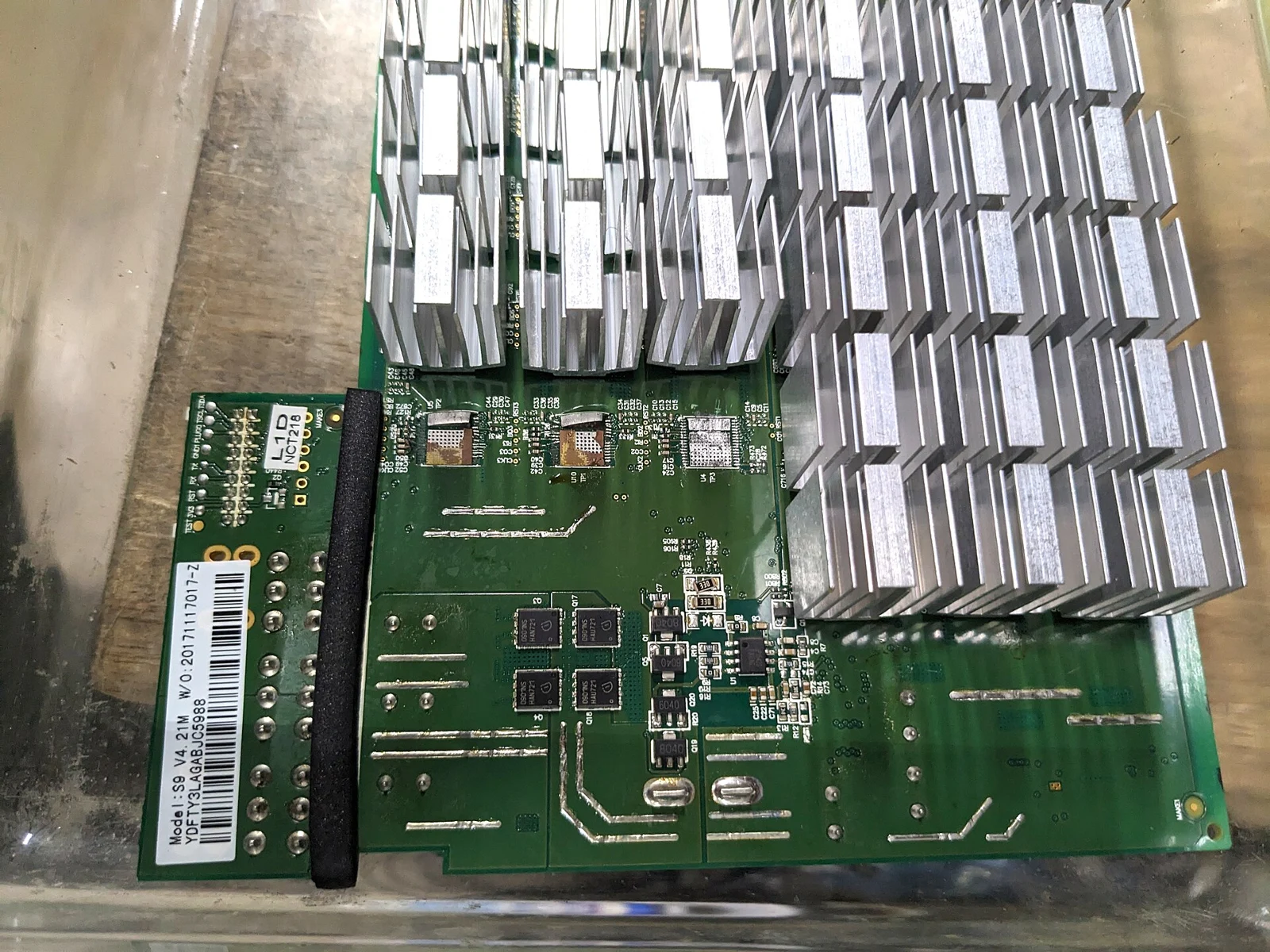
A model label is only the start of compatibility checking. Our inventory recommendation includes control-board family, cooling type and hardware revision before selecting an installation route. Test on a representative spare or a small group with a documented recovery path. Do not convert a fix for one board combination into a claim that every unit carrying the same Antminer name can use the same package.
Search logs without losing the timeline
Log search helps locate a symptom, but our troubleshooting method also reads the events immediately before and after it. Retain a complete archive before clearing logs or resetting the device. Link the archive to its serial number and test start time. A filtered result that contains no matching phrase cannot alone establish that startup was clean: the relevant event may use another message or lie outside the retained interval.
Mini Miner and acceptance criteria
Compressed swap on Mini Miner 101 concerns memory management, not additional physical RAM or a new rated hashrate. Our acceptance criteria are stable starts, preserved settings, useful logs and normal sustained operation under comparable conditions. Assess any economic result separately with pool-accepted work, metered electricity and downtime. The release notes establish what the developer changed; the farm test establishes what happened on your own hardware. Record the tested version and dates so a later update does not overwrite the evidence.
Source: Braiins Academy ↗
Mining calculator ↗