Zcash activates NU7: 25-second block targets and smaller rewards per block
Source report: 2026-11-06 · Editorial analysis published: 2026-11-06
The upgrade took effect at block 3,543,405 on November 6. The scheduled subsidy per block fell to a third, the fee split changed, and the legacy Sprout transaction path closed.
The network passed the activation block
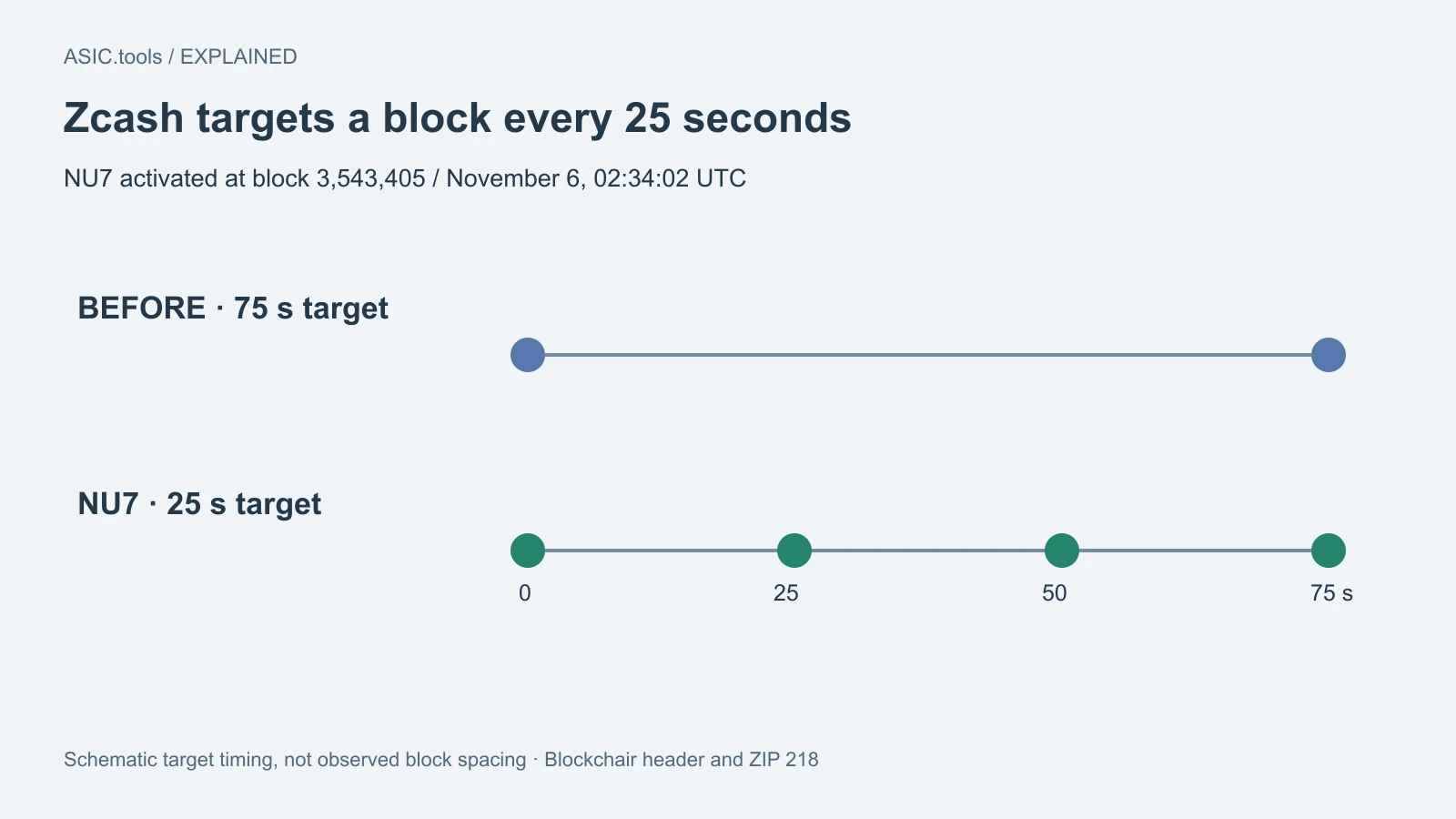
Zcash switched to NU7 on November 6 at block 3,543,405. The mainnet block header records 02:34:02 UTC; the activation height matches the deployment specification. The change matters to an Equihash miner even if the machine looks the same after a restart: the chain now aims to produce blocks three times as often, and the rules for what each block pays have changed.
The 25-second number is a target, down from 75 seconds. A particular block can still take much longer or arrive just after its predecessor. The network needs time to settle into its new rhythm as mining difficulty adjusts, so counting a few blocks over breakfast is a poor way to estimate the next month's income.
For a payment, more frequent blocks can bring the first confirmation sooner. A confirmation means the payment is included in a block, with later blocks building on it. An exchange may count several confirmations before crediting a deposit and may review that count after an upgrade; a shorter target alone does not tell you when your account balance will update.
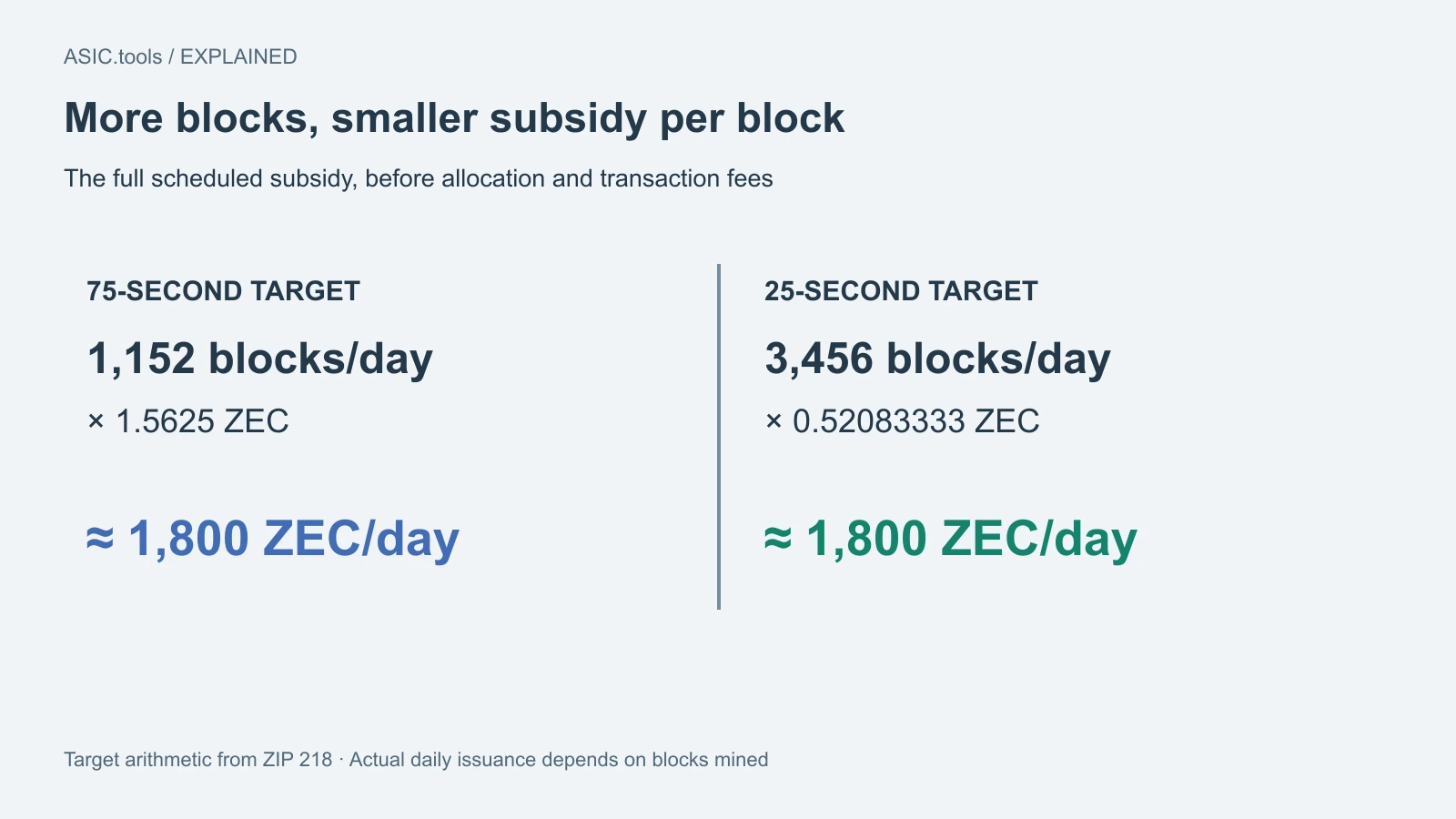
More blocks share roughly the same daily subsidy
A block subsidy is the new ZEC the protocol schedules for a block, before splitting it among eligible recipients and adding any fees. At this height it went from 1.5625 ZEC to about 0.52083333 ZEC. The old target implies 1,152 blocks per day; the new one implies 3,456. At those target rates, each schedule produces about 1,800 ZEC a day in total subsidy.
That is why the new block rhythm is neither a threefold pay rise nor a two-thirds cut in daily issuance. Think of serving the same loaf in more, thinner slices. The daily total is a protocol target; actual output on a particular date follows the blocks that were mined. A halving, which reduces the scheduled subsidy, is a separate event; the remaining intervals are rescaled in blocks to retain the intended calendar cadence.
Those totals describe the whole scheduled subsidy, not what a single worker or pool receives. For a home miner, ZEC earned also depends on the share of network work it supplies, power uptime, payout method and pool charges. The best comparison puts earnings and accepted work over the same period next to electricity consumed over that period.
A new split for transaction fees
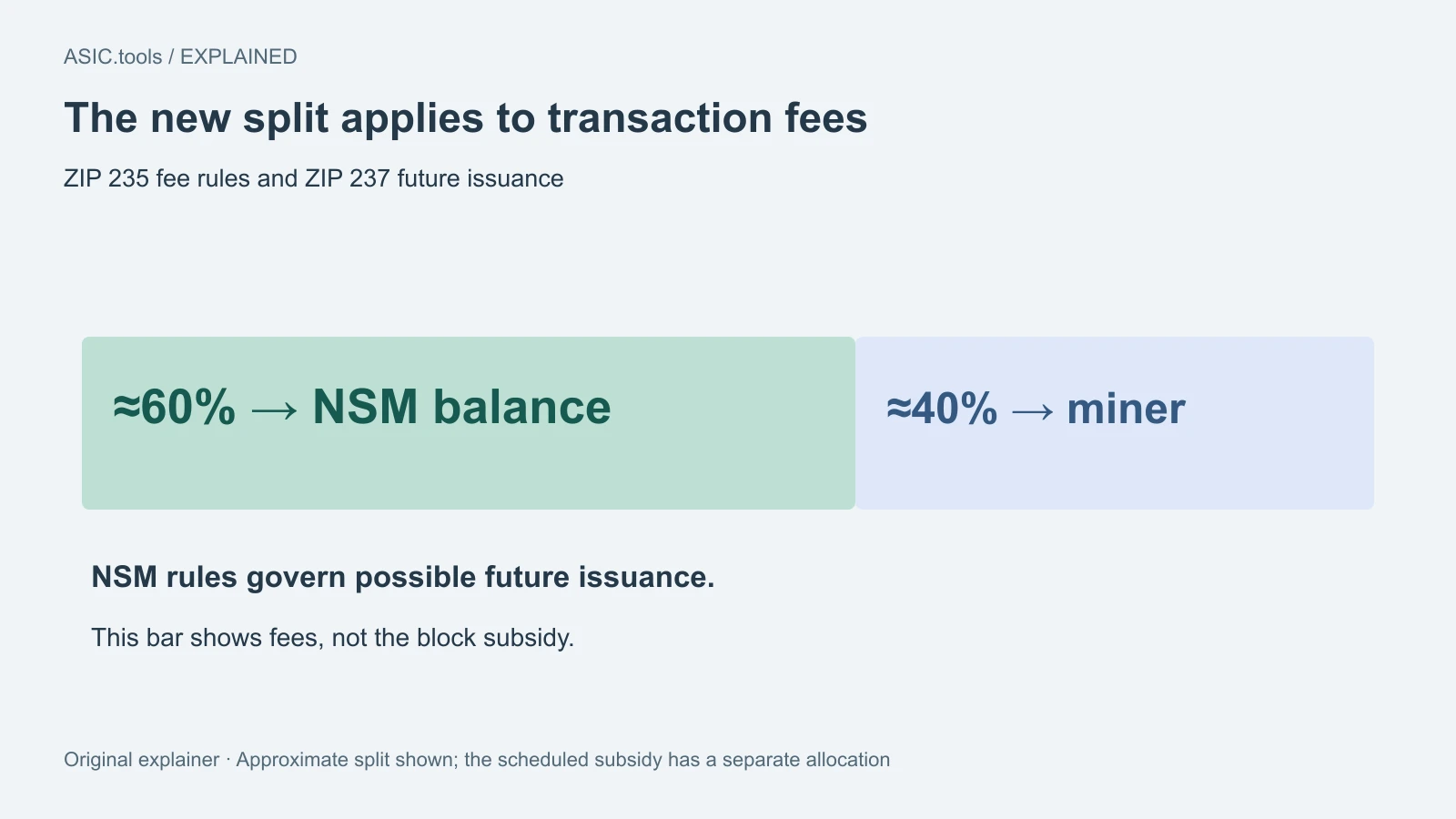
Transaction fees are separate from the subsidy. Under ZIP 235, about 60% of the transaction fees in a block are taken out of current circulation for the Network Sustainability Mechanism, a balance governed by network rules. The remaining share can go to the miner. A calculator that used to assign the whole fee to the miner needs a different assumption.
This mechanism keeps track of the funds for potential future issuance under ZIP 237. It preserves the halving schedule and does not increase the 21 million ZEC cap. An amount credited to that balance today is not a payout to the miner who found today's block; the issuance rules determine when the mechanism can add to the scheduled subsidy.
The fee split matters most when fees make up a meaningful part of a pool's income. Compare your pool's actual credited ZEC per unit of accepted work over several payout periods. Separating subsidy, fees and the pool's own deductions helps explain a change without blaming the ASIC for a change in network rules.
Sprout is a privacy pool, not a mining pool
NU7 invalidates version 4 transactions, the only format that could spend from the original Sprout privacy pool. The ZEC still in Sprout cannot be moved under the active rules. That is a change to an old wallet transaction path, separate from whether your mining pool is online. The funds have not been burned by a transfer, and there is no date for restored access.
Modern version 5 and version 6 transactions remain valid. The upgrade also sets limits on shielded actions, the operations associated with private transactions. The limits bound the work nodes and wallets need to process even though blocks are more frequent. That is another reason to distinguish an improved confirmation target from a guarantee of a fixed arrival time for every transfer.
When checking an old balance, identify the wallet and pool it actually uses. A slow deposit from an exchange, a mining pool payout below its minimum and funds in Sprout are three different situations. Only the last follows directly from the removal of version 4 transactions. Someone offering to unlock Sprout by asking for a recovery phrase is not providing a protocol fix.
Check the pool before changing the machine
Operators running a full node need software that follows the new rules; the Zcash Foundation lists Zebra 7.0.0 as its first stable mainnet release with NU7 support. If your ASIC connects to a pool, check that the pool follows blocks beyond 3,543,405 on the upgraded chain and that accepted work and payout records advance. An old node can remain online on an incompatible branch.
An ASIC reporting its normal speed shows that it is computing; it does not identify the chain branch its pool is using. Look for an updated pool notice, accepted shares, a credited balance and, once paid, a transaction on the upgraded chain. Keep a note of the switchover time so a brief pause, stale work and a new reward rule do not become one unexplained drop.
The upgrade changes the schedule and fee accounting around Equihash; it does not replace the mining algorithm. There is no reason in NU7 alone to buy another ASIC or install an unverified image. Check compatibility and compare longer payout windows before drawing conclusions from the first morning of shorter blocks.
Source: Zcash network data / ZIP editors ↗ · Activation block header data ↗ · ZIP 259: NU7 consensus deployment ↗ · ZIP 218: spacing and subsidy ↗ · ZIP 235: transaction fee split ↗ · ZIP 237: future issuance mechanism ↗ · Zcash Foundation node release ↗
Mining calculator ↗