WildRig 0.51.9 targets stale Pearl shares and replaces its Windows build for RDNA4
Source report: 2026-11-03 · Editorial analysis published: 2026-11-04
The November 3 release changes Pearlhash networking and GPU routines. Its corrected Windows package arrived later the same day, so the version number alone does not identify the current file.
More work reaching the pool in time
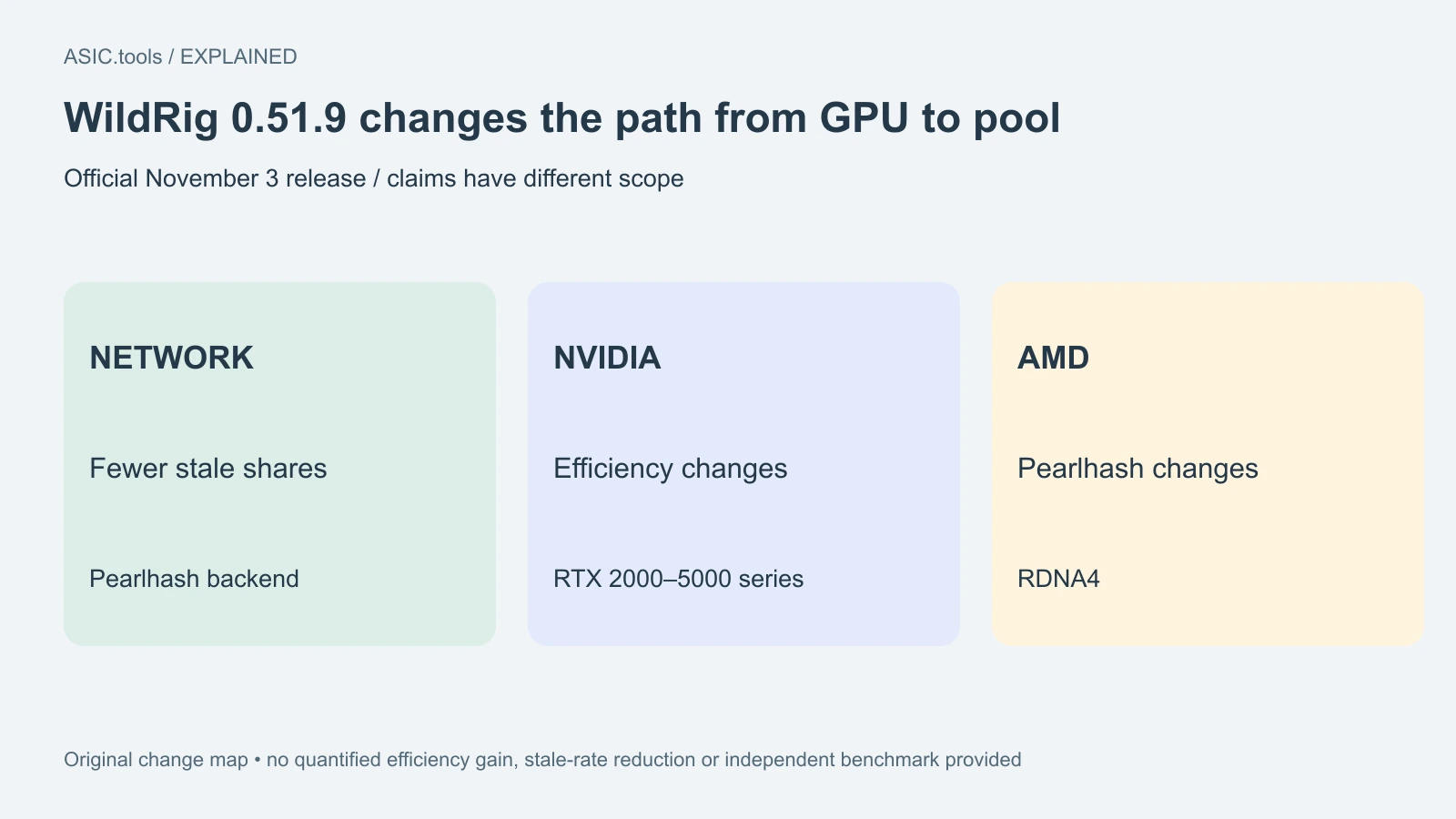
WildRig Multi published stable version 0.51.9 on November 3 at 01:43 UTC. The author says the Pearlhash networking backend now produces fewer stale shares, alongside GPU-side improvements. For an existing rig, the interesting question is how much work reaches the pool while it is still useful, rather than whether the console briefly shows a higher speed.
A share is evidence of computing work submitted to a mining pool. A stale share arrives after the relevant job has become outdated. A fast GPU can therefore show substantial local hashrate while some submissions are too late. Better communication can improve the usable result without adding a new card or increasing its nominal processing speed.
The release supplies no measured stale-rate reduction, test duration or universal earnings percentage. Its claim is a developer-reported software change, not an independent ASIC.tools test. It also does not establish that every stale submission on every pool has the same cause or the same payment treatment. Those details depend on the workload and pool rules.
For someone already mining Pearl, the practical starting point is the existing pool record: accepted work, stale work and other rejects over a meaningful period. That gives a comparison with the specific fault the update addresses. Changing the software, pool and network connection together would make it harder to tell which change affected the result.
NVIDIA efficiency and AMD RDNA4 support are separate changes
The author lists improved Pearlhash efficiency on NVIDIA RTX 2000, 3000, 4000 and 5000 series, plus improved Pearlhash operation on AMD RDNA4. These statements have different scope. The NVIDIA item explicitly concerns efficiency; the AMD item does not publish a matching quantified energy claim. Neither should be extended to unlisted card families or every algorithm WildRig supports.
Efficiency means useful output for the power consumed, rather than speed alone. A lower GPU power reading can help, but electricity is bought at the meter, where motherboard, processor, power-supply losses and cooling can also matter. Compare the same measurement boundary before and after the update, especially on mixed rigs where one card's improvement may be small in the whole-machine total.
The notes do not provide a percentage, watts per card or a controlled before-and-after table. There is consequently no basis for assigning a fixed saving to an RTX owner or predicting payback for a new purchase. Owners can evaluate an existing device; this release alone is not a hardware buying recommendation.
Keep the chosen algorithm and pool comparable, record the active clocks and watch temperatures and errors. A rising local hashrate with more rejected work does not settle the efficiency question. Conversely, a similar console number with fewer stale submissions could be useful. The relevant outcome is accepted production and the measured electricity needed for it.
Windows users need the corrected package, not just the right label
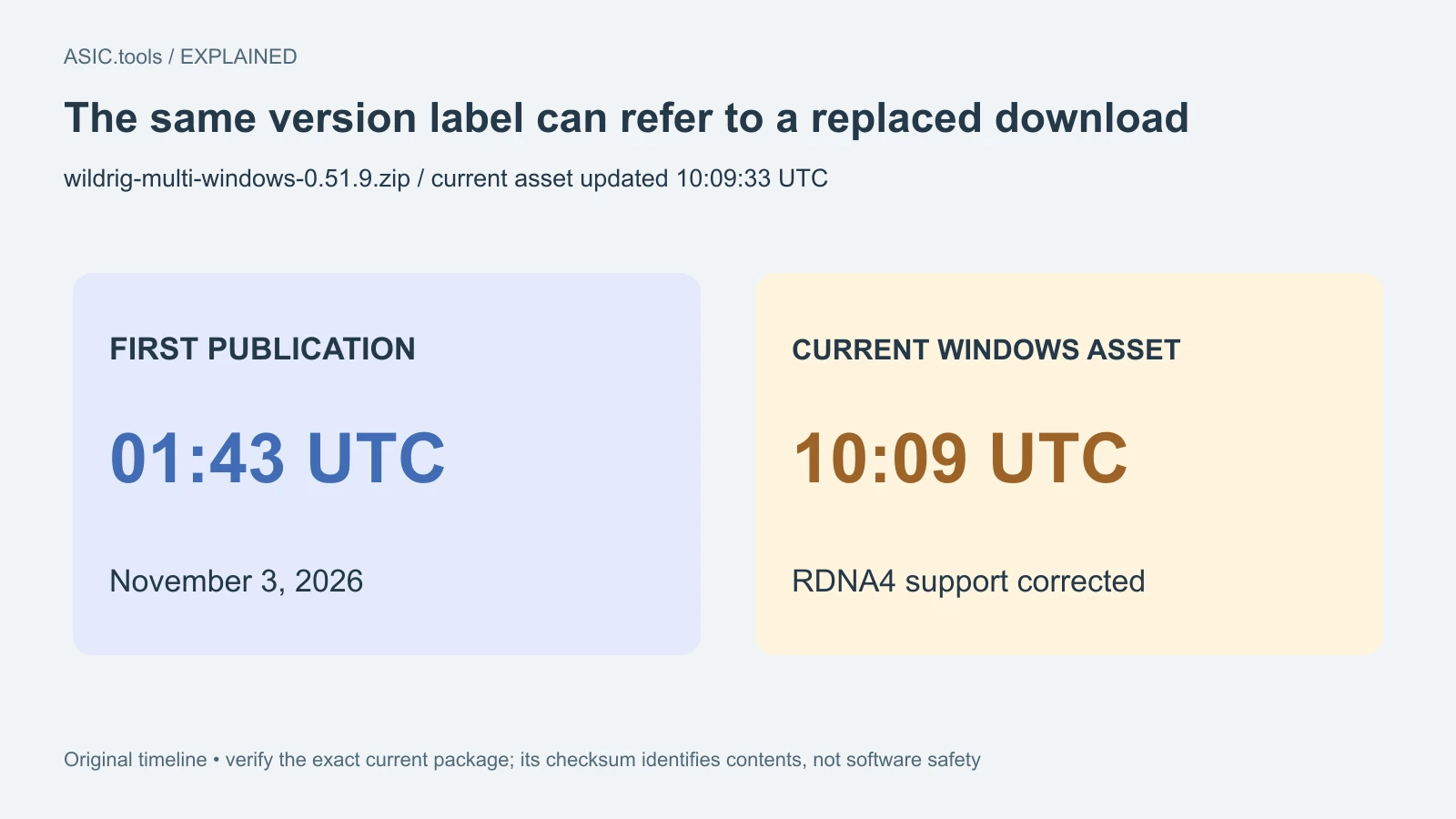
The release was updated later on November 3 to say that the Windows build had been uploaded again with fixed AMD RDNA4 support. GitHub records the current Windows asset update at 10:09:33 UTC, after the original publication at 01:43:02. A Windows archive saved soon after launch can therefore differ from the one currently attached to the same version page.
The corrected file is named wildrig-multi-windows-0.51.9.zip. At the editorial check, GitHub listed 29,465,021 bytes and the SHA-256 digest beginning ac7ec18a446887f3. The complete digest remains available in the official asset metadata. The name and version are useful labels; content verification distinguishes an archived earlier download from the currently identified package.
A checksum compares file contents, not performance or trustworthiness. Matching the official digest establishes correspondence with the published asset; it does not prove that a binary is harmless or that RDNA4 works on every Windows setup. No executable was run for this report, and the developer's repair has not been independently benchmarked here.
Linux and HiveOS archives are also attached, with separate names and digests. The replacement notice specifically names Windows. Do not infer that every platform package was replaced at the same time or that a Windows checksum should match a Linux archive. The selected operating system and the exact file matter more than a screenshot of the release title.
Measure accepted work without turning a percentage into profit
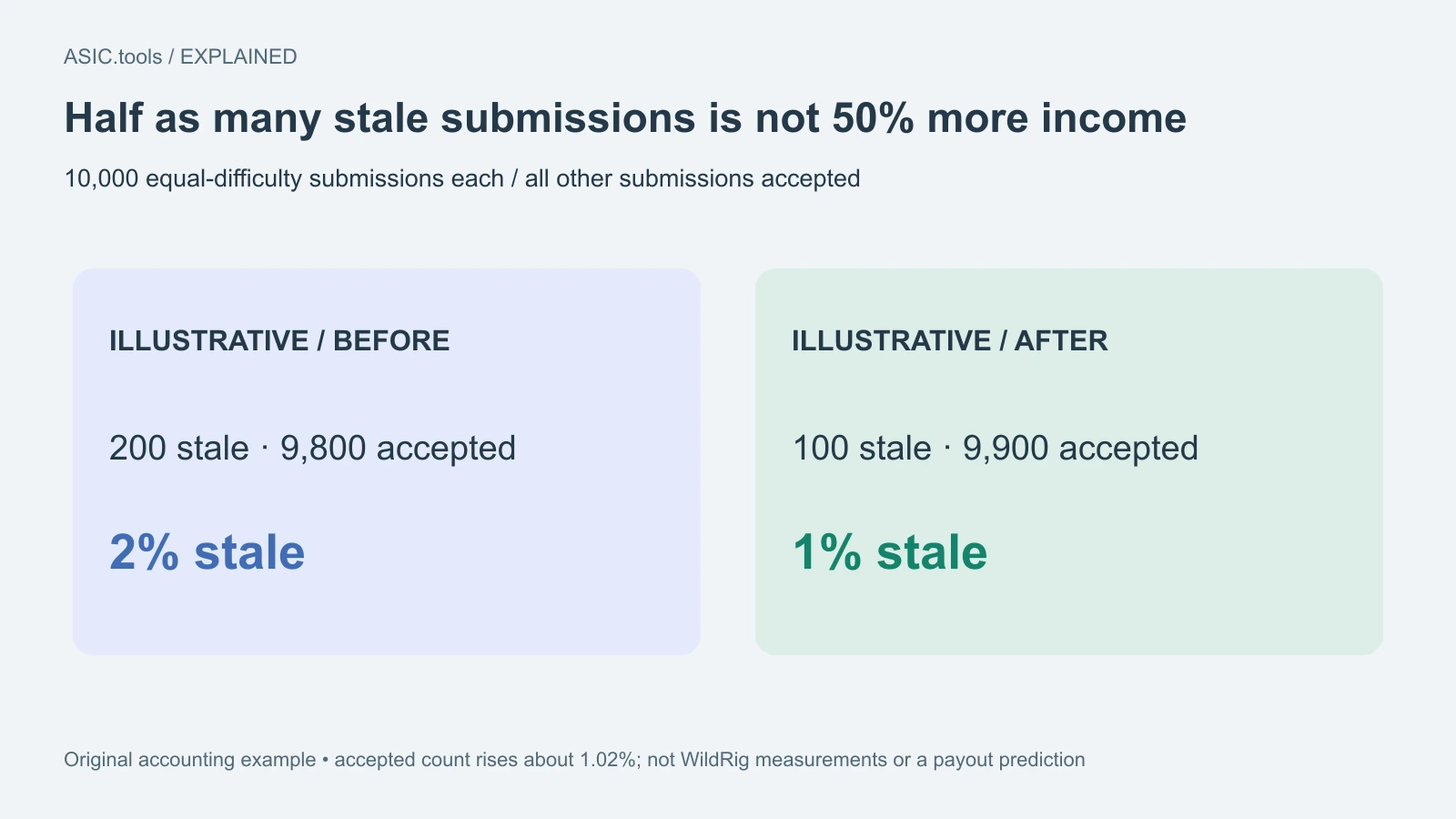
As an illustration, suppose 10,000 equal-difficulty submissions contain 200 stale shares in one comparable interval and 100 in another, with all other submissions accepted. The stale fraction falls from 2% to 1%, while accepted submissions rise from 9,800 to 9,900. That is about 1.02% more accepted submissions, not a 50% income increase. These numbers explain the accounting; they are not WildRig test results.
Real pools can use varying share difficulty, so raw counts are not always comparable. Compare credited work or the pool's own accepted-hashrate measure over an adequate window, together with its payment rules. Short observations can be noisy. The cost of extra runtime and electricity also means that a production improvement and a net-profit improvement need separate calculations.
Before a limited update, keep the working configuration and previous package, note which current asset was chosen and preserve the baseline readings. Afterward, check connection behaviour, actual acceptance and power rather than only whether the process launches. If the original problem persists, those records help distinguish software behaviour from an unrelated pool or local-network issue.
This is a new Pearlhash release with a concrete same-day Windows correction, separate from the earlier Team Black Miner and BzMiner stories. It changes no Bitcoin SHA-256 ASIC specification and supplies no guaranteed tariff or revenue. Its value for a particular owner rests on whether the stated networking, GPU or RDNA4 repair addresses that machine's measured problem.
Source: WildRig Multi ↗ · Official repository and documentation ↗
Mining calculator ↗