Vulcan sold more power to the grid as its Bitcoin mining revenue fell
Source report: 2026-11-16 · Editorial analysis published: 2026-11-17
The November 16 filing shows power and capacity sales supplied 68% of quarterly revenue. Hosted mining used 75% less energy than a year earlier.
More power to the grid, less to hosted miners
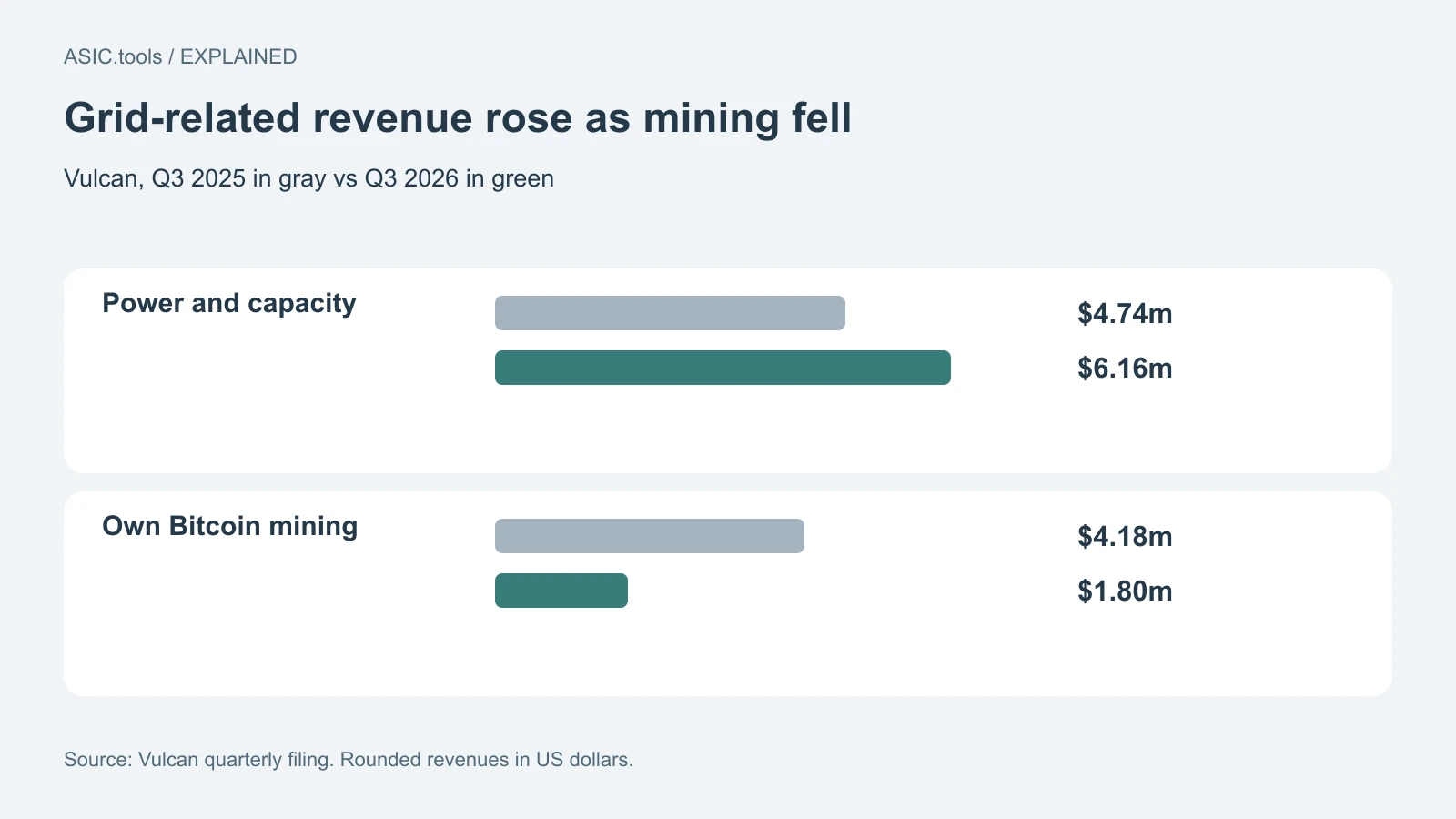
Vulcan Infrastructure and Power, formerly Greenidge Generation, reported on November 16 that quarterly power and capacity revenue reached $6.16 million, up from $4.74 million a year earlier. That was 68% of third-quarter revenue, versus 31% a year ago. Revenue from mining bitcoin on its own machines fell from $4.18 million to $1.80 million. The New York facility can earn from the power market as well as from miners, and the latest quarter shows how differently those lines can move.
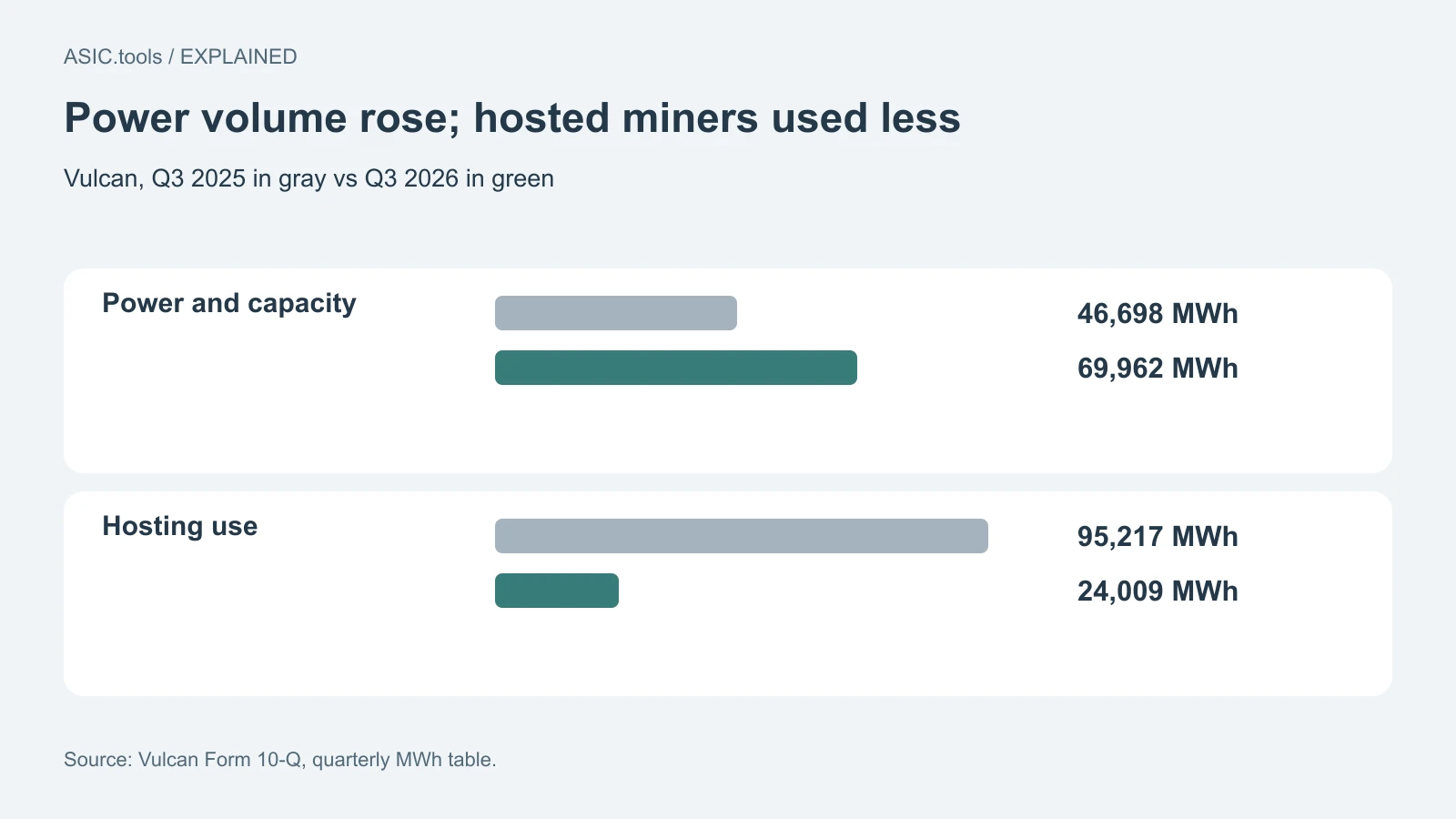
The physical volumes help explain the change. Power and capacity sales rose from 46,698 to 69,962 megawatt-hours in the filing’s quarterly table. Meanwhile, hosting used 24,009 MWh instead of 95,217 MWh, a fall of 75%. A megawatt-hour measures the energy used by a one-megawatt load for an hour. The company says it curtailed mainly older hosted machines because it was not attractive to run them under the quarter’s conditions.
One unit of energy can have several uses
The New York operation can sell electricity into the wholesale market managed by NYISO, the state grid operator. Its power line includes electricity sold at hourly prices, payments for being available to supply the grid, and payments for operating reserves. That means $6.16 million includes several services. It cannot be read as a bill from a retail electricity supplier, or as money made solely from selling a certain number of kilowatt-hours.
The operator can also use electricity for its own rigs or supply machines it hosts for customers. Those activities return money in different ways. Vulcan’s mining segment recognized rewards in bitcoin; its hosting arrangement covers power and direct management costs, a fee and a share of gross profit. A low price for electricity at one hour does not tell you what all those arrangements bring in over an entire quarter.
Compare revenue and costs using the same unit
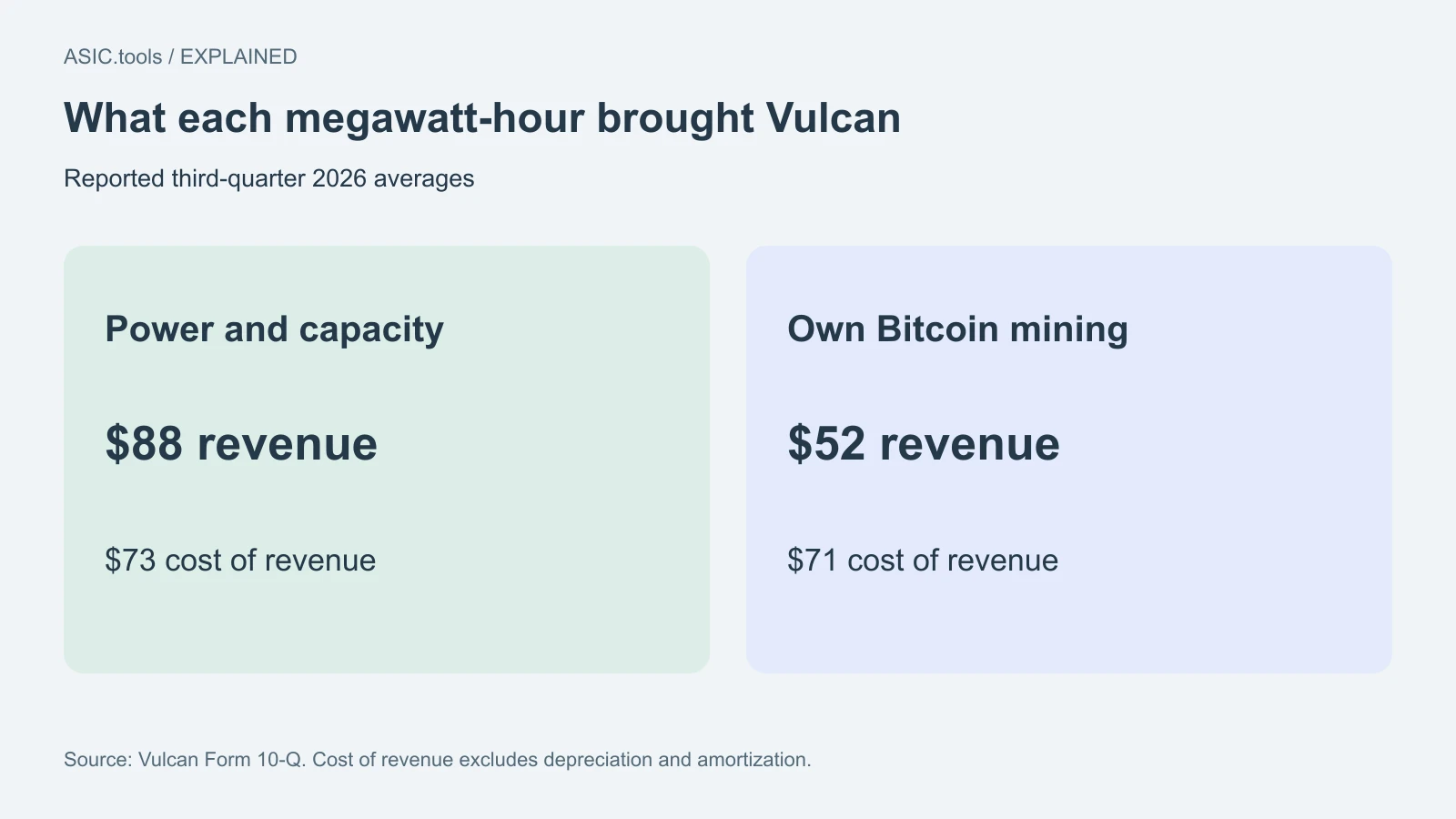
For the third quarter Vulcan reports roughly $88 in power and capacity revenue per MWh, against $52 per MWh for self-mining. Its corresponding costs of revenue were $73 and $71 per MWh, respectively, excluding depreciation and amortization. These are retrospective averages from different activities and include their own cost allocations. They illustrate why comparing the proceeds from mining with a second use of the same energy can matter.
The company also reports a cost of $97,560 per bitcoin it mined itself, against $72,080 of recognized mining revenue per coin. It counted 25 self-mined BTC, down from 36. The company cites the lower average Bitcoin price, less self-mining capacity following an earlier asset sale, and costs associated with a New York outage. The figures describe Vulcan’s period and accounting, not a network-wide cost to produce a bitcoin.
What a smaller miner can take from it
Few home miners can sell capacity to a grid operator. They may still have a choice between running on a high tariff, waiting for cheaper hours if their plan allows it, or using the energy elsewhere. Compare what your pool credits over the same hours with what the meter records. Start with the tariff you actually pay and include any costs that continue when you turn the machine off.
With hosted gear, ask how the contract handles curtailment: who can stop the machine, what still gets billed, and where you can see whether the rig was active. Vulcan’s quarter shows why the installed equipment list and actual running time are different measures. For future comparisons, use accepted pool work, energy consumed and fees from the same period. An unattended device makes the distinction easy to miss. A host may show that the machine is connected even when it is idle or sending no useful work. Cross-check the pool’s worker log against the host’s curtailment record before attributing a drop in payouts to a lower coin price. If an adjustment appears a month later, attach it to the period when the power was used.
What the report does and does not establish
Vulcan still considers mining a flexible way to use available power before any part of its New York capacity is taken by an AI or high-performance computing customer, when costs and mining conditions allow. The quarterly numbers show what happened through September. They do not establish a future power sale or when any new customer would take capacity.
The practical question is which option earns more from a unit of energy when you can actually choose. For an operator selling to a grid, that may change hour by hour. For a miner running at a fixed tariff, it may change when the pool’s payouts or the bill move. The same period and units give the clearest comparison.
Source: Vulcan Infrastructure and Power ↗ · Vulcan investor relations — full quarterly filing ↗
Mining calculator ↗