Ukrenergo plans November 14 outages: check your miner’s actual uptime
Source report: 2026-11-13 · Editorial analysis published: 2026-11-14
The grid operator announced rolling outages in some regions and separate limits for industry. Address schedules and pool records tell you how many hours a miner actually works.
What the grid operator scheduled
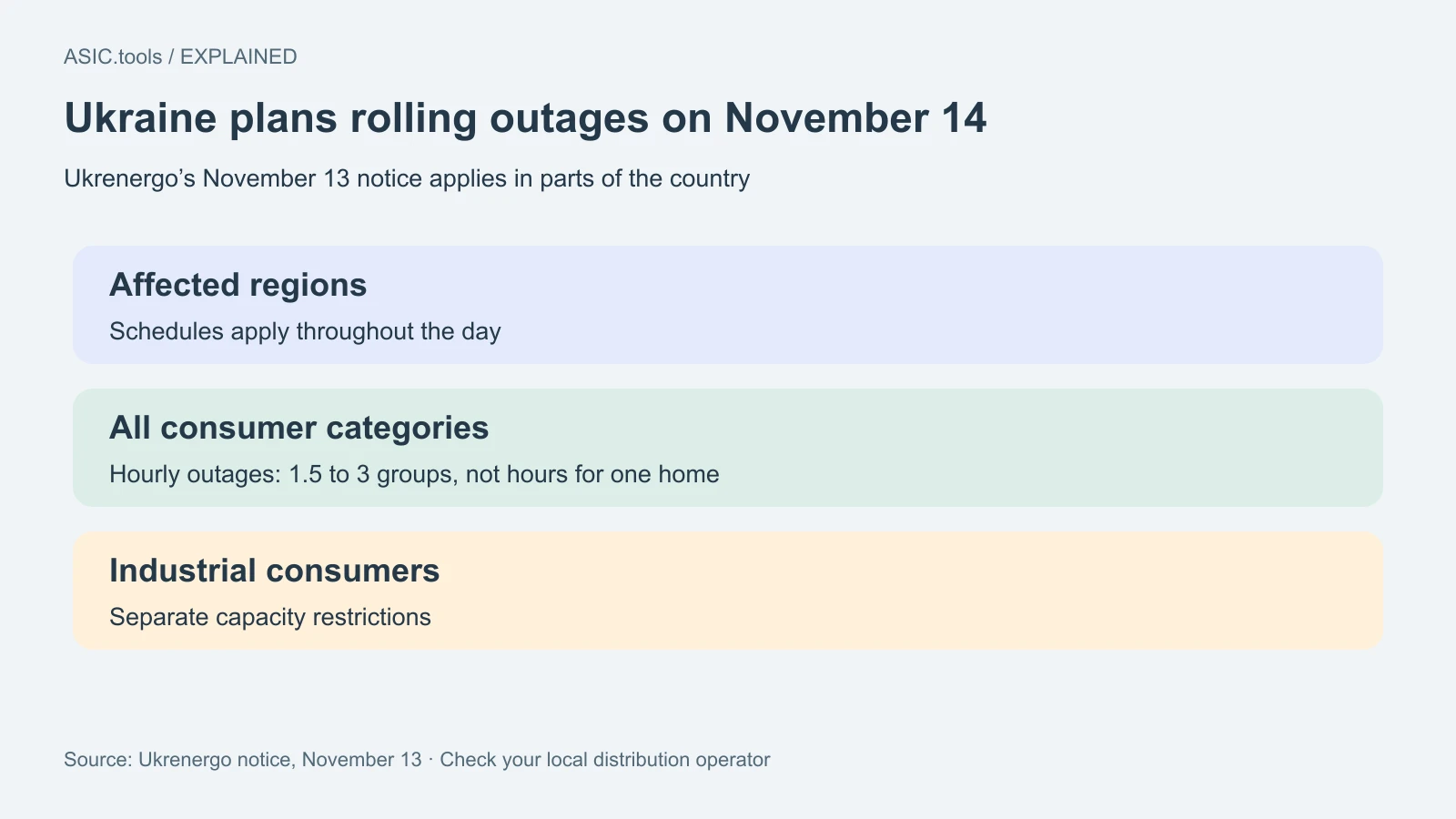
Ukrenergo said on the evening of November 13 that planned electricity restrictions would apply throughout November 14 in parts of Ukraine. The operator cited damage from attacks on the power system. It announced hourly outage schedules for all categories of customers in affected areas, with 1.5 to 3 queues, and separate capacity limits for industry. For people operating a miner, the relevant detail is the latest schedule for the place where the machine is plugged in.
A queue is a group of connections the distribution operator can switch in rotation. The number of queues says how broad the restrictions are at a given time. It is not a number of hours for a household, nor does it provide an individual address’s schedule. Ukrenergo directs customers to their local distribution operators for updated information. “Throughout the day” describes the period when the schedules apply, not a full day without power at every address.
A new schedule from your local operator can supersede an earlier screenshot. When checking an address note both the date and the time the information was updated. The notice describes the scope of restrictions at grid level; the map from that scope to sockets belongs to the distributor.
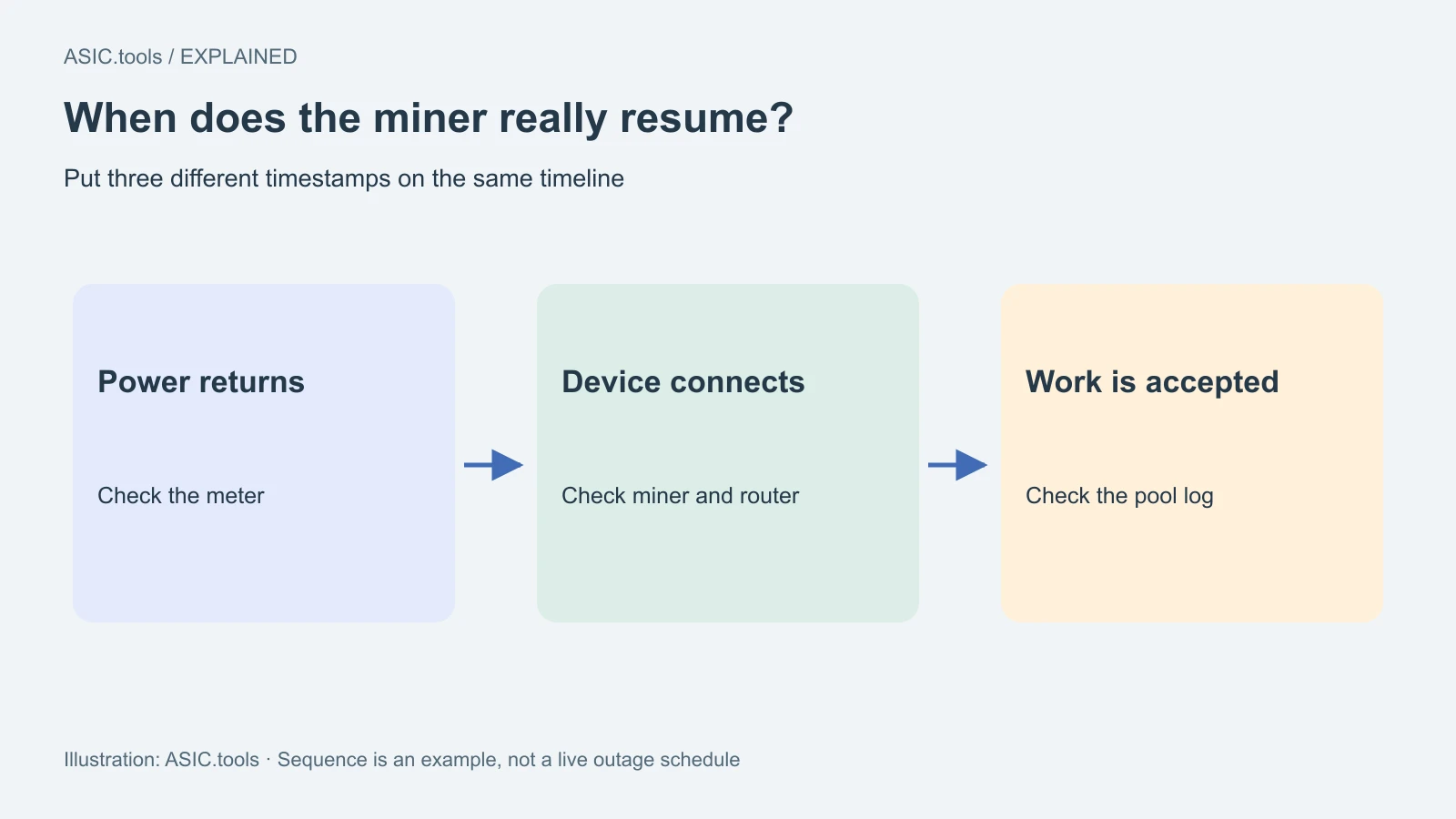
Pair the schedule with the device log
First write down the windows during which your address is scheduled to have electricity. Treat those windows as plans. A change in the grid situation can affect the notice, and there can be a delay before a device starts working after supply returns. For your own running record, keep the timestamps of actual loss and restoration of power.
Then check when the device reconnected and when the mining pool started accepting work again. Those are separate events. A local router can still be restarting when the miner comes on. A power indicator can be on even while the pool has not accepted a share. Compare the device and pool histories for the same time zone rather than counting every minute with electricity as productive.
If supply comes and goes several times, note the start and end of each window. Include when internet returned and when the pool accepted work. Separate intervals make it easier to distinguish power outages from slow restarts or trouble reaching the pool.
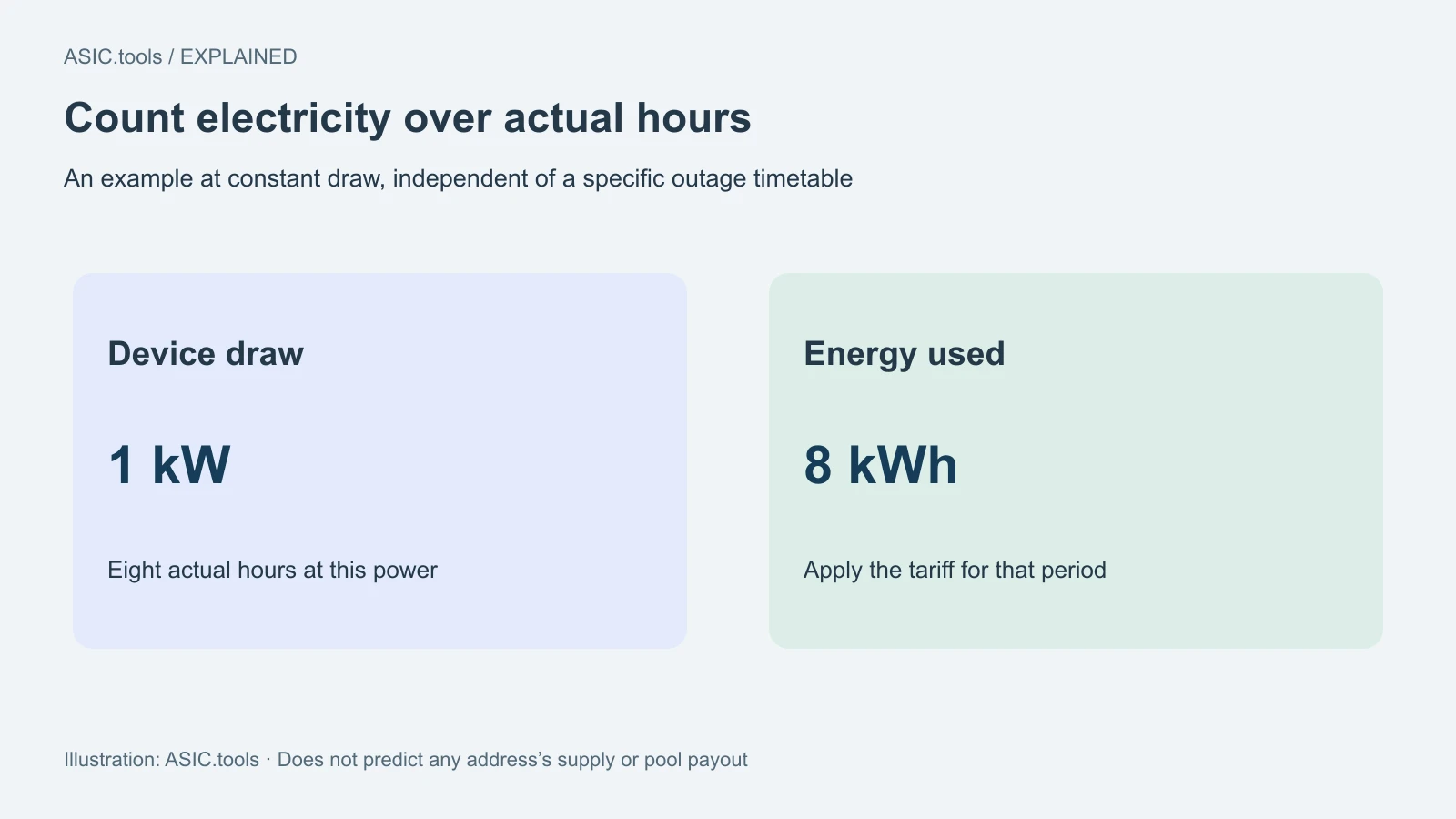
Do not charge a full day of power to a short run
As an example, a miner drawing 1 kW uses about 8 kWh during eight actual hours at that draw. This is a calculation, not an eight-hour schedule supplied by Ukrenergo. A wall meter can capture powered time when the miner is warming up or reconnecting; you still pay for that time. Do not use the miner’s full-day revenue estimate to judge a shorter run.
Keep the input to each calculation clear. Electricity cost starts with measured consumption and the rate for that time. Mining revenue starts with the work that was accepted and the pool’s payment method. If a payout arrives later, it may include work from earlier periods. Record the balance before and after the period if you need to distinguish new work from coins already on their way to your wallet.
The meter can include startup time while accepted work begins later. Separate those two stages when comparing runs with the same operating mode. A few minutes of startup can matter on a short window; the manufacturer’s rated power can only give a first estimate.
Check the next restart, not just the next outage
When electricity returns, confirm that household equipment and connectivity have recovered. If the miner started but repeatedly loses its connection, check how long that takes before treating the whole scheduled window as available. For an industrial site, the power limit for the connection is a separate constraint. A household outage timetable is not a substitute for that limit.
The notice covers November 14 and affected parts of the country. Use the distribution operator’s current page for local changes and keep your own records for costs and work. Comparing the schedule, meter and accepted shares tells you why the day's results differ from a continuous run. It also helps you decide which hours are practical without guessing from the number of queues.
If you manage several devices, do not assume that their first accepted work arrives at the same moment. Record the recovery for each worker or group on the same connection. A shared outage can leave different startup times; an average for the site can conceal a device that never resumed.
Keep the information in the order you observed it: schedule, supply, connection and accepted work. If service or internet is unstable, a later check will be easier when the original times are still available. The test of practical uptime is what the machine did during the hours you actually had.
Source: Ukrenergo ↗ · Ukrenergo — official channel ↗
Mining calculator ↗