Ukrenergo sets two to four outage queues for November 7 in parts of Ukraine
Source report: 2026-11-06 · Editorial analysis published: 2026-11-07
The national notice covers the full day and includes industrial power limits. A home miner needs the local address schedule and actual running hours to estimate the day’s work.
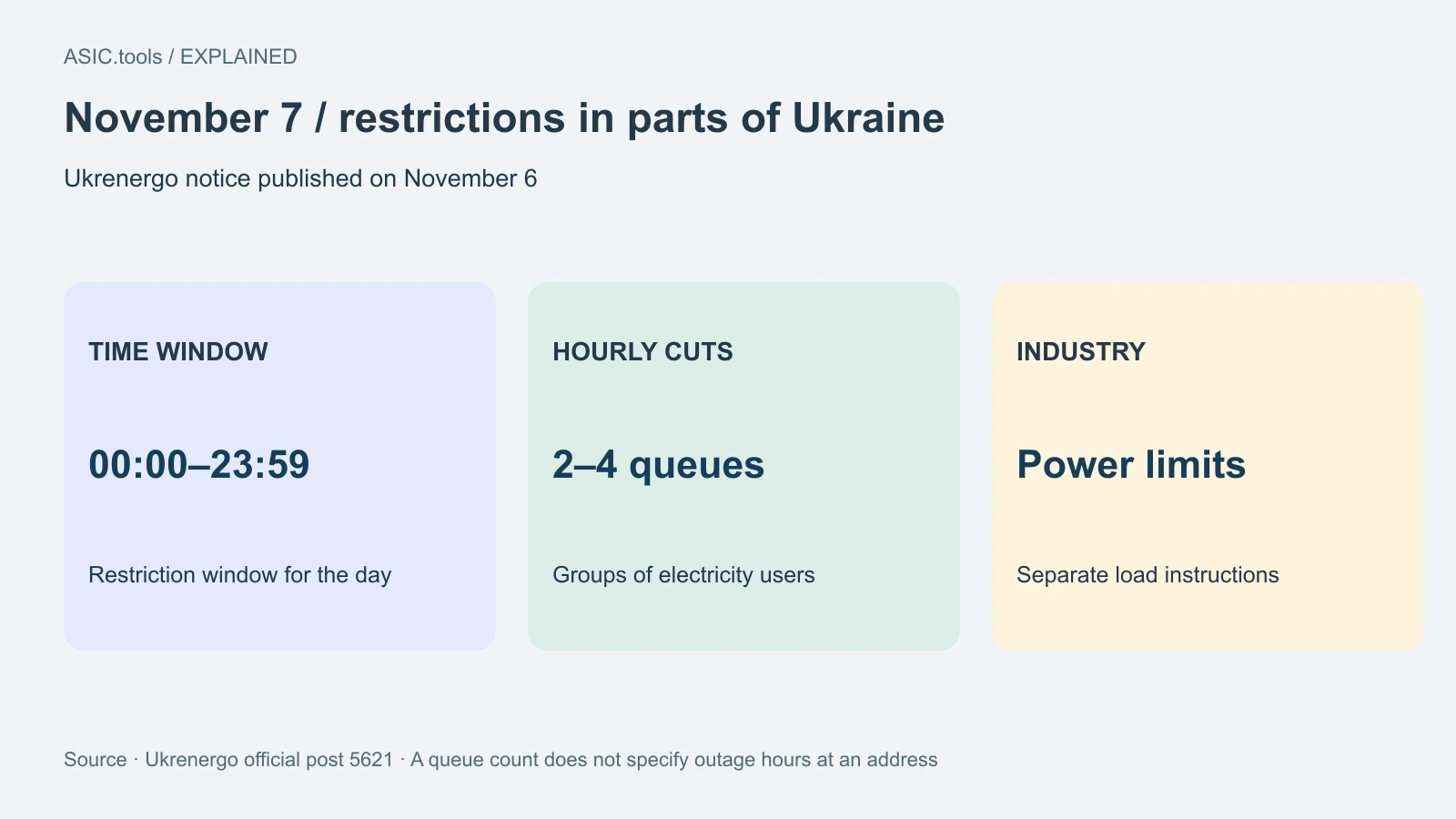
A full-day restriction window
Ukrenergo announced hourly power cuts equivalent to two to four outage queues for November 7 in parts of Ukraine. The window runs from 00:00 to 23:59 and covers all consumer categories. Industrial power-limitation schedules also apply across that window. For anyone running an ASIC at home or in a small workshop, the local connection determines which part of that window affects the machine.
The national operator published the notice on November 6 and attributed the restrictions to the consequences of Russian attacks on power infrastructure. It also said conditions could change and directed consumers to their regional distribution operators. That puts an address-specific update at the centre of planning the day's electricity use.
A queue is a group of consumers whose supply can be limited together. Two to four queues describes the amount of demand being restricted in the affected system. It does not directly translate into two to four hours without power for each address. Local operators assign the groups and publish the periods relevant to their networks.
Start with the address and the latest update
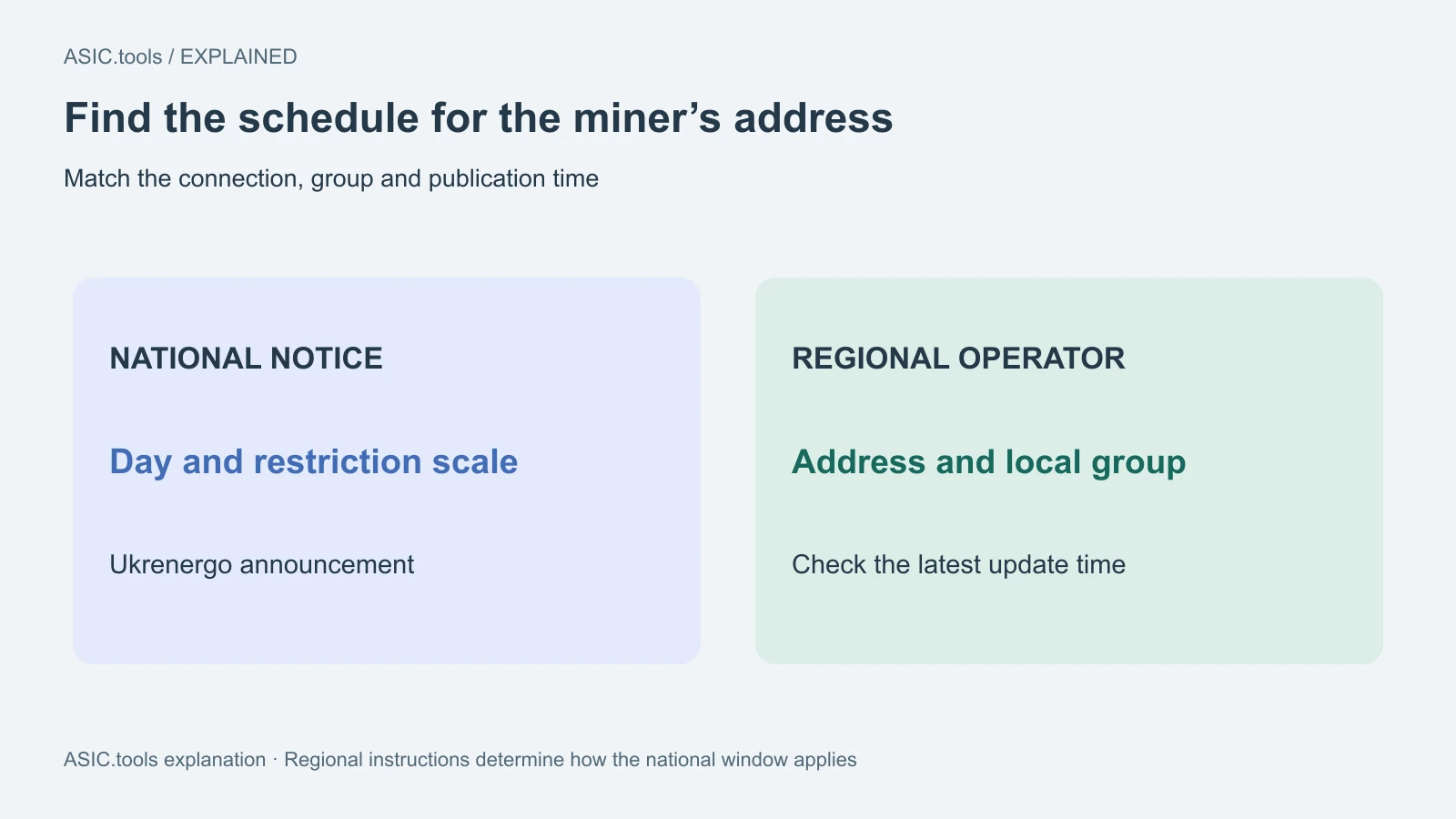
Find the distribution operator serving the miner's connection and check the address or assigned subgroup. A national time window gives the day's operating framework. The regional schedule tells the customer when their group is expected to be off. An operator's newer announcement can change how that schedule applies.
For Kyiv Region, DTEK's official outage page provides the address-checking route. Other regions have their own operators and pages. The area a company serves is important, especially where the city and the surrounding region have different networks. Save the time of the update alongside the schedule so that an earlier screenshot can be identified later.
The national notice asks consumers to use electricity sparingly when it returns. An ASIC adds its running load as soon as it resumes calculating. In a home or shared workshop, that load sits alongside heating, cooking and other equipment. Planning the available window includes the other uses on the same connection.
Running hours change the mining result
A miner's nameplate hashrate describes its computing speed while running. A full-day estimate also needs to know how many hours it could submit work. A device that has power for only part of the day has a smaller opportunity to earn, even when its display shows the usual speed whenever it is on.
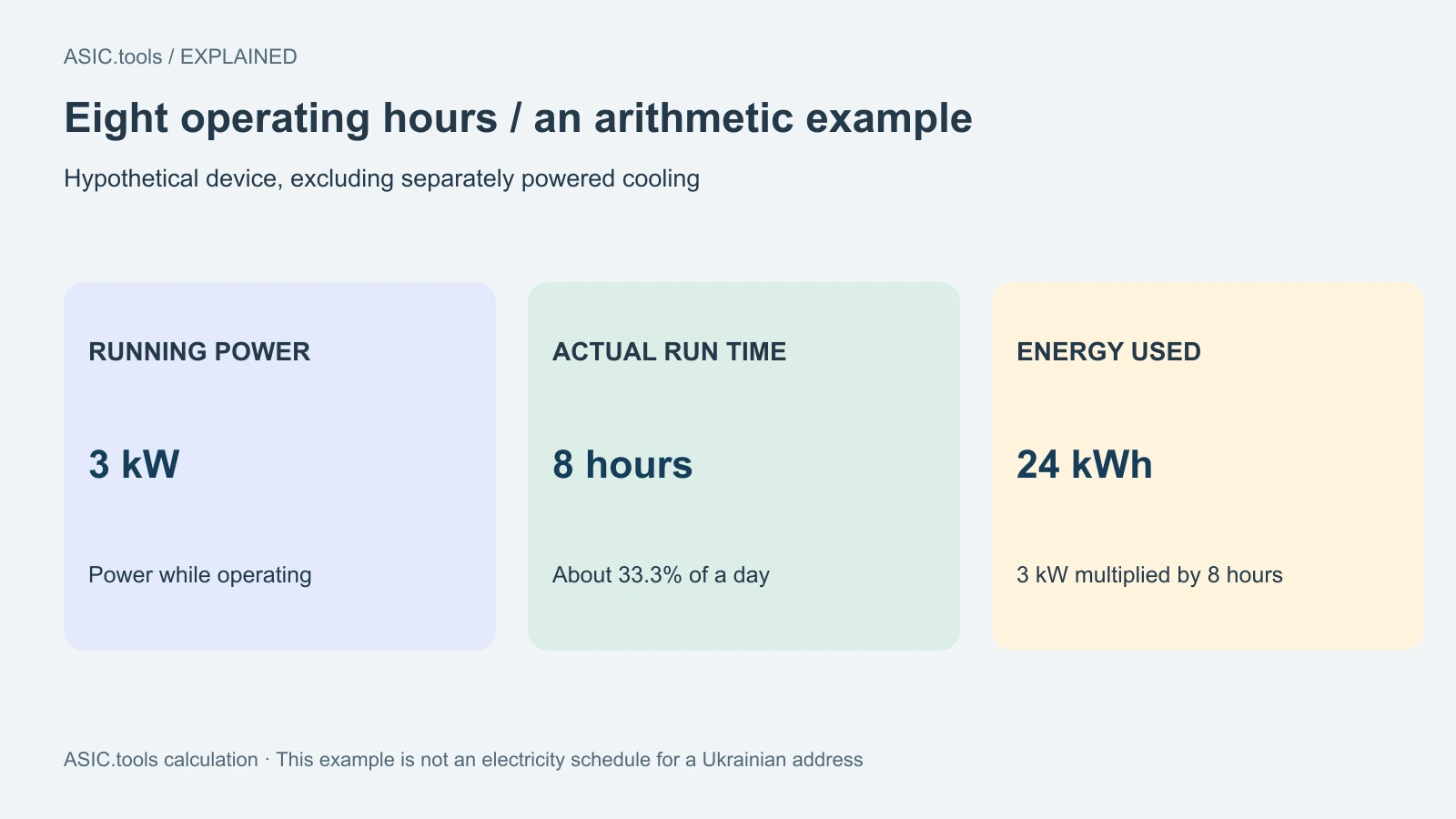
Consider a hypothetical 3 kW device that actually runs for eight hours. It uses 24 kWh over those eight hours, before any separately powered cooling equipment. Eight hours is one third of a day, or about 33.3% uptime. This is an arithmetic example and carries no claim about how long a particular Ukrainian address will have power on November 7.
A pool's credited work also depends on the connection resuming and valid shares reaching the server. Shares are small units of work that the pool can check. A machine may have restarted before it appears as active on the pool dashboard. Aligning those timestamps helps explain an interval with electricity use and little credited work.
Put the meter and the pool on the same clock
Keep the actual start and stop times, the pool's accepted work and the measured energy over matching intervals. Use the same time zone when comparing them. The electricity meter shows energy consumed, while the pool records the work it received. Together they help show what happened during short windows between cuts.
If a farm calculator has an uptime field, enter the hours observed or clearly label the planned scenario. For the eight-hour example, using about 33.3% avoids applying a full day's income and electricity to a partial day. A change in Bitcoin's price or network difficulty is a separate reason for a difference in the amount earned per unit of work.
For hosted machines, ask which site and power connection serve the device, how interruptions are recorded, and which hours are billed under the agreement. A regional announcement can describe the surrounding network while the individual site has a specific supply arrangement. The provider's device records help connect that arrangement to the customer's statement.
Recheck during the day
The November 6 national notice sets out the restrictions announced for November 7. Its full-day window leaves room for regional changes during the day. Before relying on a saved timetable, check the operator's latest information for the address and the publication time.
After a cut, the useful checks are whether the miner has power, whether it has connected to the intended pool and whether accepted work is appearing again. Record the actual recovery time. That gives the day's mining and electricity records a common timeline, even when the local timetable changed after it was first published.
Industry has a separate power-limit schedule
The industrial schedule in the notice limits power, while the hourly schedule rotates supply to groups. A mining business needs to identify which instructions apply to its connection. A national announcement with a full-day industrial limit gives no individual megawatt allocation for a named site.
A site operator can keep its connection details and received instructions with the day’s operating log. If a provider issues an updated allocation, record when it takes effect. This helps match the required load level with the machine hours and billed energy for that interval.
Source: Ukrenergo official announcement ↗ · Official Ukrenergo channel ↗ · DTEK Kyiv Region address checks ↗
Mining calculator ↗