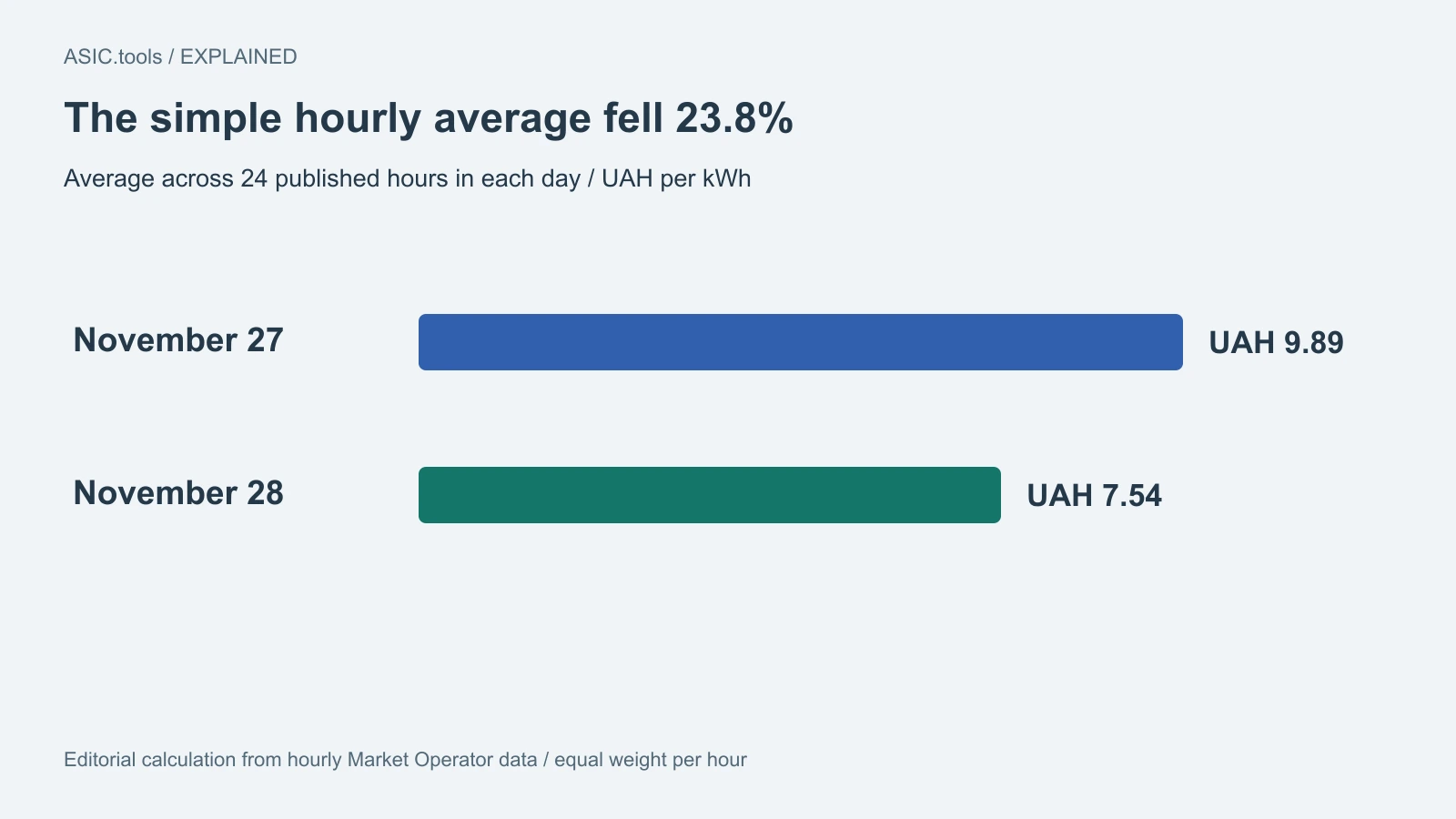
Ukraine’s day-ahead power prices averaged UAH 7.54 per kWh on November 28
Source report: 2026-11-28 · Editorial analysis published: 2026-11-28
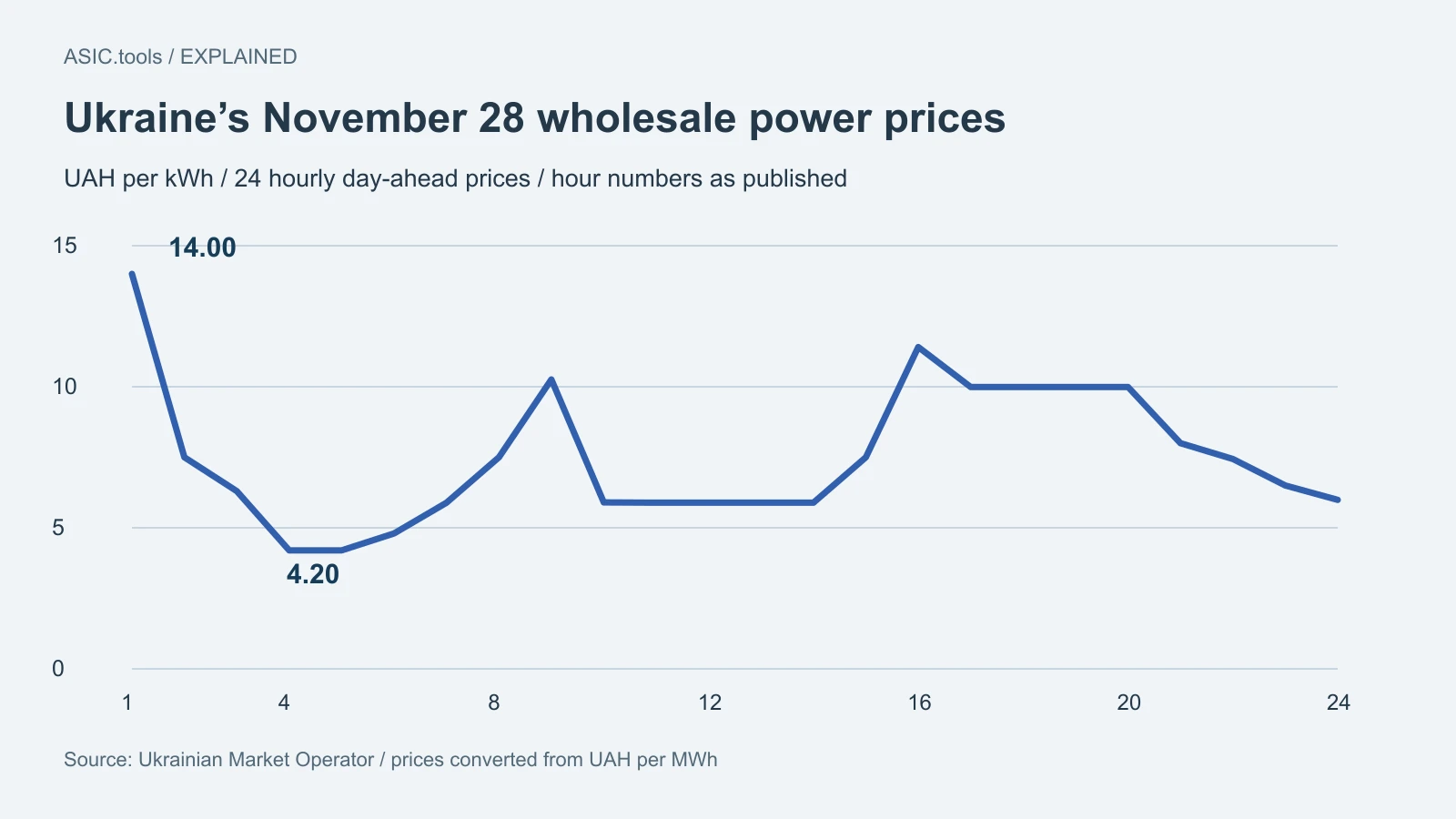
The hourly wholesale results ranged from UAH 4.20 to 14.00 per kWh. For a miner whose contract follows hourly prices, the timing of consumption still mattered despite the lower daily average.
A cheaper day with a wide spread
On November 28, the 24 hourly prices on Ukraine’s day-ahead electricity market averaged UAH 7,537.66 per megawatt-hour, or about UAH 7.54 per kilowatt-hour. The previous day’s hourly average was UAH 9,887.06 per megawatt-hour, so Saturday’s average was about 23.8% lower. Saturday’s hourly prices still ranged from UAH 4.20 to UAH 14.00 per kilowatt-hour. A miner on an hourly contract can therefore see very different costs within the same day.
The day-ahead market matches bids for electricity to be delivered the next day. The Market Operator publishes a price for each delivery hour. Those numbers describe transactions in a wholesale market. The amount a household or business pays depends on the structure of its supply contract and can include network charges, supplier charges and taxes.
The UAH 7.54 figure is our simple average of the 24 published hourly prices, with each hour given the same weight. It suits an example where a machine draws a steady load throughout the day. An average weighted by all the energy sold in the market or the hours a particular miner runs answers a different question. Check which method a table uses before comparing its headline to a bill.
An hourly price in hryvnias per megawatt-hour is divided by 1,000 to express it per kilowatt-hour. This unit conversion applies to each row, even when the price changes sharply. Keep the original precision for adding hourly costs and round only the final amount.
The hour can matter more than the average
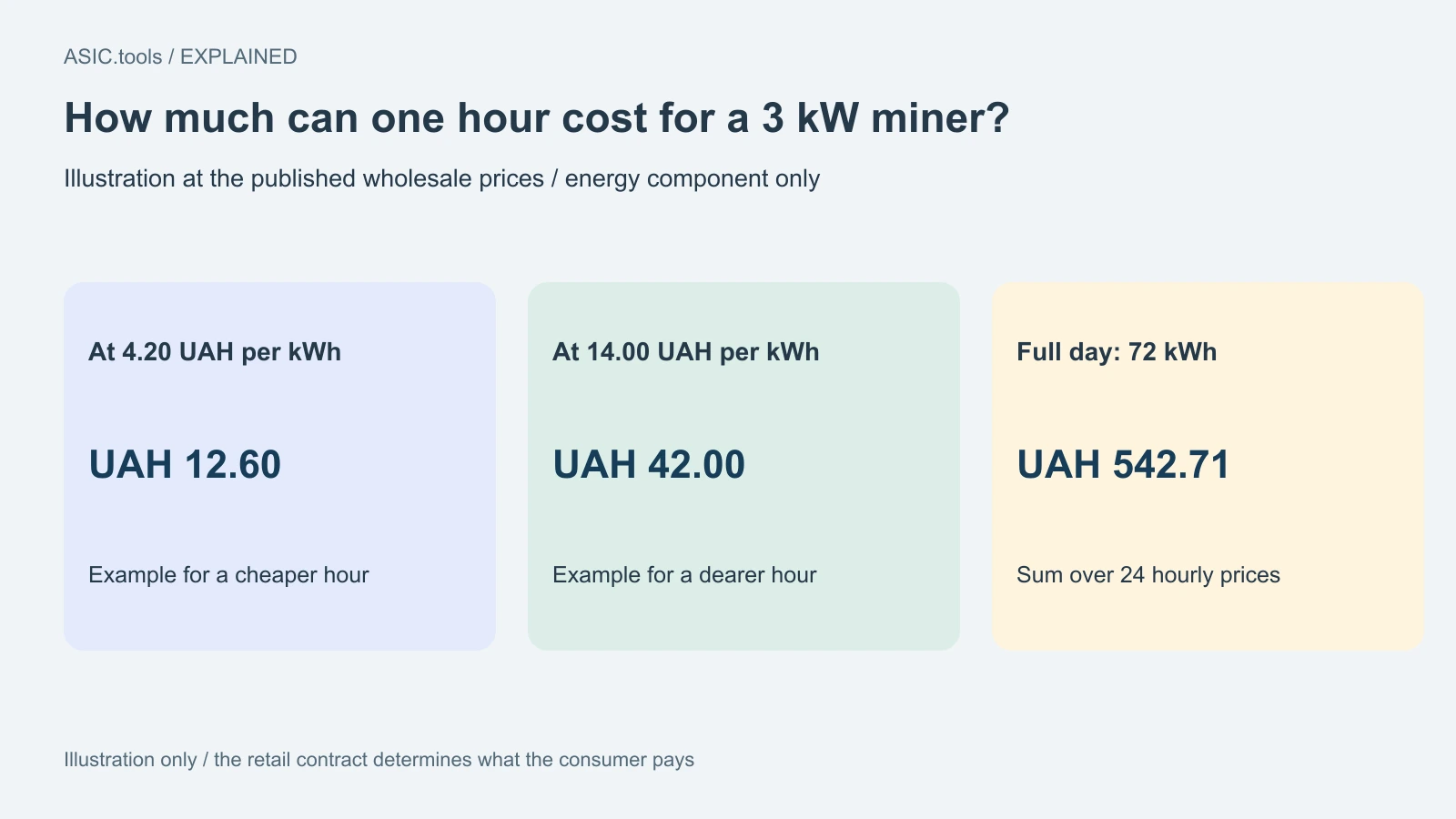
The operator’s first numbered hour was UAH 14.00 per kilowatt-hour. Hours four and five were UAH 4.20. A 3 kW device uses 3 kWh in one hour, so the wholesale energy component in those examples is UAH 42 or UAH 12.60. Using the hour numbers printed by the operator avoids assuming they match the numbering in a control app or a supplier statement.
Continuous operation for 24 hours would use 72 kWh. At the hourly wholesale prices, a constant 3 kW load would cost about UAH 542.71 for the energy component. The calculation multiplies the draw by each hour’s price and adds the amounts. A shutdown or outage changes the hours the meter actually records, so the result will move even if the published daily average stays the same.
One way to test the arithmetic is to compare the 24-hour sum with the same calculation using the unrounded simple mean and 72 kWh. For a steady 3 kW load they agree. Once the load varies, use the meter’s hourly values to weigh the prices.
Start with the contract
A fixed price per kilowatt-hour may stay the same at both ends of the wholesale range. A market-linked contract may pass on hourly prices or use a different settlement period. Check the billing interval, which price is referenced and which additional charges vary with consumption. A large installation may also pay for peak power, a separate line from its energy use.
The day-ahead table records electricity sold for delivery. It cannot tell you when your address will have power. For that, use the local distribution operator’s information. If the machine is off at a price peak, use actual metered hours when estimating the bill. If it restarts during a cheaper interval, record how long it takes before the pool starts accepting work again.
Compare electricity with the work delivered
To evaluate one hour of operation, put the cost of that hour beside expected mining revenue for the same interval. Pool records help show how much work was accepted. Electricity is one cost and equipment, cooling, fees and interruptions can add others. The November 28 spread shows why a day can look inexpensive on average while some individual hours remain costly.
Source: Ukrainian Market Operator ↗
Mining calculator ↗