Britain cancelled its Friday power reserve notice before the evening window
Source report: 2026-11-27 · Editorial analysis published: 2026-11-27
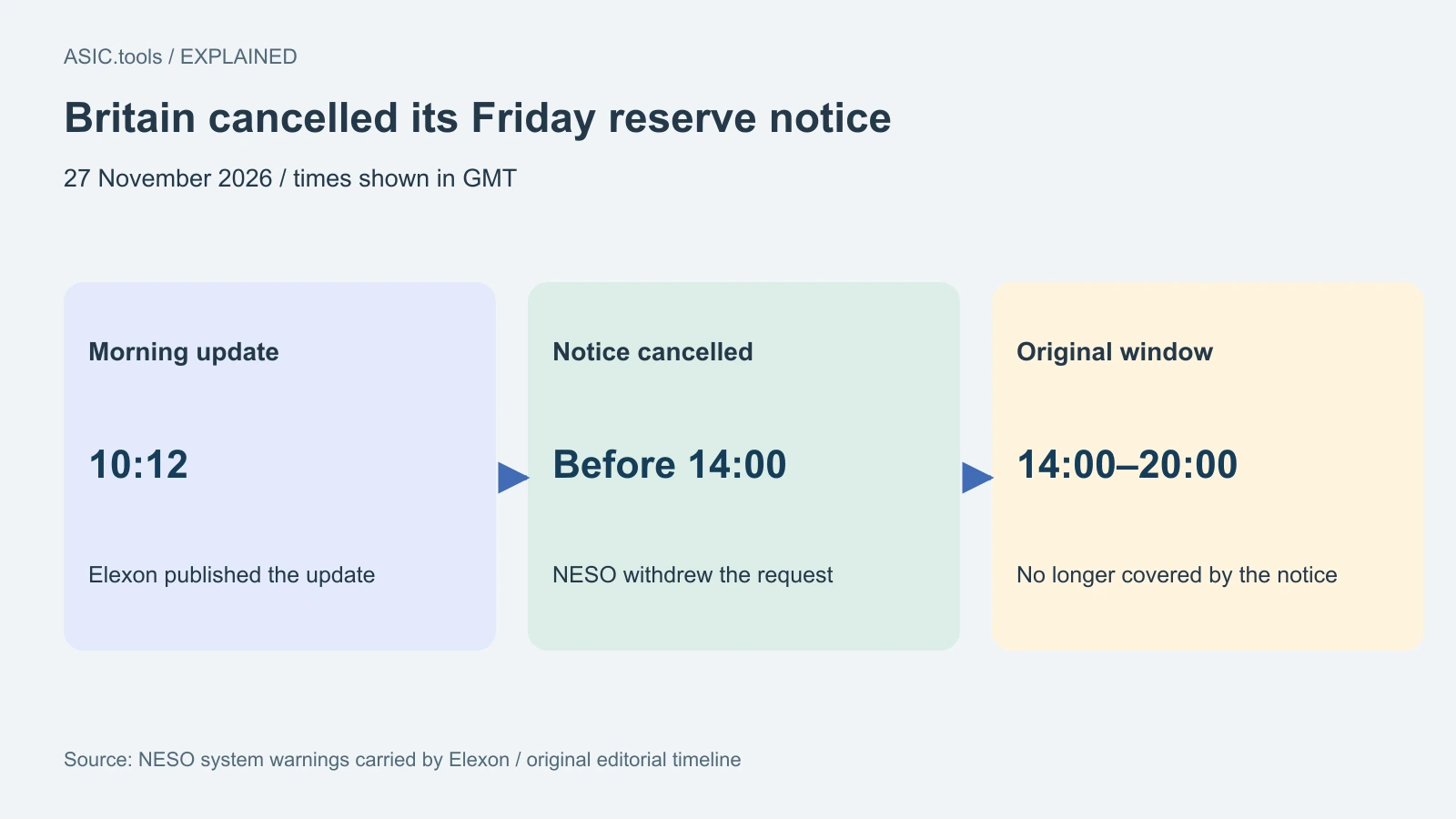
On November 27, NESO projected a 1,780 MW reserve shortfall for 14:00–20:00 GMT in its morning update. It cancelled the notice before the period began. Here is how to read that sequence when running a miner.
The notice changed before the window opened
On November 27, Great Britain’s National Energy System Operator, or NESO, cancelled its request for extra reserve before the 14:00–20:00 GMT window began. The morning update published by Elexon at 10:12 GMT had forecast a 1,780 MW reserve shortfall. The cancellation listed no other transmission system warnings in force. A mining farm watching the notice had to check the latest status before making a decision about its own power use.
Reserve is spare capacity that helps keep the system balanced if something changes suddenly. A generator can fail, an interconnector can deliver less, or demand can turn out higher than forecast. The warning describes how much of that safety margin NESO expects to be missing. Customers continued to deal with their own suppliers and contracts, and the notice was a request to market participants for additional capacity or demand flexibility.
Why available capacity matters
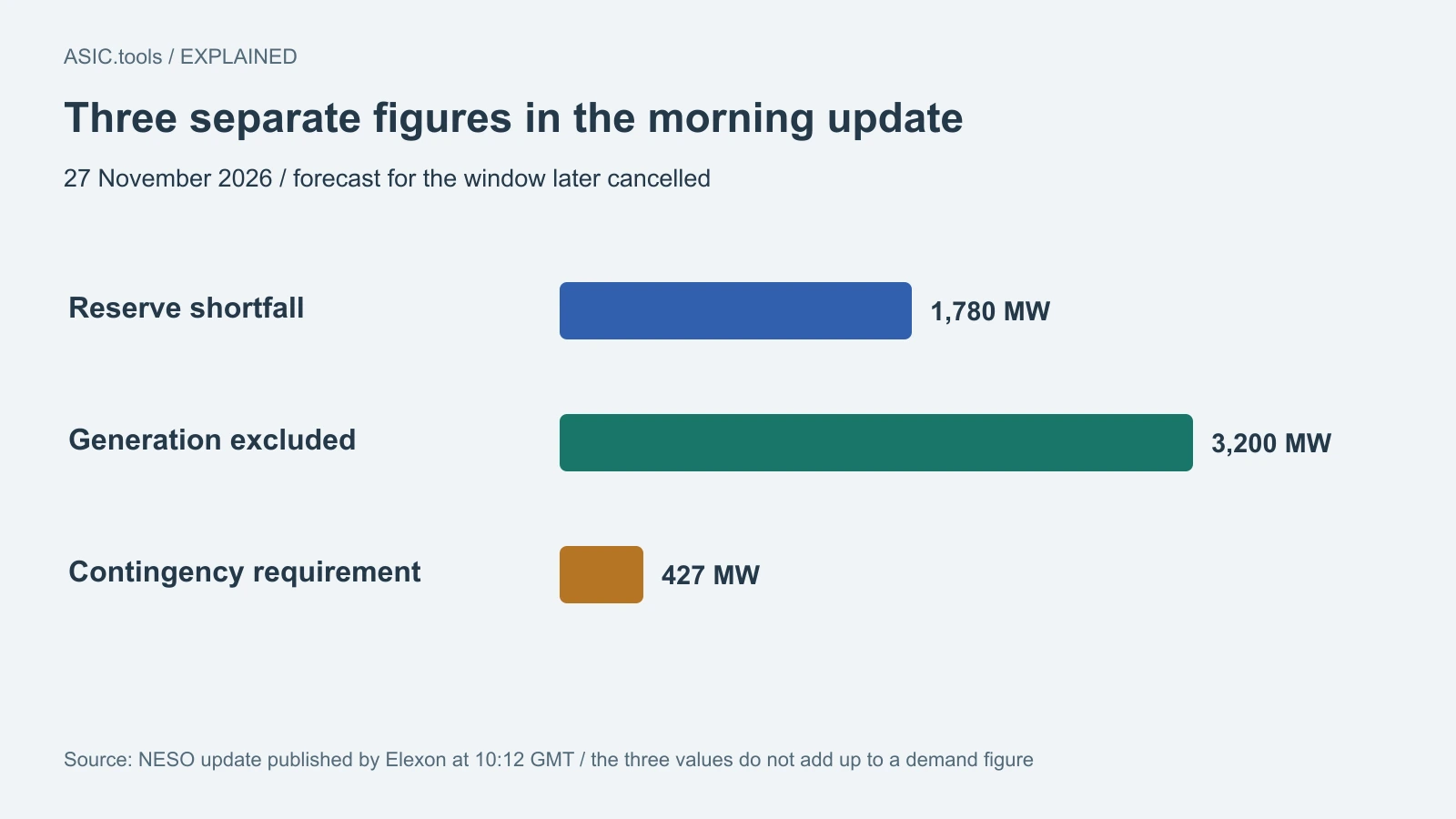
The same update said 3,200 MW of generation was excluded from the available margin because of system constraints. Power has to reach the part of the network that needs it. A plant can be ready to run while limits on moving its output prevent the operator from counting it all toward the reserve. The 3,200 MW describes excluded generation, while 1,780 MW describes the gap that remained in the operator’s calculation. The notice gives those figures different roles.
The figure was a forecast for a specific period. The update said the operator would review it again at 14:00, and NESO cancelled the notice before then. Offers of extra generation or changes in expected demand can affect the calculation. The cancellation did not say which change drove the decision. When reading early reports, put the update and its time alongside the original forecast.
The update also quoted a 427 MW contingency requirement. This refers to how much headroom the control room uses for the possible loss it is planning for. Keep this separately labelled when logging an announcement. Mistaking it for the reserve gap or for energy customers will be asked to save leads to the wrong interpretation.
The contract determines the response
A home miner paying a constant price per kilowatt-hour may see the same marginal energy cost throughout the window. A household on a time-of-use plan should check its published rates. An industrial site that buys electricity at a market-linked price needs the price at its own delivery point and interval. Sites paid to reduce demand also need the relevant dispatch instructions and the baseline used to measure a reduction.
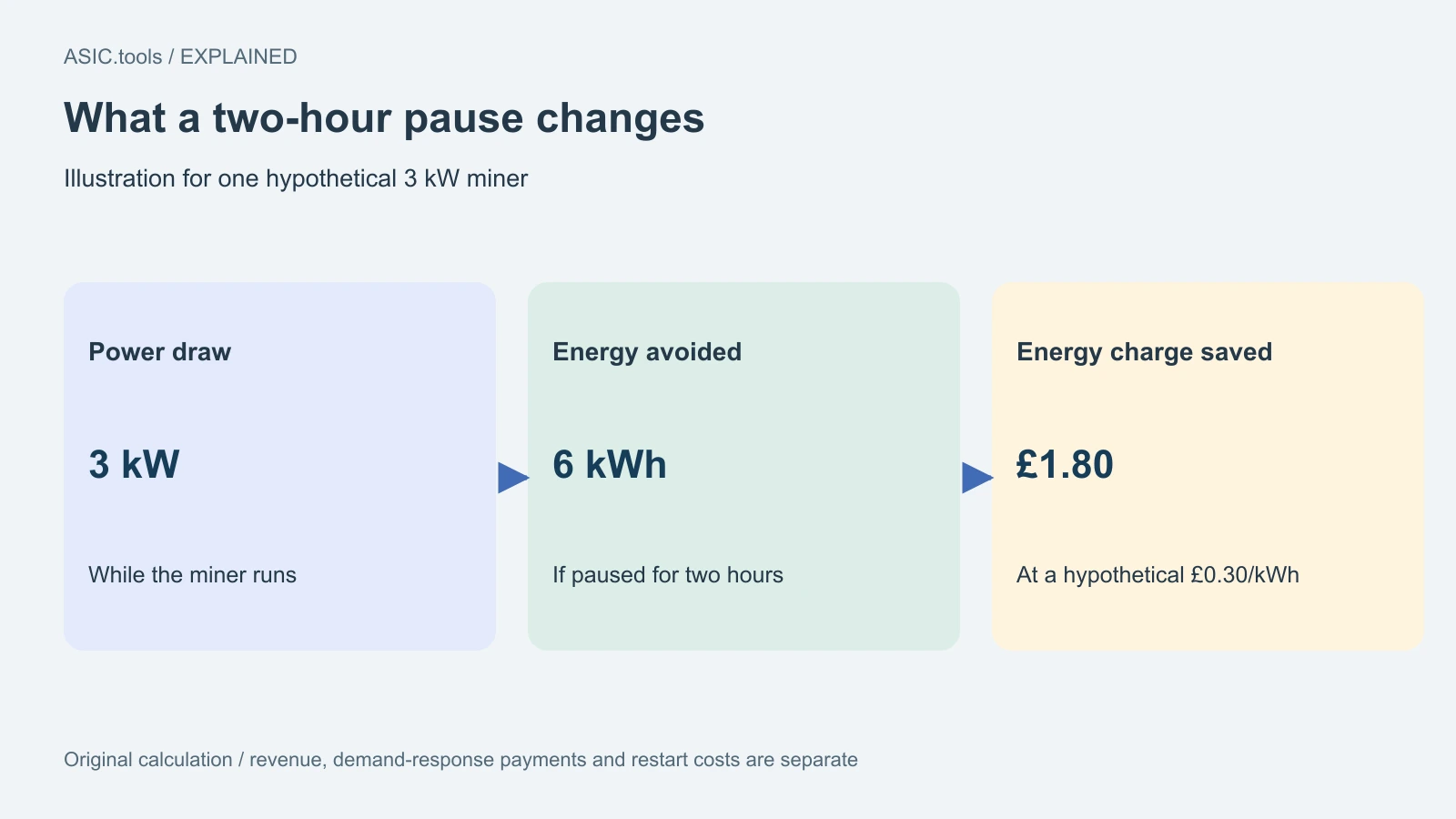
Take an illustrative 3 kW miner. Each hour at full draw uses 3 kWh. A two-hour pause cuts consumption by 6 kWh; at a hypothetical rate of £0.30 per kWh, that saves £1.80 in energy charges. The decision still depends on the expected mining revenue missed in those two hours, any demand-response payment and the costs of stopping and bringing the device back online. A national figure in megawatts does not supply any of those prices.
What to record before and after a pause
A farm can log the supplier’s message, the time demand actually fell and the meter reading. Restart time belongs in the same record. A dozen units may stop together while their cooling system still draws power, and pool-side records show the hashes the pool received rather than the electricity the site avoided. Both sets of readings help the operator check its plan.
Friday’s update put a time on a system-level need. Read it alongside the rate that will actually be charged, the operator or supplier instructions that apply to the site, and the machine’s own power and revenue figures. That is how a warning measured in thousands of megawatts can inform a much smaller decision without pretending to make it for the reader.
Keep the units in the log as well. Megawatts measure how much power is available or being used at a moment. Kilowatt-hours measure energy accumulated over time. An energy rate can be applied to the latter. A contract with a separate charge based on peak power can require another calculation, using the interval and meter specified by the supplier.
Source: NESO / Elexon ↗ · NESO explanation of system notices ↗
Mining calculator ↗