Emergency power cuts override schedules in parts of Ukraine on November 8
Source report: 2026-11-08 · Editorial analysis published: 2026-11-08
Ukrenergo and DTEK identify different affected regions. Dnipropetrovsk restoration is expected to begin with rotational supply.
Emergency cuts replace the published schedule
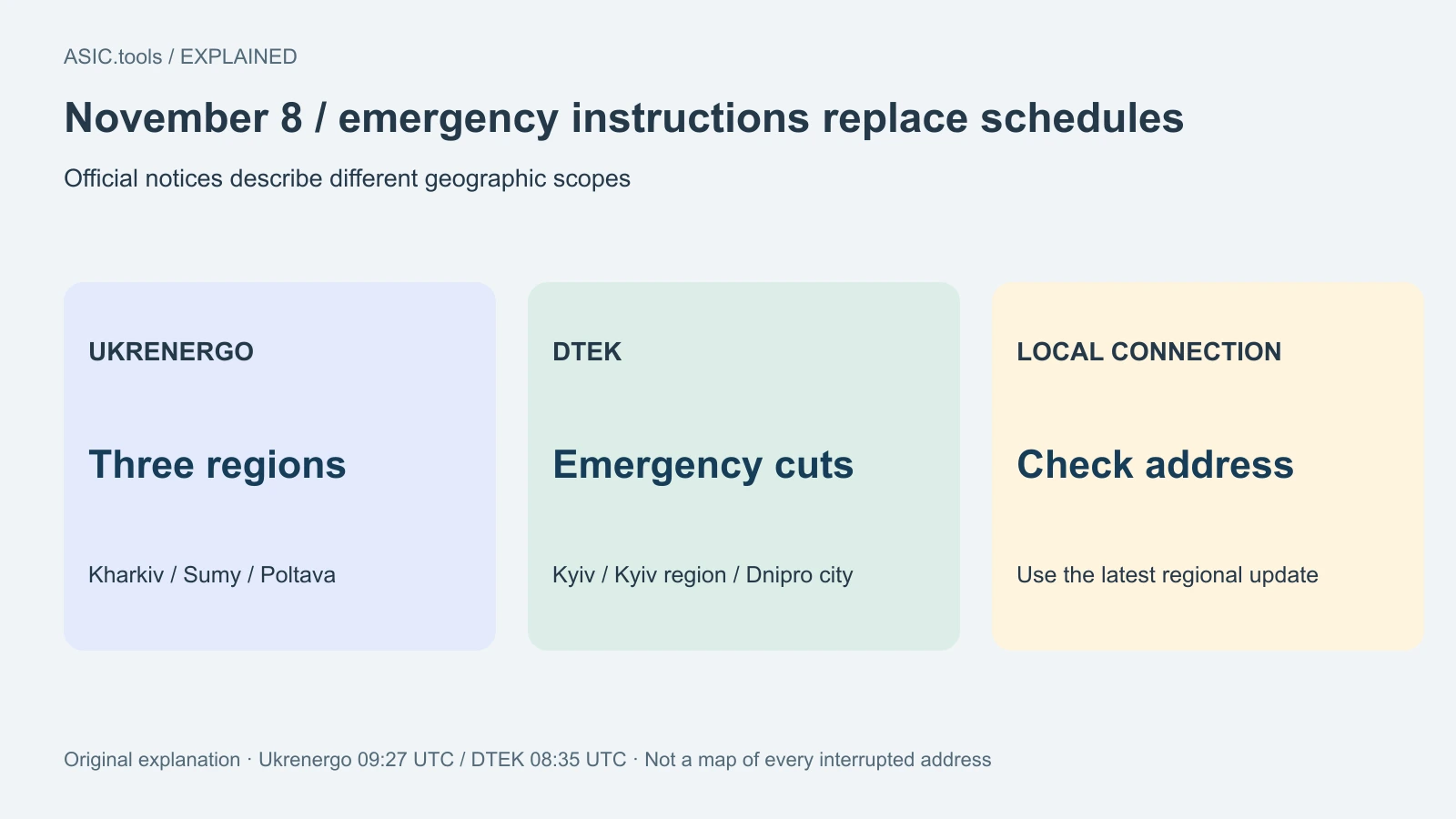
Ukrenergo reported emergency power cuts in Kharkiv, Sumy and Poltava regions on November 8, saying previously published schedules there were no longer in effect. DTEK separately reported continuing emergency cuts in Kyiv, Kyiv region and the city of Dnipro. For a home mining setup, a planned supply window is therefore not the same as electricity actually available at the socket.
The national grid operator’s notice was published at 09:27 UTC, or 11:27 Kyiv time. DTEK’s notice for its listed locations was published at 08:35 UTC. These are dated operating updates with different geographic scopes, not a claim that every connection in Ukraine has the same interruption pattern.
The immediate change is practical: the hourly timetable cannot be used as a firm restart or running-time plan where emergency cuts apply. The relevant regional distribution operator’s address check and latest notices are the next sources to follow. The November 8 notices do not establish a new electricity tariff or a change to an ASIC’s rated hashrate.
Dnipropetrovsk restoration is being staged
DTEK said at 05:39 UTC that overnight attacks had left more than 600,000 residents without power in the Pavlohrad, Samar, Kamianske and Dnipro districts and Dnipro city. The wording refers to residents, not a count of separate meters, businesses or mining devices.
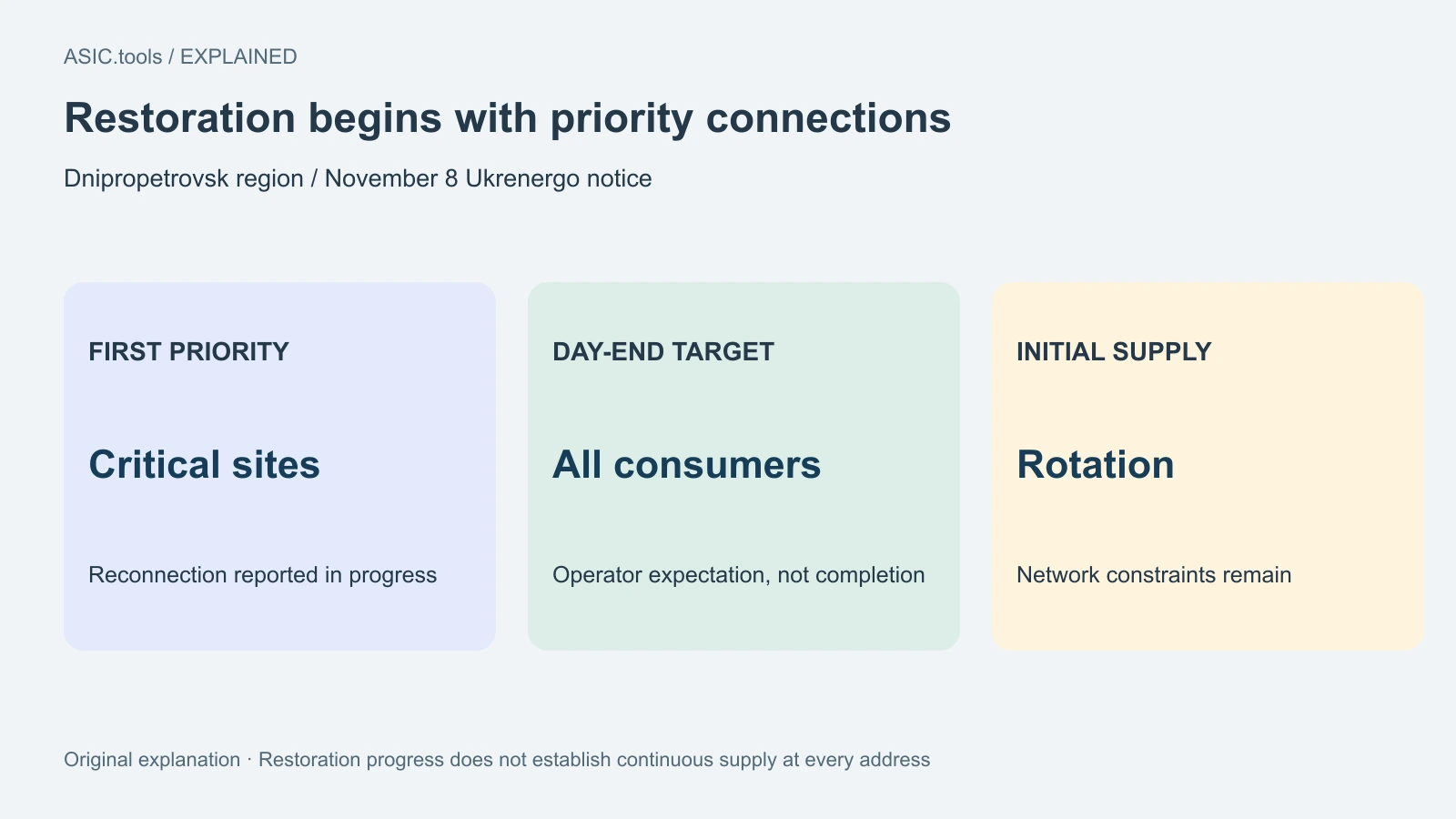
The company said important energy facilities were damaged and repeated attacks complicated the work. Its first priority was supplying critical infrastructure. Ukrenergo later said critical facilities were gradually being reconnected in Dnipropetrovsk region while repair crews continued working.
Ukrenergo expected to restore supply to all consumers by the end of the day, but said the initial supply would be rotational because the network remained constrained. That is a restoration target with a stated limitation. Reconnection of critical infrastructure does not by itself establish continuous power at every household address.
A national notice and an address answer different questions
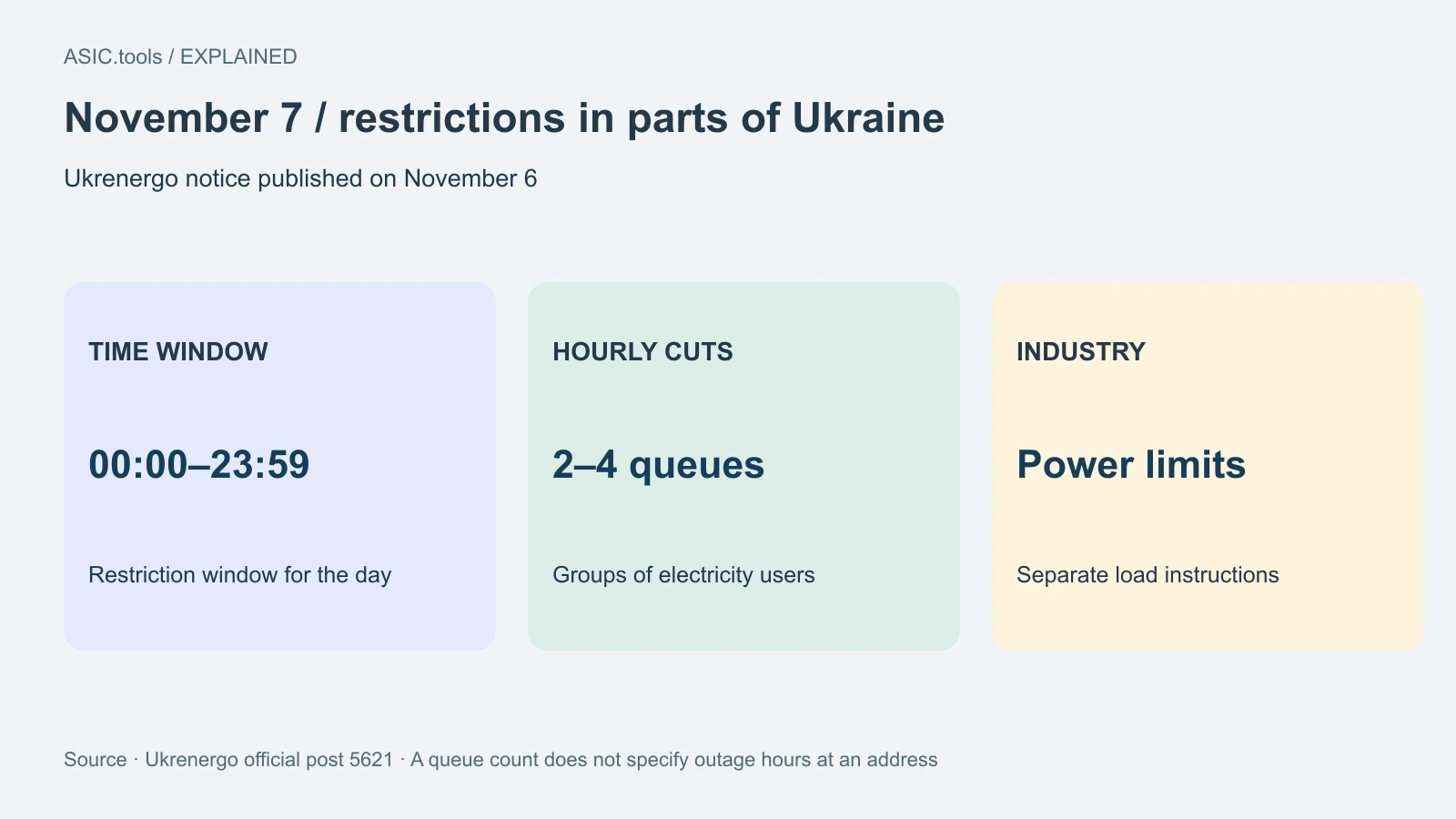
The previous evening’s plan for November 8 allowed hourly restrictions of 1.5 to four queues in parts of Ukraine. Queues are groups of electricity users, not a number of outage hours at an individual address. Emergency instructions in the named regions superseded the earlier timetable there.
The national operator describes the system situation and the need for restrictions. A distribution operator applies them to local connections. Keeping the region, address and update time together helps avoid applying a notice for Kyiv region to Kyiv city, or one for Dnipro city to every connection in Dnipropetrovsk region.
Ukrenergo said emergency cuts would end when the power system allowed. It did not give a fixed cancellation time for Kharkiv, Sumy or Poltava. A timetable returning to an operator’s page and actual voltage returning at a particular connection are observations that should be checked against the latest local status.
Use actual running time for the mining account
An ASIC’s nameplate describes its operating capability; it does not show how many hours it ran today. During interruptions, pool statistics can show submitted and accepted work, while local logs can help identify periods when the device was offline. Neither a timetable nor a configured hashrate replaces those observations.
Energy cost also belongs to the actual operating interval. A meter reading covers the equipment connected through that meter, which may include cooling and other loads. Recording energy and mining income over the same period gives a clearer account than multiplying a normal full-day estimate by a guessed outage allowance.
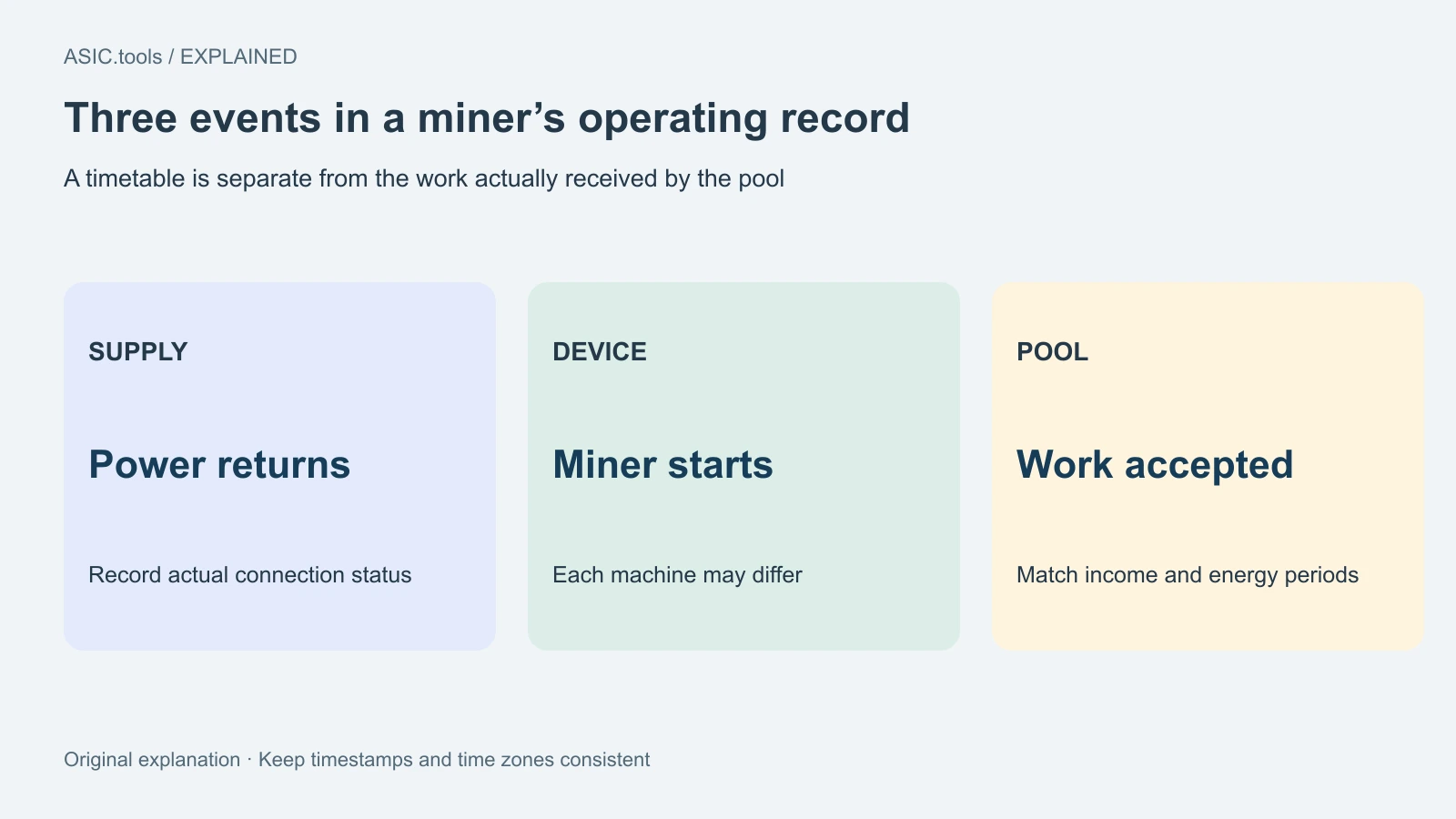
For a farm with several machines, keep each device’s downtime separate if their behavior differs. A restored connection does not prove that every miner rejoined its pool at the same moment. This is a bookkeeping distinction: a change in supply, a device restart and the first accepted work are separate events in the operating record.
Check the averaging interval behind a pool’s displayed hashrate. A chart that includes an earlier outage may take time to reflect resumed work, while a short view may show a different value. Use the pool’s stated interval alongside individual accepted-work timestamps rather than assuming the chart is an instantaneous reading of the machine.
Keep one time basis when matching notices, local logs and pool records. Mark whether an entry uses UTC or Kyiv time before assigning it to a day’s account. A notice’s publication time is when the operator reported a situation, not proof that every address lost power at that exact second.
Check the latest instruction before using a forecast
The sources are the official Ukrenergo and DTEK channels, with the specific posts linked below. The November 8 emergency notices are the event reported here. The November 7 plan supplies background and is kept separate from the later emergency instruction.
A report that repairs are progressing is useful, but it is not a guarantee of uninterrupted mining through the rest of the day. Ukrenergo explicitly warned that the situation could change and directed users to their regional operator. Its end-of-day restoration expectation for Dnipropetrovsk should be read with the rotational-supply condition attached.
For miners, the decision-relevant result is a change from planned hours to the supply and accepted work that can actually be observed. Save the time of the local update with the operating record. That keeps electricity availability, mining output and costs connected to the same day without treating an emergency notice as a universal national schedule.
Source: Ukrenergo / DTEK official notices ↗ · DTEK November 8 emergency status ↗ · DTEK morning regional outage notice ↗ · Earlier November 8 plan, now background ↗
Mining calculator ↗