THORChain lifts the GAIA pause while Solana remains restricted
Source checked: 2026-11-05 · Editorial analysis published: 2026-11-05
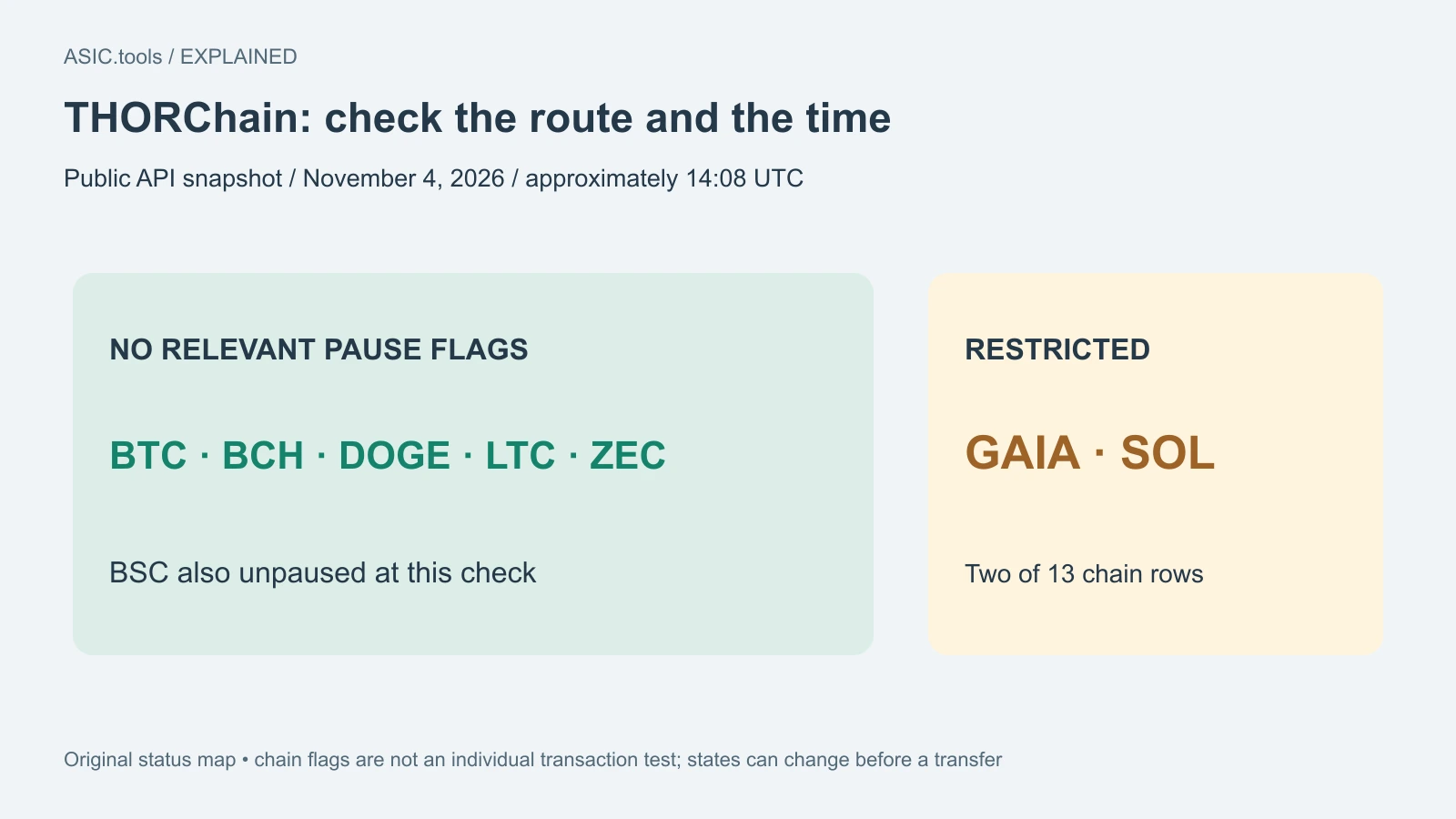
November 5 data shows GAIA’s halt and trading-pause flags cleared and the GAIA.ATOM pool available. This is a change from the retained November 4 snapshot, not a test transfer or a guaranteed swap.
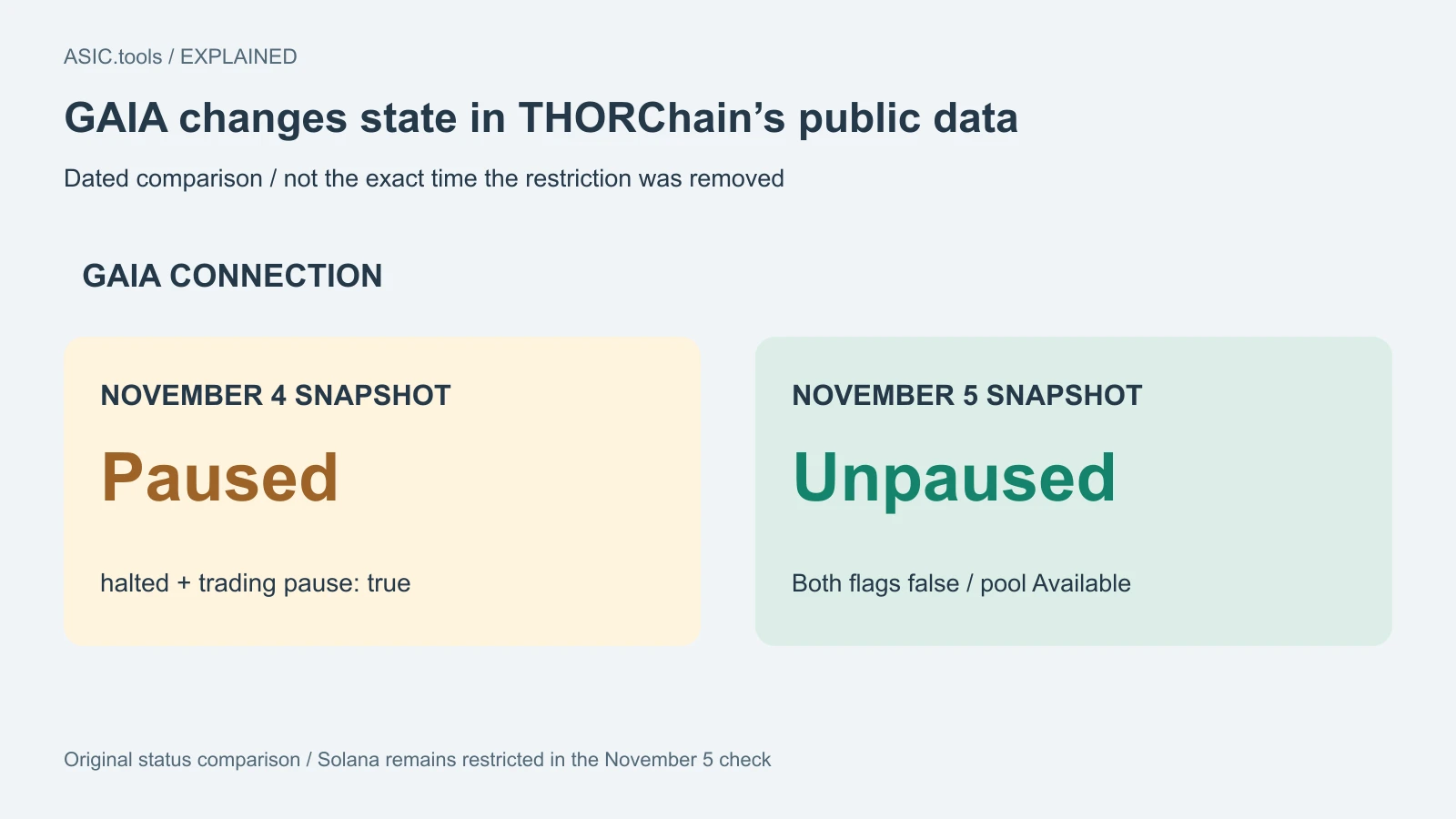
One of yesterday’s restricted connections has changed state
THORChain’s public data checked on November 5 shows that the GAIA connection is no longer marked halted or trading-paused. The GAIA.ATOM pool also reports Available. In the November 4 snapshot retained for our previous report, GAIA had both restrictions enabled. This is a concrete change for users considering an exchange between mined proof-of-work coins and ATOM through the service.
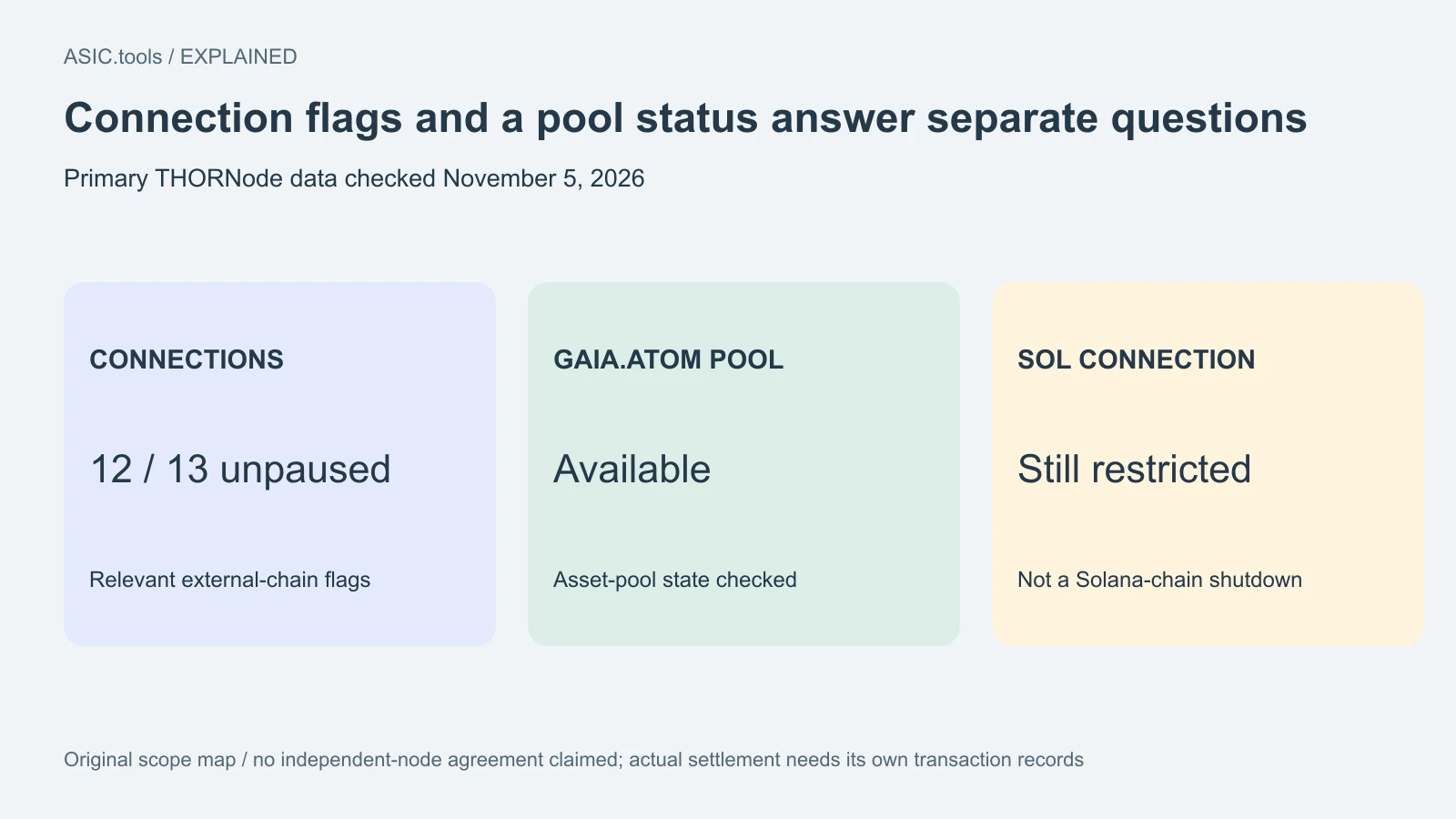
The comparison is deliberately between dated observations. It establishes that the two snapshots differ, not the exact moment a restriction was removed. The new check found twelve of thirteen external-chain rows without the relevant halt or trading-pause flags. Solana, identified as SOL, remained the restricted row with both flags enabled.
Bitcoin, Bitcoin Cash, Dogecoin, Litecoin and Zcash continued to appear without those pause flags. That is different from saying that the change improved mining output on those blockchains. The news concerns the service used after coins have been received, when an owner may want to exchange them for another asset. An ASIC’s production and a separate exchange route are different parts of the same owner’s finances.
What the GAIA and ATOM labels tell the reader
GAIA is the connection identifier used here for the network associated with ATOM, and GAIA.ATOM is the corresponding asset label in THORChain’s pool data. Users should match the network as well as the token name when reading an interface. A familiar ticker displayed on another chain is not automatically the same deposit path.
The pool’s Available status provides a second relevant check alongside the connection flags. One describes the asset pool, the other whether the service advertises restrictions on the chain connection. Neither is a completed transaction. An actual route still depends on both assets, current liquidity, fees and the conditions presented for that particular request.
The data was read through Liquify’s public THORNode service, which the official developer documentation lists as a mainnet source. Attempts to reach an additional public node were unsuccessful. The retained responses therefore support a dated primary-data report, not a claim of agreement across independently reachable nodes. No wallet was connected and no swap or deposit was made.
Both ends of an exchange still need to work
For someone receiving Bitcoin from a mining pool, checking the Bitcoin side is only the first step before a proposed exchange into ATOM. The receiving side matters too. Conversely, SOL remaining restricted here does not mean the Solana blockchain itself has stopped; it describes the THORChain service’s advertised connection state for that network.
Current network controls also show GAIA trading unpaused and SOL trading paused, consistent with the change observed in the connection data. Those controls are a live operating layer, not a permanent promise. A status recorded earlier in the day can be accurate for its timestamp and still be unsuitable as the only basis for a later payment.
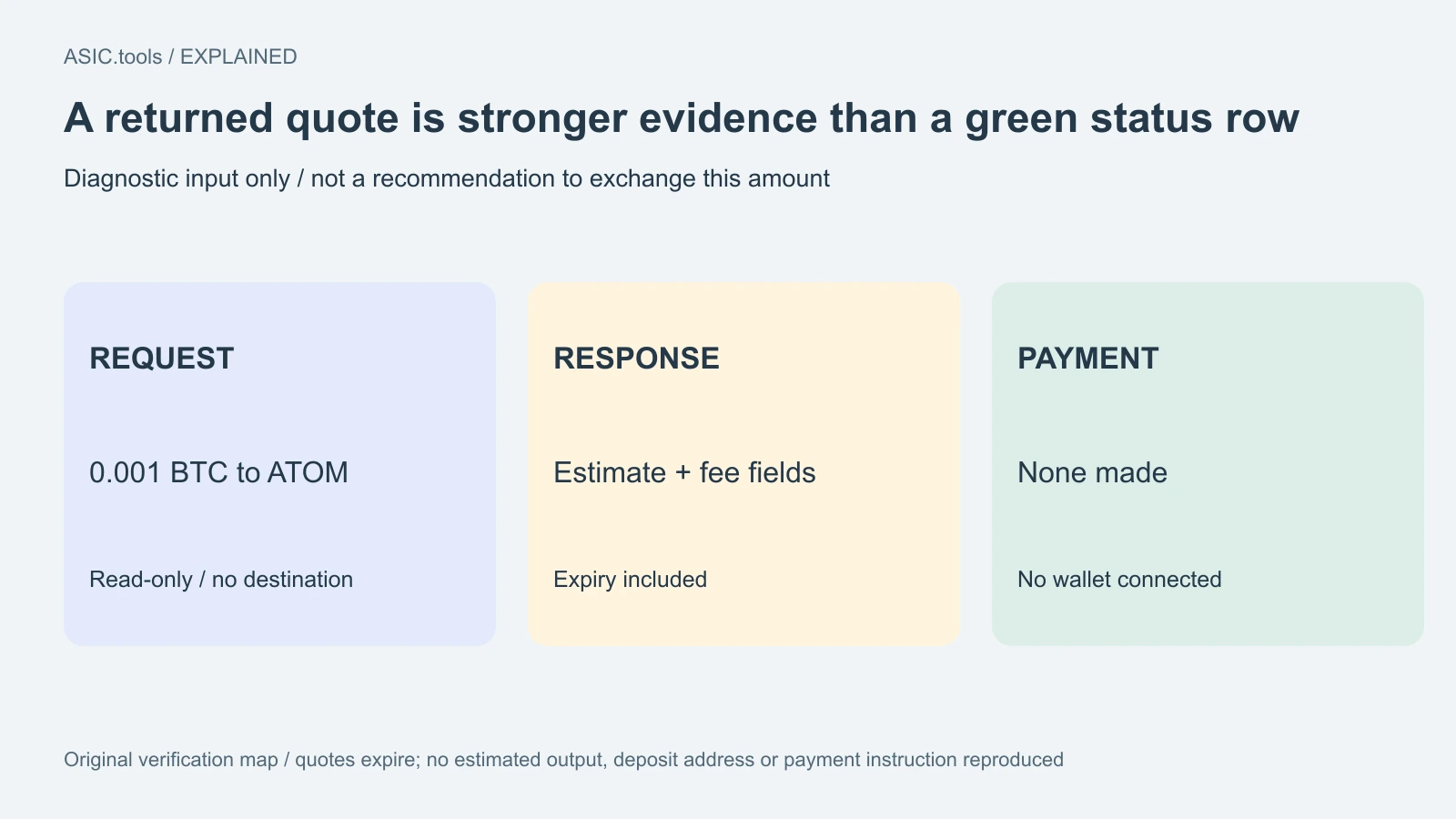
We also requested a read-only BTC-to-ATOM quote using 0.001 BTC as a diagnostic input, without a destination address. The endpoint returned an output estimate rather than a route-paused error. This checks more than the colour of a network-status row, but it still does not sign or send a transaction. The amount was a test parameter, not a recommendation about what anyone should exchange.
The response separates outbound and liquidity fees and carries an expiry time. Its affiliate field was zero for this direct request; that does not make every interface or exchange free. A quoted amount and fee breakdown belong to that request and its validity window, not a permanent tariff that can be copied into a later operation.
A fresh quote from the selected interface is the place to review the particular assets, charges and expected result before deciding whether to proceed. This article supplies no destination or vault address to copy. Such information belongs to the current transaction flow, not to a news screenshot or a saved historical response.
Follow an existing payment before starting another
A reader with an earlier unresolved transaction should examine that transaction’s record rather than infer its outcome from the new GAIA flags. Opening a route does not itself establish that every past transfer has completed or that a particular balance has been recovered. The source transaction and any resulting outbound transaction answer those individual questions.
If an interface is slow or shows an old state, sending the same payment again creates a new transaction; it does not simply refresh the first one. Keep the original transaction identifier and follow the service’s official status and support channels. A public operational change is not a reason to provide a wallet recovery phrase to someone offering private assistance.
The useful distinction on November 5 is narrow but practical: GAIA has moved out of the paused set in the checked data, while SOL has not. Users evaluating proof-of-work coin exchange routes have one new state to consider, with a dated comparison and pool status to support it. Settlement, pricing and the fate of an individual transfer still require their own current records.
Source: THORChain public API ↗ · Current GAIA.ATOM pool state ↗ · Current network controls ↗ · Official documentation for public data sources ↗ · Official quote and swap process documentation ↗
Mining calculator ↗