THORChain after 3.21.1: Bitcoin routes are available, but GAIA and Solana remain restricted
Source checked: 2026-11-04 · Editorial analysis published: 2026-11-04
A November 4 API check shows why miners exchanging PoW proceeds need the current route status. The snapshot differs from early reports, and node upgrades do not guarantee every transfer has finished.
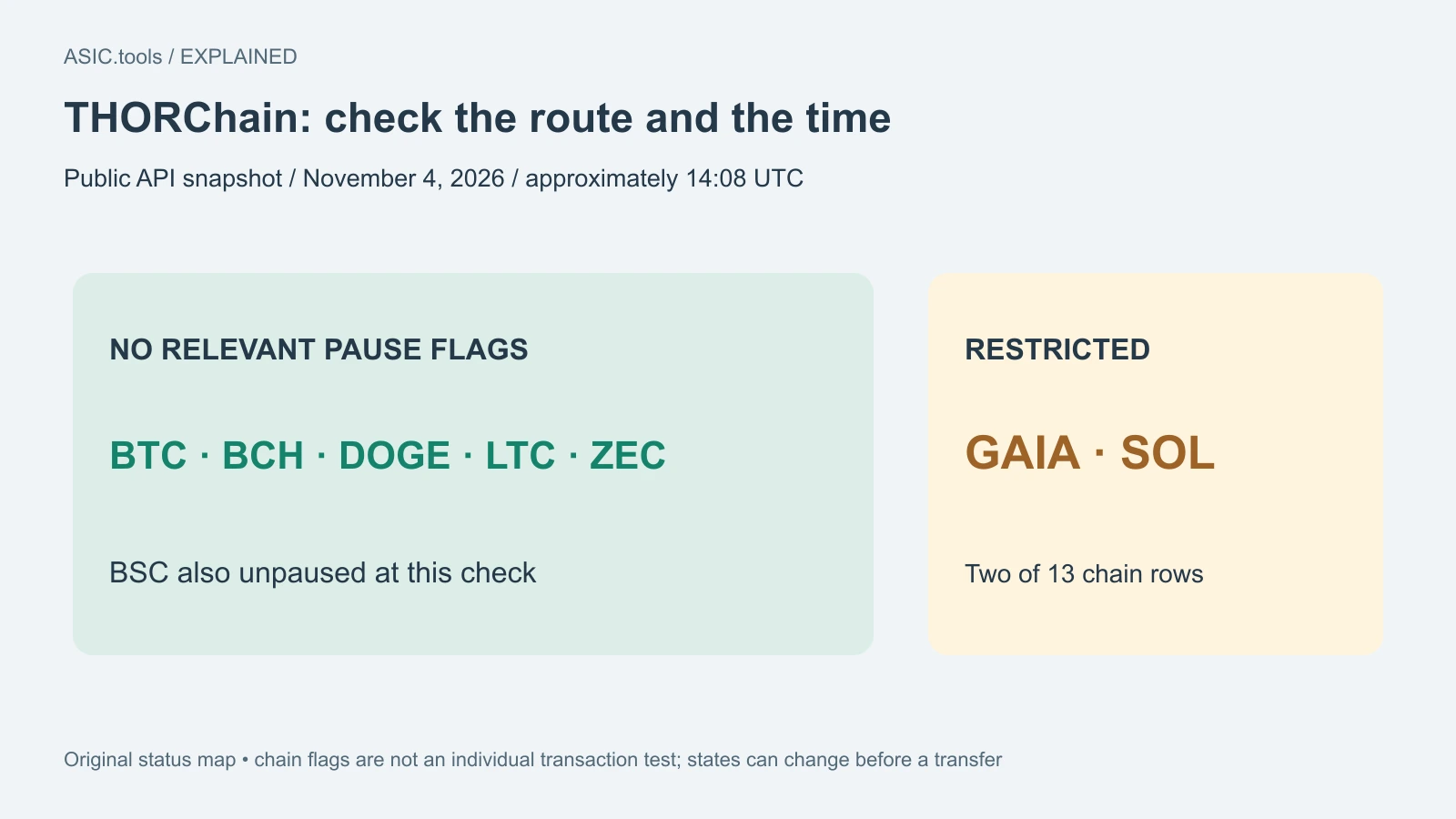
A partial recovery needs a dated route check
THORChain's public application programming interface (API), which lets programs read network data, checked on November 4 at about 14:08 UTC, showed no inbound halt or trading pause for Bitcoin, Bitcoin Cash, Dogecoin, Litecoin and Zcash. GAIA, the Cosmos Hub chain identifier, and Solana still showed restricted trading and halted inbound status. For miners who exchange proceeds from proof-of-work coins (PoW: networks secured by miners' computation) through this protocol, the useful news is which route is currently usable rather than a broad claim that everything is back.
The data service returned 13 external-chain rows. Eleven had the relevant halt and trading-pause flags off, including BNB Smart Chain at this check. GAIA and Solana were the two exceptions. This differs from early recovery accounts that also listed BNB Smart Chain as paused. The recorded time matters: these are operational states that can change, not permanent properties of a coin.
THORChain connects native assets on different blockchains through its liquidity and vault infrastructure. A Bitcoin mining pool paying an address and a later swap through THORChain are separate operations. Availability of the first does not establish the second, and a swap being possible does not prove that every old pending transaction has already completed.
The data was retrieved through the public provider endpoint linked in THORChain's developer documentation. The raw response and corresponding network controls were retained. No wallet was connected and no swap was sent for this report. This is a verified observation of published network data, not an end-to-end transaction test or a promise about every interface using the protocol.
What the 3.21.1 release changes
The official GitLab release records version 3.21.1 at 03:42 UTC on November 3. It describes a Bifrost-only patch over 3.21.0, without a consensus change or an upgrade height. Bifrost is the component that observes external chains and helps coordinate their interaction with THORChain. This is different from changing Bitcoin's own mining algorithm or block rules.
The notes include pinning Bitcoin's minimum relay-fee floor independently of a daemon's policy, preventing one unresponsive peer from starving attestation-gossip sends, and several external-chain scanning and transport fixes. Such changes concern observing and communicating work, not a percentage increase in ASIC hashrate. The release supplies no miner profitability benchmark.
It also changes how an “all clear” solvency state is gated by the network halt state, and fixes false-healthy reporting in node-status tooling. A healthy-looking individual component can therefore be different from a network being ready for a particular operation. This is why an overall green indicator or a rising swap-volume figure is not enough to decide that a specific asset path is open.
The operator warning says this release uses a private binary containing additional security patches and should not be built from source. That limits what can be independently assessed from the public source tree alone. We read the release record without downloading or executing its binary; its existence should not be presented as a completed independent security audit.
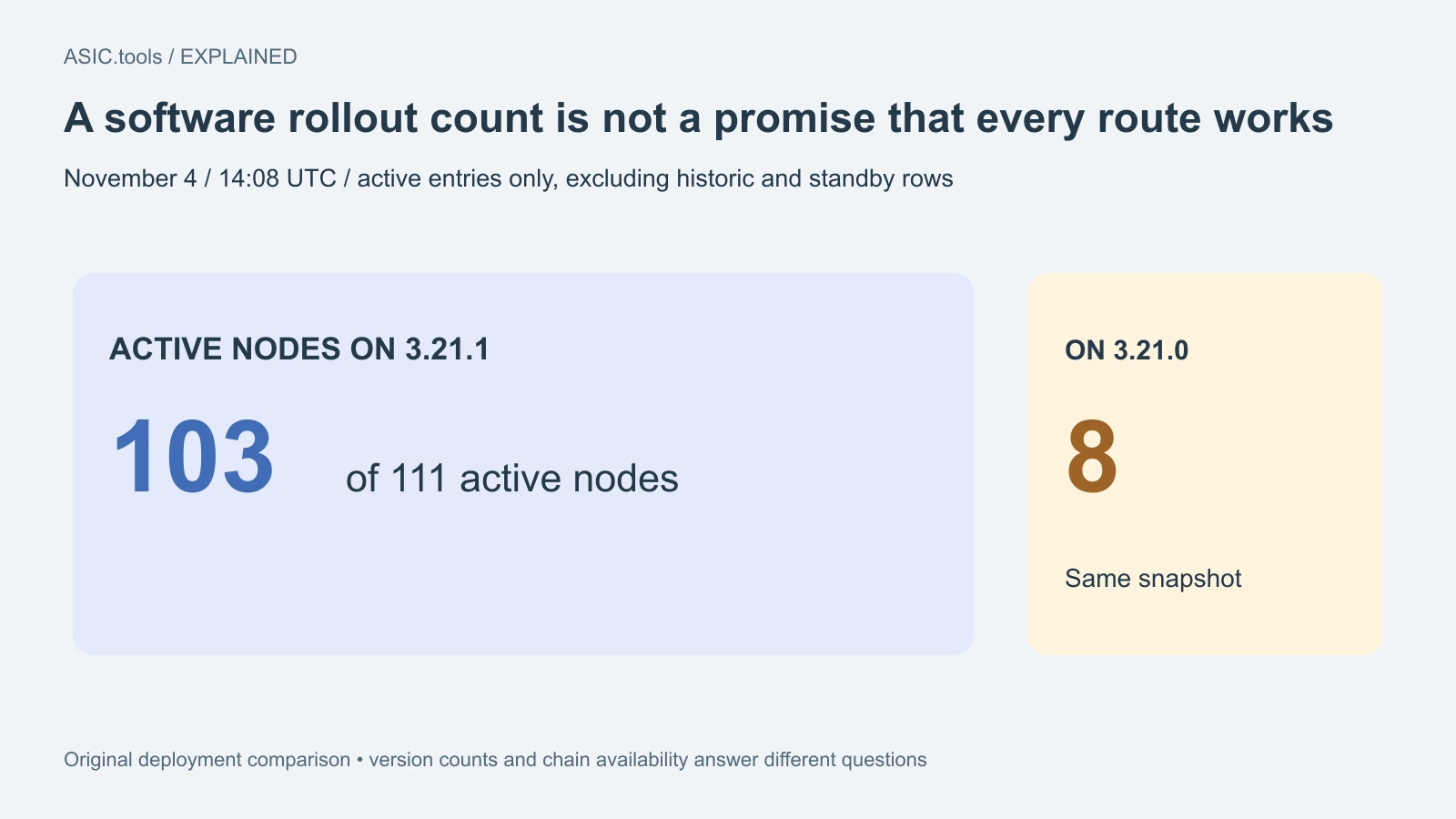
Updated nodes and available routes are different measurements
At the same 14:08 UTC check, the node endpoint listed 111 active nodes: 103 on 3.21.1 and eight on 3.21.0. These are active nodes, not all historic or standby entries returned by the API. The distinction prevents a long database response from being mistaken for the number currently participating in the network.
A software-version count measures rollout progress. It does not certify every chain, wallet interface or outstanding outbound payment. Nor does an available Bitcoin row mean a Bitcoin-to-Solana route can complete while the Solana side is restricted. For a cross-chain exchange, both the sending and receiving sides and the relevant asset pool matter.
The retained control response agreed that global trading was not halted and that GAIA and SOL trading controls remained set. It also contained other specialized controls, including a churn halt. Those should not be collapsed into “the whole network is stopped” or “every network feature is normal.” Different controls govern different operations.
Current flags need a fresh check before an actual transfer. THORChain's documentation also says only pools marked available are available to trade. Even an unpaused chain therefore does not make every listed asset pair executable at any size or price. A quotation, pool liquidity and final transaction completion answer further questions beyond the chain-level status recorded here.
What changes for someone converting mining proceeds
Check the exact native asset and both networks before relying on a route to turn mined coins into money for an expense. BTC, BCH, DOGE, LTC and ZEC have different networks and address rules. A familiar coin ticker is not a substitute for checking what the receiving wallet or service accepts; a functioning ASIC does not remove a later exchange bottleneck.
Do not reuse a vault address copied from an old article or saved screenshot. The official documentation says active inbound addresses can change as vaults rotate, and warns not to send when the endpoint marks the chain halted. Get transfer details from a current trusted interface and verify the relevant status rather than treating this report's snapshot as permanent payment instructions.
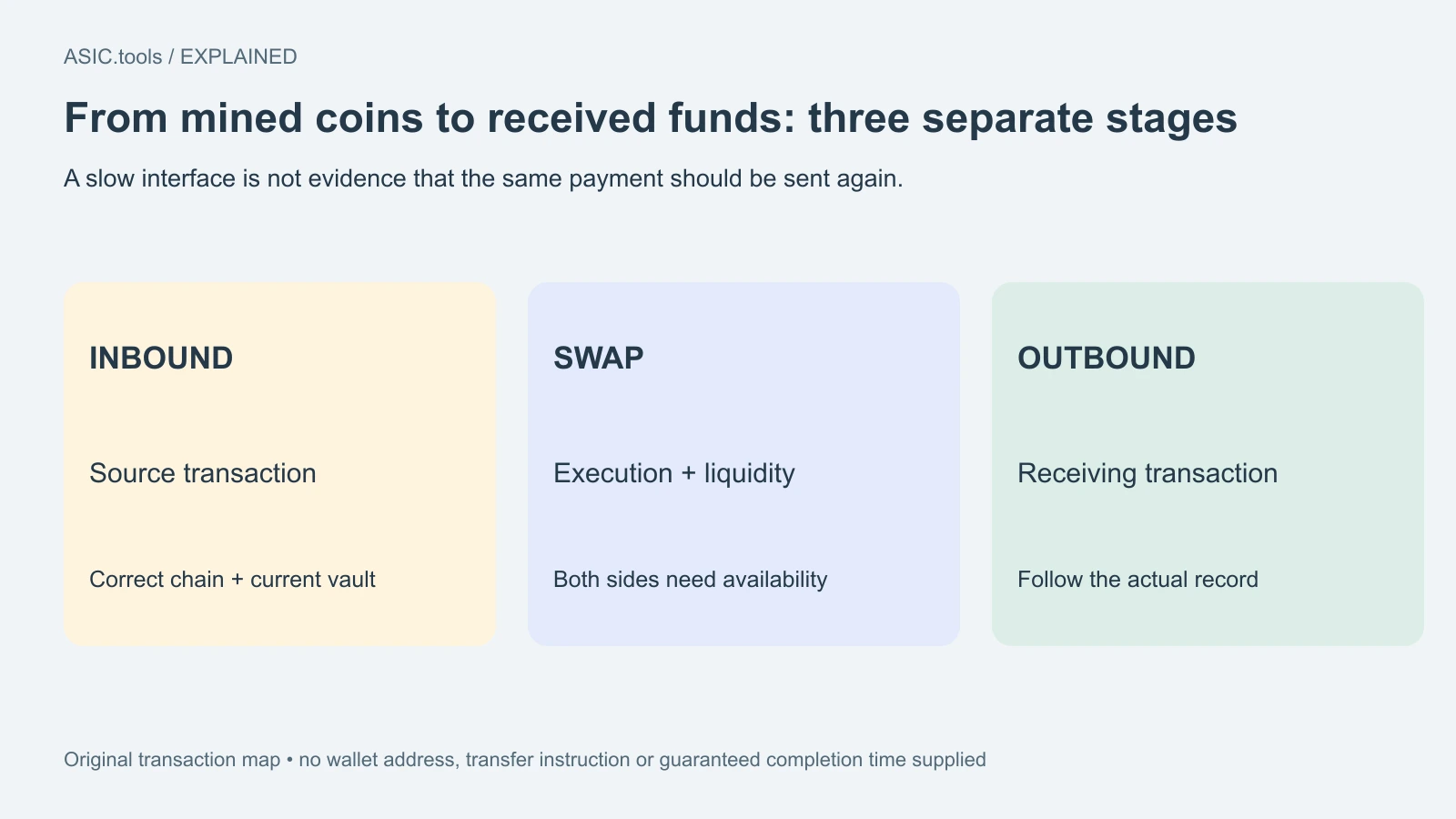
For a pending swap, follow its transaction record instead of sending the same amount again because a page appears slow. An inbound transfer, swap execution and outbound transfer are separate stages, potentially across different blockchains. The availability snapshot cannot establish whether an individual payment succeeded, refunded or remains in progress; that needs the actual transaction evidence.
The fresh release and November 4 state check show a meaningful recovery for several PoW routes while preserving specific restrictions. No restart date for the remaining routes, guaranteed settlement time, Monero launch or token-price forecast is established here. For an operator budgeting electricity, the practical benefit is a clearer view of the path from mined asset to usable proceeds, with a timestamp attached.
Source: THORChain ↗ · THORNode 3.21.1 official release ↗ · Official route and status documentation ↗
Mining calculator ↗