Why Texas power prices switched Bitcoin miners off before the difficulty cut
Source report: 2026-11-17 · Editorial analysis published: 2026-11-18
A November 17 analysis links West Texas shutdown hours to electricity prices. Its 25 J/TH example explains why an easier network can still leave a miner below its power bill.
A power bill behind the network change
An analysis published by Hashrate Index on November 17 argues that expensive electricity in West Texas played the main role in the mining shutdowns preceding Bitcoin’s November 14 difficulty cut. That is a different question from whether the cut itself helped miners: it asks why machines stopped working, and why they could return while Bitcoin’s dollar price was still falling. For an operator, the useful lesson is to compare the revenue earned during a particular hour with the electricity needed during that same hour.
Difficulty is Bitcoin’s automatic setting for how hard it is to find a valid block. It changes every 2,016 blocks in response to the time the previous blocks took. The latest reduction was 9.13%. It reflected earlier block production, rather than a decision about the next fortnight’s electricity tariff. The new report examines those earlier conditions using regional power prices and a reference machine. Its explanation is an attributed analysis, not a direct count of every machine that switched off.
When electricity costs more than the work earns
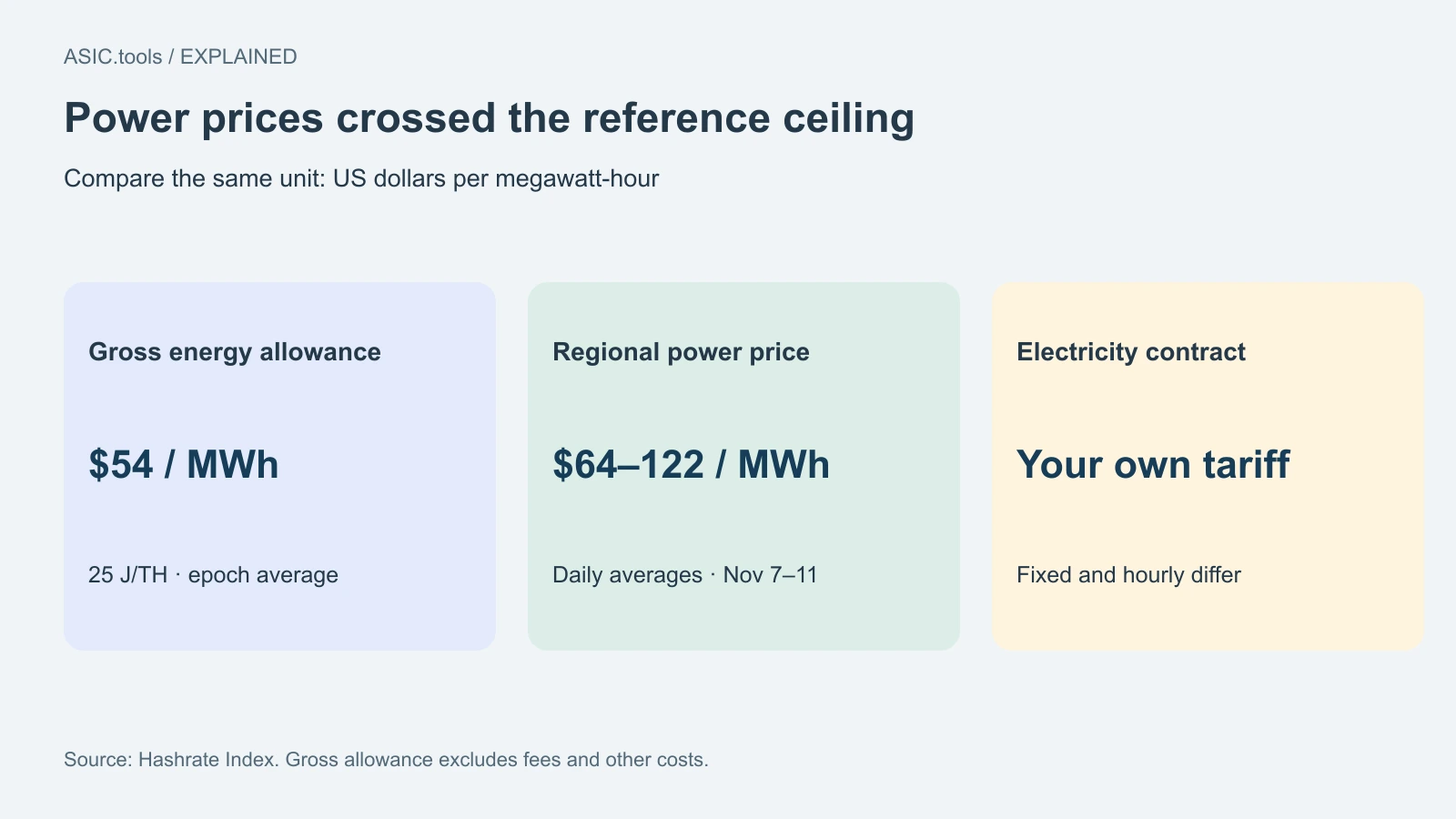
The report uses a device rated at 25 joules per terahash, written 25 J/TH. A terahash is a trillion hashing attempts; the rating describes the energy needed for that work. Its energy hashprice averaged $54 per megawatt-hour during the October 29–November 14 difficulty period. Energy hashprice converts expected gross mining revenue into the amount of electricity a particular efficiency rating consumes. It is a revenue ceiling for power, before the pool fee and other operating costs.
West Texas daily wholesale averages reached $64–122/MWh on November 7–11, according to the analysis. These are regional market prices, not a universal household tariff or the invoice of a particular hosting customer. In the reference example, the daily price range sat above the gross revenue allowance. A miner on a fixed contract may face a different decision from a facility exposed to hourly wholesale prices, even when their machines have identical efficiency.
Why the evening mattered
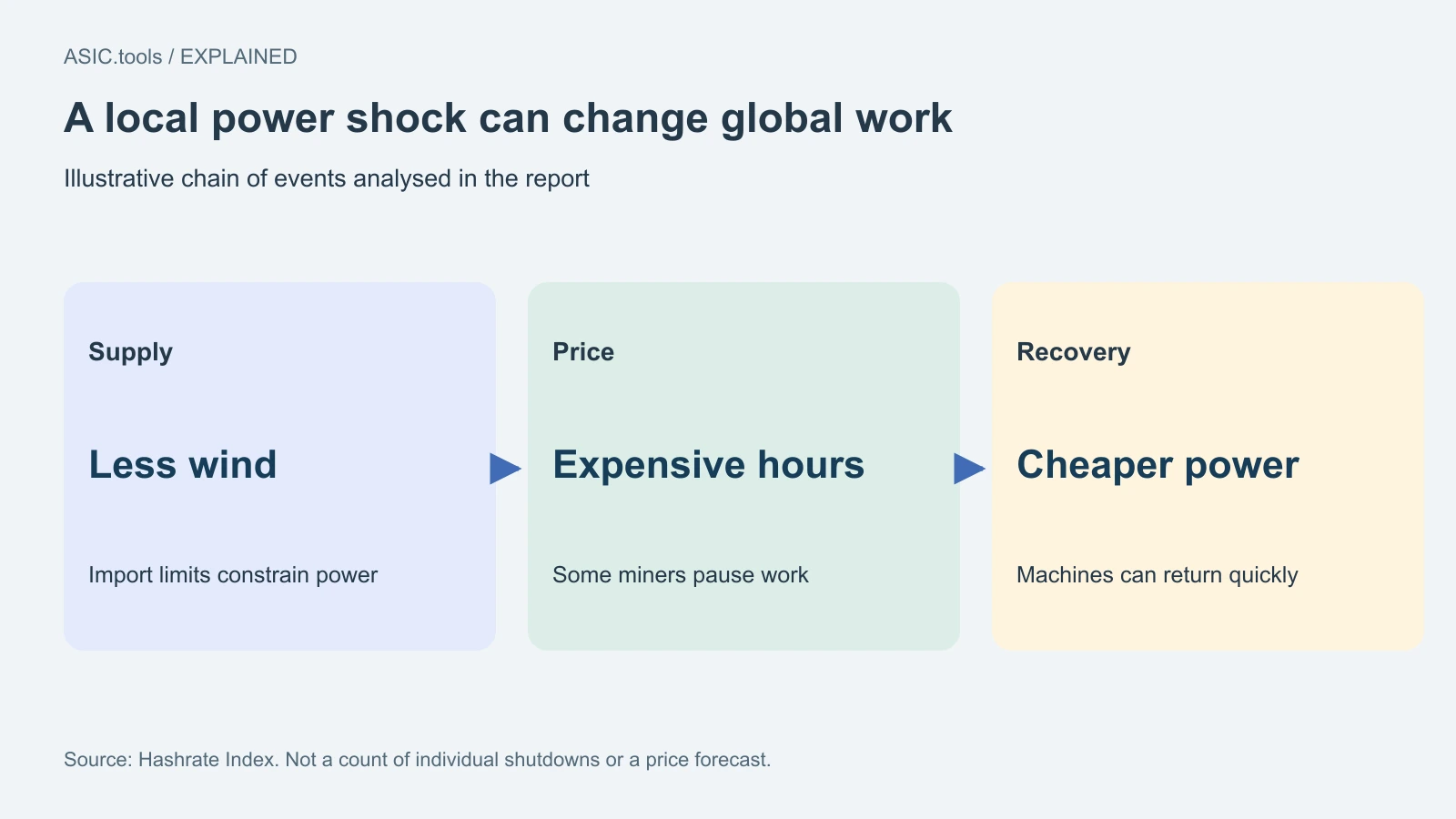
The authors link the squeeze to low wind generation and limits on importing power over transmission lines. Solar generation then fell after sunset, leaving the evening especially expensive. This is how a local energy shortage can affect a global mining network: a cluster of facilities reduces work in the same expensive hours, even though the Bitcoin protocol and the machines themselves still function normally.
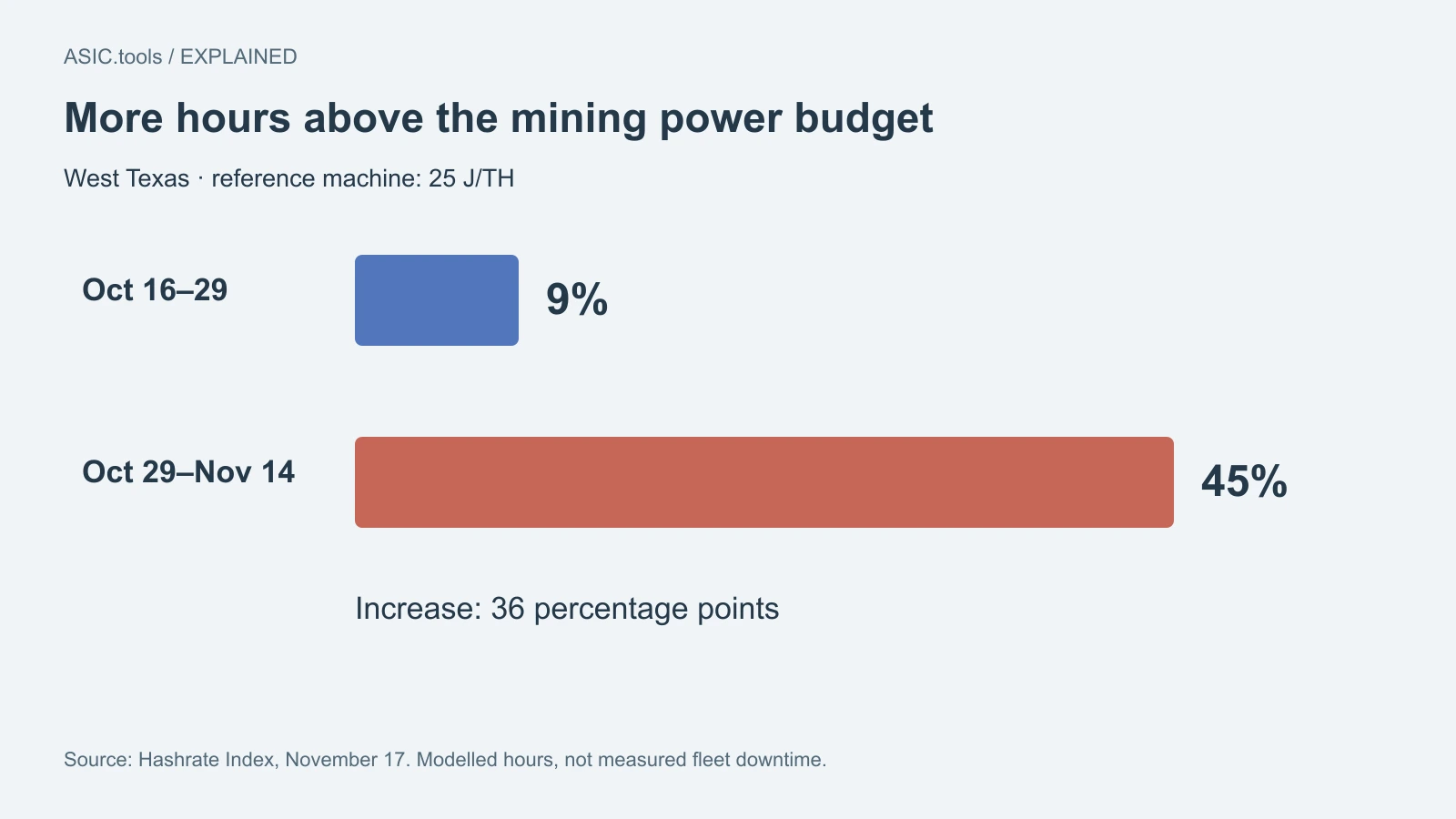
For the 25 J/TH reference, electricity exceeded gross mining revenue in 45% of West Texas hours in the latest period, compared with 9% in the previous one. That is an increase of 36 percentage points. It does not mean each Texas miner was off for 45% of the time. The calculation classifies hours at one reference efficiency and market price; contracts, newer equipment, on-site generation and operating decisions can change what individual sites actually do.
A pause can be reversed quickly
Hashrate Index compares the two periods while holding one input constant. With the newer power prices but the older hashprice, the share of uneconomic hours would have been 39%; with the older power prices but the newer hashprice, 17%. The authors use this comparison to attribute about four-fifths of the deterioration to electricity. Those are separate scenarios with a common baseline. Their contributions are not independent pieces to add together, and the exercise is not a meter reading of shutdown capacity.
The report then points to a recovery in estimated network computing power as regional electricity became cheaper, despite Bitcoin’s lower price. Network hashrate is inferred from block production, so a short interval is noisy. Still, the sequence explains a practical risk for miners who keep running: competitors can return quickly after a temporary energy squeeze. A difficulty reduction therefore does not promise two weeks of an unchanged competitive environment or a fixed dollar payout.
What to compare at your own site
At the report’s $54/MWh energy benchmark, the electricity allowance is $0.054/kWh before other costs. This unit conversion is useful when reading a local bill: one megawatt-hour equals one thousand kilowatt-hours. Use the actual wall-power reading and the applicable tariff, including any hourly variation. Add cooling and other site electricity if they are charged separately. A chip efficiency figure and a complete facility power bill describe different boundaries.
The practical comparison is dated revenue, accepted work at the pool and energy used over the same period. If a hosting contract includes a curtailment rule, read what it says about shutdowns, restarting and charges during a pause. If power is fixed, a Texas wholesale spike is context rather than your own tariff change. The new analysis shows why mining economics can change at the electricity connection before they appear in Bitcoin’s next difficulty adjustment; it supplies no guaranteed next adjustment or profit for an individual machine.
Stopping power and stopping costs are different
An hourly shutdown removes only the electricity that actually stops being consumed. A powered network switch, ventilation left running or another fixed site load can remain on the meter. Hardware financing, rent and a fixed hosting charge can also continue while an ASIC is idle. These costs explain why the cheapest choice for the next hour and the long-term return on buying the machine are different calculations. The report’s power comparison addresses the former, not the full investment decision.
For a home miner, include the time spent restarting and confirming that the pool accepts work again. Record the complete window instead of comparing one cheap-hour revenue estimate with an entire day’s bill. For a hosted machine, ask which costs are measured at the device and which are shared across the site. Clear accounting boundaries make the Texas example useful elsewhere without assuming that another country has the same market prices or contract terms.
Source: Hashrate Index ↗ · Energy hashprice methodology ↗ · ERCOT market prices ↗
Mining calculator ↗