Team Black Miner 2.45 brings Pearlhash to GTX 10 and Radeon RX 400 cards
Source report: 2026-11-01 · Editorial analysis published: 2026-11-02
The November 1 release adds NVIDIA and AMD implementations and repairs statistics on older AMD cards. Its sample hashrates do not include the power needed to judge running costs.
Older cards get another Pearlhash option
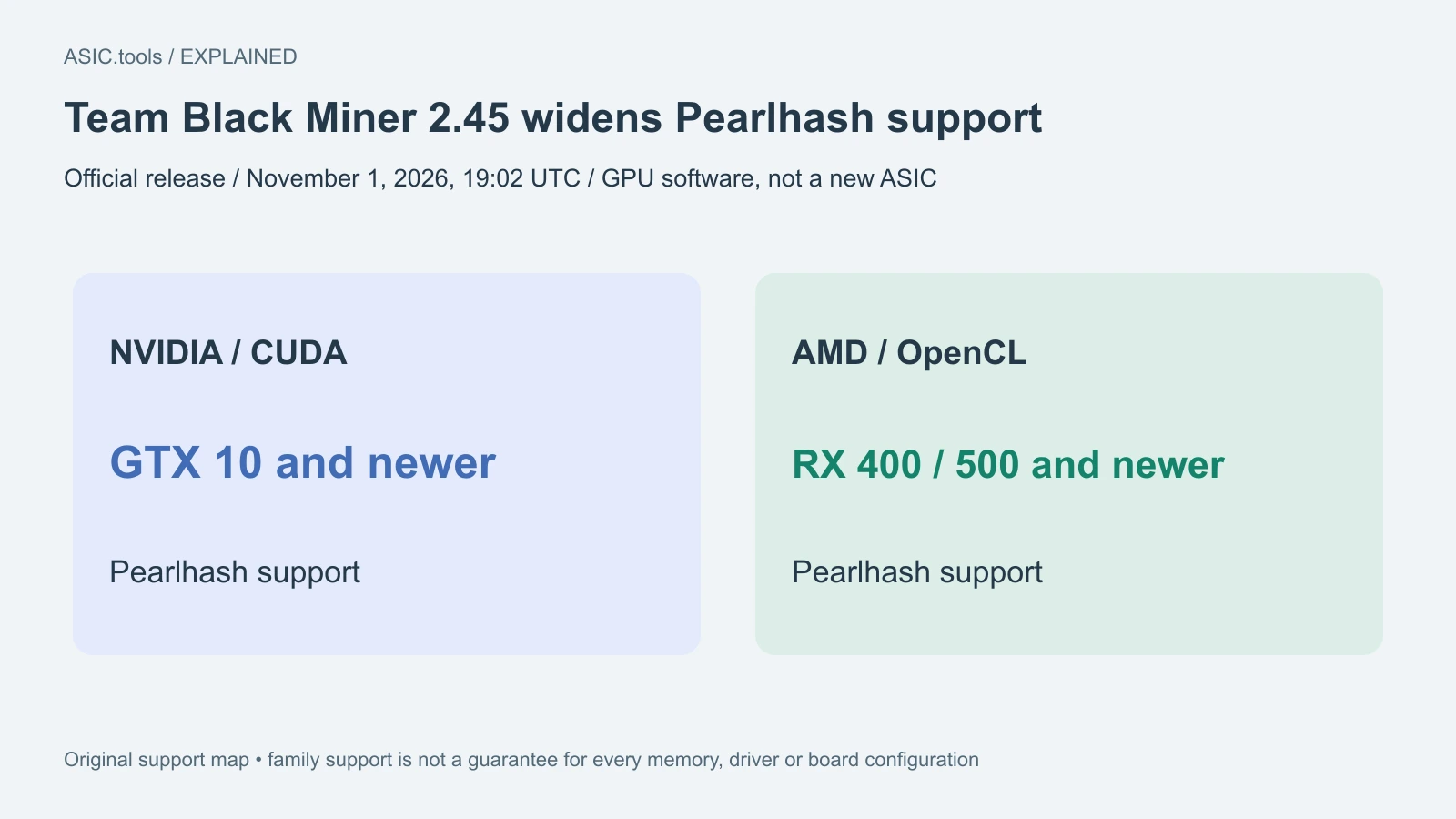
Team Black Miner published version 2.45 on November 1 at 19:02 UTC. The release adds Pearlhash support for NVIDIA GTX 10-series cards and newer, and AMD Radeon RX 400/500-series cards and newer. For someone who already owns an older GPU, the change is another software option to evaluate before deciding whether that card has a useful mining role.
This is a new Team Black Miner release, separate from yesterday's BzMiner update. GPU support means the software has an implementation for the stated families; it does not guarantee that every card, memory configuration and driver combination will run well. No new ASIC is being announced, and Pearlhash performance is not directly comparable with Bitcoin SHA-256 hashrate.
What the examples do and do not show
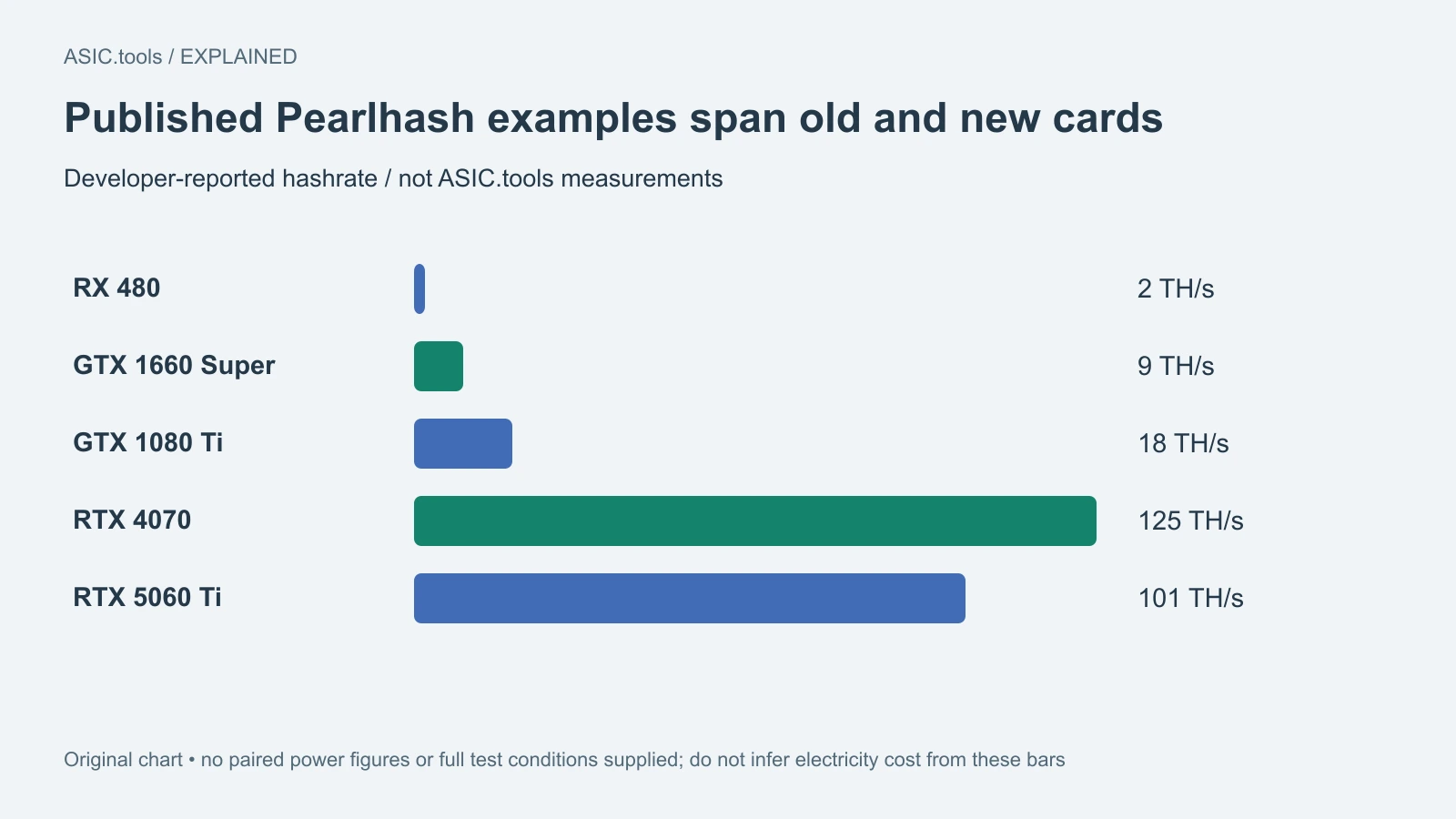
The developer lists Pearlhash examples of 2 TH/s for an RX 480, 9 TH/s for a GTX 1660 Super and 18 TH/s for a GTX 1080 Ti. Newer examples include 125 TH/s for an RTX 4070 and 101 TH/s for an RTX 5060 Ti. These are the developer's reported figures, not measurements made by ASIC.tools.
The release does not pair those numbers with power draw, a full set of tuning conditions or a controlled comparison against another miner. A faster row cannot establish a lower electricity cost. Nor can the numbers be compared with another developer's table as if the card, clocks, pool and measurement window had been held constant.
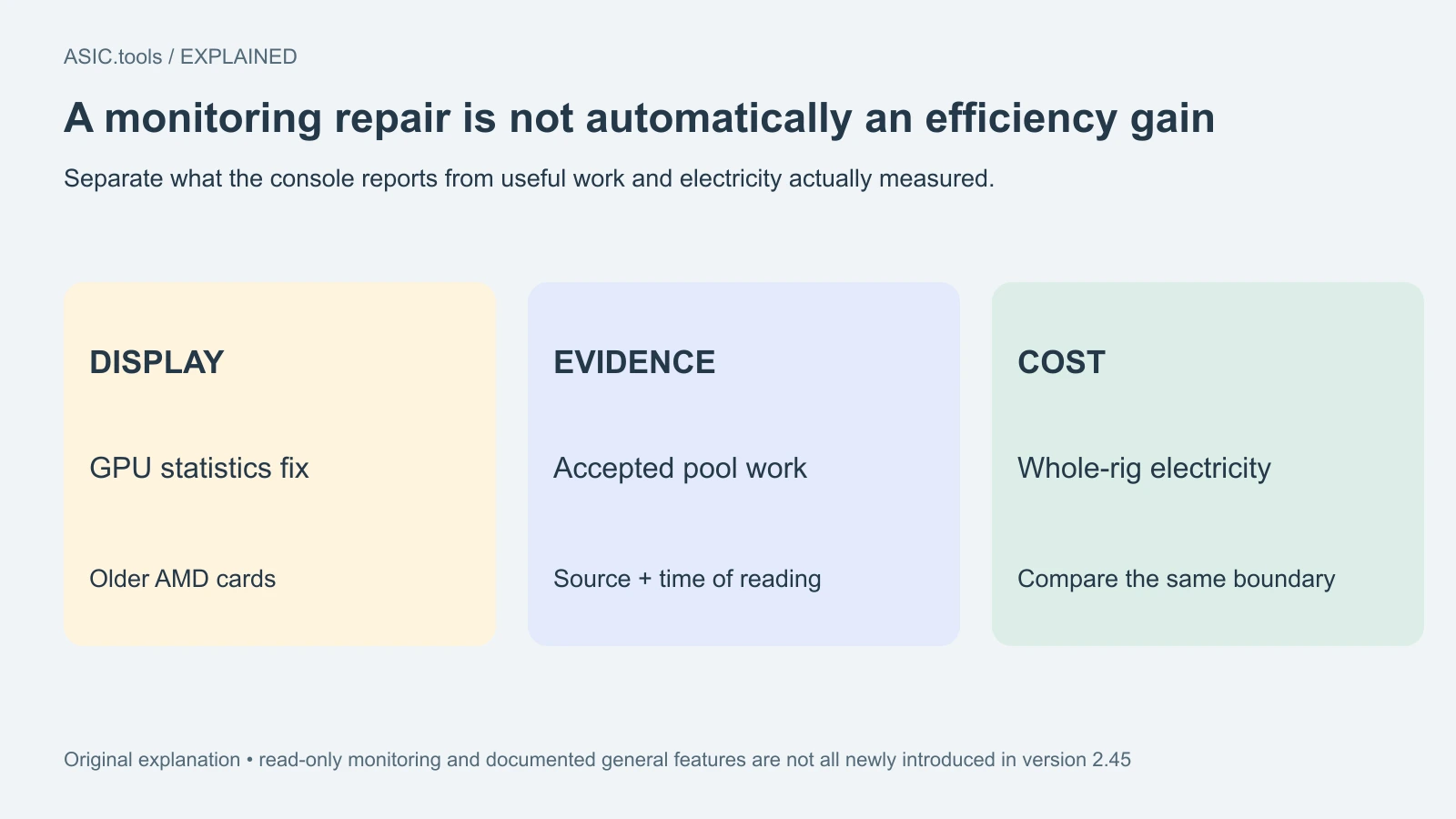
For an existing machine, the useful comparison is accepted pool work against whole-rig electricity over the same period. Local hashrate describes attempted work; a pool credits what it accepts. An old card can be supported yet still be uneconomic at the owner's tariff. Hardware already paid for also has operating costs, so software compatibility and financial usefulness remain separate questions.
Older AMD monitoring is part of the update
The notes also say GPU statistics were fixed for older AMD cards. That matters when an operator uses the console to notice changes in temperature, power or load. A repaired reading can make a running rig easier to understand without changing how much useful work the card actually performs.
After updating, compare the displayed values with the available system readings and the same external meter used before. A missing sensor value is not zero consumption. Conversely, a changed displayed number is not proof of a real efficiency gain if the underlying reporting was what changed. The release supplies no universal percentage improvement for this fix.
The README also describes a read-only HTTP monitoring API, logging, temperature protection and reconnection features. These are general documented capabilities, not all newly introduced in 2.45. Reading a monitoring value is different from issuing a control command. Keep the source and time of a reading clear when comparing the console, monitoring software and pool, and use the log to establish when a device actually started working again.
Documentation, algorithms and fees
The current repository describes Windows 10/11 or 64-bit Linux and NVIDIA CUDA or AMD OpenCL GPUs. The two published release assets are a CUDA 12.9 archive and an Ubuntu 24.04/CUDA 12.9 archive. A package name is useful for selecting a build, but does not by itself establish the minimum driver for every supported board. Keep the previously working version and its configuration while evaluating the new one.
The release mentions added Ergo support under the label “Octopus V2”; the current README's algorithm table correctly identifies Ergo as Autolykos v2. Follow the matching algorithm and pool configuration rather than treating those names as different coins. The README also states a 0.5% developer fee; that is distinct from a mining pool's fee and the electricity bill. We did not run the downloaded miner or independently benchmark it.
Make a small test answer a real question
The repository's Pearl examples use a wallet address, pool host, port and worker name. The worker name helps separate one rig's results from another's. Replace example payment details with the intended account and check that work appears there; a console saying “connected” is not the same observation as credited mining work.
For a fair trial, retain the same card, algorithm, pool and observation period, and record accepted work, rejections, stability and wall power. The practical news is broader access to Pearlhash in this particular miner, including older equipment, plus a monitoring fix. Whether that becomes a worthwhile daily setup depends on the actual rig and costs, not on support appearing in a release note.
Source: Team Black Miner ↗ · Official repository and current documentation ↗
Mining calculator ↗