Proxima 1.7.4 fixes final-milestone timing for sequencer operators
Source report: 2026-11-21 · Editorial analysis published: 2026-11-22
The later November 21 release keeps final milestones within the existing tick-119 rule. Access-only nodes may stay on 1.7.3; pre-1.7.0 nodes and wallets must update.
Proxima fixes the reference sequencer's final timing
Proxima v1.7.4 was released on November 21 at 17:16:29 UTC, or 19:16:29 in Kyiv. Its developer recommends it for every sequencer: the reference implementation now gets the slot's final milestones in on time and stops building milestones with timestamps that the ledger will refuse. For an operator, this addresses useful participation, rather than merely whether the node process is online.
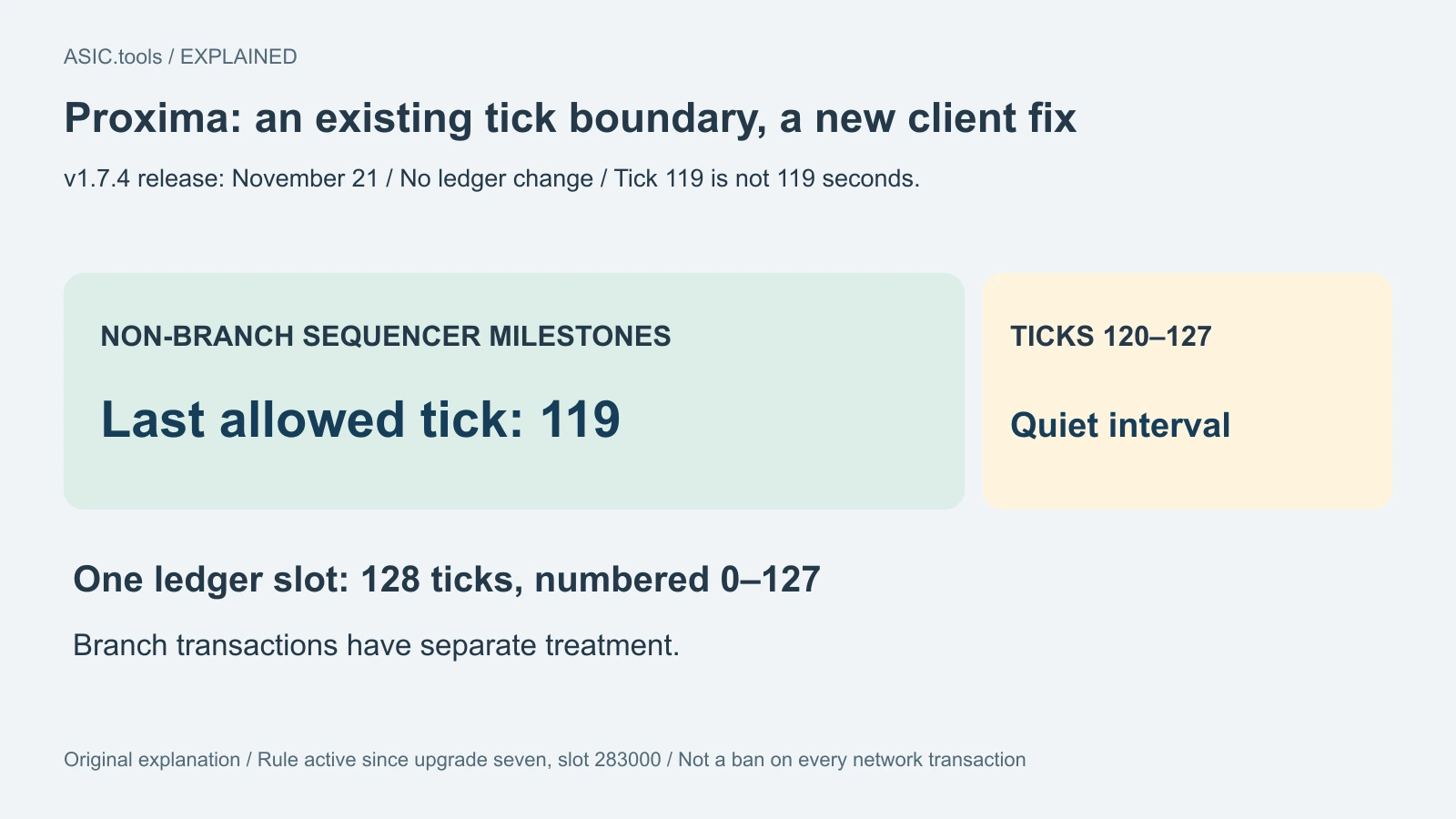
The release states there is no ledger change. The last permitted tick for these milestones has been 119 since upgrade seven, activated on November 20 at slot 283000. Version 1.7.4 adjusts the reference sequencer to the already active boundary; it does not announce another activation date, a new mining algorithm or a change to Bitcoin's consensus.
A slot has internal timing, not a 119-second deadline
A sequencer builds a sequence of transactions and milestones, records that extend its work and incorporate other work it has seen. A slot is a period of ledger time. The tagged source divides it into 128 ticks, numbered 0 through 127. Tick 119 is an internal position in that slot, not 119 seconds or a wall-clock time shown by a mining pool.
The upgrade-seven documentation explains why the end of the slot matters. A later milestone could include earlier final milestones from others and give its branch an advantage in coverage. Here coverage concerns the ledger state and work the branch has incorporated; it is not a graphics card's hashrate. A strict coverage advantage is different from an exact tie between branches.
The rule leaves ticks 120–127 as a quiet interval for these non-branch sequencer milestones before the boundary. It does not mean every kind of network transaction is forbidden during those ticks: branches are treated separately. Keeping this scope visible avoids turning an implementation fix into the claim that the entire network stops processing transactions at tick 119.
The fix makes the intended tie-break relevant
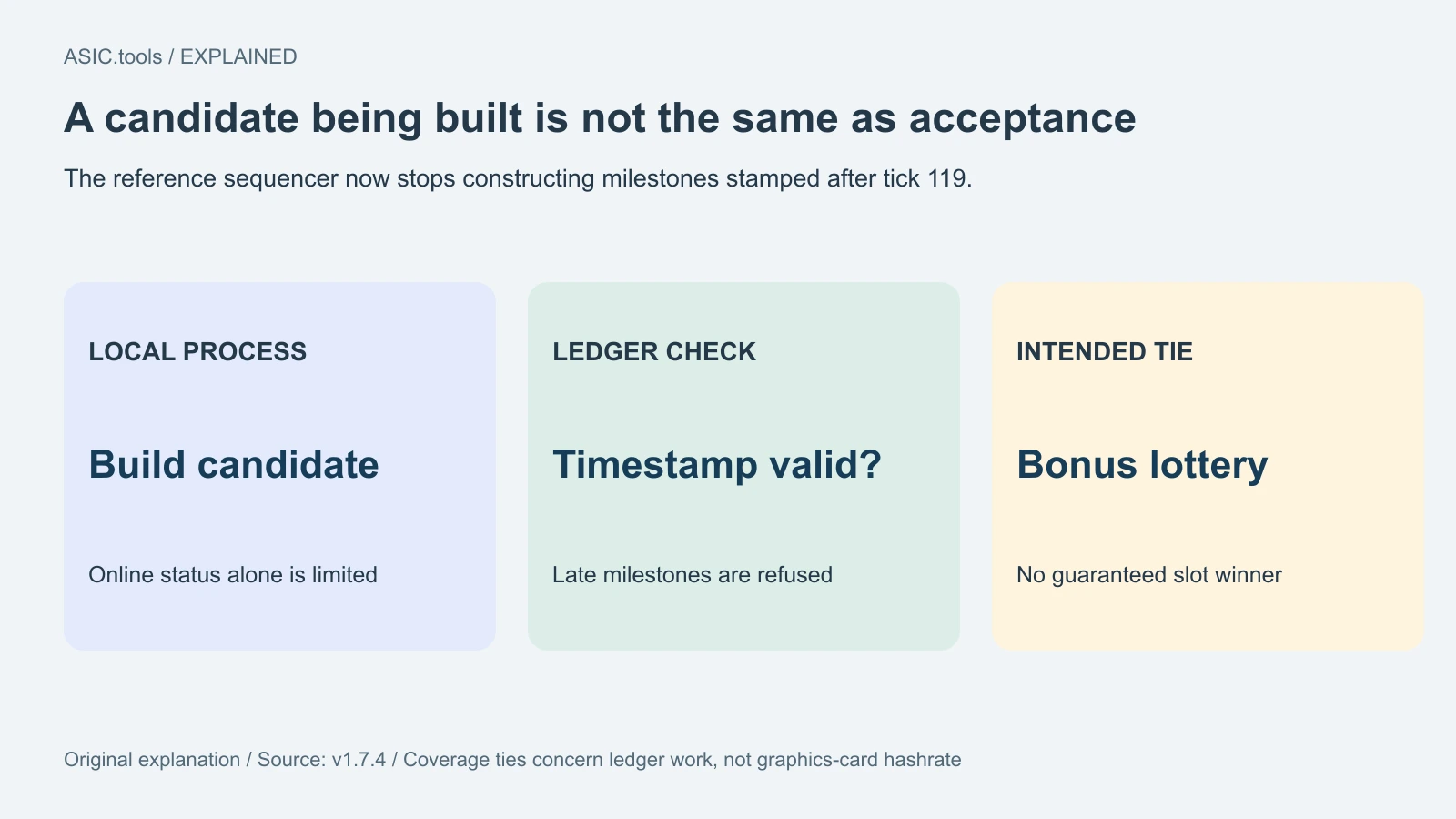
The v1.7.4 note says the reference sequencer now gets its last milestones in by tick 119. Its branches can then tie with the best branches of the slot, so the bonus lottery decides the tie as intended, instead of the outcome depending on who folded in the latest milestones. This is the developer's description of the corrected behavior, not a measured guarantee that any operator will win a particular slot.
The second part of the fix stops the sequencer building a milestone stamped after tick 119, which the ledger refuses. Creating a local candidate and having it accepted under network rules are different stages. An active-looking process can therefore be less useful than its status suggests if it keeps producing candidates outside an already enforced boundary.
Which operators need which update
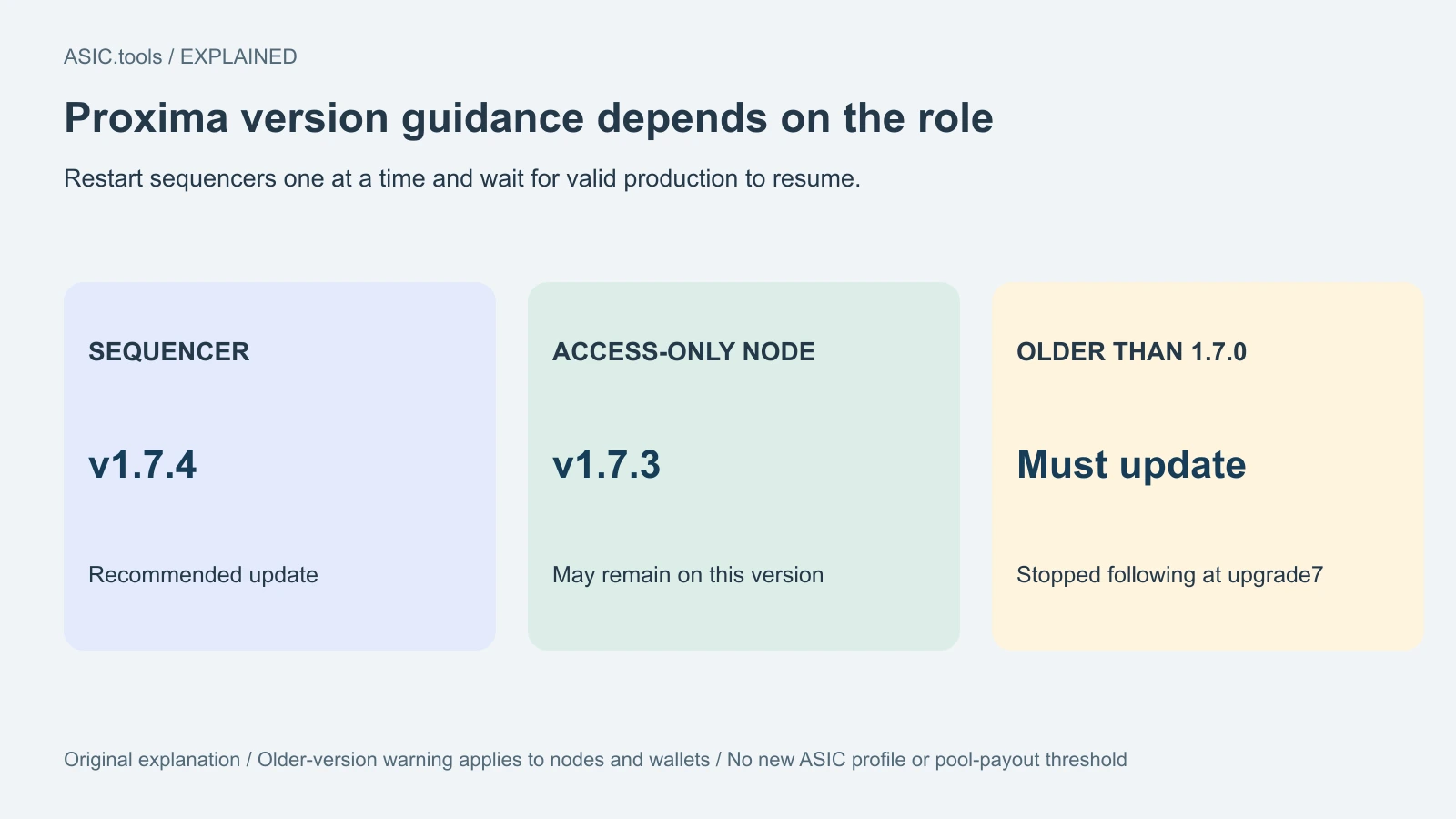
Sequencer operators are instructed to build from the v1.7.4 tag and restart one sequencer at a time, waiting until each is producing again before moving to the next. Access-only nodes may remain on v1.7.3, according to the release. The recommendation is thus component-specific, not a statement that every machine connected to the project must run the same task.
Nodes and wallets older than v1.7.0 are a separate, more serious case: the note says they have not followed the network since upgrade seven activated at slot 283000 and must update. Do not read permission for an access-only 1.7.3 node to stay as permission to leave an older pre-upgrade node untouched. The version and role both matter.
For a miner using another operator's pool, the mining client is also different from that operator's sequencer. A release note about reference sequencing does not establish a new ASIC profile, a GPU speed increase or a new pool payout threshold. Proxima's token-issuance mining and its ledger's sequencing roles should not be collapsed into the same hardware benchmark.
A different issue from yesterday's snapshot changes
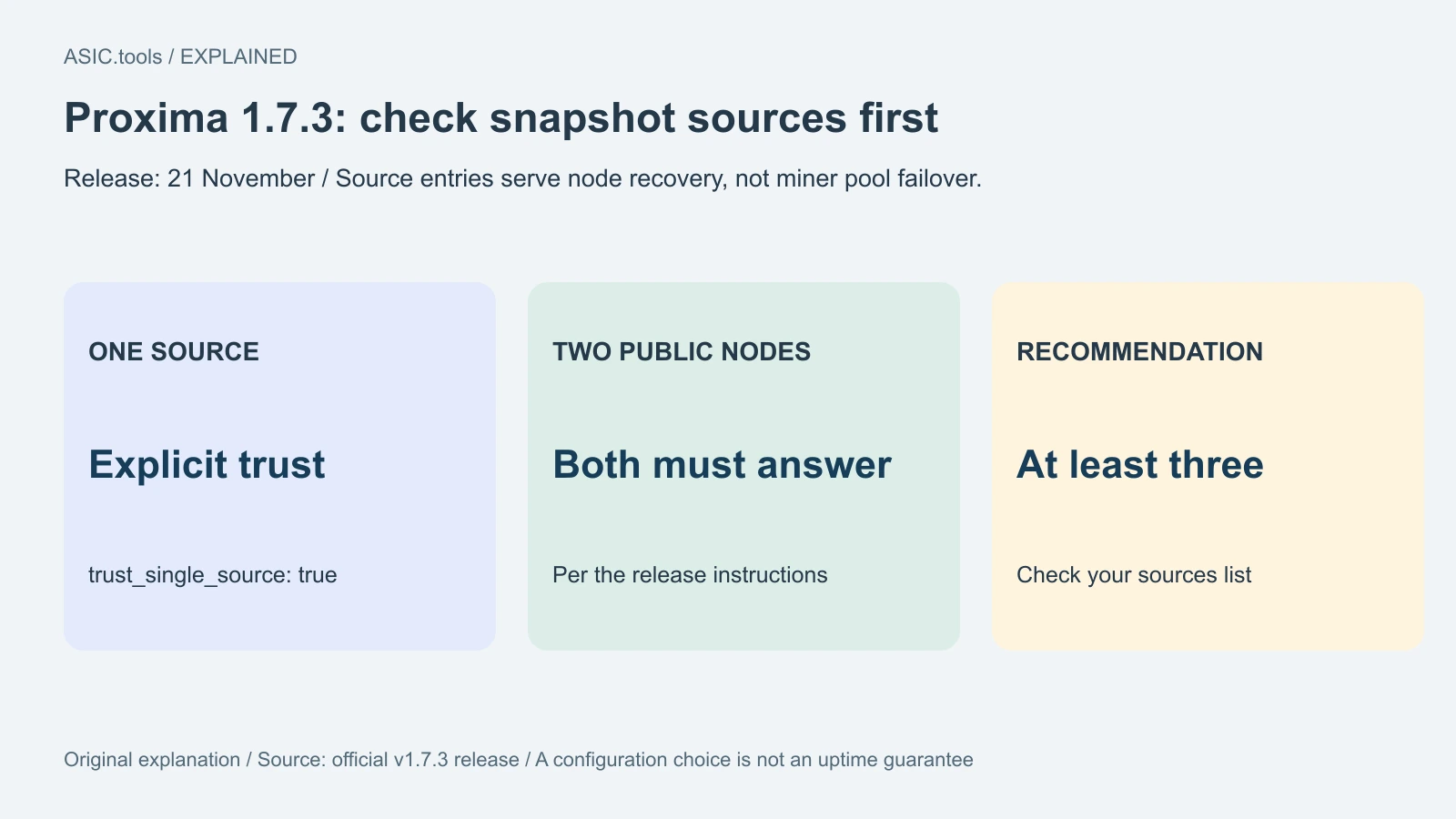
Version 1.7.3 dealt with recovery-source trust and memory handling of stale branches. Those were the changes covered in our previous report. Version 1.7.4 is a later release with a distinct sequencer-timing correction; it is not a second report of the same snapshot option. An operator reviewing both should keep the recovery configuration and the final-milestone timing as separate concerns.
The source record gives the release date and the instructions, but no universal extra PROX per day or measured increase in the probability of winning. The ledger's selection process and actual competition still determine outcomes. Treating the word lottery as a guaranteed payment would misrepresent the note, just as treating an online process as proof of accepted production would.
ASIC.tools checked the tagged release, time definitions and upgrade-seven documentation without installing the executable on users' systems. Our original diagrams show the tick boundary, the difference between candidate construction and ledger acceptance, and the role-specific version guidance. After following the release instructions, the useful check is resumed valid production, with its timestamps, rather than a promised income multiplier.
Source: Proxima ↗ · Tagged upgrade-seven timing and branch rules ↗ · Tagged ledger time definitions ↗ · Earlier ASIC.tools report on v1.7.3 snapshot recovery ↗
Mining calculator ↗