Strategy buys 267 Bitcoin, but spends much more buying back its own shares
Source report: 2026-10-19 · Editorial analysis published: 2026-10-19
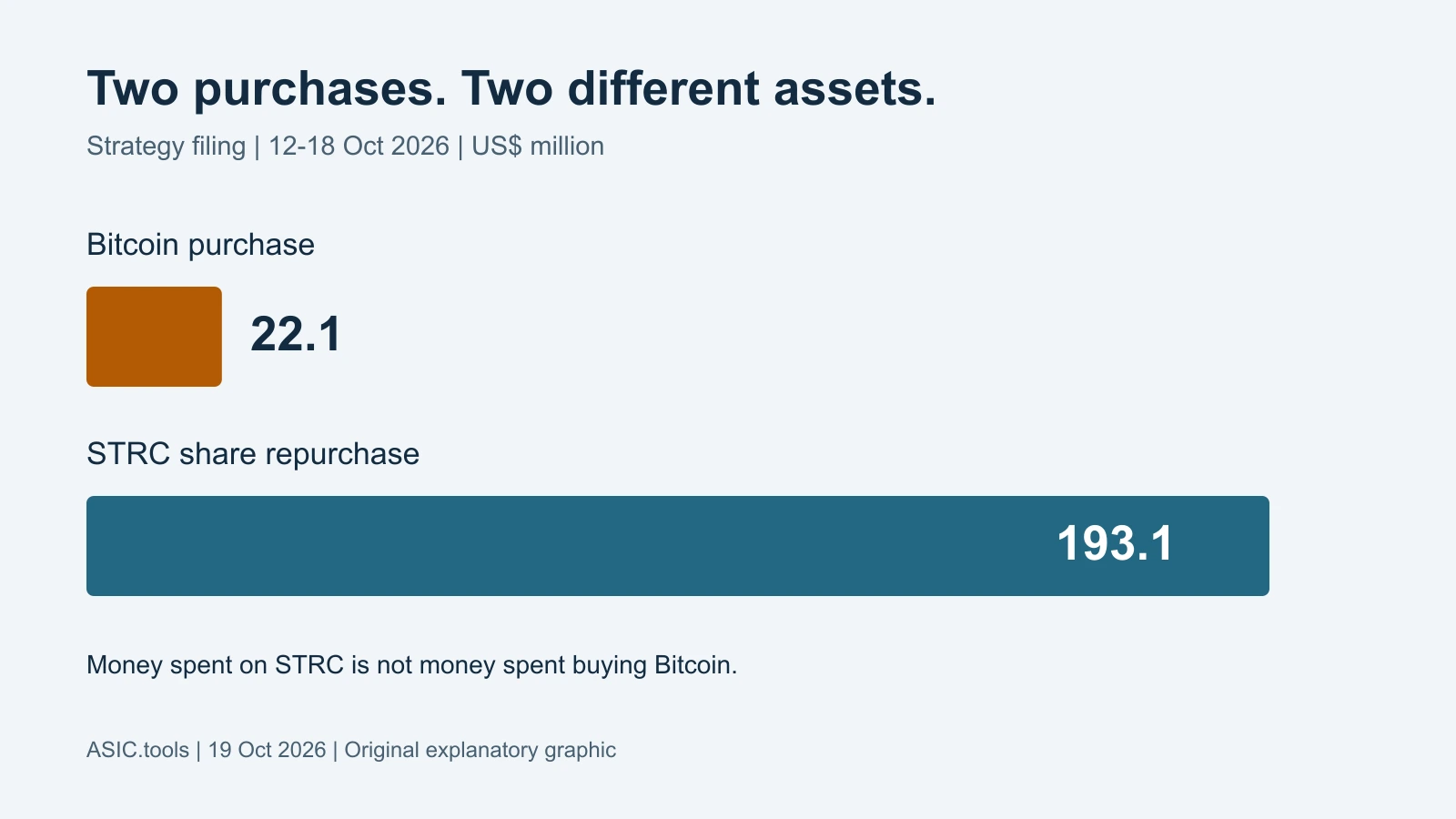
The October 19 filing separates a $22.1 million Bitcoin purchase from a $193.1 million STRC share buyback. Here is what those two numbers mean for the Bitcoin market.

One announcement, two very different purchases
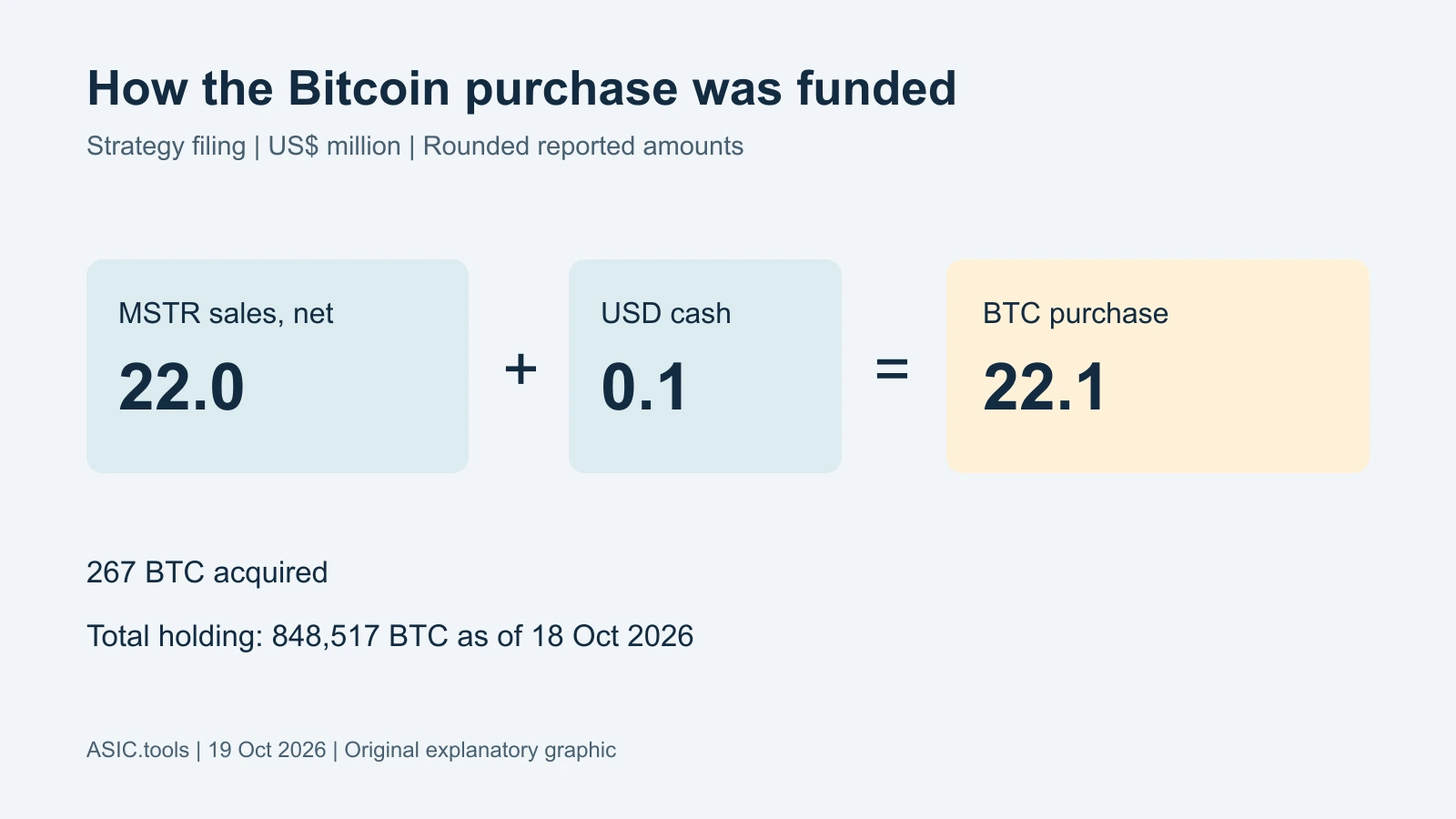
Strategy reported on October 19 that it bought 267 BTC during October 12–18 for $22.1 million, including fees and expenses. Its Bitcoin holdings reached 848,517 BTC. The average price for the new coins was $82,900: a historical purchase average, rather than a live market quote.
The same filing lists $193.1 million spent repurchasing STRC shares. That larger number can easily dominate a headline. It describes a transaction in the company's own securities, however, and should not be added to the amount spent on Bitcoin. For anyone following large buyers of coins, the relevant purchase in this update is the smaller of the two amounts.
What does buying back shares actually do?
A share buyback means a company purchases its own shares from their holders. STRC is one of Strategy's preferred securities: a class of shares with its own dividend terms. It is a financial claim on the company, not a Bitcoin balance in the shareholder's personal wallet. Spending money on these shares and acquiring coins are different uses of cash.
An everyday comparison is a shop owner buying additional stock for the shelves versus buying out a partner's stake in the shop. Both require money, but only the first increases the stock of goods. The comparison explains the distinction; it does not describe the legal terms of STRC. The filing reports the two operations separately for a reason.
Where the Bitcoin purchase money came from
Strategy says the coin purchases used $22.0 million of net proceeds from selling MSTR common shares, plus $0.1 million in dollar cash. Net proceeds mean the money remaining after the sales commission. MSTR and STRC are separate share classes, so selling one while repurchasing the other is not an accounting contradiction.
The company uses an at-the-market programme, often shortened to ATM, to sell shares into the market. Here ATM has nothing to do with a cash machine. This matters because the announcement is also a financing update: it tells readers how the company raised the dollars, rather than merely stating that its Bitcoin wallet grew.
Financing through shares also has an ownership side. A share represents a fraction of a company; issuing additional shares can spread ownership over more pieces, a process called dilution. New money entering a company and an existing shareholder’s percentage interest are therefore separate questions. This is another reason to read the financing line alongside the coin purchase rather than treating corporate buying as money appearing without a source.
A wallet total and a week's purchases answer different questions
The 848,517 BTC figure describes the company's total holding at the reporting date. The 267 BTC figure describes the additions over the stated week. Confusing the two would be like reporting an entire water tank as the amount poured into it this morning. A large accumulated reserve does not mean equally large new buying every week.
The figures in the filing have different rounding. The $22.1 million cost is displayed to one decimal place in millions, while $82,900 is the stated average per coin. Multiplying rounded numbers need not reproduce a displayed total to the last dollar. Both purchase figures include fees and expenses; neither tells a reader the price available on an exchange now.
Why miners and ordinary Bitcoin owners care
A confirmed corporate purchase is one piece of evidence about demand for existing Bitcoin. It does not create new coins or change the network's rules. Mining is the separate process in which machines compete to add valid blocks to the blockchain, the shared transaction record. Strategy's purchase should therefore be read as market activity, rather than an increase in mining rewards.
For a miner paid in BTC, the market price matters when coins are converted into money to pay bills. Profit also depends on electricity use, the power tariff, equipment performance and the pool's fee. A pool combines miners' computing work and distributes rewards under its rules. One buyer's weekly announcement cannot settle all of those costs or predict the next exchange rate.
How to read the next update without getting lost
Start with the reporting period, then separate coins bought, total coins held and transactions in shares. Check the unit beside each number: BTC, dollars and shares describe different things. Compare a weekly flow with another weekly flow, rather than treating the whole accumulated holding as fresh demand. This makes a short filing much easier to understand.
Owning Bitcoin directly, holding a company's shares and operating a mining machine are three different activities. They expose people to different costs and rights even when all are discussed under the same Bitcoin headline. In this update the clear new fact is a 267 BTC addition. The much larger STRC buyback belongs to the company's capital management story.
Source: Strategy ↗
Mining calculator ↗