Southwest Power Pool proposes a $25/MWh grid cutoff for flexible loads
Source report: 2026-11-20 · Editorial analysis published: 2026-11-24
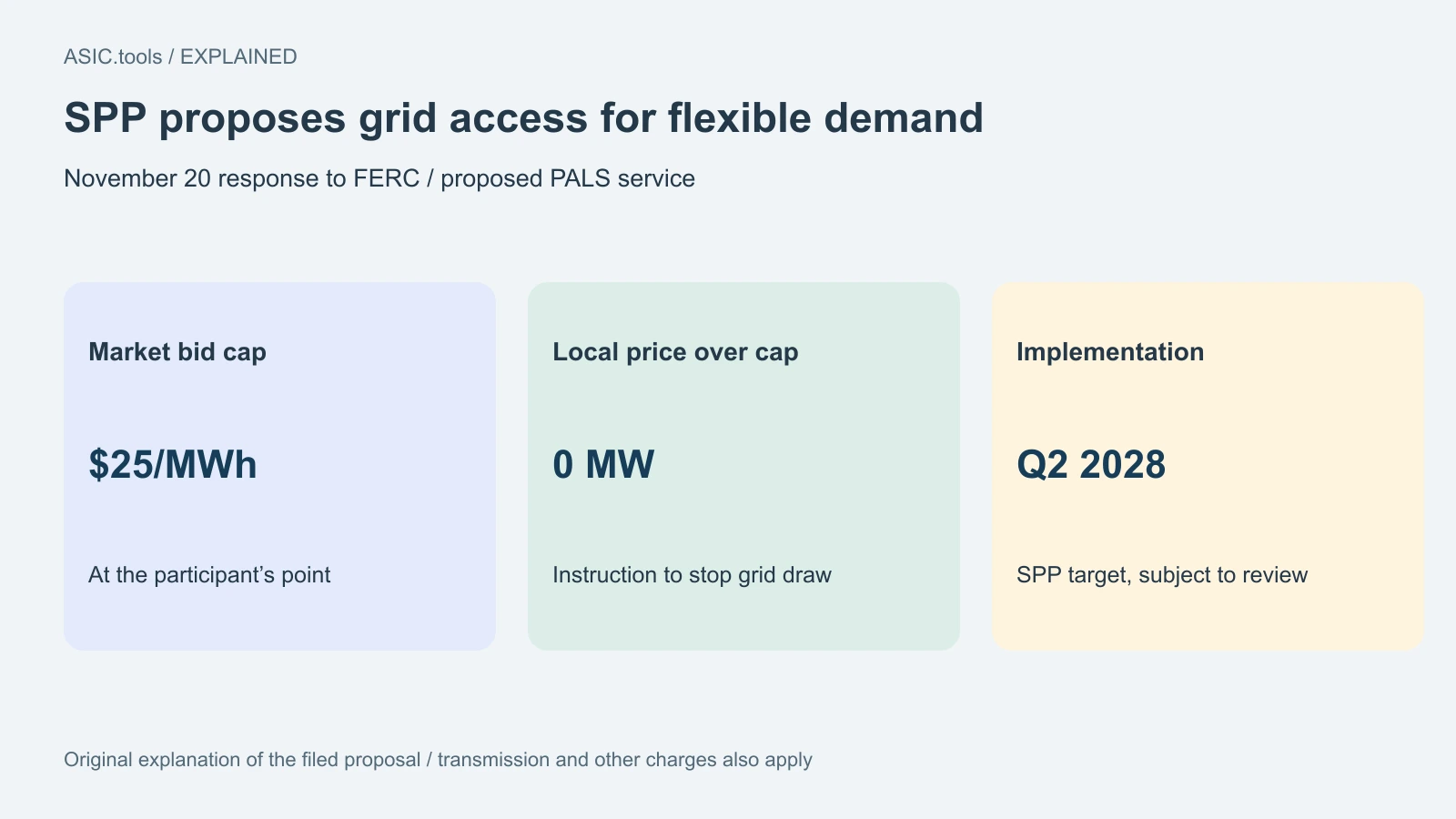
SPP’s November 20 response to FERC details a proposed service for sites that can stop taking grid power. It targets the second quarter of 2028.
A grid connection with a stop condition
Southwest Power Pool described a proposed way of serving flexible electricity demand in its November 20 response to the US Federal Energy Regulatory Commission, or FERC. For a mining site able to stop on command, the service would offer access when transmission capacity is available. The operator would have to live with interruptions tied to local prices and grid conditions.
SPP calls the proposed option Price Adaptive Load Service, or PALS. A customer’s demand bids in the day-ahead and real-time markets would have a $25 per megawatt-hour cap. SPP says the participating load would be dispatched to zero megawatts if the local price at its settlement point exceeds $25/MWh. Megawatts measure how much power is drawn at a moment, while megawatt-hours measure energy over time.
A $25/MWh energy price equals 2.5 US cents per kilowatt-hour for that market component. Transmission and other applicable tariff charges would still affect the bill. The filing describes hourly use charges for transmission, subject to a monthly cap on that component, with other applicable charges on top. A mine would need its own assumptions about available hours and total cost to decide whether the service fits.
The local price is calculated at the participant’s settlement point. Two facilities in the same regional market may see different prices because electricity must reach their particular points on the network. For a proposed site, time below the cap must be evaluated at that location, using its actual market and service conditions.
What a mine would have to give up
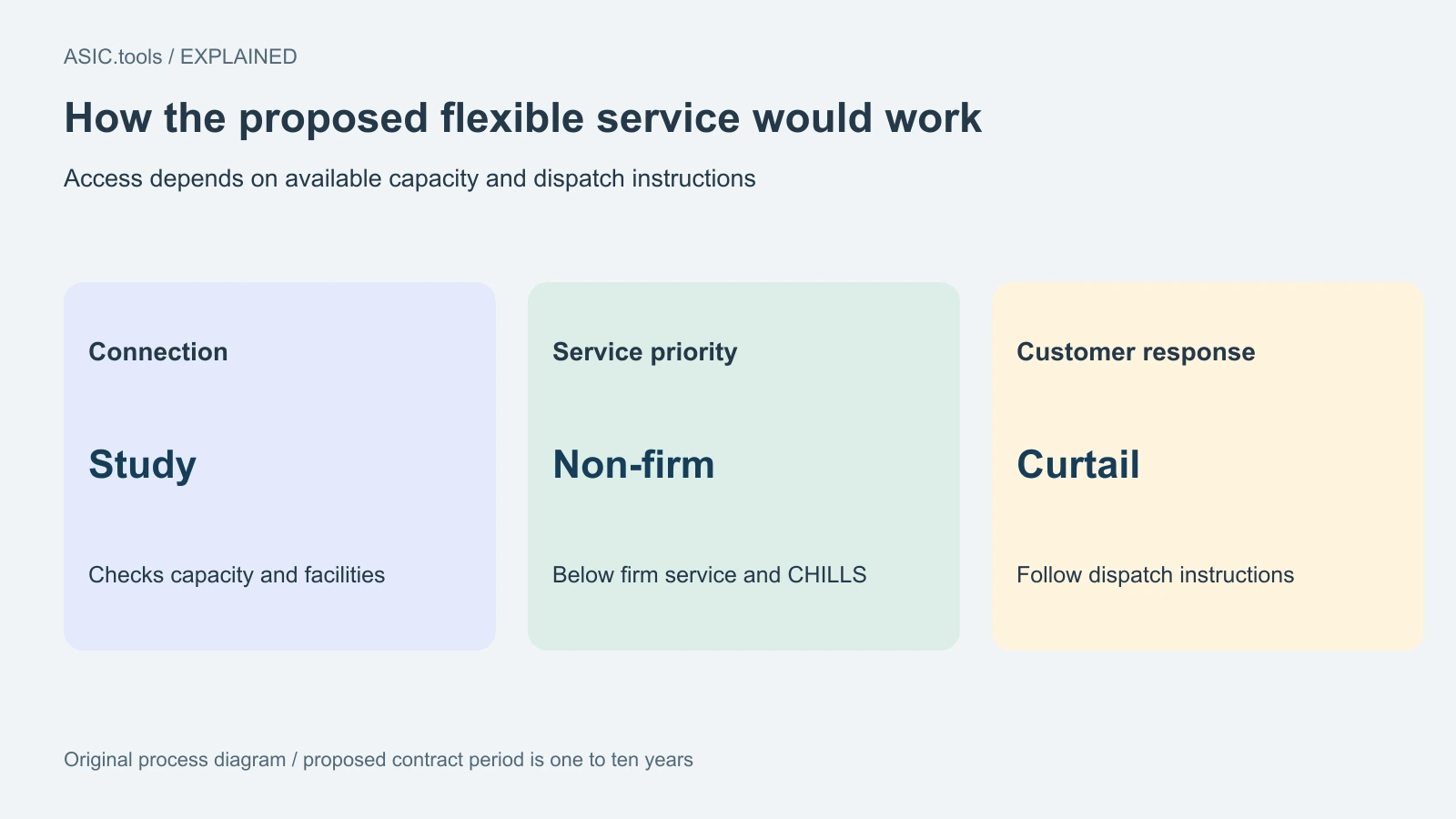
The proposed transmission service is non-firm. That means it can be interrupted when the grid is constrained. It would rank behind firm service and SPP’s existing conditional service for high-impact loads. Participants would have to comply with dispatch and curtailment instructions. In this context, curtailment means being told to reduce grid draw, potentially to zero, to protect reliability.
SPP would study how much PALS capacity can be accommodated without new network upgrades. The owner of the local transmission facilities would still need a connection study, which could identify facilities required to connect the project. The proposed contract term ranges from one to ten years. SPP’s existing transitional service, CHILLS, serves high-impact loads awaiting resources or upgrades. PALS is designed as an ongoing non-firm route.
The SPP response also describes charges for departing from dispatch instructions or exceeding the agreed usage limit. A feasible connection therefore needs a way to verify what it actually drew and whether the site followed each instruction. The cost of operating outside those limits belongs in the project’s evaluation.
An operator considering this model needs to know how quickly it can reduce its draw and how often the site will be available to mine. Switching off reduces variable energy spending and also cuts the amount of accepted work. Fixed site and equipment costs continue on their own schedules. A budget built around 24-hour operation and a low energy bid would miss that trade-off.
Who would pay for network work
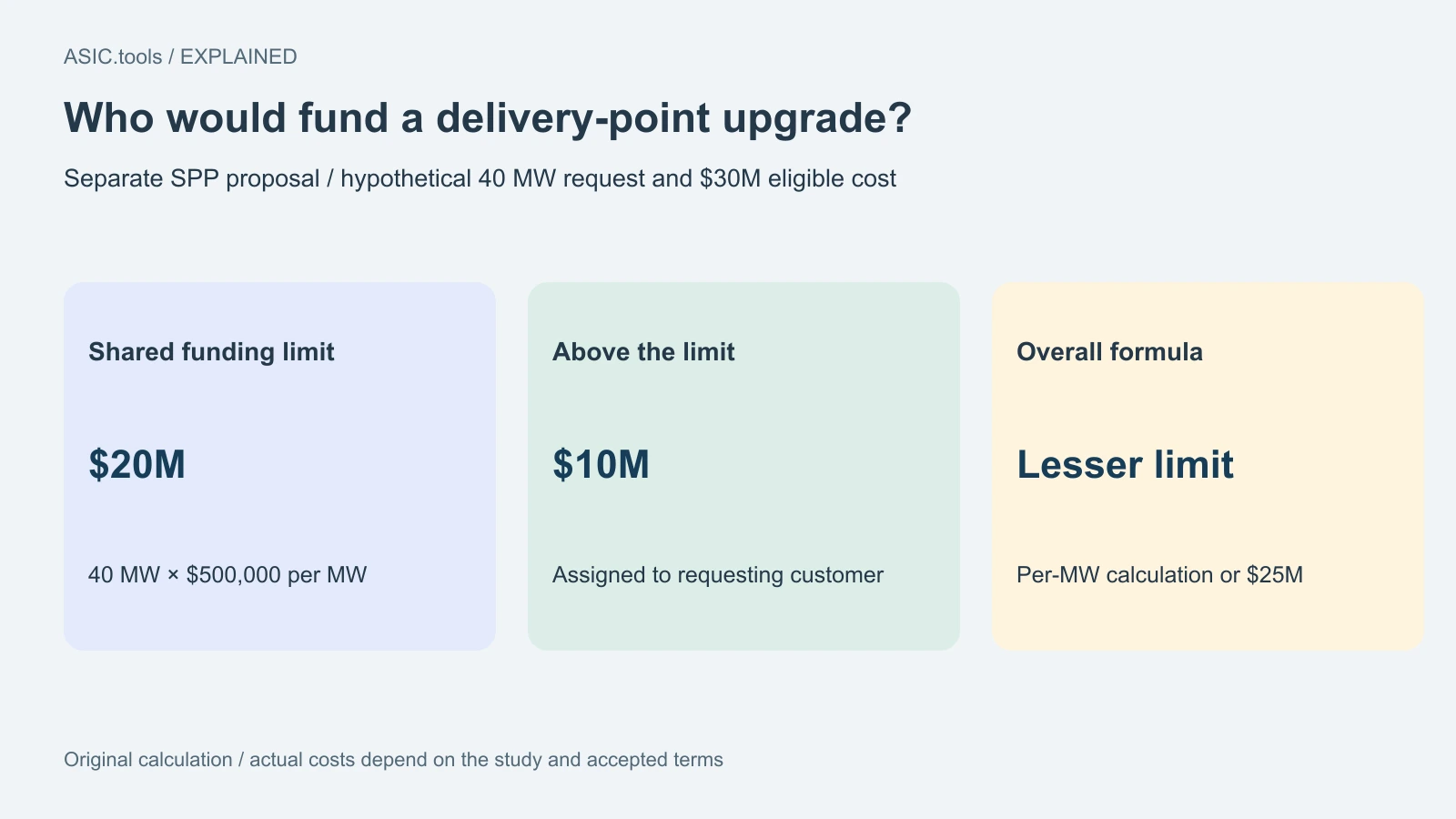
The response also describes a separate proposal to limit the shared portion of eligible network upgrade costs for a delivery-point request. The proposed limit is the smaller of $500,000 per megawatt of requested load or $25 million. Above it, costs would be assigned directly to the transmission customer making the request and backed by financial security. This proposal concerns connection costs under the specified study processes.
For example, a hypothetical 40 MW request yields a shared-funding limit of $20 million under that formula. With $30 million in eligible upgrade costs, $10 million would fall above it under the proposal. The example shows the allocation rule. The actual scope, pricing and recovery depend on the study and accepted terms. It is a separate question from the hourly energy price for flexible service.
SPP proposes direct assignment for up to 40 years, or less if the transmission owner recovers the upgrade’s full service-life revenue requirement earlier. The filing calls for financial security tied to the assigned amount. A site’s own useful life and financing schedule should be read alongside the proposed recovery period.
The November 20 response is SPP’s account of its filings, separate from FERC’s decision. SPP targets the second quarter of 2028 for implementing PALS and says it will file the actual effective date before implementation. For a project screening sites today, the filing identifies what to compare: capacity in the study, hours lost to curtailment, and who bears connection costs.
Source: Southwest Power Pool ↗ · SPP Price Adaptive Load Service filing, ER27-578 ↗ · SPP network upgrade cost filing, ER27-577 ↗ · SPP transmission and non-transmission facilities filing, ER27-559 ↗
Mining calculator ↗