New attacks cut power in parts of Dnipro and Samar, DTEK says
Source report: 2026-11-22 · Editorial analysis published: 2026-11-23
DTEK reported damaged energy facilities and some critical infrastructure without power on November 22. Separately, November 23 plans allow up to 3.5 outage groups in parts of Ukraine.
Fresh damage, rather than just a new timetable
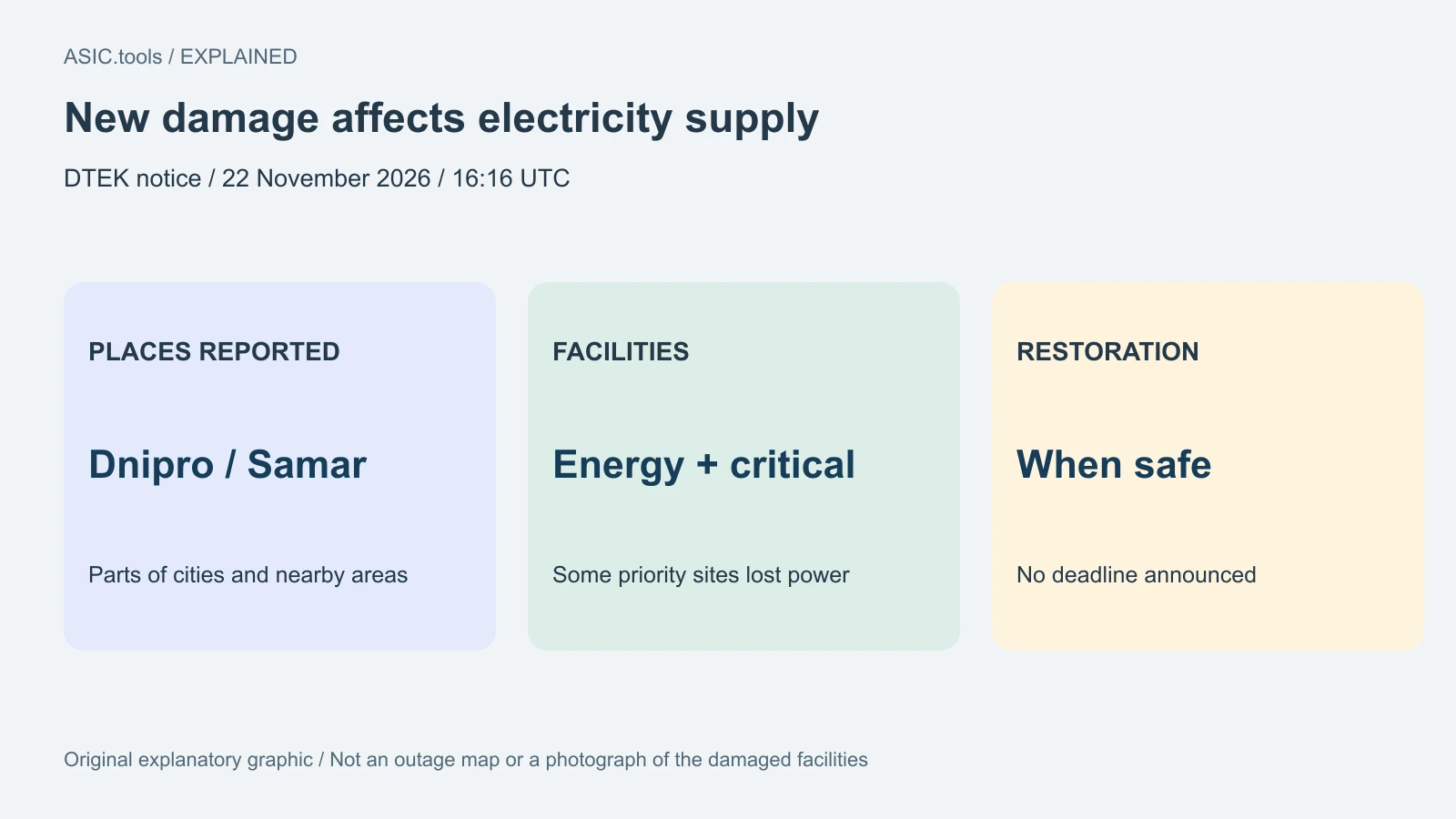
New attacks damaged energy facilities in the Dnipropetrovsk region, including a DTEK Dnipro Grids facility, the company said on November 22. Parts of Dnipro, Samar and nearby districts lost electricity, along with some critical infrastructure. For miners there, a published daily timetable cannot by itself establish when the machine will actually have power.
DTEK's message was published at 16:16 UTC, or 18:16 in Kyiv. It said restoration work would begin as soon as the security situation allowed. It gave no number of disconnected customers, address list or restoration deadline. This report was checked on November 23; it describes that dated damage notice, rather than asserting that every affected address is still disconnected at publication.
What has changed since the earlier Dnipro notice
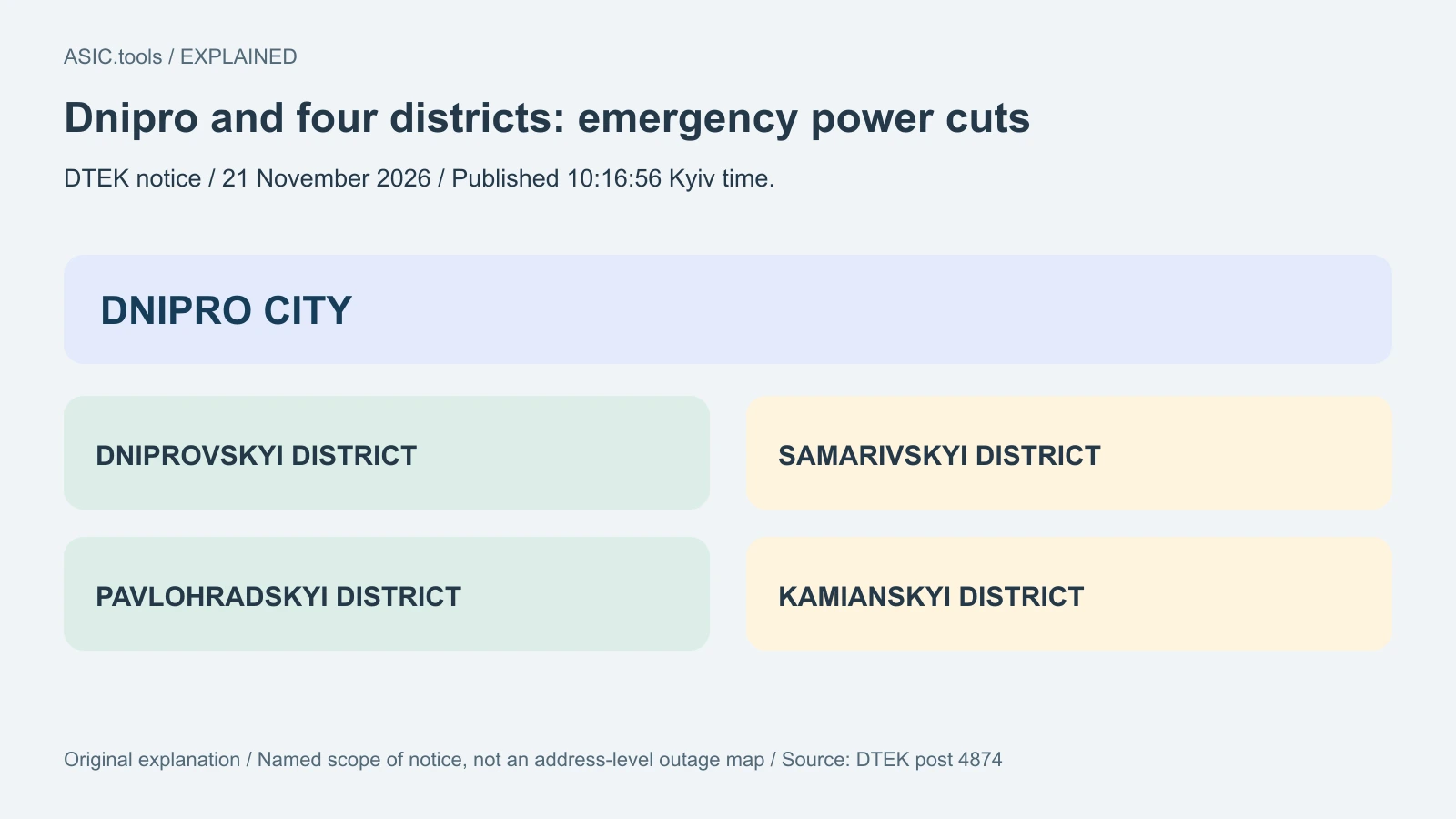
The new statement concerns another attack and newly damaged facilities. It is distinct from DTEK's November 21 announcement of emergency restrictions in Dnipro and four districts. That earlier notice said schedules did not apply during emergency cuts; the November 22 message identifies new physical damage and power loss, without providing a replacement address-by-address schedule.
The mention of critical infrastructure is also significant: priority facilities can be affected by damaged supply routes. It does not mean every critical site in either city was disconnected, nor does it tell a home or hosting customer the condition of their own connection. Local distribution information remains necessary to relate a regional notice to a particular meter.
November 23 has a separate national plan
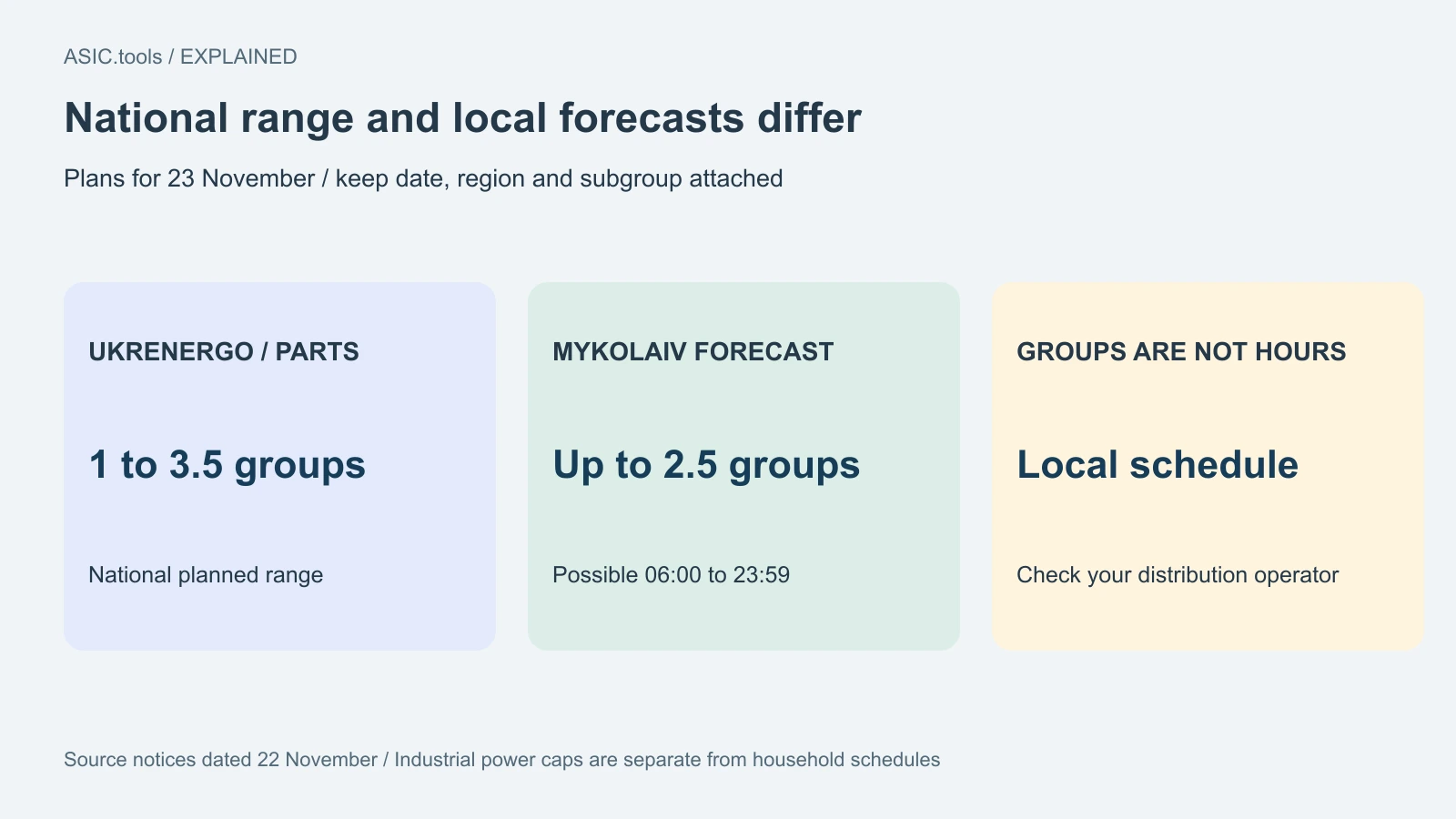
Later on November 22, at 18:31 UTC, Ukrenergo announced planned restrictions for November 23 in part of Ukraine's regions throughout the day. Industrial customers face power limits, while hourly cuts for all consumer categories range from one to 3.5 groups. The operator attributes the restrictions to the consequences of attacks on the power system.
The previous plan for November 22 had ranged from one to 2.5 groups. The new upper limit is one group higher, but groups are portions of consumers rotated through restrictions, not a number of hours assigned to every address. The announcement is not a nationwide 3.5-hour outage order. Industrial power limits describe allowed demand and need not mean the same pattern as a household hourly cut.
Regional forecasts show why the distinction matters
Mykolaivoblenergo's November 22 forecast allows possible hourly cuts on November 23 from 06:00 to 23:59, up to 2.5 groups. It explicitly says the operational situation can change. That is a regional forecast, not a contradiction of Ukrenergo's broader range and not evidence that Mykolaiv must use the maximum stated for another area.
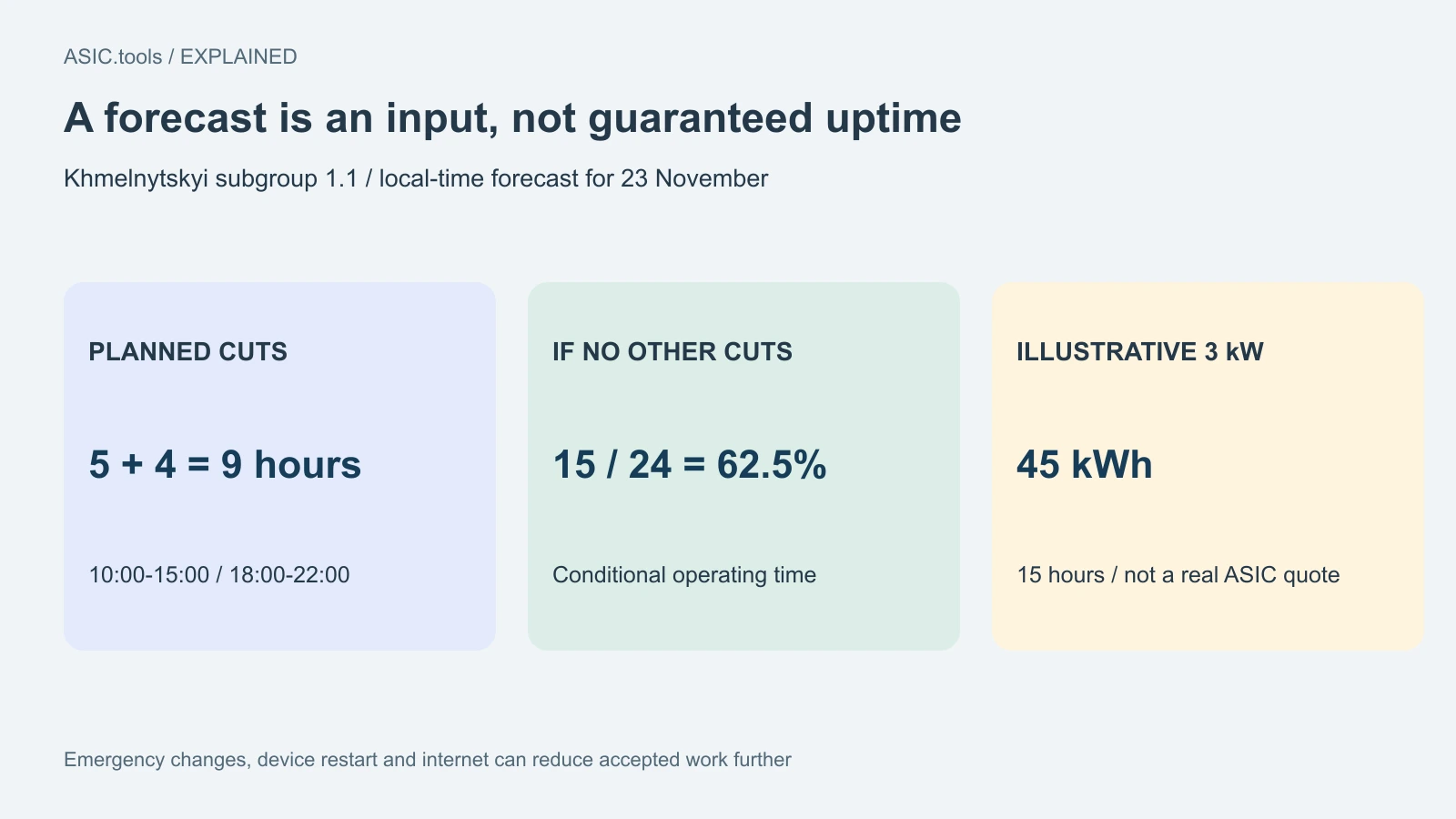
Khmelnytskoblenergo separately lists the hours for each subgroup. In its November 23 forecast, subgroup 1.1 has 10:00–15:00 and 18:00–22:00 without power, using the region's local time. Those two windows total nine hours. They are a planned example for that subgroup, not a Dnipro schedule or a promise about a hosting site's real supply.
An operating plan needs actual running time
If those nine planned hours were the only interruption, 15 hours of a 24-hour day would remain: 62.5% of the day. This arithmetic can help check an uptime input in a calculator. It is a conditional illustration from a regional forecast; emergency changes, equipment recovery and internet service can further change the miner's accepted work.
When a miner has no power it cannot submit new work during that period. A pool may still display averaged hashrate or later make a payment for earlier accepted work. Thus a payment arriving during an outage is not proof the equipment continued hashing, and a delayed graph is not proof it has failed after power returned. Check the timestamp and period behind each reading.
For a separate hypothetical constant 3 kW load, 15 operating hours use 45 kWh instead of 72 kWh over 24 hours. Nine hours off would save 27 kWh of that variable electricity use. Under otherwise unchanged conditions it also removes those hours of new work; saving electricity is therefore not the same as preserving the full day’s mining revenue.
Hours and power are separate inputs: nine hours without supply are not nine kilowatt-hours, and an industrial power cap is not itself an outage duration. Fixed charges can also remain when variable consumption falls. Use the actual billing structure before turning a runtime percentage into an estimate of money saved.
What to verify when supply returns
Use the distribution operator's current address-specific notice to establish the supply situation, then compare the device's operation with accepted shares at the intended pool. A restarted controller, working network connection and correct payout configuration answer different questions from electricity being present. A changed uptime assumption should reflect observed operation, rather than automatically returning to 24 hours because a daily plan exists.
Neither DTEK's damage notice nor Ukrenergo's group range announces a new electricity tariff, a mining ban or a guaranteed restoration time. The practical change is new damage affecting Dnipro and Samar, alongside a wider planned restriction range for November 23. Keep the damage notice, the national plan and the local schedule as separate dated inputs when deciding what work the equipment can realistically complete.
Source: DTEK / Ukrenergo ↗ · Ukrenergo plan for November 23 ↗ · Previous November 22 plan for comparison ↗ · Mykolaiv regional November 23 forecast ↗ · Khmelnytskyi regional November 23 forecast ↗
Mining calculator ↗