Monday power costs more than triple Sunday’s on Spain’s day-ahead market
Source report: 2026-11-22 · Editorial analysis published: 2026-11-22
OMIE sets November 23 averages at €205.20/MWh in Spain and €205.61 in Portugal. The energy component for a constant 3 kW load rises from about €4.69 to €14.77 a day in Spain.
A different price day for miners
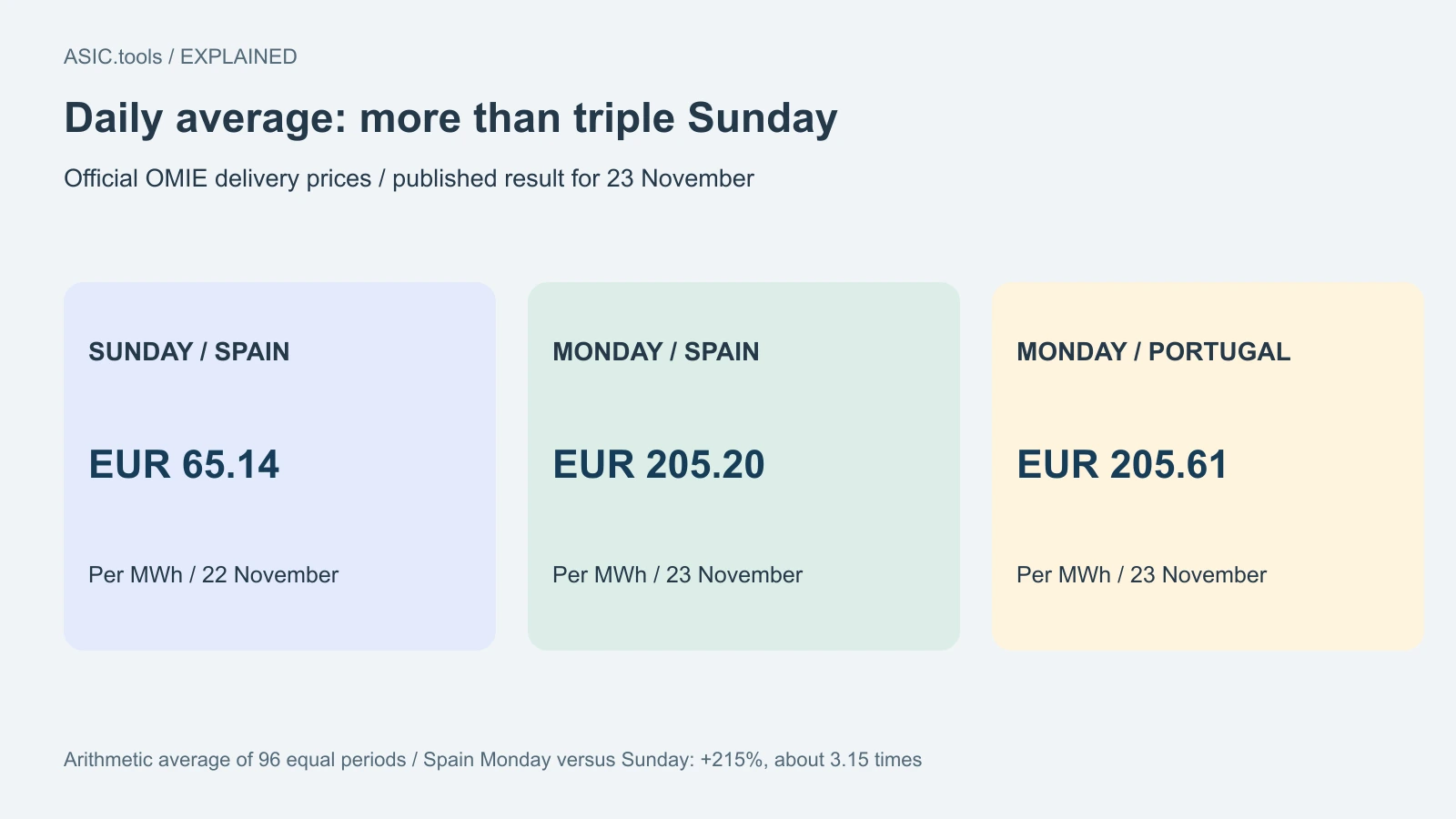
Electricity bought on Spain's day-ahead market for Monday, November 23 averages €205.20 per megawatt-hour, up from €65.14 for Sunday. OMIE published the new result on November 22. The increase is about 215%, or 3.15 times the previous day's price. Portugal's Monday average is slightly higher, at €205.61/MWh, after sharing Sunday's €65.14 average.
This matters directly to a miner whose contract passes through day-ahead prices. A machine that runs unchanged can face a very different energy bill without any change in its hashrate. A fixed retail contract is a different case: this auction result does not automatically reset every household tariff in Spain or Portugal.
What the market figures describe
The retained OMIE files contain 96 equal fifteen-minute periods for each delivery day. The daily figure is the arithmetic mean of those marginal prices, following OMIE's method. It is not a consumption-weighted average for an individual farm. The November 23 source file appeared in the official listing with a November 22 modification date, while the electricity is for delivery the next day.
A megawatt-hour is 1,000 kilowatt-hours. Spain's Monday average therefore equals roughly €0.20520/kWh for the traded energy component, compared with €0.06514 on Sunday. Portugal's equivalent is about €0.20561/kWh. Network charges, taxes, supplier margins, contracted capacity and other applicable bill items still need to be added under the actual contract.
The two country averages should remain separate. In the Monday file four of the 96 periods have different Portuguese and Spanish prices; all other periods match. Their small full-day difference does not justify replacing one country column with the other for an interval-based calculation. Select the market area in the contract, even when the two daily headlines look almost identical.
A 3 kW example makes the change visible
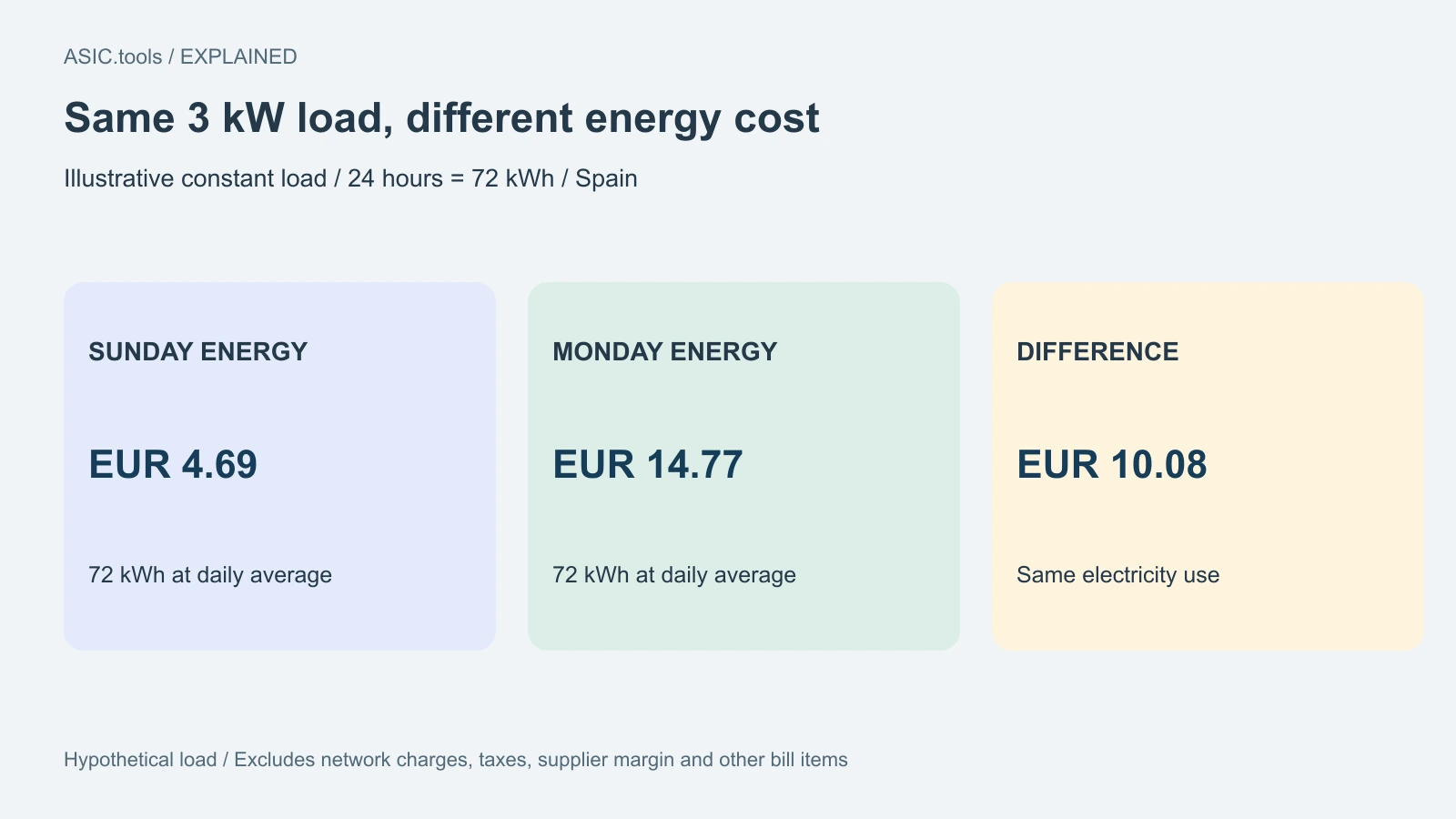
A hypothetical steady 3 kW load running for 24 hours uses 72 kWh. At the full-day Spanish prices, that amount corresponds to about €4.69 of auction-priced energy on Sunday and €14.77 on Monday: an increase of roughly €10.08 for the same electricity use. This example assumes the load is constant in all periods and the energy component follows the auction exactly.
It is a cost example, not a forecast of an ASIC's daily profit. No model has been assigned a hashrate, revenue or purchase price here. For an actual installation, wall power includes whatever auxiliary equipment is being counted. If cooling, pumps or networking draw additional electricity, a miner-only nameplate does not describe the whole site's bill.
At 3 kW, one fifteen-minute interval uses 0.75 kWh. Monday’s minimum and maximum prices put that interval’s energy component at about €0.0975 and €0.2350 respectively. To reconstruct a nonconstant day, multiply each interval’s actual kWh by that interval’s €/kWh, then sum; multiplying a daily mean by an irregular load can miss when the electricity was used.
The daily average hides the shape
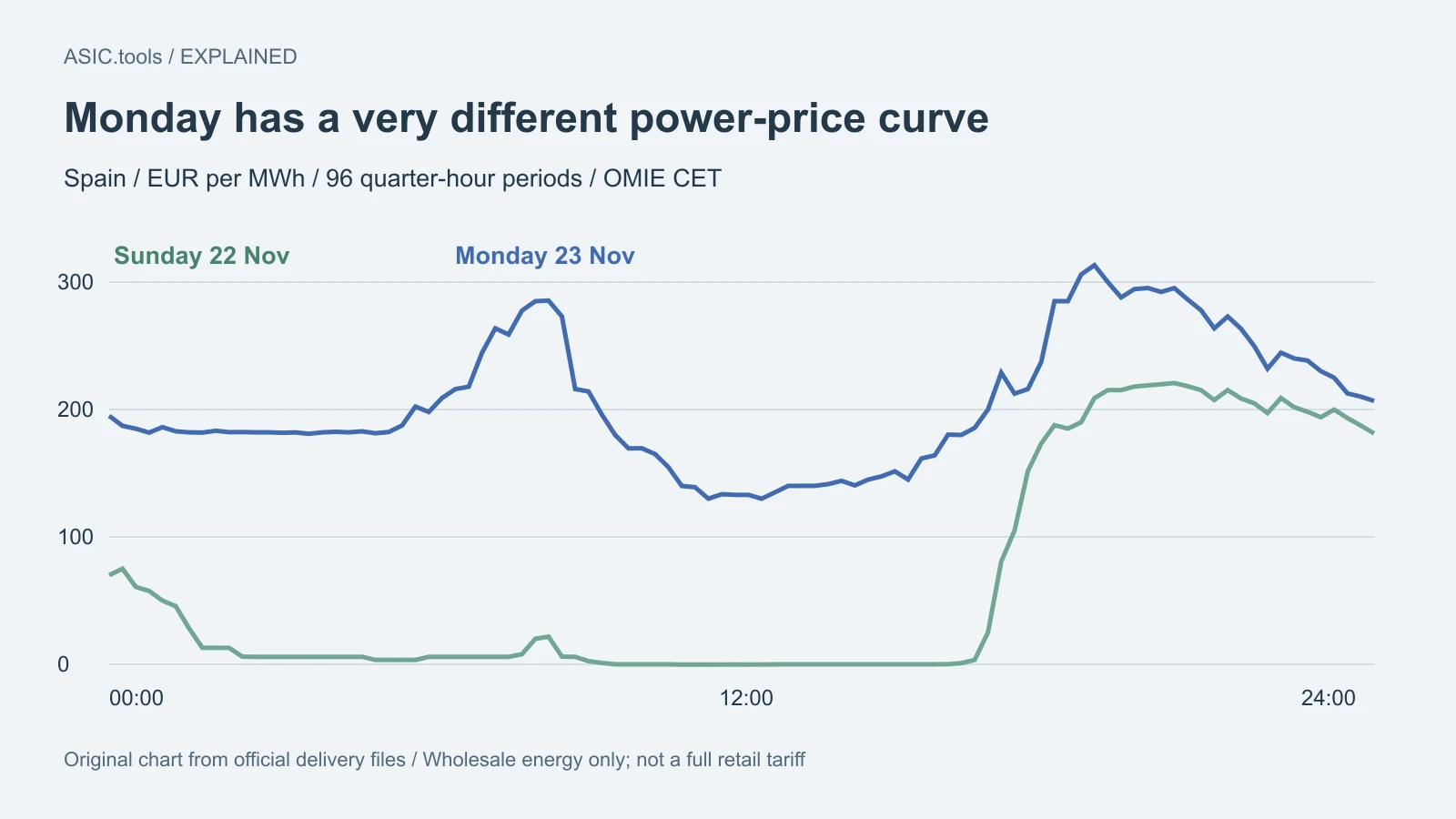
Monday's lowest Spanish and Portuguese period price is €130/MWh, occurring at 11:15–11:30 and 12:15–12:30 Central European Time. The maximum is €313.30/MWh at 18:30–18:45. Those periods range from €0.13 to €0.3133 per kWh before the other bill components. In November, mainland Spain and Portugal have different local clock times; these interval labels use OMIE's CET convention throughout.
For comparison, Sunday's Spanish series ranges from minus €0.30/MWh at 10:45–11:00 CET to €220.76/MWh at 20:00–20:15. A negative wholesale interval does not mean every customer's complete bill becomes negative. It shows why a daily mean alone cannot decide which exact periods are worth running under an indexed contract.
Compare the contract with accepted work
An operator exposed to quarter-hour prices can compare the energy cost in each interval with expected mining revenue, pool charges and the cost of stopping and starting. If the miner is off, it saves variable electricity but also submits no work during that interval. The relevant revenue is what the pool accepts and credits, not merely a fan running or a local speed display. A fixed-price customer should begin with the fixed contract instead of substituting this wholesale curve.
The source data establish the prices, not the cause of the jump. They do not by themselves prove a weather change, a generation outage or a mining-specific surcharge. This report uses the November 22 and 23 files and OMIE's published averaging method. The practical change is substantial enough to check Monday's energy exposure separately, rather than carrying Sunday's cheap-day assumption into the next operating plan.
For the same hypothetical 72 kWh, Monday’s Portuguese average gives about €14.80, only around €0.03 above Spain. That comparison isolates the energy-price difference; it does not compare the countries’ complete retail bills. The large change in this event is Sunday versus Monday, while the two Monday market-area averages remain close.
Source: OMIE ↗ · November 22 delivery comparison ↗ · OMIE current daily results ↗ · Day-ahead price methodology ↗
Mining calculator ↗