Serbian day-ahead electricity reaches €330/MWh: a tougher day for spot-priced mining
Source checked: 2026-10-29 · Editorial analysis published: 2026-10-29
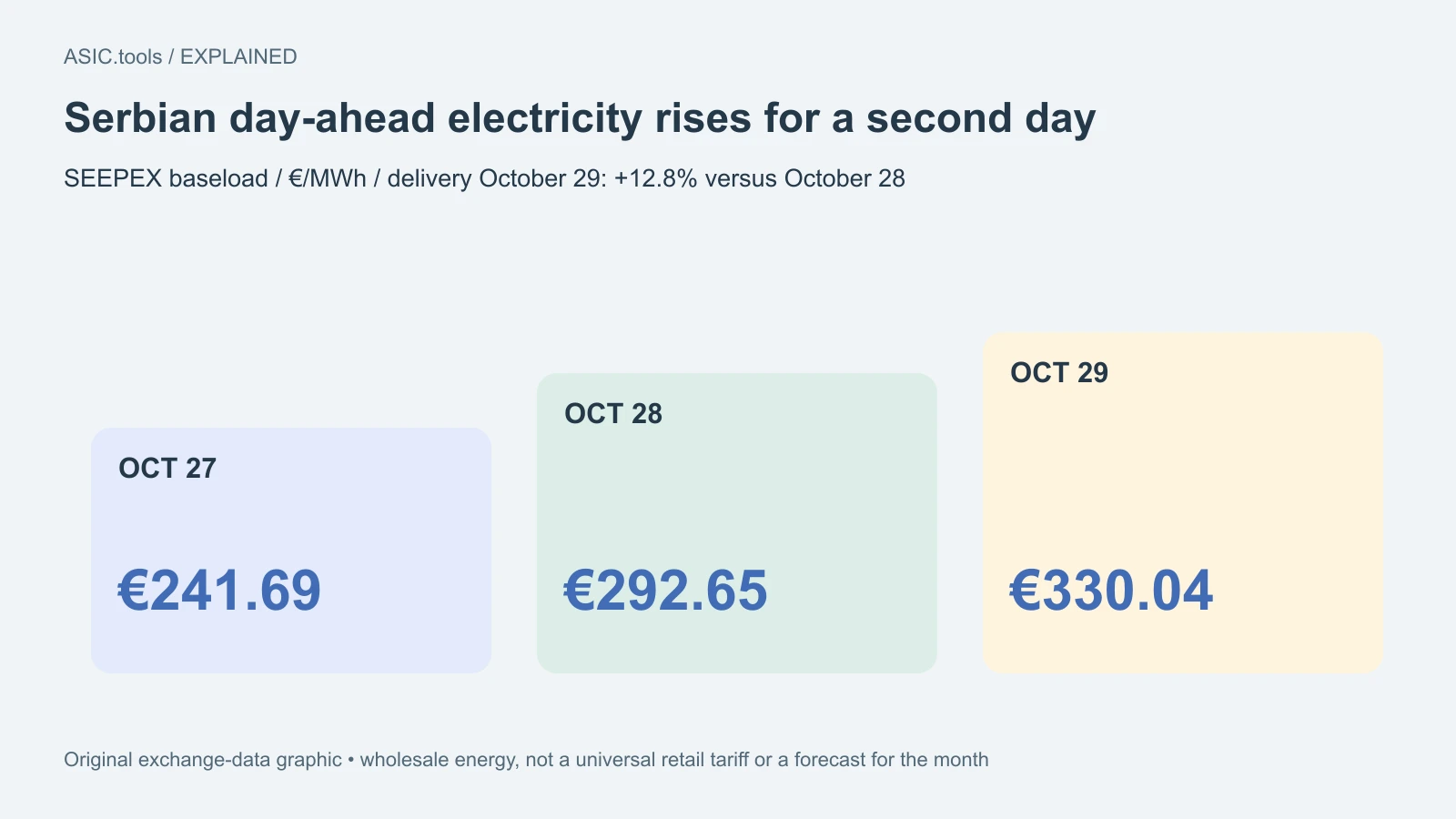
SEEPEX lists €330.04/MWh for October 29, 12.8% above October 28. A constant 1 kW load would use about €7.92 of wholesale energy that day, before network charges, taxes and supplier costs.
The exchange’s new daily result raises the energy bill
Serbia’s SEEPEX day-ahead auction lists a baseload electricity price of €330.04 per megawatt-hour for delivery on October 29. That is €37.39/MWh, or about 12.8%, above the €292.65 listed for October 28. The previous October 27 figure was €241.69, so the daily result has risen in two steps. For a mine paying a price linked to this market, the same machine now faces a higher energy component even if its power setting has not changed.
This is a wholesale auction result for Serbia, not a new household tariff across Europe. The direct effect depends on the supply contract: a spot-indexed customer can be exposed to these prices, while a fixed-price customer does not automatically receive this daily change in its next bill. Network charges, taxes and supplier costs sit outside the simple exchange-price comparison. The auction table does not establish one final delivered tariff for every miner.
What 1 kW running all day costs in this example
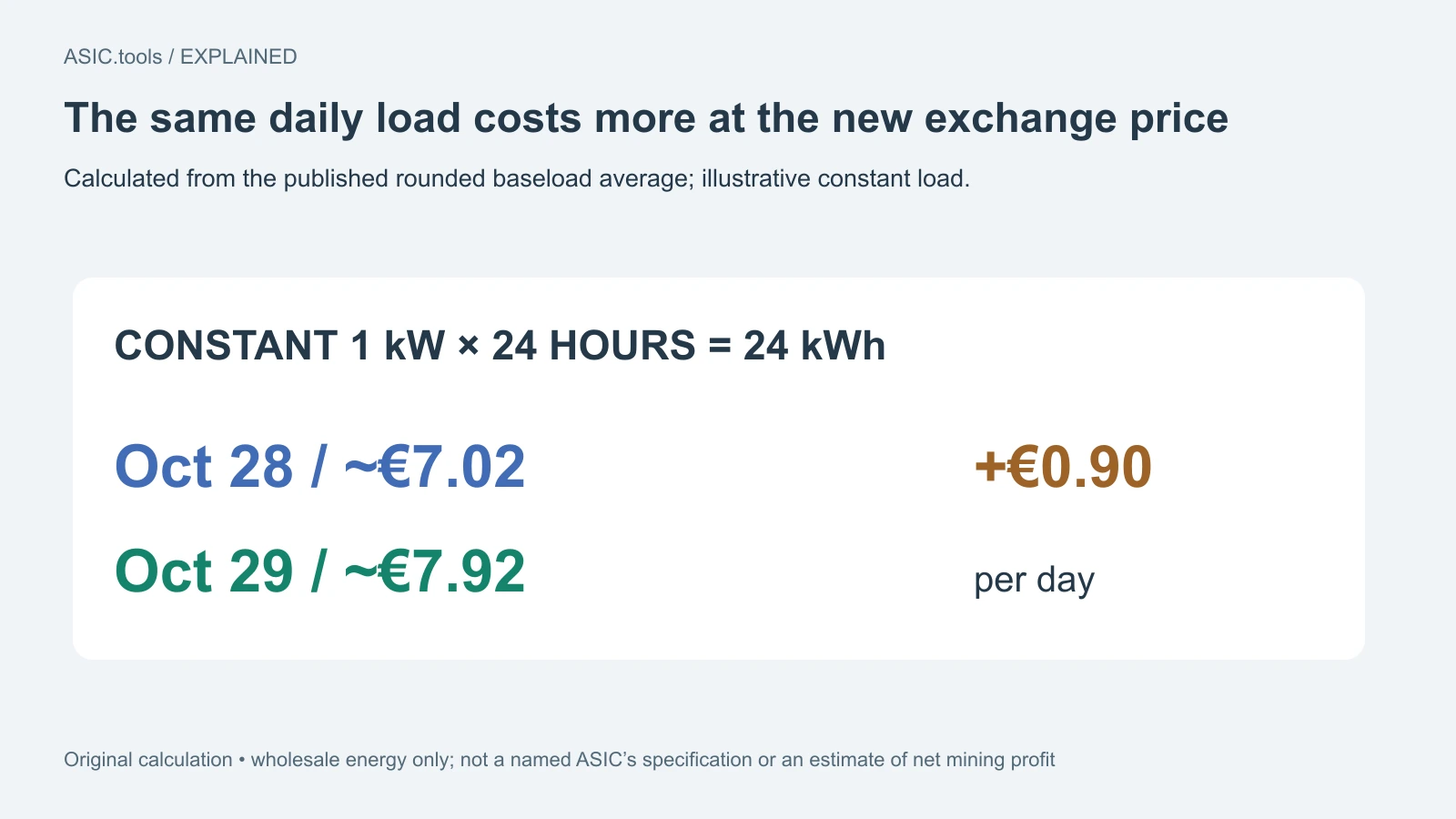
One megawatt-hour is 1,000 kilowatt-hours, so €330.04/MWh equals €0.33004/kWh. A device drawing a constant 1 kW uses 24 kWh over 24 hours. At the published rounded daily price, its wholesale energy component is approximately €7.92 on October 29, compared with €7.02 using October 28’s average: about €0.90 more for the same day of operation.
The calculation is a transparent load example, not a claim about a named ASIC or a profitability estimate. It assumes the same draw in every hour and excludes the rest of the bill. If the comparison is for an entire installation, measure the relevant load, including the cooling and supporting equipment it actually uses. Do not replace a whole-system measurement with a chip’s power figure and still call the result the installation’s electricity expense.
The average hides a large gap between hours
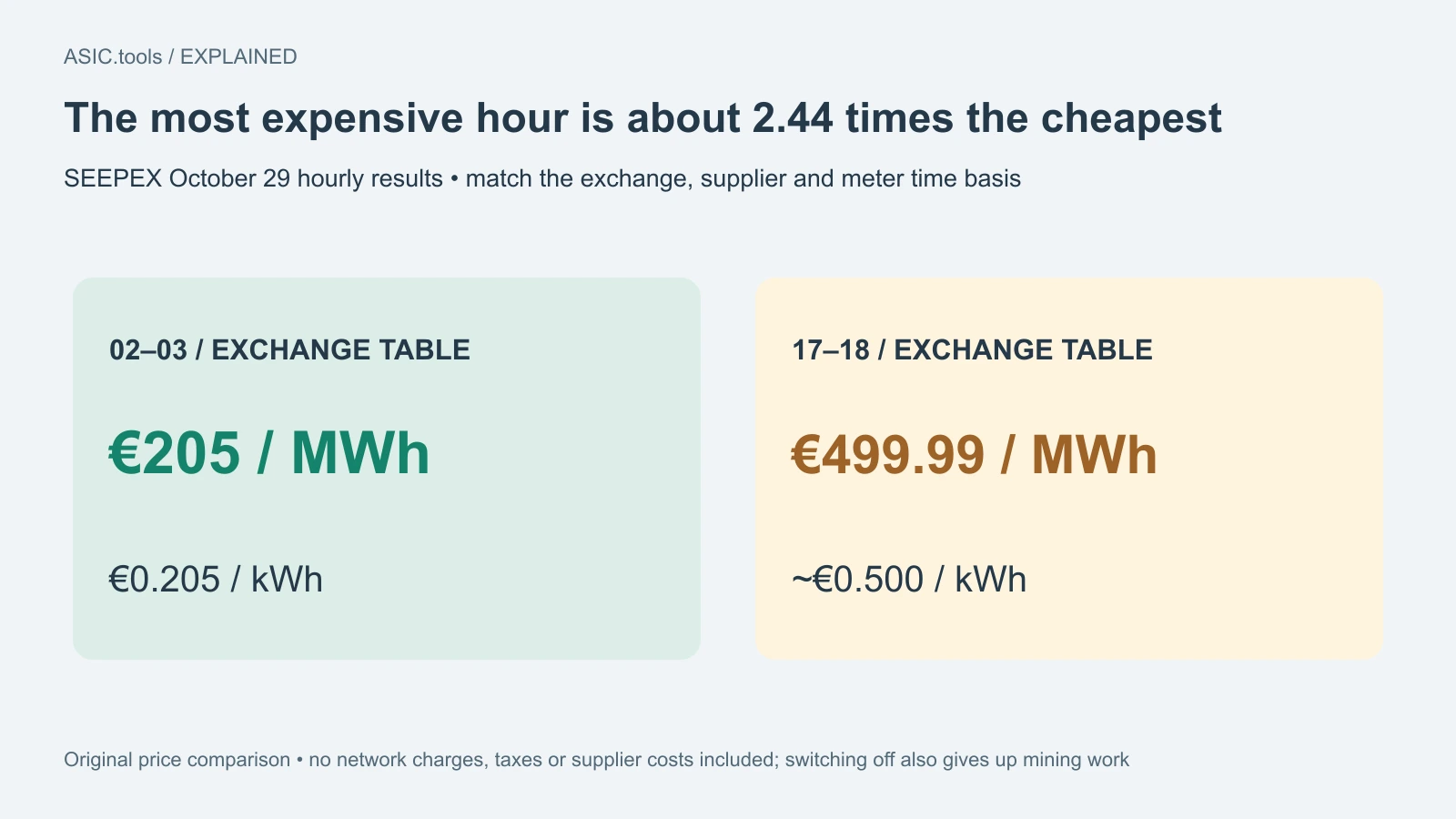
The October 29 hourly table ranges from €205/MWh in its 02–03 interval to €499.99/MWh in 17–18. Converted to energy units, those are €0.205/kWh and almost €0.50/kWh before additional charges. The maximum is roughly 2.44 times the minimum. These are the exchange’s displayed time intervals, not Kyiv clock times; readers scheduling a device should match the supplier and meter’s time basis.
A 1 kW load for one hour uses 1 kWh, so those two intervals correspond to about €0.205 and €0.500 of wholesale energy. The difference is about €0.295 for that one hour. It is an illustration of the hourly spread, not a statement that all equipment can shift the same amount of productive work from one hour to another. Turning a miner off avoids electricity for that hour but also gives up its work during the shutdown.
SEEPEX separately lists a peak-load average of €369.69/MWh and baseload traded volume of 19,351.8 MWh for the day. The peak-load average is not the highest individual hour, and the traded volume is not a measurement of Serbia’s total electricity consumption or mining demand. Keeping those labels separate avoids turning several different auction statistics into a single “price of electricity” headline.
Which operating decision the price can inform
For a miner with an hourly indexed contract, compare expected revenue for the running hour with the electricity and other variable costs that hour. A machine can remain technically efficient and still face a poor operating margin when energy rises. The auction result changes the cost side of that comparison; it does not reveal the device’s hashrate, pool payout, network difficulty or maintenance expense.
For a fixed-price contract, the more immediate task is checking what is actually fixed and when the agreement resets. A fixed energy component can coexist with other bill items, and the SEEPEX table does not replace the contract. Likewise, a hosting fee may bundle electricity with other services rather than pass the spot price through directly. Ask which pricing basis the bill uses before plugging a wholesale number into a farm calculator.
A one-day rise is not a monthly forecast
Day-ahead means electricity traded for delivery on the following day. The October 29 result is therefore a dated market outcome, not a forecast that €330.04 will hold for a month. Multiplying this day’s example by thirty would describe thirty identical days, which the table does not predict. The seven-day comparison is useful for seeing the recent increase, but it cannot establish where prices go next.
The practical takeaway is to use the right layer of the price: the market’s daily or hourly result for a matching indexed contract, and the actual all-in bill for real operating costs. On this October 29 result, a constant load clearly costs more than on October 28. Whether to run, reduce power or pause still depends on the miner’s own revenue and contract, rather than the cheapest hour or average price alone. The table gives prices; it does not by itself prove why they rose.
Source: SEEPEX ↗
Mining calculator ↗