Riot reports $39,265 per bitcoin before miner depreciation — $78,805 with it
Source report: 2026-11-04 · Editorial analysis published: 2026-11-04
The new third-quarter report shows why a low mining-cost headline needs its accounting boundary. Power-curtailment credits helped, while equipment depreciation remained substantial.
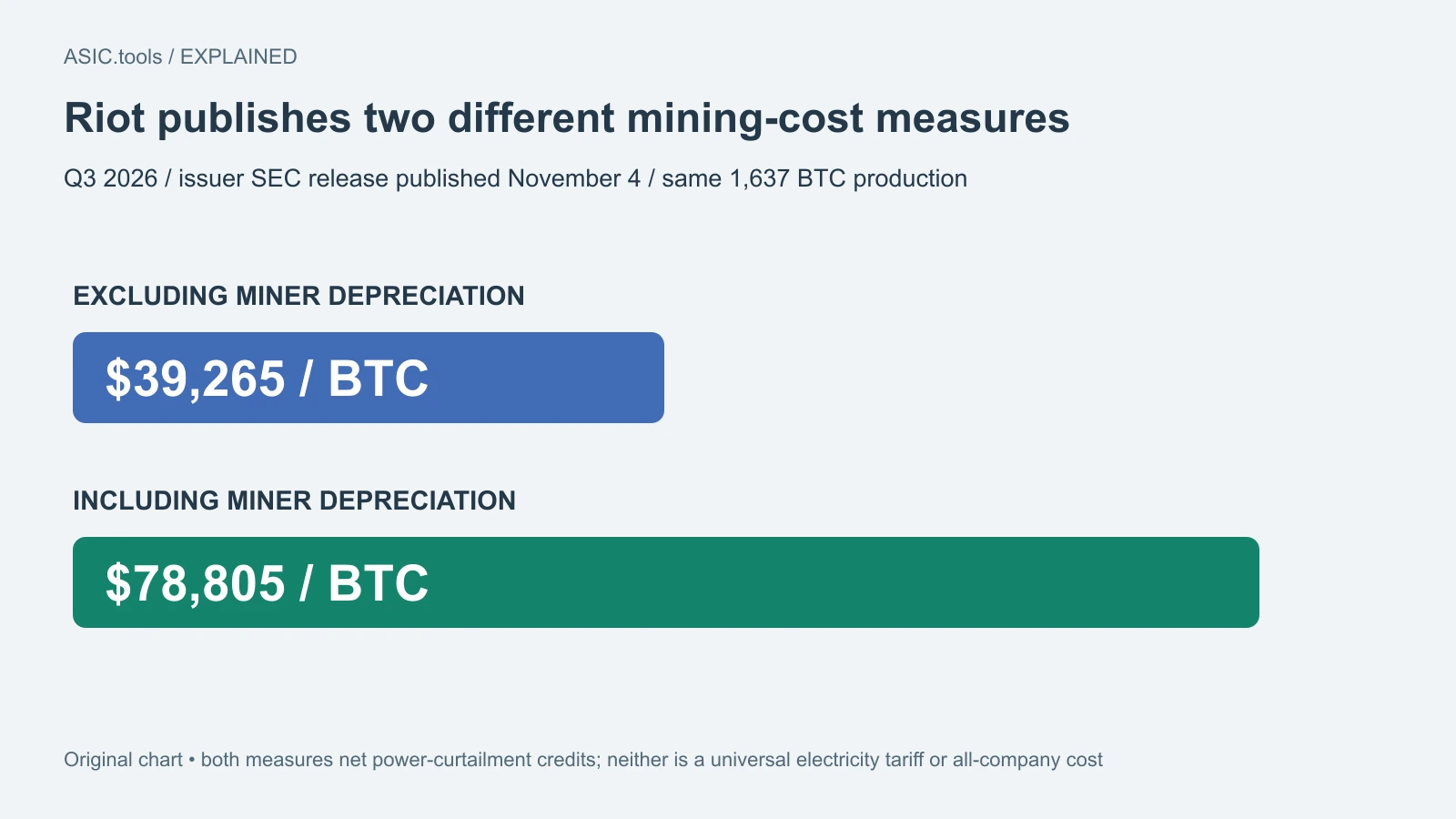
Two mining-cost figures in the same new report
Riot Platforms published its third-quarter results on November 4, reporting 1,637 bitcoin mined in the three months ended September 30. Its cost to mine one bitcoin was $39,265 excluding bitcoin-miner depreciation, versus $46,324 a year earlier. Including that depreciation, the same table gives $78,805. The gap matters to anyone comparing a home machine or hosting offer with a large miner's headline cost.
Depreciation is the accounting allocation of equipment cost over its useful life. It is not a second electricity payment made when a block is found, but it records that hardware is being used up. The two numbers answer different questions about the same operation; neither should be relabelled as a universal electricity price or a complete household break-even point.
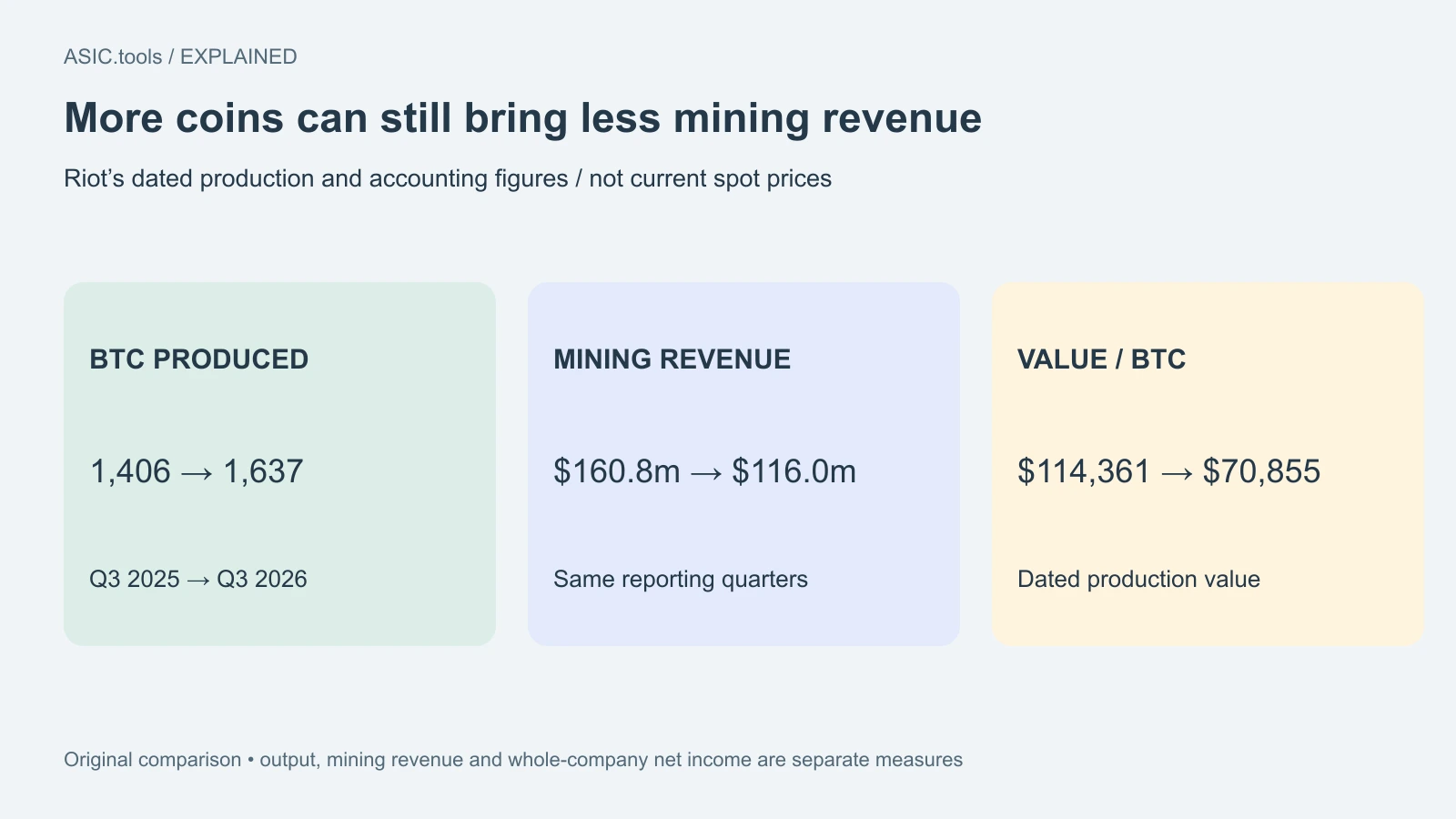
These are Riot's reported quarter-level results, not a measurement of today's network or a promise for the coming quarter. Production rose from 1,406 BTC in the comparable 2025 quarter. More output can spread a given cost across more coins, while changes in power expense also affect the result. A per-coin figure alone does not identify an ASIC's efficiency in joules per terahash.
Power credits make the comparison less portable
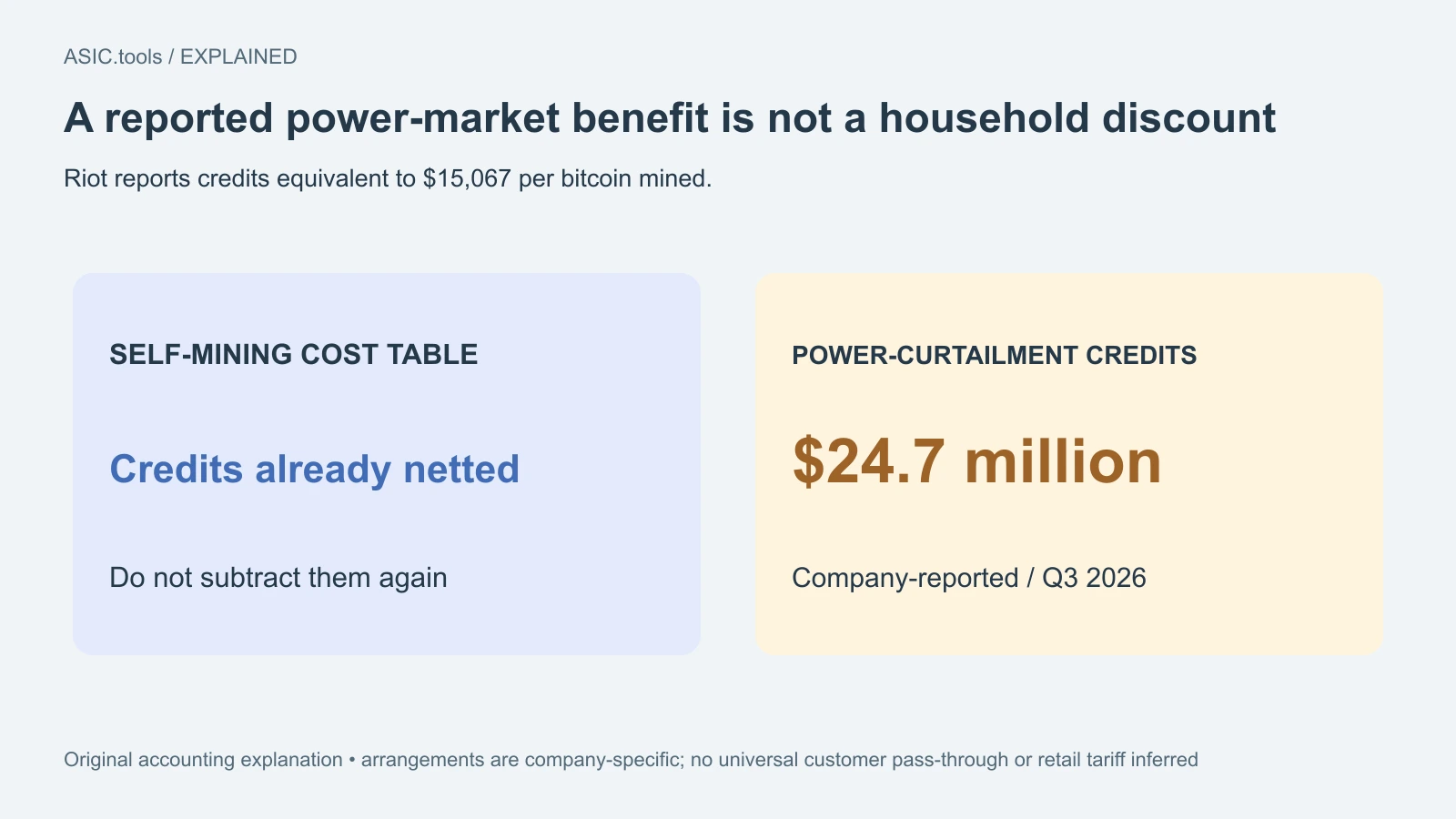
Riot says lower power costs and higher production helped reduce its cost excluding depreciation. It also reports $24.7 million of power-curtailment credits, equivalent in its release to $15,067 per bitcoin mined. These credits are benefits associated with reducing electricity consumption under applicable arrangements; they are not a discounted tariff automatically offered to every household or hosting customer.
The cost table already nets power-curtailment credits from self-mining revenue costs. Subtracting them again from $39,265 would count the benefit twice. Conversely, ignoring the credits when comparing with a small operation would hide an important difference in business conditions. The right question is which charges and credits the published measure already includes.
A home miner can use its own meter and contract to assess electricity expense. A hosting customer can ask how energy, service fees and any demand-response benefit are treated in the agreement. The report supplies no universal pass-through rule for someone else's host. A large operator's participation in power markets does not establish that a reader can reproduce its net power economics.
Equipment costs still change the picture
The reconciliation lists $64.276 million of self-mining revenue costs after power credits and before miner depreciation, plus $64.728 million of bitcoin-miner depreciation. Together they total $129.004 million. Dividing by the reported 1,637 BTC gives the two per-coin measures in the table, rounded to whole dollars.
The difference between the published $78,805 and $39,265 measures is $39,540 per BTC. That does not mean every owner should depreciate a machine by that amount. Riot's equipment base, accounting estimates, production and reporting period are specific to the company. It does show why an operating surplus before hardware cost cannot automatically be called recovery of the hardware investment.
The table's production value per bitcoin is $70,855 for this quarter, compared with $114,361 a year earlier. Riot reports cost ratios of 55.4% without miner depreciation and 111.2% with it. Those relate to that dated production value, not the current spot quote. The second ratio also does not, by itself, describe the profit or loss of the entire company.
More coins did not mean more mining revenue
Bitcoin-mining revenue was $116.0 million, down from $160.8 million a year earlier despite higher production. Riot attributes that mainly to the lower average bitcoin value in its reporting period, partly offset by producing more coins. This is a concrete example of output and money moving in different directions without implying that each individual machine became slower.
Total quarterly revenue was $181.4 million, including $18.4 million from data centers and $47.0 million from engineering. Those other operations make the company-wide income statement different from a standalone mining calculation. Reported net income of $4.034 million cannot be divided by 1,637 and presented as a typical miner's profit per coin.
The release also announces a 15-year powered-land lease covering 910 MW of critical IT capacity at Corsicana, with about $28 billion of base-term contract value. This is contracted future infrastructure business, not a statement that all that capacity is already serving AI equipment or that every mining machine was switched off on announcement day. Contracted capacity, deployed capacity and current mining production remain separate measures.
What an ordinary operator can take from the numbers
When comparing a miner's economics, keep at least three boundaries visible: gross mining receipts, operating expenses under the actual contract, and the cost of owning and replacing the machine. A calculation can be useful without pretending to include everything, provided its exclusions are stated. The ASIC.tools calculator and My farm allow readers to enter their own power and income assumptions.
For an existing device, record whole-system electricity and accepted pool work over a comparable period. For a potential purchase, include the actual acquisition and hosting terms rather than substituting Riot's accounting charge. Keep dated revenue assumptions separate from a fixed tariff: a machine does not automatically retain today's revenue throughout its expected life.
The fresh event is Riot's November 4 disclosure, retained in its SEC-filed issuer release. Its value for a smaller reader is the clear example of how credits and hardware accounting change a mining-cost headline. It is not a forecast of Bitcoin, a guarantee of mining profit or evidence that the same costs apply to every operator.
Source: Riot Platforms ↗ · Issuer SEC 8-K filing ↗
Mining calculator ↗