Bitcoin difficulty estimate points up 9.51%, putting November’s mining relief at risk
Source checked: 2026-11-22 · Editorial analysis published: 2026-11-22
The November 22 mempool.space snapshot projects the next adjustment around November 27. At unchanged conditions, that scenario means about 8.68% less BTC per unit of hashrate, before costs.
The next adjustment is pointing the other way
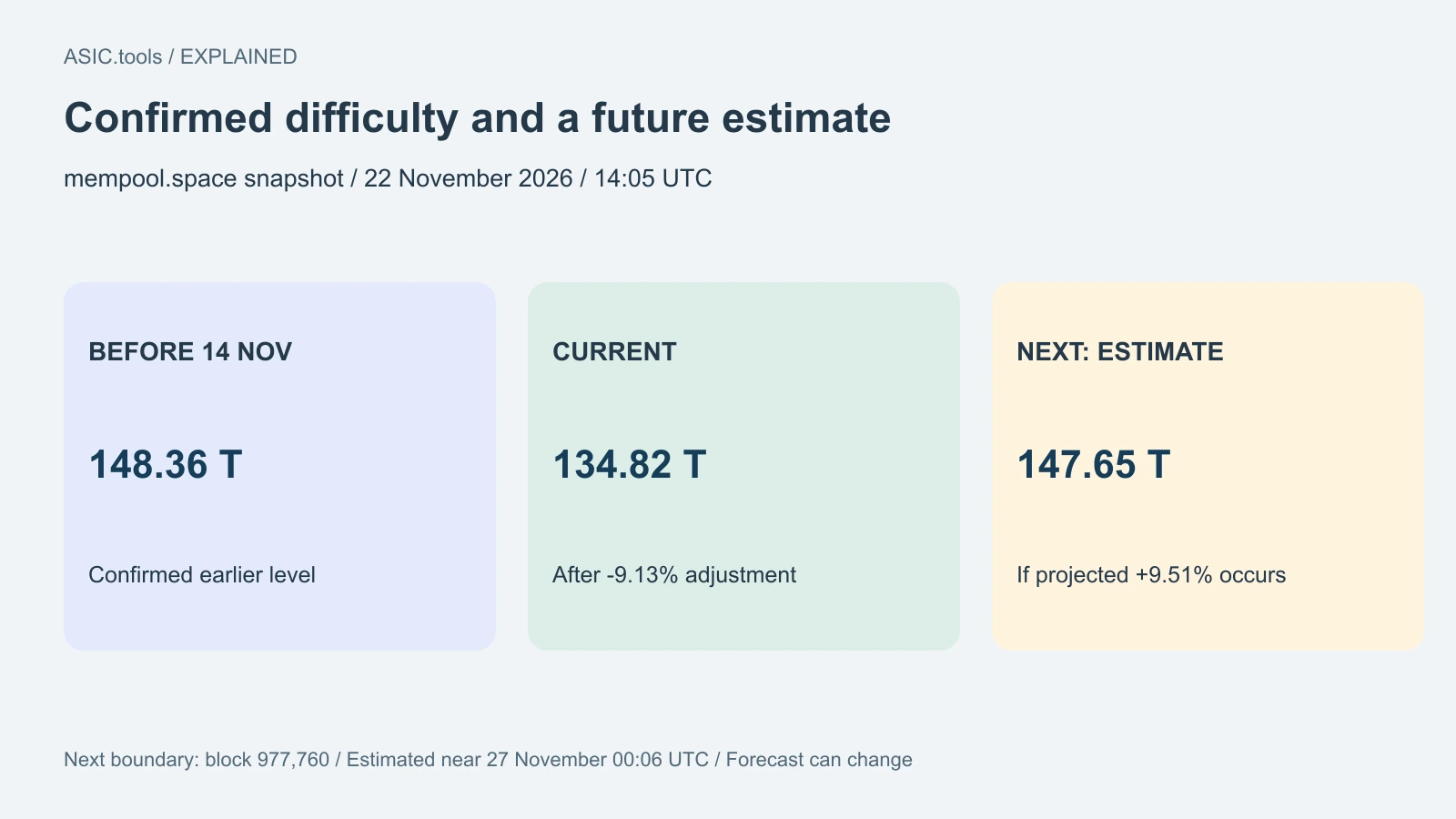
Bitcoin miners could lose much of the difficulty relief they received on November 14. A mempool.space reading collected on November 22 at 14:05 UTC puts the next change at approximately +9.51%, with block 977,760 estimated around November 27 at 00:06 UTC. This is a live projection of a future adjustment, not a change already applied to mining equipment.
The current difficulty remains about 134.82 trillion. Difficulty describes how demanding a valid block's proof of work is. If it rises, a fixed amount of hashing has a smaller chance of finding a valid block. That affects expected bitcoin production for both large farms and small home miners, even if their machines keep the same speed and electricity use.
Why the estimate is rising
The retained snapshot reports 1,320 blocks completed in the current 2,016-block adjustment period, or 65.48%, with 696 remaining. Its average interval is about 548.3 seconds, roughly 9 minutes 8 seconds, rather than the ten-minute target. Blocks arriving faster than the target point toward an upward difficulty adjustment.
Bitcoin Core's retarget code uses the elapsed time across the adjustment window, with protocol limits, to calculate the next target. It does not look at the dollar price of bitcoin or an operator's power invoice. The remaining blocks can arrive faster or slower, so both the projected percentage and the calendar date can move before the boundary is reached.
The snapshot’s remaining-time field is roughly four days and ten hours. The height 977,760 is the adjustment boundary for this period; the calendar estimate is derived from the observed pace. For Kyiv readers, the collection time was 16:05 local time on November 22. Those labels keep the fixed block boundary distinct from the moving countdown.
The earlier cut is real; the rebound is still a scenario
The confirmed November 14 adjustment at block 975,744 lowered difficulty from about 148.36 trillion to 134.82 trillion, a decrease of approximately 9.13%. The November 22 estimate would take it to about 147.65 trillion, close to the earlier level. It would reverse much of the cut, not establish that the next outcome is already fixed.
Percentages in opposite directions do not cancel one for one. They apply to different starting levels: a 9.13% reduction followed by a 9.51% increase still leaves the resulting difficulty slightly below the original value. Comparing the actual difficulty levels is clearer than subtracting two rounded percentages and treating the result as a direct measure of miners' income.
A 9.51% difficulty rise is not a 9.51% production cut
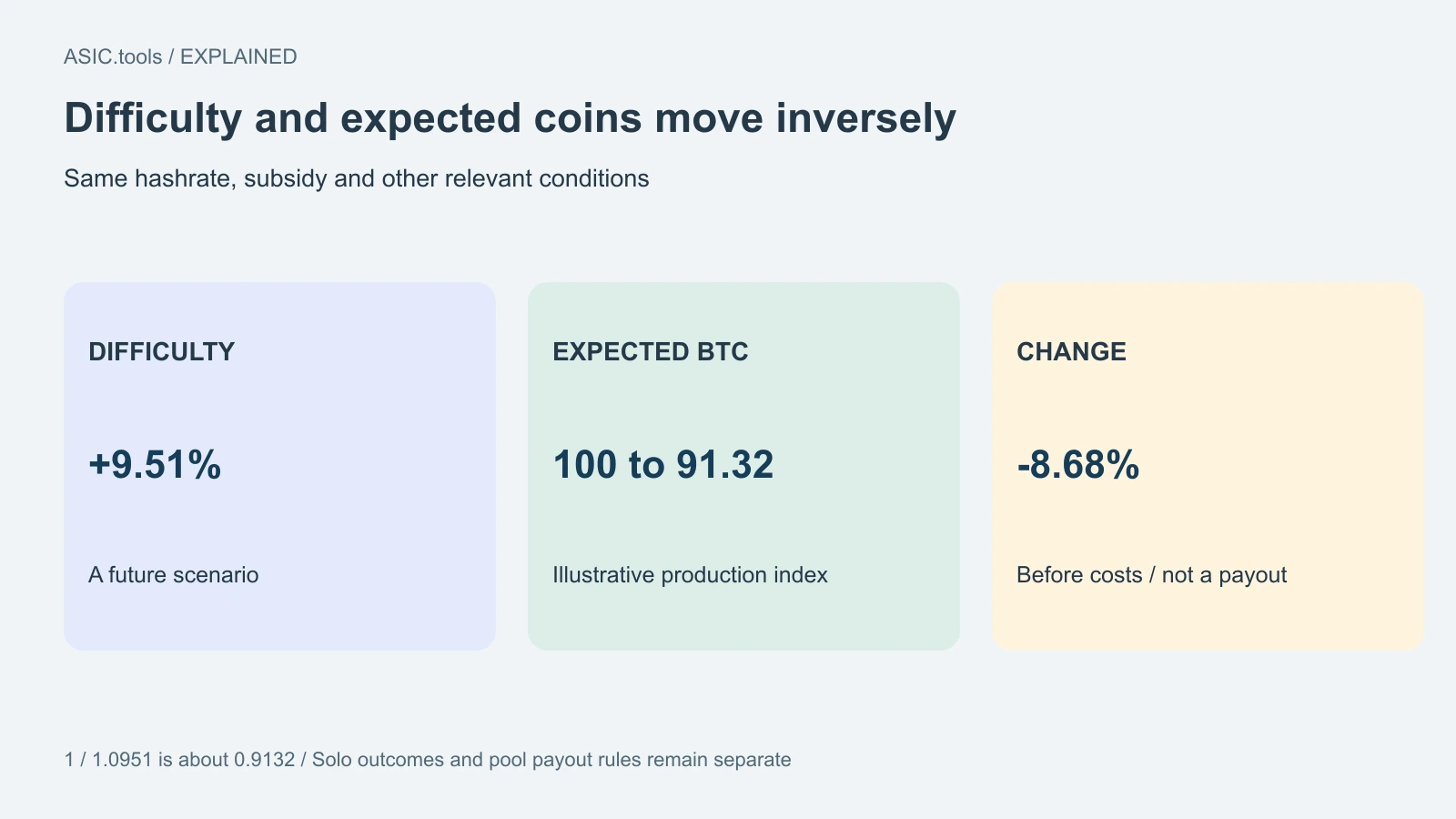
For unchanged hashrate, subsidy and other relevant conditions, expected BTC production varies inversely with difficulty. Dividing by 1.0951 gives about 0.9132: roughly 8.68% fewer expected coins per unit of time. On an illustrative production index, a current 100 becomes about 91.32 under that scenario. This is a relationship between inputs, not an individual pool payout quote.
A pool combines miners' work and applies its payout method and fees. Accepted shares, uptime and, for some payout methods, pool luck affect credited results. A solo miner faces highly uneven outcomes and can receive nothing for long periods; the index does not promise a small daily deposit. A future bitcoin price change would separately alter the dollar value of whatever BTC is earned.
A thin margin can shrink much more sharply
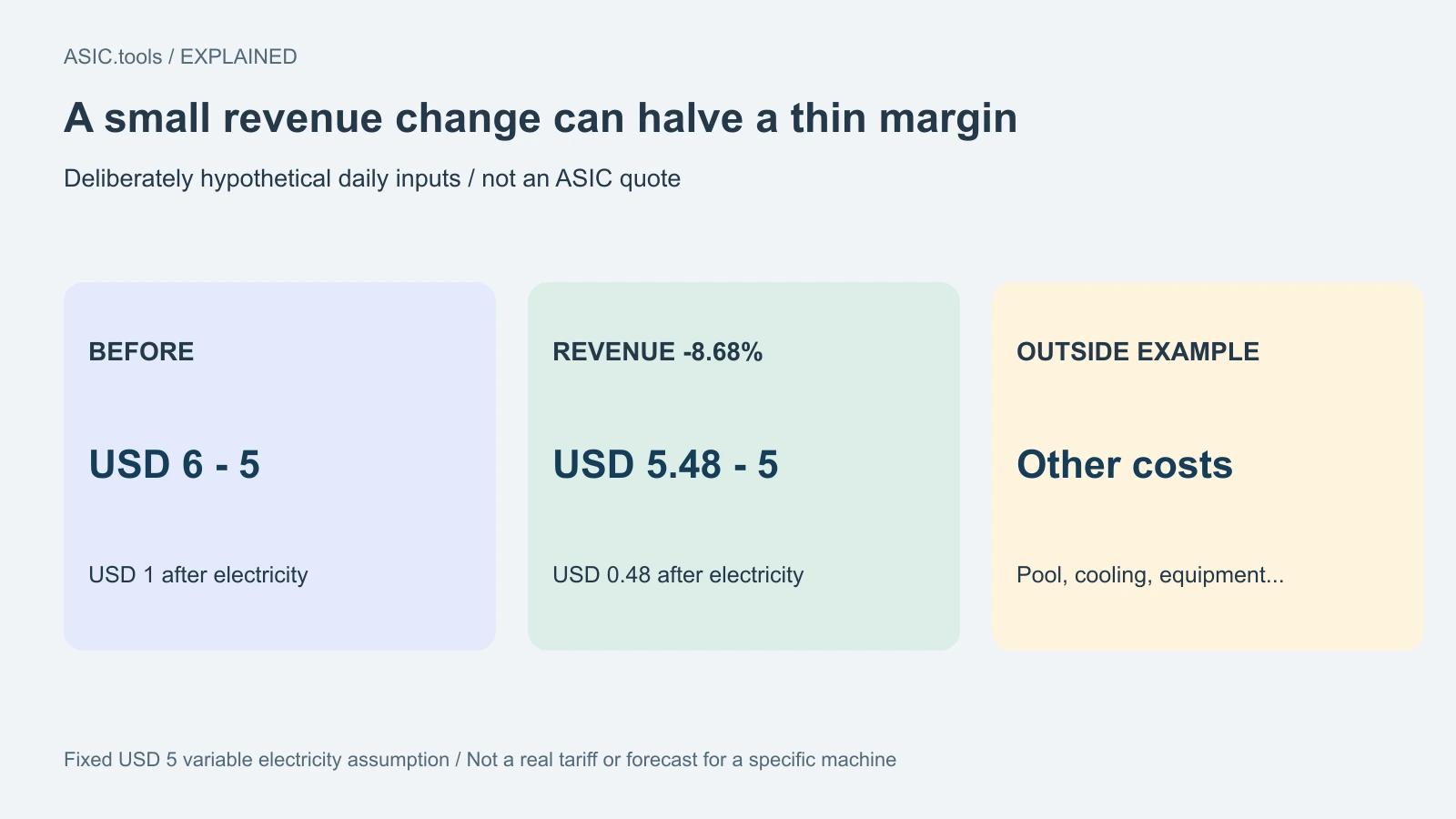
Consider a deliberately hypothetical machine with $6 of daily gross revenue and $5 of variable electricity cost. If its revenue followed the 8.68% decline while everything else stayed fixed, gross revenue would be about $5.48 and the remaining amount after that electricity about $0.48, compared with $1 before. A modest revenue percentage can therefore remove more than half of a narrow margin.
These are invented round inputs for explaining sensitivity, not today's performance or tariff for any ASIC. Purchase cost, pool charges, repairs, cooling and other expenses are outside this small example. If the real margin is already negative, changing an estimated network input does not by itself identify which machine should run; the actual contract and measured operating figures still matter.
What to carry into the next operating plan
Keep the current confirmed difficulty as the baseline and test the estimated increase as a separate scenario. Update actual wall power, electricity rate, pool terms and uptime alongside it. A network hashrate chart estimates computing power from observed blocks; it is not a meter attached to every machine, and figures from different averaging windows need not match.
The new point in this November 22 reading is the prospect of a sizable upward retarget after the confirmed November cut. It is separate from yesterday's bitcoin price fall and from an announcement of a new ASIC. The next useful checkpoint is the evolving block pace and, ultimately, the actual result at block 977,760. Until then, the +9.51% figure belongs in planning as an estimate, with its collection time attached.
Source: mempool.space / Bitcoin Core ↗ · Difficulty adjustment history ↗ · Network hashrate observations ↗ · Bitcoin Core proof-of-work retarget implementation ↗ · mempool.space public API ↗
Mining calculator ↗