Bitcoin falls below $60,000: the same mining payout buys fewer dollars
Source report: 2026-11-21 · Editorial analysis published: 2026-11-21
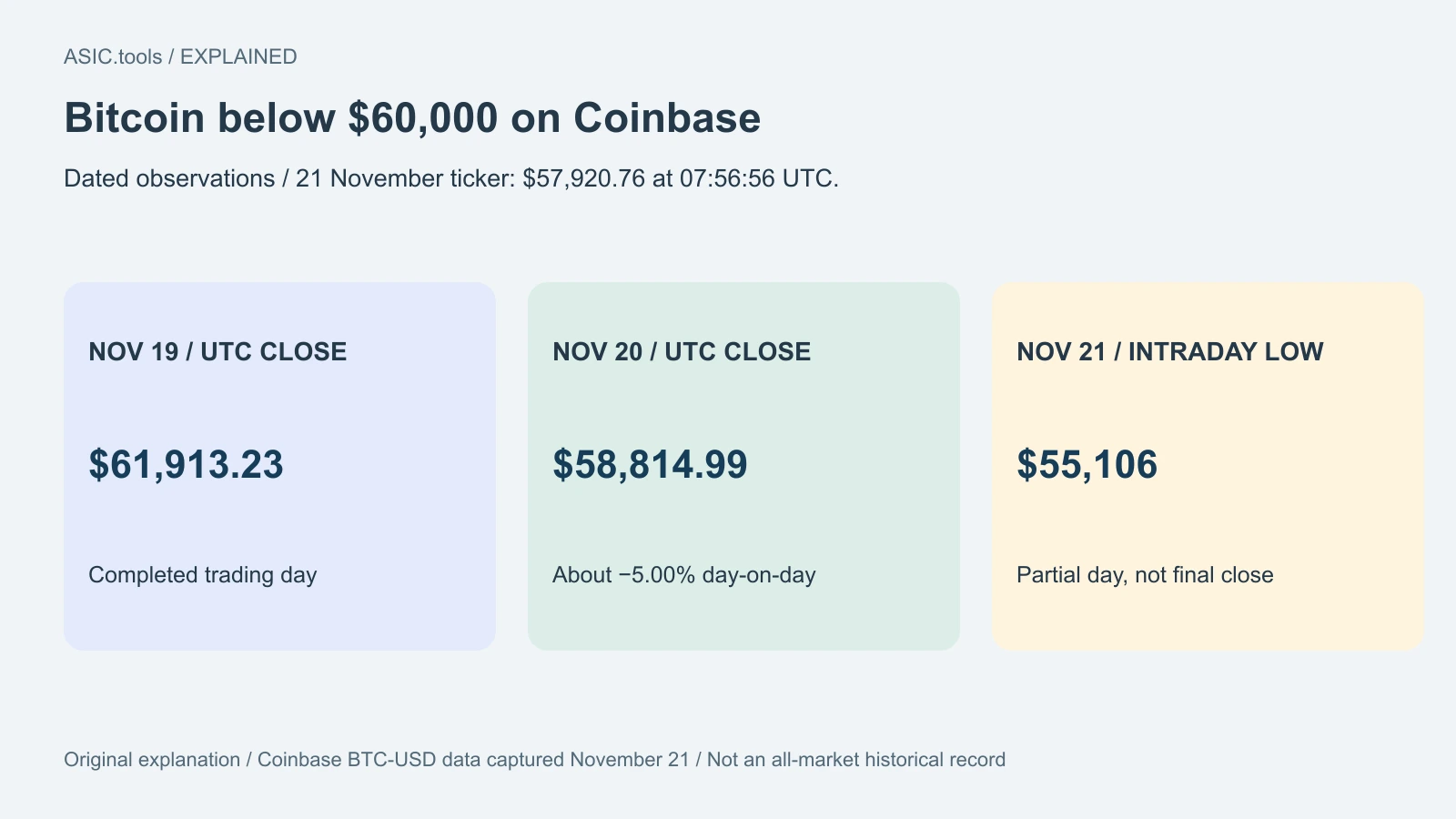
Coinbase recorded a $55,106 intraday low on November 21 and a $57,920.76 ticker at 07:56:56 UTC. The price move changes conversion value, while difficulty has not automatically adjusted.
Bitcoin trades below $60,000 after another fall
Bitcoin traded as low as $55,106 on Coinbase Exchange during the still-open UTC day of 21 November. At 07:56:56 UTC, or 09:56:56 in Kyiv, the exchange's ticker showed $57,920.76. For miners paying electricity bills in ordinary currency, the practical effect is immediate: the same Bitcoin payment converts into fewer dollars, even if the machine submits the same amount of accepted work.
Coinbase's completed 20 November daily candle closed at $58,814.99, versus $61,913.23 on 19 November, a fall of about 5.00%. Those are UTC trading days. The 21 November candle was incomplete when checked, so its low is an observation from the day so far, not a final daily close or a claim about an all-time market record.
A price fall changes the dollar side of mining
A miner earns Bitcoin through the network and its pool's accounting rules, while many operating bills are denominated in dollars or another national currency. A lower BTC price changes the exchange value of that revenue. It does not by itself increase the number of coins already earned, nor does it delete coins that are held in a wallet.
This distinction is easy to lose when a pool shows both BTC and a dollar estimate. The BTC balance and its displayed conversion can move differently. To understand a session, keep the accepted work, the amount credited in BTC, the pool fee and the conversion price separate. A changing dollar display is not evidence that the pool has changed the underlying coin balance.
Hashrate is computing work per second, not a dollar balance. A higher hashrate display can coexist with a lower dollar valuation when BTC falls, and a lower dollar number does not alone diagnose a hardware fault. Compare the device's work with the pool's accepted contributions before attributing a revenue change to tuning or a connection problem. The currency example holds only the coin amount constant; it makes no promise that future production will stay constant.
Difficulty has not automatically followed the price
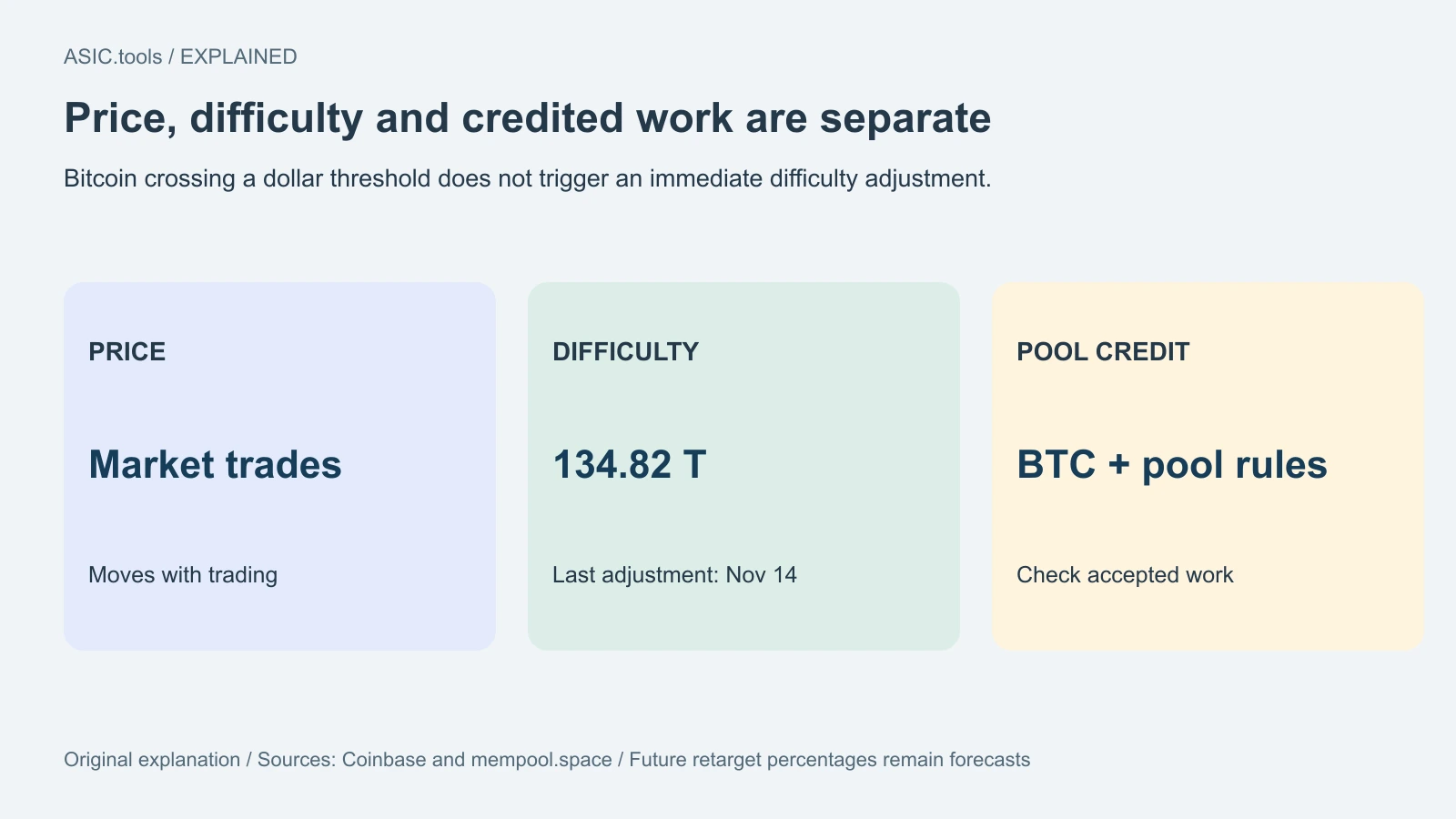
The retained mempool.space difficulty history shows Bitcoin's last adjustment on 14 November: difficulty fell from about 148.36 trillion to 134.82 trillion. Difficulty describes how hard the network's block-finding target is. Its scheduled adjustment follows blocks, not a dollar price threshold, so crossing $60,000 does not trigger an immediate reduction for miners.
Current estimates of the next adjustment are forecasts. They can change with the pace of blocks before the period finishes; they are not already active network rules. We therefore do not turn a dashboard's projected percentage into a confirmed increase, or claim that a future adjustment has already changed today's payout for the same machine.
A fixed Bitcoin amount makes the currency effect clear
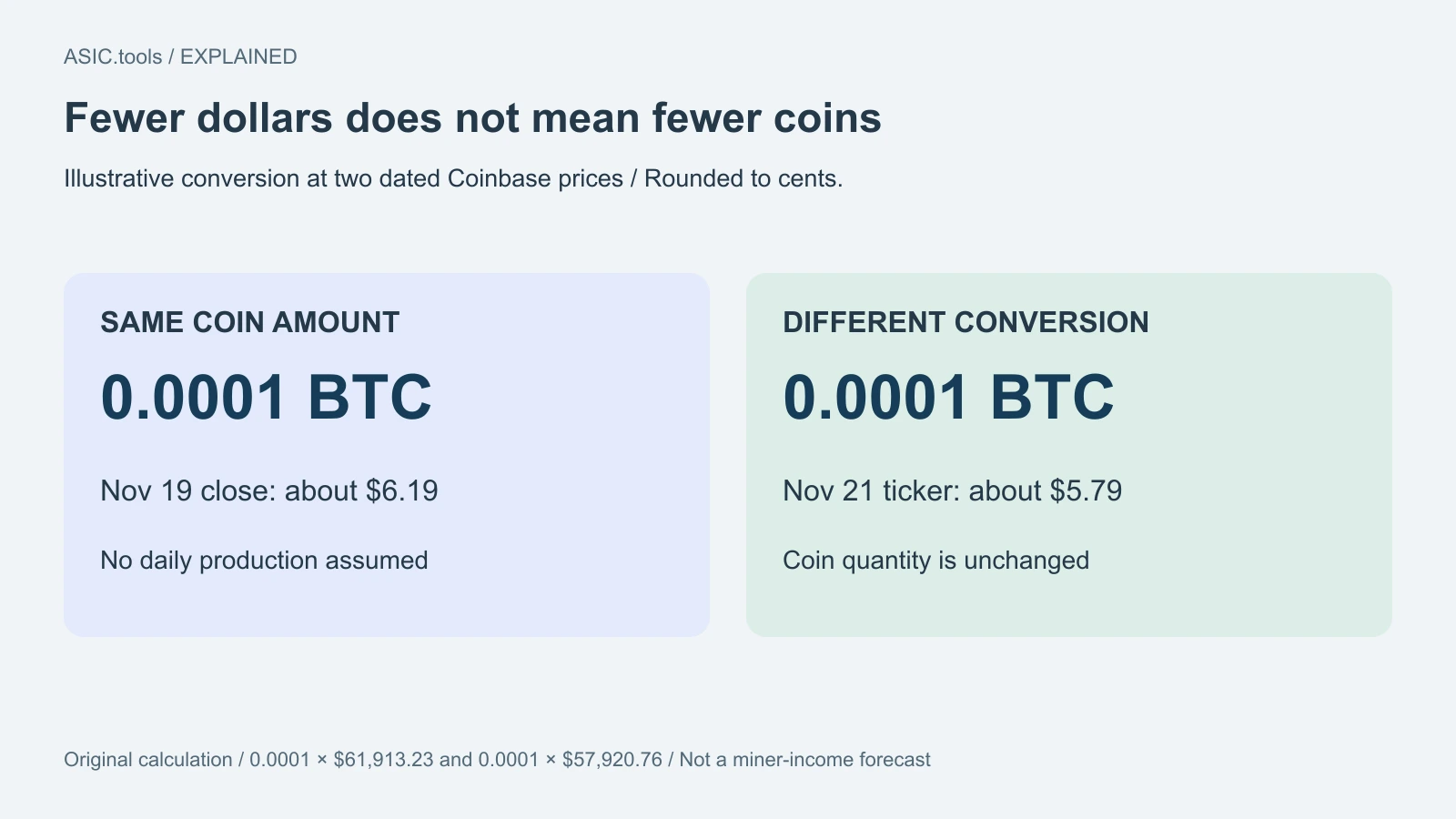
For illustration, 0.0001 BTC would be worth $6.19 using Coinbase's 19 November close and $5.79 at the captured 21 November ticker price, rounded to cents. The coin amount is identical; the difference is about 40 cents. This is a conversion example, not a forecast that a particular miner will earn 0.0001 BTC per day.
Electricity remains a separate expense based on actual energy use and the applicable tariff. A machine's nameplate wattage or a software power limit is not automatically a complete wall-power measurement. Comparing the same period's accepted revenue and measured consumption is more useful than applying a single supposed production-cost floor to every model, household and hosting contract.
Use a dated snapshot, then check the next session
The sources behind this report are Coinbase's public BTC-USD ticker and daily candles, plus mempool.space's difficulty history. They answer different questions: a trade price at a moment, an exchange's completed or partial trading day, and the network's adjustment record. Their timestamps and units matter; mixing them with an undated calculator can produce a precise-looking but inconsistent result.
The new event is the price move below $60,000 and the observed $55,106 intraday low on 21 November. It is not a prediction that the market has bottomed or that all miners must switch off. Our three original diagrams show the dated price observations, a fixed-coin conversion and the difference between market prices and block-based difficulty changes. Recheck live prices and your own operating records before evaluating the next session.
Source: Coinbase Exchange / mempool.space ↗ · Coinbase BTC-USD daily candles, dated capture ↗ · Bitcoin difficulty adjustment history ↗
Mining calculator ↗